
Dear Subscribers and Followers,
I have not written an article for 18 months, in part because I have been concentrating on commenting in other people’s Substacks, mainly about vitamin D, rather than preaching to the choir here. My comments are at: substack.com/@robinwhittle.
Today I wrote a two-part comment on the need for at least 50 ng/mL circulating 25-hydroxyvitamin D, as measured in “vitamin D blood tests” (125 nmol/L in the units used in the UK, Australia, NZ etc.) for reducing the risk of sepsis and for treating it.
The 11 million deaths a year from sepsis, worldwide, takes an horrendous toll on humanity, with many more permanently harmed and millions more left grieving. Yet mainstream medical professionals don’t really know what it is or how to prevent or treat it effectively.
I wrote the comment in response to an article by Philip McMillan MD, in the UK, who discussed sepsis, without mentioning the word “vitamin”. He was prompted to do so by the sudden, shocking, death of a prominent and well liked American racing car driver Kyle Busch, who:
was reported to have died at the age of 41 after severe pneumonia progressed into sepsis, with his family describing “rapid and overwhelming” complications. Reports also described shortness of breath, feeling very hot, near-collapse, and coughing up blood before he was taken to hospital.
Dr McMillan’s article is philipmcmillan.substack.com/p/when-sepsis-stops-looking-like-sepsis . I highly recommend his Substack philipmcmillan.substack.com.
My comments there are (1 of 2) and (2 of 2) if you would like to like or comment on them there.
The onset of sepsis often takes treating doctors and nurses by surprise. Everyone needs to be on the lookout for people whose health is deteriorating rapidly. Minutes and hours really matter, so it is best to get the person to an emergency room ASAP.
Kyle Busch en.wikipedia.org/wiki/Kyle_Busch completed 762 NASCAR races in his 24 year career. He is survived by his parents, wife and two young children. Dr McMillan links to this BBC article and a Google search for his name leads to thousands of articles and tributes.
I have come to realise that a major, probably crucial, impediment to most medical professionals - as well as endocrinologists, virologists, epidemiologists etc. - understanding the need for at least 50 ng/mL circulating 25-hydroxyvitamin D is that they cannot understand how a vitamin, often claimed, falsely, to be a hormone, could be so important to the immune system. This can only be overcome if vitamin D aware clinicians and vitamin D researchers explain that many types of immune cells need at least 50 ng/mL (1 part in 20,000,000 by mass) circulating 25-hydroxyvitamin D (also not a hormone) in order for the individual cells to respond rapidly and fully to their changing circumstances.
However, most vitamin D aware clinicians and vitamin D researchers have either not heard of the intracrine and paracrine signaling systems which enable these responses, of have too poor an understanding of them to explain them to anyone else.
Doctors, nurses etc. rightly want to know exactly why many types of immune cell need this level of circulating 25-hydroxyvitamin D, which is two and a half times the level the kidneys need to perform their role in regulating calcium-phosphate-bone metabolism.
The key purpose of the following vitamin D pep-talk is to prompt everyone into reading a tutorial on these signaling systems. I wish I could point to a peer-reviewed journal article or textbook which explains these systems in a manner suitable for those who are not well versed in cell biology. They are not complex.
In 2020 there were no such articles. As far as I know there are still none - please let me know at <rw@firstpr.com.au> if you find one! So I wrote my own, non-peer-reviewed, tutorial: vitamindstopscovid.info/02-intracrine/ . A simpler introduction is at this section of a long page in which you will find links to and discussion of a great deal of research into the immune system’s dependence on 25-hydroxyvitamin D: vitamindstopscovid.info/00-evi/#02-compounds.
Here is the text of my comments, with extra sub-headings, graphs and links.
The first thing that happens is usually a viral or bacterial infection which the immune system fails to suppress, though I understand severe burns - and possible bacterial infections - can also trigger it.
Sepsis itself is a massive inflammatory response to this. Inflammation in this context means indiscriminate cell destruction, such as that mediated by eosinophils, the suicide bombers of the immune system. When eosinophils arrive on the scene, they and their vacuoles of enzymes disintegrate and the enzymes destroy all protein, DNA and RNA. This kills all cells, including bacteria and our own healthy cells - and it destroys viruses.
These inflammatory immune responses seem to have evolved primarily or solely to tackle multicellular parasites, such as helminths (intestinal worms), since the usual cellular and viral immune responses do not work against a multicellular organism. Innate and adaptive immune responses to bacterial, fungal and viral pathogens - such as tagging pathogens with antibodies which attract macrophages which engulf and destroy the pathogens - cannot work against a multicellular organism with a thick layer of protective outer cells.
Throughout mammalian history - and probably going back to earlier vertebrates - it seems that helminths have ubiquitously infested our ancestors, until the last century or so when medications and better sanitation freed most of humanity, and our agricultural and companion animals from multiple species of helminths. Some were relatively benign - and it was the relatively benign ones which became most prevalent because they did not kill or seriously disable their hosts.
Helminths long ago evolved the ability to exude multiple compounds which had the effect of downmodulating the inflammatory immune responses which targeted them, while probably not affecting the immune responses against single cell pathogens, viruses and malignant cells.
Our ancestors - again going back well before primates - long ago responded to the downmodulating impact of these compounds from one or more helminthic infections by evolving stronger inflammatory responses than would otherwise be necessary. So today, humans and other mammals, birds and probably fish have an unhealthily strong inflammatory response if they are not infested with helminths. As far as I know, the same is broadly true of at least some other types of multicellular parasite. I recall reading that Helicobacter pylori, the gastrointestinal bacteria which causes stomach ulcers, also produces anti-inflammatory compounds. Perhaps such indiscriminate cytotoxic immune responses are a good way of tackling bacteria which live primarily in the stomach and intestinal lumen.
Now most humans are dewormed, we are left with generally overly-strong, potentially self-destructive, inflammatory immune responses which can be triggered by all sorts of conditions. There is considerable genetic variation between individuals which causes some people to have particularly strong responses which increase their risk of developing a wide variety of auto-immune inflammatory disorders.
Please see helminthictherapy.org and the research cited and discussed at: vitamindstopscovid.info/06-adv/ for more on this, and the use of very high levels of 25-hydroxyvitamin D in the Coimbra and similar protocols, to suppress a broad range of inflammatory disorders, including multiple sclerosis, psoriasis, cluster headache, migraine, arthritis, asthma, Crohn’s disease etc. - much the same set of conditions which can be suppressed by helminthic therapy, which is the introduction of generally benign helminthic infestations. In that page, I state that I do not have a hypothesis about how this high level of 25-hydroxyvitamin D suppresses these excessive inflammatory responses. Now I do and I plan to update the page accordingly in the next few months.
I argue that lack of helminths is a primary contributing cause to the prevalence of sepsis. The Global Burden of Disease project reported that sepsis killed 11 million people worldwide, in 2017: https://www.thelancet.com/journals/lancet/article/PIIS0140-6736(19)32989-7/fulltext . Conventional medical approaches to sepsis are haphazard and not very effective. Antibiotics may help, as well as suppressing the inflammatory responses - and all other immune responses including those directed at viral and bacterial pathogens - with drugs such as prednisolone.
Helminthic therapy would take too long to save sepsis patients. They succumb rapidly to the massive destruction caused by their own vastly overpowered inflammatory responses.
The second major factor, which is easy to correct as a preventive and as a clinical intervention for sepsis patients, is a low level of circulating 25-hydroxyvitamin D calcifediol (AKA “calcidiol”). This is made, primarily in the liver by hydroxylating vitamin D3 cholecalciferol. About 1/4 of ingested vitamin D3 or that which is produced by the action of short wavelength ultraviolet B light on 7-dehydrocholesterol in the skin is converted, over multiple days, into circulating 25-hydroxyvitamin D.
Neither vitamin D3 nor 25-hydroxyvitamin D are hormones. They are not signaling molecules. “Vitamin D” blood tests measure the level of circulating 25-hydroxyvitamin D. It is a common mistake to refer to these two compounds, and the third - calcitriol (1,25-dihydroxyvitamin D) - all as “vitamin D” or to refer to calcitriol as “activated vitamin D”, as Reinhold Vieth wrote in 2004: sci-hub.su/10.1016/j.jsbmb.2004.03.037.
Calcitriol has one, well known, hormonal function. The kidneys maintain a very low level - 0.05 to 0.1 ng/mL (1 part in 20 to 10 billion by mass) - level of circulating calcitriol, which operates as a hormone (a long distance, blood-borne signaling molecule = endocrine signaling) so they can affect or control the behaviour of multiple cell types in distant parts of the body which are involved in calcium-phosphate-bone metabolism.
All medical professionals understand this hormonal function of calcitriol, and that the kidneys generally perform it well, as long as they are have an adequate supply of 25-hydroxyvitamin D (which cells in the kidneys hydroxylate on the number 1 carbon to transform it into calcitriol). This requires at least 20 ng/mL circulating 25-hydroxyvitamin D, which is 1 part in 20,000,000 by mass, or 50 nanomols per litre, to use the units preferred in the UK, Australia, New Zealand and some other countries.
There is a growing awareness that many types of immune cell - and so the whole immune system - can only work properly if they have a significantly higher level of circulating 25-hydroxyvitamin D. 50 ng/mL (125 nmol/L) and above are good levels for the immune system. Please see the research cited and discussed at: vitamindstopscovid.info/00-evi/, especially this section on research from Massachusetts General Hospital on how the risk of post-operative infections skyrocket above 2.5% the further the pre-operative level of 25-hydroxyvitamin D is below 50 ng/mL: vitamindstopscovid.info/00-evi/#00-50ngmL.
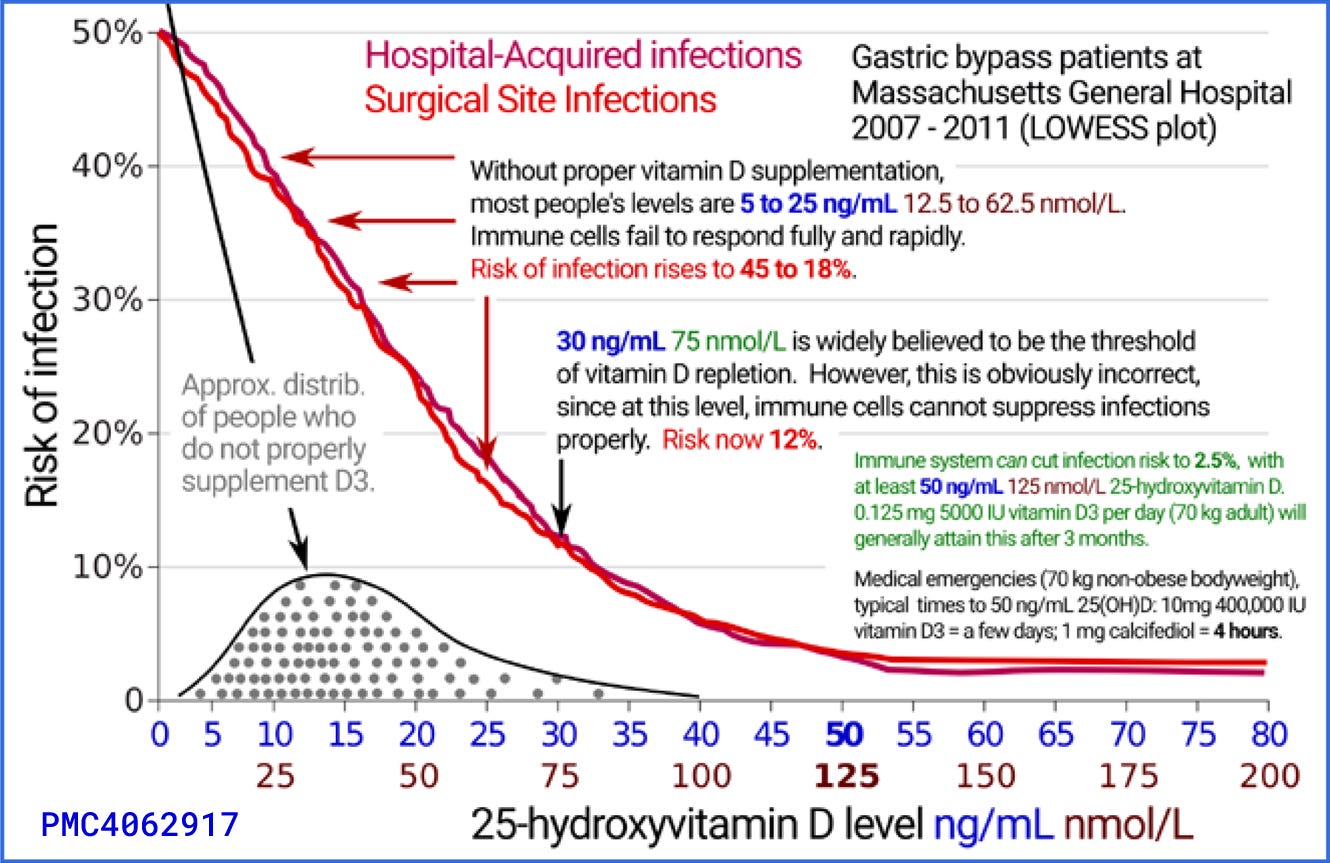
This section vitamindstopscovid.info/00-evi/#00-how-much points to recommendations by New Jersey based Professor of Medicine Sunil Wimalawansa on how much vitamin D3 to supplement, on average, per day, to attain at least 50 ng/mL circulating 25-hydroxyvitamin D, without the need for blood tests or medical monitoring. The amount depends on body weight, with higher ratios for those suffering from obesity.
For 70 kg (154 lb) body weight without obesity, 125 micrograms (5000 IU) a day, on average, is a good amount. This is a gram every 22 years - and pharma-grade vitamin D3 costs about USD$2.50 a gram ex-factory. Only a handful of plants make it, worldwide. This was the price about 5 years ago - it may be higher now.
There’s very little vitamin D in food, including that which is fortified with vitamin D3 or the less effective D2. Far from the equator, UV-B in sufficient quantities to appreciably raise 25-hydroxyvitamin D levels is only available in the middle of cloud-free summer days, without glass, clothing or sunscreen intervening. All such UV-B damages DNA and so raises the risk of skin cancer. To rely entirely or primarily on UV-B to produce enough vitamin D3 to attain 50 ng/mL or more circulating 25-hydroxyvitamin D all year round would be impractical and would lead, in the long term, to very high risk of skin cancer.
In the USA and the UK, as in many countries, the recommended daily allowance of vitamin D3 is a paltry 15 to 20 micrograms = 600 to 800 IU. Except in obesity, this can go a long way to attaining 20 ng/mL circulating 25-hydroxyvitamin D, but the quantities recommended by Prof. Wimalawansa are required to attain the 50 ng/mL 125 nmol/L the immune system needs to function properly.
The immune system needs a good supply of 25-hydroxyvitamin D to run many of its cell-types’ 25-hydroxyvitamin D to calcitriol intracrine and paracrine signaling systems, which operate within an individual cell and to nearby cells, typically of different types, respectively.
Since these have only been discovered in the last 20 years and since no peer-reviewed publication provides a tutorial explanation of them, medical professionals and most vitamin D researchers have never heard of these systems, which are crucial to the ability of many types of individual immune cells’ ability to rapidly and fully change their behaviour in response to their changing circumstances.
I wrote the only two (non-peer-reviewed) tutorials I know of. Please let me know if you find any others. It is not complex - if you read vitamindstopscovid.info/00-evi/#02-compounds you will have a good understanding, much better than that of most medical professionals, immunologists, virologists, vaccinologists and vitamin D researchers. A more detailed description is at: vitamindstopscovid.info/02-intracrine/.
It is common for vitamin D researches to state that “vitamin D is a hormone” and other such mistaken beliefs, including referring to all three compounds as “vitamin D”. “Vitamin D regulates the immune system” is another one. Because they do not understand 25-hydroxyvitamin D to calcitriol intracrine and paracrine signaling, which has nothing to do with hormonal signaling and the very low, stable, level of circulating calcitriol, most of these people assume that the immune system uses the three compounds in a hormonal fashion. This is not the case.
Most people who do not supplement vitamin D3 properly and who have not had extensive UV-B exposure of ideally white skin have circulating 25-hydroxyvitamin D levels of 25 ng/mL (67.5 nmol/L) or less. The elderly, those with dark or black skin, and those with sun-avoidant lifestyles - who live far from the equator - have even lower levels, down to 5 ng/mL or less.
Sepsis patients, as with severe COVID-19 patients, are well known to have even lower levels than the very poor average levels such as 20 to 30 ng/mL - and this was the case before they became ill.
Consequently, the best approach to sepsis, along with dozens of other acute and chronic diseases, is to reduce the risk of it occurring by maintaining at least 50 ng/mL circulating 25-hydroxyvitamin D all year round.
It does little good to give a sepsis patient 5000 IU of vitamin D a day. That takes months to raise the level of circulating 25-hydroxyvitamin D from typical starting levels of 5 to 20 ng/mL to 50 ng/mL.
A bolus oral dose of 10 milligrams (400,000 IU) vitamin D3 is a much better approach, but this still takes several days to attain at least 50 ng/mL circulating 25-hydroxyvitamin D, due to the time it takes the liver to hydroxylate it. Sepsis patients are fighting for their lives hour-by-hour.
By far the most important and effective treatment for sepsis, as with severe COVID-19, Kawasaki disease, MIS-C etc. is a single oral dose of calcifediol, which *is* 25-hydroxyvitamin D. This is more easily absorbed than vitamin D3 with three hydrophilic hydroxyl groups rather than two, and it goes straight into circulation rather than needing hydroxylation. The amount to take is about 0.014 mg per kg body weight. For average weight adults, this is 1 milligram. See Prof. Wimalawansa’s protocol for this, which also involves vitamin D3 or calcifediol to maintain the level in the days which follow: vitamindstopscovid.info/00-evi/#4.7.
This oral calcifediol treatment will boost circulating 25-hydroxyvitamin D safely over 50 ng/mL in 4 hours or less. This would save the lives of many or most sepsis patients.
The problem with vitamin D is that most medical professionals cannot believe that something so simple could be so important. Also, they would have to admit they have been wrong ignoring and denying its importance for all these years.
However, vitamin D researchers themselves are part of this problem. Because very few of them understand - or have even heard of - 25-hydroxyvitamin D to calcitriol intracrine and paracrine signaling, they do not understand how the immune system depends on a good supply of 25-hydroxyvitamin D. So they cannot explain it to anyone else.
Worse still, some vitamin D researchers proclaim that “vitamin D is a hormone”, or for extra oomph a “secosteroid hormone”. It is not.
This puts people off the idea of ingesting Five Thousand International Units or whatever a day of a Hormone - as Reinhold Vieth warned 22 years ago.
Without a proper explanation of 25-hydroxyvitamin D to calcitriol intracrine and paracrine signaling, medical professionals, immunologists etc. cannot understand the mechanisms by which the immune system uses 25-hydroxyvitamin D to create calcitriol as an intracrine agent, in a single cell, when that cell detects a cell-type specific condition, with that calcitriol binding to so-called “vitamin D receptor” (really the calcitriol receptor) which leads to cell-type specific changes in gene transcription (up- and down-regulating dozens to hundreds of genes in a cell-type-specific manner) and so to changed protein synthesis and behavioural changes which vary from one cell-type to the next. That was a long sentence, but it was a summary of the intracrine signaling process.
Medical professionals are wary of over-hyped nutritional supplements - especially a supplement which is claimed to act as a hormone.
The assumed belief by many vitamin D researchers seems to be that vitamin D3 supplementation boosts 25-hydroxyvitamin D, which it does, and that this boosts circulating calcitriol, which it does to only a modest degree -
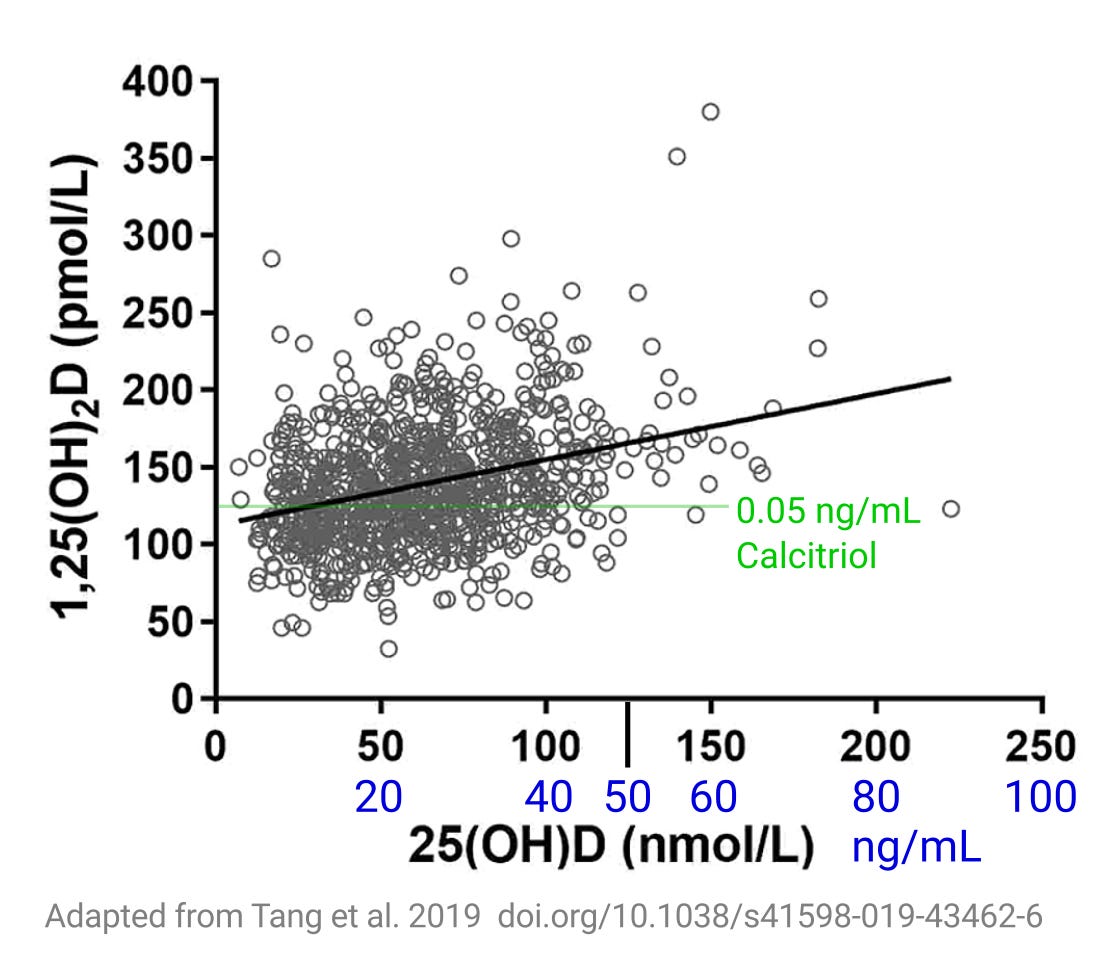
[Tang et al. 2019 www.nature.com/articles/s41598-019-43462-6.]
with that higher level of circulating calcitriol somehow boosting the immune system. This makes no sense, because the kidneys tightly control the circulating calcitriol level in order to control the level of circulating calcium ions within a very narrow range.
So many medical professionals cannot understand how vitamin D3 supplementation can “boost the immune system”.
The result, in sepsis alone, is an appalling toll of suffering, damage and death, sometimes within hours or a few days of an otherwise unremarkable infection turning for the worse. The pathways to sepsis are varied and even attending doctors and nurses may only correctly diagnose the condition after the self-destructive dinflammatory immune responses have damaging the patient’s organs.
If you have understood the above an have read one of the tutorials on 25-hydroxyvitamin D to calcitriol intracrine and paracrine signaling, then you understand and can communicate more about the immune system’s need for good 25-hydroxyvitamin D levels than most vitamin D researchers. This understanding makes it clear that maintaining at least 50 ng/mL circulating 25-hydroxyvitamin D is crucial to good health. This includes improving pregnancy https://vitamindstopscovid.info/00-evi/#3.2 and reducing the risk of cancer and of neurodegeneration: https://vitamindstopscovid.info/00-evi/#3.3.
Comments
Nothing yet. Say the first thing.
Sign in to join the conversation.