
A small programming note before we get to the zucchini. Cancer, living with cancer, and the absurdity of behavior will remain the principal occupant of this little corner because, having arrived without an invitation, it has provided rather more material than I ever requested.
But I've been thinking there is equal merit in occasionally writing about the considerable absurdity of simply being alive and getting older: the quiet indignities, the changing rules, the things we used to manage perfectly well without, and the younger generations who have discovered that human survival is apparently impossible without technologies that did not exist five years ago.
I remember when getting into a stranger's car was something your parents specifically warned you against; now we summon one with an app and complain if he takes six minutes to arrive. So expect the occasional excursion beyond the Cancerverse, including food, because before all this I had another life that involved professional kitchens, sharp knives and people actually paying me to cook.
Which leads to an offer. If there is something you've always wanted to cook, a recipe you want improved, a sauce that keeps betraying you, a piece of meat you don't know what the hell to do with, or you simply want some culinary advice, send it my way. I'll happily provide recipes and advice for free. If what I give you saves dinner from becoming evidence, and you feel so inclined, you can make a small contribution to the NICU bassinet initiative instead. Consider it my peculiar new restaurant: no reservations, no bill, no tipping, and the money goes toward babies who are far too young to complain about the service. You can email me at hans.casteels@gmail.com
Now on the the recipe. Zucchini has a public relations problem. Nobody waits eleven months for zucchini season. Nobody drives through the countryside, sees a handwritten sign advertising FRESH ZUCCHINI and slams on the brakes hard enough to deploy the airbags. Nobody has ever opened a restaurant menu, spotted zucchini and whispered to his wife, “Jesus, Sharon, they have zucchini.” Mostly zucchini happens to you.
Someone grows it. This is usually the beginning of the problem. The novice gardener plants four zucchini plants because four doesn’t sound like many, then discovers that by August he is operating a zucchini distribution cartel. They appear on neighbours’ porches. They are brought to work. They are left anonymously beside mailboxes. Eventually enormous specimens begin circulating that look less like vegetables than unexploded Belgian artillery shells.
I have never hated zucchini. Hate requires effort, and zucchini rarely inspires that much emotion. For most of my life I regarded it as a perfectly serviceable supporting vegetable. Sauté it. Grill it. Put it beside the lamb. Perhaps stuff it if the afternoon has become unusually long. Then I discovered what happens when southern Italians get hold of one. They fry the bastard.
The dish is Spaghetti alla Nerano, associated with Nerano, a small village on the Sorrento Peninsula. And what fascinates me about it is not merely that it is delicious. It is that the dish takes one of the least assertive vegetables in Western civilization and produces a pasta so voluptuous that the first time you eat a really good version you assume someone has sneaked cream into it. Nobody has. That is the trick.
Zucchini contains a remarkable amount of water, which is one reason so much badly cooked zucchini has the personality and structural integrity of a wet facecloth. Frying changes the equation. Moisture leaves. Sugars concentrate. The edges caramelize. The flavour that was hiding inside all that water suddenly has nowhere left to hide.
Serves 4
360 g excellent spaghetti or linguine
6 to 8 small, very fresh zucchini
100 ml extra virgin olive oil
Neutral oil for frying
1 garlic clove, lightly crushed
60 g unsalted butter, very cold, cubed
80 g Provolone del Monaco, finely grated
40 g Parmigiano Reggiano, finely grated
12 to 15 fresh basil leaves
4 zucchini flowers, if available
Freshly ground black pepper
Fine sea salt
Pasta water, lots of it
The crucial point is small zucchini. Large ones become watery and seedy and begin behaving more like agricultural equipment than vegetables.
Slice the zucchini extremely thinly, ideally about 2 mm, (1/16 inch for the Muricans) using a mandolin. (A mandolin is a kitchen slicing device invented to produce perfectly uniform slices of vegetables while periodically reminding cooks that ten fingers are more of a starting inventory than a guarantee). Fry them in batches until golden but not brown. You’re trying to concentrate their sweetness and develop some caramelization without producing zucchini potato chips. Drain them, salt lightly and scatter a few torn basil leaves through them. This frying step is fundamental to Nerano because it changes both the flavour and texture of the zucchini.
Now take about one third of the fried zucchini and blend it with approximately 75 ml (75 ml of water, or about ⅓ cup in American) hot pasta water and a tablespoon of olive oil until completely silky. This isn’t strictly the old Nerano method, but it gives us the creamy texture we’re after. A similar purée technique is used in contemporary versions to intensify the creamy zucchini base.
Bring the pasta water to a boil and salt it moderately. Cook the spaghetti about three minutes short of al dente. Before doing anything rash like pouring away the most useful ingredient in the kitchen, reserve at least 500 ml pasta water.
Meanwhile, warm two tablespoons olive oil with the crushed garlic in a wide sauté pan. Let the garlic perfume the oil without browning, then throw it away. Garlic has now completed its assignment and may retire.
Add half the remaining fried zucchini, roughly crush it with a wooden spoon and add about 100 ml pasta water. Add the spaghetti and begin finishing it in the pan, tossing vigorously and adding small quantities of pasta water as necessary.
Now add your zucchini purée.
This is where the transformation happens. The spaghetti should become coated in an intensely zucchini flavoured, pale green, glossy sauce. There is no cream. The creaminess comes from zucchini, pasta starch, cheese, butter and aggressive emulsification. That’s the essential technique behind excellent Nerano.
When the pasta is properly al dente, take the pan completely off the heat. Add the cold butter and toss. Then gradually add the Provolone and Parmigiano while continuing to toss vigorously.
Do not add the cheese over roaring heat. You’ll get strings and clumps rather than an emulsion, at which point you’ve made zucchini macaroni and cheese and Naples will issue an arrest warrant. Add the remaining fried zucchini and torn basil. Grind in plenty of black pepper. Taste before adding salt because Provolone del Monaco has opinions of its own.
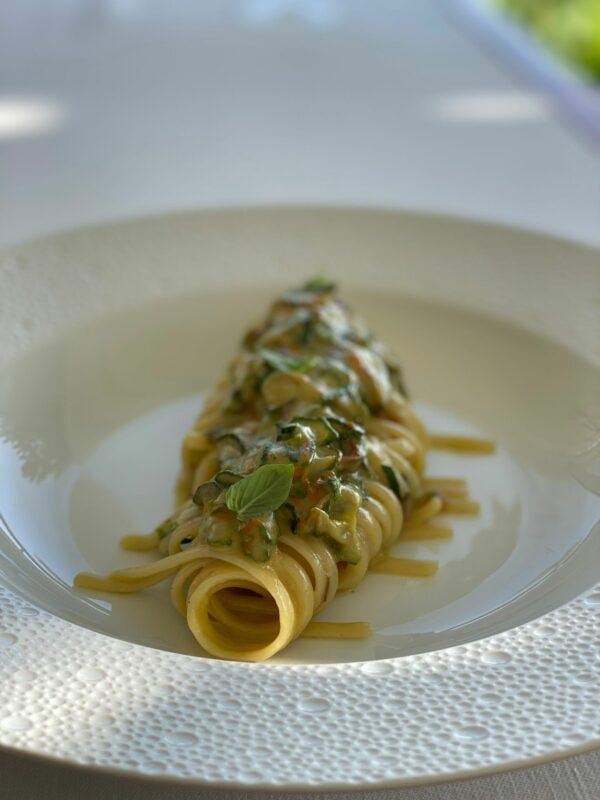
Use a large, warm, white plate. With carving fork and ladle, wind a modest cylinder of spaghetti in the centre. Not a mountain. Not something suggesting the diner has just completed a marathon.
Spoon a little of the glossy zucchini emulsion around it. Arrange perhaps five beautiful golden zucchini rounds against and around the pasta rather than throwing forty of them on top.
If you have zucchini flowers, tear them delicately lengthwise and place one or two petals around the pasta. Add three or four tiny basil leaves.
Finish with a few drops of excellent olive oil, freshly ground black pepper and the faintest snowfall of Parmigiano.
And stop.
No parsley. No balsamic reduction. No truffle oil. No decorative cherry tomato desperately seeking employment.
The plate should look almost suspiciously simple. Then you eat it and discover that fried zucchini, pasta water, butter and cheese have somehow conspired to produce something that tastes considerably more expensive than its ingredients.
One further trick from the chef in me: make the zucchini several hours ahead. Let the fried slices sit with basil and their own oil. They soften, deepen and become almost jammy. Then use those to build the sauce. That is where this dish stops tasting like pasta with zucchini and starts tasting like Nerano.
The version above is very good, but there is a more involved version that I think is better. The improvement is not adding more ingredients. Nerano falls apart when people start decorating it with garlic, lemon, cream and other culinary résumé padding. The improvement is treating the zucchini in three different ways, so you get concentration, creaminess and texture.
I would make the serious version like this:
Use 8 small zucchini for four people. Slice six very thinly, about 1/16 inch, and cut the other two lengthwise into slightly thicker ribbons.
Fry the thin rounds in olive oil rather than neutral oil, in small batches. Pull some while still pale gold and let others become considerably darker around the edges. That gives you two flavours from exactly the same ingredient. Drain them onto a rack rather than paper towels so they don’t steam themselves soggy. While warm, season lightly and layer them with basil. Then refrigerate them for at least four hours, preferably overnight. This resting period is one of the secrets associated with traditional Nerano. The zucchini collapses, concentrates and becomes almost confit like.
Now take roughly half of those rested zucchini rounds and make the sauce base. Warm them very gently with a little pasta water until they practically disintegrate. Blend only half of that mixture until perfectly smooth, then combine it again with the unblended portion. That gives you a sauce with both velvet and tiny pieces of concentrated zucchini rather than something resembling baby food.
Take the two remaining raw zucchini and char the thicker ribbons very quickly in a screaming hot dry pan or on a grill. You want dark marks while the centres remain slightly firm. These don’t go into the sauce until the very end. They provide the fresh zucchini flavour and a little bite against all that luxurious fried zucchini.
Then cook 360 grams of good spaghetti in less water than usual. That’s deliberate. Less water means a higher concentration of starch, and that starchy water is going to become part of the sauce. Salt it moderately because Provolone del Monaco is not known for its shyness.
Cook the spaghetti only about two thirds of the way in the pot. Transfer it into a broad sauté pan containing your softened zucchini mixture and begin cooking it almost like risotto, adding small ladles of hot pasta water while continuously tossing and stirring. The spaghetti finishes cooking while absorbing zucchini flavour rather than simply getting dressed with sauce afterward.
When it’s nearly al dente, add the silky zucchini purée. Keep tossing until the sauce clings tightly to the pasta.
Then comes the part that matters most: turn the heat off and wait about thirty seconds. Add 50 to 60 grams of very cold butter in small cubes, tossing continuously. Then add about 100 grams finely grated Provolone del Monaco, little by little, followed by perhaps 20 to 30 grams Parmigiano Reggiano. Add tiny splashes of pasta water as needed.
You are essentially making an emulsion directly around the spaghetti. If you get it right, there should be almost no visible liquid in the bottom of the pan. Lift a strand and the sauce comes with it.
Now fold in some of your darker fried zucchini rounds, the charred ribbons and fresh torn basil. Keep several beautiful fried rounds for plating.
And I’d add one tiny restaurant trick that changes the aroma without changing the identity of the dish: basil oil. Blanch a generous bunch of basil for about ten seconds, plunge it into ice water, squeeze it absolutely dry, then blend it with good olive oil until brilliant green. Strain it. You need perhaps five drops per plate, not enough to make the pasta look as though Kermit had an accident.
For plating, don’t build the usual pasta haystack. Use a large warm shallow bowl and make a loose, low coil of spaghetti slightly off centre. Spoon a little zucchini emulsion underneath and around it. Lay two charred zucchini ribbons through the pasta, place three or four dark fried rounds deliberately around it, add perhaps one torn zucchini flower and a few tiny basil leaves. Finish with finely grated Provolone and those few drops of basil oil.
The result is considerably more interesting than the simpler version because one zucchini now appears four ways: slowly rested fried zucchini gives sweetness, puréed zucchini gives the sauce body, darker fried zucchini gives caramelization, and charred fresh zucchini restores some vegetal freshness and texture.
The whole point becomes not merely Italians discovered that zucchini tastes better fried, but how far can you push one absurdly ordinary vegetable without turning the dish into chef theatre? And, naturally, somewhere in the process we’ve dirtied a blender, grill pan, sauté pan, pasta pot, rack and probably seventeen utensils to make spaghetti with zucchini. Now we’re cooking professionally.
If I May…If you enjoyed watching me turn a zucchini into a project requiring more equipment than minor surgery, there is a more useful place for your money than buying me dinner. My daughter Ashley works in a NICU, where the patients arrive extremely small, frequently frightened and without so much as a reservation. I am trying to help raise money for two desperately needed bassinets, each costing roughly $30,000, because apparently even the tiniest humans have discovered the astonishing price of hospital furniture. I don't charge for these essays and don't intend to. If one made you laugh, think, cook, or reconsider the tragic life you've been inflicting on zucchini, please consider tossing a few dollars toward the NICU through my GoFundMe. The babies won't care whether you know a mandoline from a bucket of steam. They'll just get something they actually need.
If you are able, the donation link is below. Every contribution, no matter the size, helps give a newborn the chance to grow up and one day argue about something much more sensible.
The essays will remain free. The bassinets, unfortunately, are not.
No posts
Comments
Nothing yet. Say the first thing.
Sign in to join the conversation.