
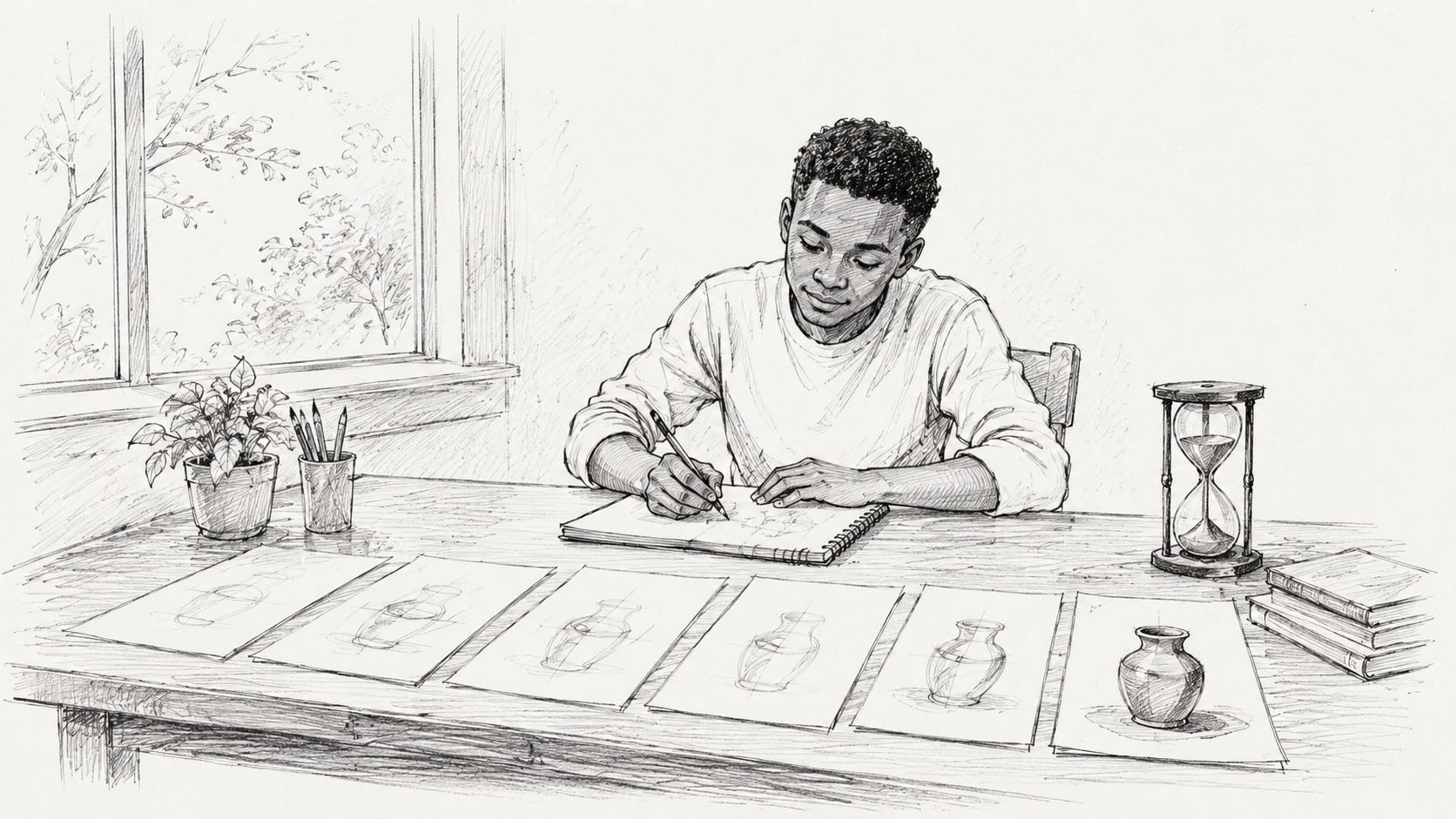
You’ve probably come across the 10,000-hour rule, popularised by Malcolm Gladwell in Outliers – the idea that it takes 10,000 hours to become an expert at almost anything. The first time I heard it, it sounded inspiring. I could become an expert at anything, as long as I put in the hours.
Then I did the math, and the inspiration immediately left me.
If you spread 10,000 hours across your calendar, it’s brutal. At 1 hour a day, that’s 10,000 days — around 27 years. At 2 hours a day, 5,000 days. Even at 5 hours a day, you’re looking at 2,000 days – around 5 and a half years. I went from motivated to completely discouraged, and I became convinced I’d never truly master any skill I cared about, because who has that kind of time?
Then one day I was scrolling online and came across the 20-hour rule, popularised by Josh Kaufman in his TED talk “The First 20 Hours”. His point was different: you don’t need 10,000 hours to become an expert to enjoy a skill or use it well. You need about 20 focused hours to become decently good at almost anything. And 20 hours isn’t 27 years — it’s a few days. Two hours a day for ten days. Three hours a day for a week or four hours daily for five days. That’s it.
That reframed everything for me. And it’s the exact method I now use whenever I want to pick up a skill fast. Here’s how it works.
Step 1: Deconstruct the skill.
Break the skill into its smaller parts and get specific. This is where most people fail before they start — they say, “I want to learn video editing” or “I want to get good at cooking”, and the vagueness paralyses them.
When I learnt video editing, I didn’t set out to “learn video editing”. I broke it into pieces: how to import and cut clips, how to fix bad audio, how to colour-correct, and how to add text and transitions. Suddenly it wasn’t one intimidating mountain — it was several small hills I could climb.
Cooking works the same way. “Learn to cook” is too broad. But “learn to boil pasta” or “learn to fry an egg” is something you can actually work towards. Now you know exactly what to practise: your knife work, your timing, and a handful of basic recipes. Specificity takes you from a fog into a checklist.
Step 2: Learn just enough to self-correct.
Gather three to five resources — books, YouTube tutorials, or a course — and learn just enough to start and catch your own mistakes. Not so much until you feel ready. Just enough to begin.
Most people get this wrong. They binge tutorials for weeks and call it “learning”, when really they’re hiding from the discomfort of being bad at something. It’s like a quote by Mark Manson where he says, “learning is a smart person’s way to procrastinate.” So action is vital regardless of your level of readiness.
With video editing, I watched a couple of tutorials on cutting and audio, then immediately opened the software and starting experimenting and making mistakes. But those experiments and mistakes taught me more than ten more hours of watching ever could. Same with cooking — you don’t need to read the whole cookbook; you need to burn the first pan and learn from it.
Execute fast. The mistakes are the lesson.
Step 3: Remove the barriers to practice.
Make it effortless to start and hard to get distracted. Kill the friction on the good behaviour and add friction to the bad.
When I was learning video editing, that meant I’d need to keep my phone in another room, turn the TV off, and have the editing software already open on my laptop so there was no “getting set up” excuse. For cooking, it’s having your ingredients and tools already on the counter so the gap between “I should practise” and actually doing it is as small as possible. You’re far more likely to sit down and work when the work is right there and the distractions aren’t.
Step 4: Pre-commit to the 20 hours.
Decide in advance that you’re doing the full 20 — before you hit the wall where you feel awkward and incompetent and want to quit. Because you will hit it, usually somewhere in hours 3 to 8, and that’s exactly where most people abandon the skill.
Break it into something you can sustain: 2 hours a day for 10 days, 3 hours for 7 days, or 4 hours for 5. Whatever fits your life — but commit to the number first, so that when the discouragement hits, the decision is already made. That’s the whole game.
You really don’t need 10,000 hours to become great at a skill. You need 20 focused ones. The reason so few people ever stand out isn’t talent or time — it’s that almost nobody actually sits down and dedicates the 20 hours to do the deliberate work.
Which is exactly why doing it makes you the exception.
Thanks for reading.
Nurain.
No posts
Comments
Nothing yet. Say the first thing.
Sign in to join the conversation.