
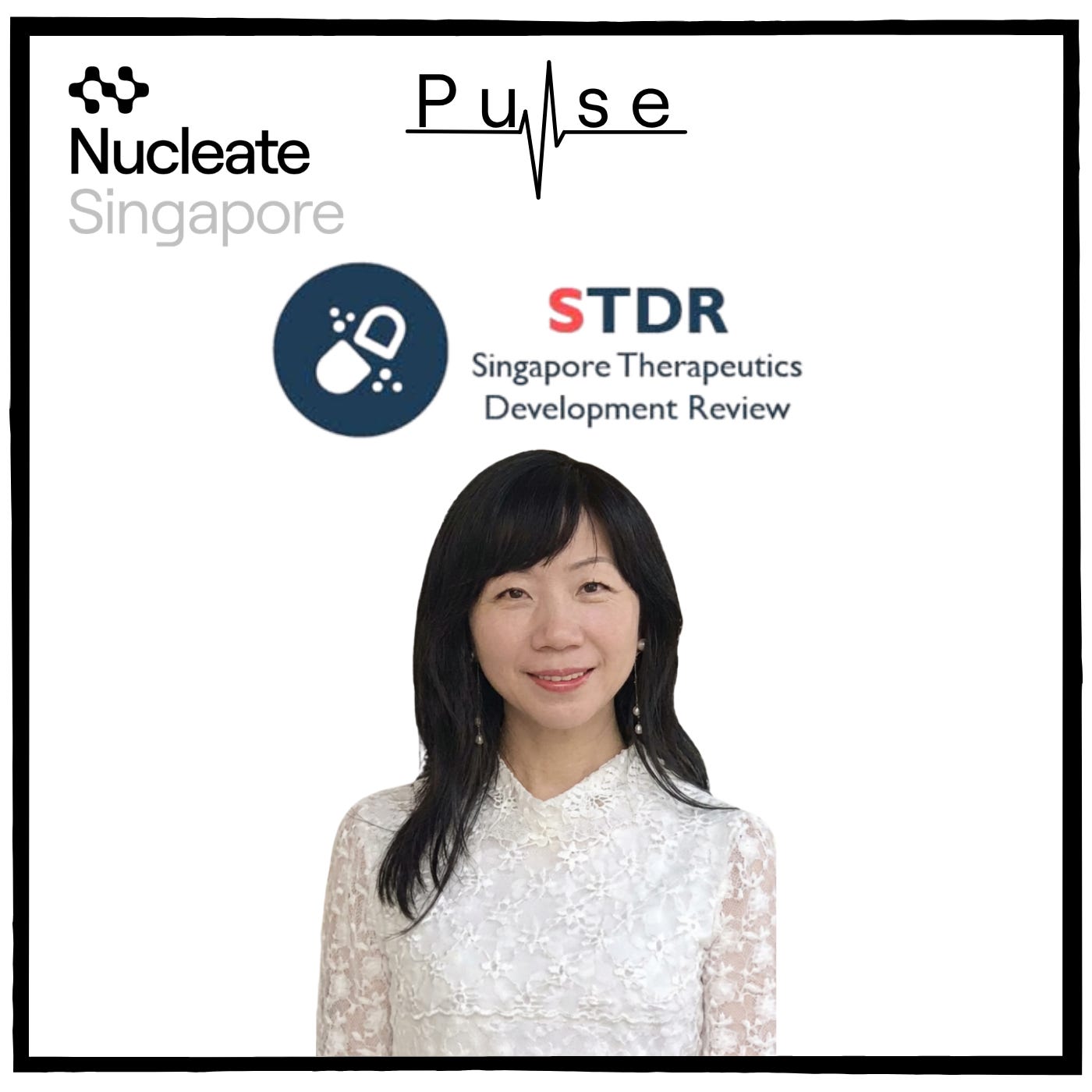
Dr. Katherine Wang, Deputy Director of the Biomedical Research Council and lead of the Singapore Therapeutics Development Review (STDR), joins the show to unpack what it really takes to move a scientific discovery from the lab bench to a viable biotech company. Drawing on a career that spans a PhD at NYU, tech transfer, program building at Duke-NUS, and now national drug-discovery strategy at A*STAR, Katherine explains why Singapore’s researchers excel at science but stumble at commercialization. She also delves into what STDR is doing about it through mentorship, bootcamps, and new schemes that pair scientists with serial entrepreneurs. Along the way she compares the US, China, and Singapore ecosystems, shares what she looks for when funding early-stage projects, and offers candid advice for any scientist curious about a career beyond the PI track. It’s a practical, clear-eyed conversation about turning good science into products that reach patients.
In this episode, Katherine discusses how researchers can translate scientific discoveries into commercially viable therapeutics and why strong science alone is not enough to build a successful biotech company. She explains the importance of defining unmet medical needs, developing a clear target product profile, understanding the competitive landscape, prioritising value-driving experiments, and building multidisciplinary teams with complementary scientific and business expertise. Katherine also shares perspectives on the differences between the biotechnology ecosystems in Singapore, the United States, China, and Europe; the role of public funding and private-sector partnerships; and how initiatives under RIE2030 may shape Singapore’s biomedical research and innovation landscape.
🧬 Strong science alone is not enough for commercialisation: Researchers also need to understand unmet medical needs, product development, intellectual property, competitive positioning, funding, and long-term commercial strategy.
🎯 Translational research requires a clear product vision: Promising projects should define what the final product is intended to achieve, including efficacy, safety, mode of administration, development milestones, and go/no-go decision points.
⚡ Speed and prioritisation matter in biotechnology: Researchers must identify the experiments and milestones that create the greatest value rather than attempting to pursue every scientific question at once.
🌍 Global competitiveness requires meaningful differentiation: Therapeutic projects should aim to be first-in-class or best-in-class and must be developed with a strong understanding of the international competitive landscape.
🤝 Successful biotech companies need multidisciplinary teams: Scientific expertise is essential, but commercialisation also requires people with experience in business development, fundraising, partnerships, intellectual property, operations, and industry engagement.
💼 Industry mentorship can help bridge the gap between academia and business: Through STDR, researchers gain access to experienced investors, former pharmaceutical executives, biotech leaders, commercialisation training, and strategic guidance.
🇸🇬 Singapore has strong public support for translational research: Government funding and national initiatives provide a strong foundation, while greater private-sector participation, entrepreneurial talent, and industry partnerships can further strengthen the ecosystem.
🌐 Cross-border partnerships may shape the future of Singapore biotech: Collaborations with investors, pharmaceutical companies, CROs, and clinical research partners across the United States, Europe, China, and Australia can support global commercialisation.
🎓 Commercialisation skills should be introduced earlier: Exposing PhD and Master’s students to entrepreneurship, industry careers, venture building, and translational science can broaden career pathways and grow the next generation of biotech leaders.
💬 Curiosity and networking can open unexpected career paths: Speaking with people across different roles, exploring internships, and gaining experience beyond academic research can help scientists discover where their skills may create the greatest impact.
On focus and prioritization: “Doing everything doesn’t mean that it’s gonna add value... What are the key milestones they should fulfill to ensure that the project moves to the next value inflection point?”
On speed and market timing (the Moderna example): “By the time the product came out, COVID already ended, then there would be no need for such a drug... even if they’re trying to address a long-term goal, they should also accelerate because the market landscape will keep changing.”
On building a founding team: “Some researchers thought that if I would like to spin off, probably my whole lab will just join the company — which shouldn’t be that way... Who is gonna do the business development? Who is gonna negotiate terms with VCs or pharmas?”
On her own career philosophy (the parenting analogy): “Just like as parents, our role is not only just to give birth to a baby, but also to ensure that the child grows healthily.”
On taking initiative / networking: “Although at that time I was quite junior, I just directly wrote an email to the director... You won’t lose anything just by chatting with the people.”
00:00 Introduction to Dr. Katherine Wang
01:17 From Research to Research Leadership
03:13 Comparing the US, Singapore and China Biotech Ecosystems
06:20 Building a Career Across Strategy and Operations
10:10 What Is the Singapore Therapeutics Development Review?
17:59 Global Models for Translational Funding
23:22 Introducing the Venture Lead Scheme
27:15 Bridging the Commercialisation Skills Gap
29:00 New STDR Initiatives under RIE2030
33:26 The Future of Singapore’s Biotech Ecosystem
35:01 Training the Next Generation for Commercialisation
37:40 Current Gaps in Singapore’s Biotech Ecosystem
Katherine Wang: Some researchers thought that, oh, if I would like to spin off, probably my whole lab will just join the company, which shouldn’t be that way because the lab people, they’re all strong in conducting lab experiments. But then who is gonna do the business development? Who is gonna negotiate the terms with VCs or pharma? Who is gonna go to interface with a lot of other partners? Who is gonna negotiate terms with the CROs? All this needs a very different kind of skill set, very important skill sets as well. So actually it’s very important for researchers to understand...
Shamieraah: Hi, thanks for joining us on Nucleate Singapore Pulse, Singapore’s premier podcast on the biotech ecosystem. I’m your host, Shamieraah Jamal, a computational biologist. Whether you’re a student thinking about creating your own startup or an industry professional looking for diverse perspectives, this is the podcast for you. The show notes and transcripts for the episode can be found on nucleatesingapore.substack.com.
Dr. Katherine Wang is the Deputy Director of the Biomedical Research Council, BMRC, and she also leads the Singapore Therapeutics Development Review, STDR, a National Therapeutics Funding and Capability Building Program, which aims to strengthen Singapore’s drug discovery and development pipeline, as well as groom scientific founders.
Katherine, welcome.
Katherine Wang: Hi. Thanks Shamieraah!
Shamieraah: So to get started, could you paint us a broad picture of your journey going from research to a more executive role?
Katherine Wang: Sure. I pursued my PhD studies in biology at NYU, New York University, in the United States. In the final year of my PhD, I did an internship at NYU Tech Transfer Office.
I drafted the business plans for biotech spin offs. That was the first time I gained some exposure to venture building. After my PhD studies, I came to Singapore. I established and managed an international collaborative laboratory between Singapore and Israel. Through that role, I gained some experience in program management.
Later on, I joined Duke-NUS and helped the senior management to develop new initiatives. One of the initiatives that I developed was Singapore’s first and the only PhD program in Clinical and Translational Sciences. The program was developed to address an ecosystem gap. There was a shortage of clinician-scientists who could bridge clinical practice and scientific discoveries.
The program has trained multiple cohorts of clinician-scientists over the years. Then about three and a half years ago, I joined A*STAR to lead STDR, Singapore Therapeutics Development Review, which is a national initiative to boost the local drug discovery and development pipeline. By working closely with industry partners as well as our strategic partners e.g. EDDC and SMART, we developed multiple initiatives including project evaluation, advisory, mentorship, bootcamps, as well as ecosystem building. Yeah, that’s pretty much.
Shamieraah: Wow. So that’s very well-rounded in going through so many different specialties. So what motivated you to venture into empowering researchers to transform their research?
Katherine Wang: Through my work experience and engaging researchers, I realized that there are some gaps in our ecosystem. Researchers are very strong in science, but they were never trained in commercialization. They need support and guidance. I hoped that I could be the enabler to support them through their commercialization journey.
Shamieraah: Right, and to go to some specific experiences, so you spent some time in the US to do your PhD at NYU, so were there some structural differences that you observed between Singapore and the US maybe in terms of funding, regulations, basically startup culture, the entrepreneurial culture.
Katherine Wang: Yeah, sure. Let’s talk about funding structures first.
The funding structures in US and Singapore are quite different. The US system is decentralized and is driven by multiple federal agencies as well as industry. Our Singapore system is centralized and led by the government. In US, public funding covers a broad range, whereas in Singapore, as a small nation, we tend to prioritize strategic niche areas.
We saw in the US the industry plays an important role in applied R&D. In Singapore, the government has been encouraging translational research and public-private partnerships. Then, in terms of the regulations around startups, in US, the FDA conducts comprehensive reviews and the process can be lengthy. In Singapore, HSA has a streamlined review process. If a drug has already been approved by another reputable agency, such as FDA, HSA may use a verification pathway to accelerate the process. Then, let’s talk about entrepreneurs and entrepreneurial culture in US. There are quite a lot of entrepreneurs and the entrepreneurial culture is very mature. In Singapore, our government is still working really hard to develop more entrepreneurs.
Shamieraah: Right, so very stark differences in terms of the government involvement as well as the baseline culture of risk taking in entrepreneurship. Do you observe any similar differences in Singapore and China as well?
Katherine Wang: Yeah, China and Singapore ecosystems are also very different. The ecosystem in China has matured a lot, and we actually can see that they are quite vibrant in terms of biomedical and biotech ecosystem. The Chinese government has been very supportive. They provide funding support in terms of research. They also actively attract their talent back from US and Europe.
There are quite a lot of collaborations between industry and academia. And also the regulation system in China has matured a lot. We also observe quite a lot of entrepreneurs in China. And interestingly, some of the entrepreneurs may not be really well-educated. They may not really have an advanced degree, but they are really entrepreneurs who can identify the market needs as well as to develop the products quickly to address the market.
Shamieraah: Are there some lessons that you think Singapore can learn from China in that regard?
Katherine Wang: It is actually very hard to say exactly what to learn because the two ecosystems are very different. But actually what we can learn is, for example, the China companies - they actually are very fast. They’re very efficient, very fast. Whereas our researchers, I mean, our researchers very strong in science, but then probably the mindset in terms of accelerating the biotech projects or the companies, we will still need to educate our researchers so that they can really be fast enough to develop a product to catch the market opportunities.
Shamieraah: And this is something I’m sure we will touch on a lot later as well. And also you’ve spent a lot of time working on legal agreements, managing KPIs. And you mentioned you also designed the PhD in Clinical and Translational Sciences program at Duke-NUS. So what has it been like juggling so many roles and wearing so many hats? How did every step in your career prepare you for the next one?
Katherine Wang: It’s true that it’s not easy to juggle many different roles, but I believe in purpose and value creation. It is important to be highly engaged in both the strategy side, as well as the operations side, to ensure that a new initiative is well-developed and properly implemented. Just like as parents, our role is not only just to give birth to a baby, but also to ensure that the child grows healthily.
Yeah, so, when I was doing my PhD degree at NYU, I got this opportunity to do an internship at the Tech Transfer Office. So I thought, why not? Although at that time I had no idea about how venture building was about. So I wanted to give it a try, and then I got interested in it and also learned a lot.
Then later on when I was in Singapore, I also was involved in administration as well as program management/ program development. Then I started to wonder whether I could also work a bit upstream to develop any new initiatives or new ideas or any new strategies. So then I started to join Duke-NUS to lead the development of new initiatives.
After I already learned about strategy as well as operations, I joined A*STAR to lead STDR, which needs both the strategy side as well as the operations side. I think probably it’s always good to stay curious about what are other kinds of work that we could also help and what are the kind other experience that we could learn, besides doing what we have been doing every day.
Shamieraah: And I’m also very curious, when you step into these new roles, how exactly did you manage to get this opportunity? Is it through proving your existing skillset or was it through networking and understanding the needs on the other institution side?
Katherine Wang: Yeah, that was a good question. I remember when I started thinking about what I wanted to do besides doing research, I actually chatted with quite a lot of people, tried to understand the nature of their day-to-day work. I tried to understand what they were doing, if it would be something that I also wanted to do.
And so trying to think about myself, whether I would be able to do that kind of work or whether I would be keen on that type of work. So then after chatting with different kinds of people, then I found out actually I probably would like to be involved in the programs, would like to be involved in a lot of activities as well as initiatives.
Because I believe in the purpose. I believe that’s where I can contribute. So that’s how I started to look for such opportunities. And then when I saw such opportunities, I directly wrote an email to the director. Although at that time I was quite junior, I just directly wrote an email to the director, asking, sort of introduced myself, and then sort of shared with them, you know, I was passionate about you know, joining a team because I have what kind of interest. So I think also fortunately, the directors actually believe that I could contribute, although, sometimes, you know, I may not have exactly the same experience, but they actually had the trust in me, so they actually brought me in. That also gave me quite a lot of opportunities to contribute.
Shamieraah: It’s nice to be in a culture where you can write to someone and gain their trust and be given an opportunity to do something different and explore something different.
Katherine Wang: Yeah.
Shamieraah: So let’s move on to STDR. So could you give us a brief overview of what STDR is?
Katherine Wang: Yeah, sure. STDR is a national initiative to boost the local drug discovery and development pipeline. We focus on the translation from science to business and contribute to the local biotech spinoffs through following funding from the government, VCs or incubators.
Shamieraah: So how many spinoffs or startups have been supported by STDR so far? Are there any notable success stories?
Katherine Wang: So far, we have resulted in four companies. One of them is Nuevocor, you’ve probably heard about it, and it’s a gene therapy company to treat cardiomyopathies. It has successfully raised Series A as well as Series B funding rounds.
Shamieraah: STDR provides funding in both pre-pilot and pilot stage drug discovery programs. For researchers who want to plan to take their research to clinical stages, what do you look out for when assessing the grants for STDR’s pre-pilot program?
Katherine Wang: So for the STDR pre-pilot: we mainly give people the funds to validate a drug target. So when researchers apply for STDR pre-pilot, they should have already identified a drug target and then they should also show some causal link between the target and also the disease indication.
Of course, besides that, they also have to have a very clear idea what kind of medical need they’re trying to address. And then they should also have already conducted some loss-of-function or gain-of-function experiments to have some preliminary data showing that this target probably is gonna be a promising target.
And then they also propose, if they get funded by STDR pre-pilot, what they would propose to do. For example, are they gonna validate the target in vitro, in vivo? Are they gonna study the mechanism-of-action? How are they gonna study those? So actually that’s something that researchers should bear in mind.
Shamieraah: So when it comes to target validation , what is the extent of evidence we are expecting? Is it just cell line or is it also in vivo and in-human trials?
Katherine Wang: Probably, I would say in vivo, in vitro, because clinical trials would be a quite later stage.
Shamieraah: I mean, the sense of like, are we looking at a patient population and looking at their genome?
Katherine Wang: Yeah, if they could have that level of data, that would be interesting, but probably not really in the clinical trials itself. Not there yet. I believe the researchers who come to us actually are still at a quite early stage. But with in vitro data, in vivo data or, you know, in the samples, you know, in the patient samples, that would be helpful.
Shamieraah: And for the projects that are approved for the pilot phase funding, who are the main players that you usually see applying for this funding? Are they small research teams, spinoffs or more established firms?
Katherine Wang: So for STDR we only can fund the researchers from public institutions as well as universities and hospitals. We don’t support the spin-off companies.
Shamieraah: And so are these projects also following up from the pre-pilot funding?
Katherine Wang: Not necessarily. So some of the projects may just directly come from the researchers’ host institutions if the projects are mature enough. Some other projects could also come from pre-pilot.
Shamieraah: How do research projects compete for grants? What are the priorities guided by? Is it some current need or is there a long-term goal?
Katherine Wang: For STDR projects, actually we don’t define whether short-term goal, short-term need, or long-term need. Actually for researchers, they need to think about if they are trying to address a short-term need, then they really have to bear in mind that they should develop a product. They really have to accelerate; make sure they can develop a product that can address the short-term need. For example, when it was COVID pandemic, right? At that time we could see that the companies like Moderna already quickly developed the vaccines to treat COVID19 quickly control it.
That’s a very good example of the companies make the profit, whereas if the researchers back then were working on COVID vaccines or other ways to control the situation, but then by the time the product came out, COVID already ended, then there would be no need for such a drug or a vaccine anymore. So actually, for us, we don’t have a preference in terms of short-term or long-term. But actually for research, they really have to bear in mind. But in either case, even if they’re trying to address a long-term goal, they should also accelerate because the market landscape will keep changing.
Shamieraah: That also ties into my next question. What type of science is favoured more in these research projects? I think I get an understanding of what your answer is, but I just wanna ask. Would it be more translational, fundamental, or one that is just directly with commercialization potential?
Katherine Wang: For STDR projects, we are looking for translational research with commercialization potential.
Shamieraah: Right. And give us an idea of the observed outcomes of approved projects so far. What are the successes and challenges that you have observed?
Katherine Wang: Sure. So, for STDR successful projects, we can see that first of all, there has to be an unmet medical need - that has to be very clear. And then the researchers should also have a product vision.
They should be clear what kind of product they’re trying to develop. So which means they have to also have a clear TPP, target product profile. For example, if they want to develop a drug, how efficacious would they define as efficacious and how safe would they define as safe? And also in terms of mode-of-administration, they should actually start to propose, even dosing.
They should start to link together what are the current stages of development, what are the scientific data, how their current discoveries, in terms of scientific data can support what they propose. And then what would be the developmental plan. Short-term for example, within STDR funding stage, what would be the short-term goal, right?
What kind of milestones they would like to achieve? What would be the key go/no-go milestones. And also what are the experiments they would like to do within the STDR funding stage. And then after that, long-term goal would be where to go, right? Whether they’re gonna approach VCs for fundraising or they would like to partner together with pharma or partner together with biotech companies.
So all these long-term goals should also be well thought of. In the meanwhile, IP strategies are also important. They also have to make sure that they have freedom-to-operate. That’s actually essential. Because without patentable IP, it would be very hard for researchers or companies to raise any VC funding or move the asset to the clinic.
Shamieraah: So you mentioned a lot of key ingredients that are necessary for these research projects, and as I understand, STDR is also a little more hands-on in how they operate. So what are the mechanisms or resources that you have available at STDR to help these projects and these potential spinoffs navigate this, all these commercialization challenges?
Katherine Wang: We not only provide public funding, we also provide industry mentorship. Our mentors are all industry experts who are either VCs or ex-pharma executives. Some of them are biotech CEOs. And then we pair each of our project teams with at least one mentor. And the mentor actually gives very constructive feedback as well as guidance to guide the project teams towards commercialization. We also send our project teams to bootcamps for training. We teach them how to define the TPP, what are the business models that they should define. What is the competitive landscape, how to conduct that, and how to reach out to VCs for fundraising. We let them practice their pitching skills as well, and so on.
Shamieraah: How is the grant landscape for translational research in Singapore versus the rest of the world?
Katherine Wang: The translational funding is quite a lot I would say. Government is very supportive. And globally, different countries have different ecosystems.
For example, in US there are quite a lot of industry participation in the funding. China also has quite a lot. And also in Europe, for example, in Switzerland. There are quite a lot of VC fundings as well as global pharmas over there. So actually the funding structure is quite different.
Whereas in Singapore, our government is really trying to encourage the private- public partnerships, but actually in the meanwhile our government is also very supportive in terms of providing the public funding.
Shamieraah: So of the countries that you listed, which one do you find the most interesting and why? And is there anything we can learn from them?
Katherine Wang: Sure. I think BaseLaunch is an interesting model that I am always very keen to find out more as well as to see how we could adopt it to our ecosystem. So BaseLaunch is an accelerator in Basel, Switzerland. It is an accelerator that has strong support by global VCs as well as pharmas.
So what they do is they have very early stage commitments and they evaluate the projects, either the projects from academia or early stage project companies. Then they provide the funding, provide guidance, industry and advice. They also connect them with different facilities as well as the lab access.
And they also help the early stage companies to identify the potential industry experts, serial entrepreneurs to be the potential CEOs of the companies - team building. So actually if I remember correctly, BaseLaunch was established in the year 2018. So far, they have already achieved a lot of biotech companies and most of ‘em are very successful and they have raised quite a lot of VC fundings.
So I would hope that one day if our ecosystem gets more mature, if we have enough critical mass in Singapore, we could also adopt BaseLaunch model in Singapore so that we could engage the industry partners from VCs as well as pharmas to have very early stage commitment.
Shamieraah: Hopefully that we can achieve that someday.
Katherine Wang: Yeah.
Shamieraah: So moving on to something for our researchers, what are some misconceptions you see researchers having about moving their discoveries to the clinic?
Katherine Wang: Yeah. So, what I saw is that sometimes researchers, their projects are a bit lack of differentiation. Although our researchers are very strong in science, but then when it comes to the business model, when it comes to how to be globally competitive, they are not very sure about how exactly they can be globally competitive. So it turns out that actually the most important thing is researchers should bear in mind that the project should be either best-in-class or first-in-class rather than in the end become me-too kind of projects.
So that’s something that I sort of observed in many cases. And also another misconception is that researchers sometimes they probably don’t prioritize, which means they feel that, for this technology, I would like to further finetune it. And for that part of my project, I would like to do more experiments to get more data.
But actually in reality the best way is actually to prioritize, to see which are the key milestones that I should meet. And also what are the key experiments I should do rather than do everything ‘cause doing everything doesn’t mean that it’s gonna add value, right?
So what are the key experiments? What are the key milestones they should fulfill to ensure that the project moves to the next value inflection point? This is very important and this is very industry-driven kind of milestones. But whereas actually our researchers, they are very innovative, they may have a lot of ideas in their mind and don’t realize that it’s so important to focus and also to prioritize to really accelerate the projects.
Shamieraah: On the point of differentiation , do you think that researchers are maybe lacking a bit of perspective of what kind of research similar to theirs is going on in the world? And would understanding that help them to find what is the differentiating factor?
Katherine Wang: Yeah, definitely. I think in many cases, try to identify the differentiating factor, there has to be a lot of studies.
For example, the landscape studies, competitive analysis studies. There are quite a lot of databases. For example, DealForma, such kind of databases actually, researchers may have to talk to the TTOs (Tech Transfer Offices) to get the TTO support and help, to help them to conduct such studies to identify, for example, for this domain, right? A bit like a modality or disease indication. Who are the players in this domain, right? Where they are, right? Whether they are like us, still in academia or some of them already created a company running at a preclinical stage, or some of them are already in the clinical trials.
So actually it’s very important to be fully aware of such competitive landscape so that researchers will identify, “how am I gonna be the missing puzzle in this landscape,” rather than, “I’m gonna repeat something that someone else or doing something similar that someone else has already been doing but they are already in clinical trials.” Right? So that’s actually very important. They need help.
Shamieraah: What initiative under STDR was the most impactful in empowering the transition from bench to bedside?
Katherine Wang: I think all our initiatives are impactful. But I can share that in the next five year tranche, which we just started this month, we proposed quite a few new initiatives.
One of the new initiatives that I propose is called Venture Lead Scheme. So through the Venture Lead Scheme, what we’ll do is we are gonna bring serial entrepreneurs to partner together with our project teams to really develop business plans. Also to interface with VCs or pharmas to ensure that our projects are globally competitive, also attractive to private funders.
Shamieraah: So these serial entrepreneurs, are you attracting them from all over the world or just from our local neck-in-the-woods?
Katherine Wang: So I have to attract all over the world. Of course, if let’s say we have local entrepreneurs, I’ll be really happy to engage them because having face-to-face engagement makes so much difference.
But if, let’s say we don’t have that many local entrepreneurs, which is the fact actually, so I’m also open to engage people from US, Europe, as well as other countries.
Shamieraah: What are some key concepts that researchers must know when translating their ideas? And this could be anything, legal, marketing, et cetera.
Katherine Wang: Yeah, sure. So, it’s essentially quite important. First of all, researchers should be clear about what is the unmet medical need they should develop, and also to try to address, and also they have to have product vision, so is clear TPP. They have to be clear about their differentiation.
So the team is also very important. Who are the team members? If, let’s say researchers really have the passion to create a biotech company, they should also have team members who have complimentary skill sets. Some researchers thought that, oh, if I would like to spin off, probably my whole lab will just join the company, which shouldn’t be that way because the lab people, they’re all strong in conducting lab experiments, but then who is gonna do the business development? Who is gonna negotiate terms with VCs or pharmas? Who is gonna go to interface with a lot of other partners? Who is gonna negotiate terms with the CROs? All these need a very different kind of skill sets, very important skill sets as well.
So actually it’s very important for researchers to understand that as they move the project along, as the project getting more and more mature, they really need to partner with the people, engage people who have very different, but very important relevant skill sets. So this’s something that I also would like to share with the researchers.
They have to identify the right people to really partner with, like when to partner, who to partner with, and also, even at a certain level, they may have to really hand over their projects or program to the right hands.
Shamieraah: And given that a lot of these partnerships and teamwork is really necessary, how can early stage investigators identify the necessary collaborators and also engage them, incentivize them to work with them?
Katherine Wang: It’s through networking. For example, our researchers can start to attend the conferences, not the very basic science kind of conferences, but the conferences that where pharma and also VCs would attend. For example in the past few years, Singapore has been hosting BioCentury summit. This year, BioCentury is held in South Korea, but actually previously there were three years it was organized in Singapore. So such kind of conferences where VCs attend also where pharma people went to attend. So actually it’s very good platforms as well as some other conferences. For example, like Asia Bio, such kind of conferences that where our researchers can get to know people and then have some conversations to industry people. That’s how they can start to build a network.
Shamieraah: So in your view, what is the most pressing challenge that researchers have to navigate when translating their project?
Katherine Wang: There are quite a lot of challenges, I would say. Because our researchers are very strong in science, but then when it comes to commercialization, to be honest, to be fair to them, they were never trained in doing that.
So in terms of I think once the project gets more and more mature, then the business component becomes more and more important. They are not sure how to talk to VCs and who to engage and how to talk to pharma, even which VC to approach. It’s actually quite difficult for researchers to do all this by themselves.
So actually, as I briefly mentioned, it’s actually quite important for them to identify the right partners, to really get the help, get the support to help them do that.
Shamieraah: So I wanna switch gears and talk about something that affects all of us in this ecosystem, and that is the RIE2030. So could you explain to us what does RIE2030 stand for? What is it and why does it matter?
Katherine Wang: Sure. I’ll be happy to share my thoughts about RIE2030. But also I would like to caveat that I may not be the best spokesperson for RIE2030. If you want to get to know a bit more details, probably you can actually check with NRF. So RIE stands for Research, Innovation and Enterprise. RIE2030 is our government’s next five years plan to strengthen our research capabilities, enhance the talent pool, and drive impactful innovation.
It’s very important as it assesses the priorities and launches new initiatives for the next five years.
Shamieraah: And RIE2030 is something that will affect how research is done and what is prioritized here. So what are the new initiatives that STDR wants to launch in view of this RIE2030?
Katherine Wang: Yeah, I briefly mentioned about this Venture Leads Program, right? We are gonna launch that and also we are gonna launch another new initiative, which is enhanced project management. So I’m gonna engage people who, preferably, who have industry background. For example, who have pharma or biotech experience to actively manage our projects to ensure successful project delivery.
Yeah, so that’s another initiative I would also want to launch in RIE2030.
Shamieraah: And have you observed any other exciting or interesting initiatives that are being launched in the ecosystem, generally?
Katherine Wang: Yeah, there are quite a few that I observed. One is that I can see that we’ll continue to strengthen the capabilities in AI, data and computing to enable cutting edge research and innovation.
Another initiative that I observed is that we will continue to promote healthy longevity. In Singapore, we have a large aging population, so to address this national challenge, we deepen our understanding of the biology of aging, and also our ability to conduct early and effective interventions.
Another initiative that I also observed is that we will continue to enhance our talent pool. We’ll continue to develop our local talent such as researchers, data scientists, engineers, and entrepreneurs. We also attract foreign talent to strengthen our ecosystem.
Shamieraah: So how do you think the RIE2030 is going to impact the biomedical science scene in Singapore? What does it mean for investors in Singapore’s biotech and pharma ecosystem?
Katherine Wang: I think we will have a more vibrant ecosystem through all these initiatives. Also, we will probably be able to attract more industry investment and develop more strategic partners.
So actually how to measure the impact in RIE2030, there will be for example, we can measure in terms of how many new biotech companies raising VC funding, that would be something black and white. And then in the meanwhile, we can also measure it through intangible ways. For example, we can see how many researchers start to think about commercialization and get interested in commercialization and also in terms of the quality of the projects, although maybe they haven’t got chance to spin off yet, but they already started to have some good quality projects in the pipeline or more projects, more good quality projects in our pipeline. So that would also be the ways that we could also measure, how many new partnerships between our academic or biotech companies together with the MNCs, the global pharma would also be a way to see.
Also how many talent we are gonna have, right? Whether we have more talent compared to the past five years, or we’re gonna have a lot of educational as well. A lot of trainings. The talent that we develop can also further develop their staff or their students to be talented as well.
Shamieraah: And for investors specifically what can they expect in terms of the kinds of projects that are going to be carried out and the kind of market reach that these projects might have?
Katherine Wang: Yeah. Although it varies between investors to investors, also pharma, different pharmas also have different priorities and focus. But in general I think VCs as well as pharmas, they would like to see that the projects have really achieved some proof of concept, right?
For example, if it’s a single asset project, then actually they would like to see very robust preclinical data. Also, they would like to see the potential that the translation from the preclinical to clinical looks like is very promising. Also, on the other hand, there also some quite a lot of VCs and pharmas would like to see some human data, right?
Or even if just simple clinical trial of five people, 10 people, but if can show that the drug is gonna be safe, they will feel more comfortable to invest in the projects. But always good to check with the VCs as well as the pharmas, because different VCs have different risk appetite and also different VCs are looking for different types of projects.
It could be that some VCs or some pharma think that, oh, I’ve already taken quite a few of such kind of projects like this in this domain, then I would like to change to another domain, right? So there are different preferences. So always good to be updated by having a chat with industry people.
Shamieraah: That’s great. So moving forward, what are your predictions for Singapore’s biotech scene in the next 10 years?
Katherine Wang: It’s actually very hard to predict, but I would expect that probably there will be more cross-border partnerships. For example we could actually collaborate with US and Europe to get more VC funding.
Of course, we also have quite a lot of local VCs who are also actively investing. And also we could also partner with, for example, China for their CROs because currently, the China CROs are very efficient, very good quality, and they’re also very affordable. And also we could also potentially collaborate with China to set up IIT, investigator initiated trials, to get some human data. And we could also potentially partner with Australia to run clinical trials. So I think I would expect that probably we will have more and more such cross-border partnerships to achieve successful commercialization with various partners.
Shamieraah: These are all very exciting prospects and I think cross-border partnerships are probably one of our strengths given our strategic location.
So how do you think our current commercialization efforts are going to influence the biotech scene in 10 years time?
Katherine Wang: I think in the next 10 years we should have more and more biotech talent and we’ll have more people who are interested also are doing very translational research.
And we should also have more entrepreneurs who are happy, and also very efficient, and very capable to really drive the companies. And we should also have more mature R&D capabilities. So that we could actually attract more investment as well as more partnerships over here.
Shamieraah: What can we do to improve commercialization of local biotech inventions in the years to come?
Katherine Wang: I think we will have to continue to develop talent, also we will have to educate our researchers as well as maybe even at the, let’s say, PhD stage, right? Because what we see is that our researchers are very strong in science, but then they were never trained for commercialization.
They were never really trained about how to start a company. But there could be people who have that kind of high potential in the early days. So if, let’s say, when they are conducting PhDs, when they’re doing PhD studies, they are trained, this could be a potential career, right?
If you open a company, you can be the potential CEO. But then what takes to commercialize, what takes to become a biotech CEO or even the biotech project managers? So we could actually potentially add such content in terms of teaching in the graduate studies, being Master’s studies or PhD studies to start to educate our younger generation at early stage and also to let them gain some exposure to this type of opportunities.
Get them excited about this type of career as well. So that when they start to do their research, they can also start to think about what’s next, beyond just being a PI. Yes, it’s very important, being a PI, being a professor is also a very exciting journey. But not everyone is meant to do that, right?
Or maybe not everyone would like to be a professor in the end, or maybe not everyone is suited, right? So then there could be different careers that we could actually share with our students when they were still trying to figure out what they’re good at and also what they would like to do.
Shamieraah: Yeah, definitely. There’s a lot of different careers that are available to people in biotech. And how can our institutions prepare our PhD and Master’s students for such roles? What kind of initiatives would you like to see?
Katherine Wang: Right now I saw that some of the host, some of the institutions, university have the seminars and also they have some student networking sessions, which is quite good.
And also I think we can do more and more by having more engagement between our students together with industry people, right? We could actually involve, invite more and more pharma people or VC people who used to be a PhD student, but then how they actually move over to industry. We could actually have more of such sessions, more networking sessions, and also more educational sessions. I think that would be very helpful.
Shamieraah: And are there any other bottlenecks that you think are holding us back in our local biotech scene?
Katherine Wang: Yeah, currently we are lack of pipeline, I would say. We don’t have that many very good drug discovery and development projects, so we are still working really hard on that. STDR is also working very hard on that.
And also we are lack of talent in terms of conducting translational research as well as entrepreneurs. So these are the areas that we would like to further strengthen. There are also some other gaps. For example, we don’t have many good CROs in Singapore, but that part we probably can leverage by interacting with China CROs.
Shamieraah: And finally, on a personal level, you are someone who has worked in many different roles. You have worked in research, scientific advisory, legal, business development, fundraising, grant approval, and it goes on.
So what advice would you give to someone in research who is interested in diversifying their skillset and becoming more well-versed in the business and operational side of biotech as well?
Katherine Wang: I think networking is very important. Try to talk to different people and also be more open-minded and try to find out what they’re doing. Be a bit curious as well. And then think about whether I would like to do that kind of work. And also get to know different opportunities as well, and just by chatting with the people. You won’t lose anything just by chatting with the people.
Also, of course, there’s also search online, trying to find out what are the different profiles. We never know sometime when we’re doing research, oh, actually there is something else that could be more interesting than research or something else. Maybe in the company, working in the companies or maybe join a CRO, or maybe even doing an internship somewhere. I think sometimes, probably be a bit more open-minded in terms of doing some voluntary work as well as internship.
Or maybe even if you feel comfortable, probably also good to do some work in a overseas company, right? Probably, for example, maybe spend like, a couple of years in US or Europe or China, or Japan or South Korea. To join such company, see how things are operated, and also see how the drug actually is developed, have some real life experience. That would be very helpful.
Shamieraah: Yeah, you never really know what you like. Unless you actually try a bunch of different things.
Katherine Wang: Yeah.
Shamieraah: Yeah. I think that’s very sound advice. And on that note, thank you so much for your time today, Katherine. We learned a lot from you today.
Katherine Wang: Oh, my pleasure. Thanks Shamieraah!
Shamieraah: Stay tuned for monthly podcasts with key stakeholders of the biotech ecosystem, including founders, investors, and policymakers. If you have suggestions for the podcast or who you’d like to hear from, feel free to send us an email in the episode description. Subscribe to our newsletter, The Nucleate Artery, on Substack to stay engaged with Singapore’s biotech ecosystem. Join the Biotech Kopitiam Telegram channel, powered by Nucleate Singapore, where we are building an open community to enable conversations in the life science ecosystem of Singapore.
Comments
Nothing yet. Say the first thing.
Sign in to join the conversation.