
Since shutting down the Paducah gaseous diffusion plant in 2013, America has been devoid of any domestically-owned means of enriching uranium. Considering enriched uranium is for more than just enabling the commercial reactor fleet to power a portion of the nation’s grid, the DOE’s National Nuclear Security Administration (NNSA) is deeply involved in restoring this lost stage in the nuclear fuel chain.
The NNSA is responsible for America’s nuclear weapons program, as well as providing fuel for the Naval Nuclear Propulsion Program. This means the agency is responsible for all the highly enriched uranium (HEU) in the country, which is additionally used in some research reactors for nuclear industry R&D and medical isotope production. The NNSA also needs low enriched uranium (LEU) for use in two reactors with the Tennessee Valley Authority (TVA) to produce tritium.
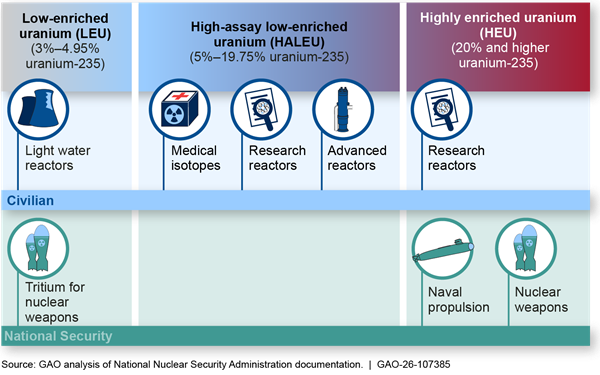
One of the central issues is the difference between obligated and unobligated uranium. Obligated uranium is required to be used for non-defense purposes only, such as the production of medical isotopes and operation of reactors for providing electricity. Unobligated enriched uranium can be used for defense purposes, such as powering reactors on submarines and aircraft carriers, and for nuclear weapons. Uranium can only be considered unobligated if it is mined, milled, converted, enriched, and fabricated all within the United States, utilizing U.S.-owned and originated equipment. With the country unable to produce unobligated enriched uranium, the NNSA developed a few plans over the past decade to restore the lost capability.
Don’t forget to subscribe for future nuclear industry updates!!!
The Government Accountability Office (GAO) is an independent/nonpartisan agency that serves as a sort of spending watchdog for Congress. They recently reviewed the DOE’s/NNSA’s plans for the uranium enrichment industry, grouped mainly within four topics:
The status of the current supply
The status of current and future demand
The current and future delta between the two
The plan to close the gap
I copied and pasted the headers and sub-headers from the report (link: https://www.gao.gov/products/gao-26-107385) and provided some cliff notes for the major takeaways in each section. Even though the report is pretty long at just over 80 pages, I strongly encourage anyone that has the time to actually read it front to back, as there is a significant amount of data and historical content included in the extensive report.
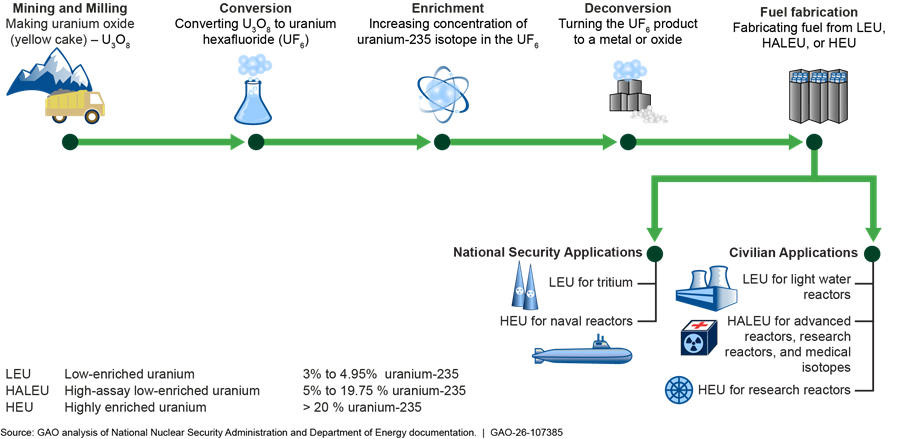
Enriched Uranium Production Stages
Describes how the fuel chain works
Briefly describes the difference between the large centrifuge design of Centrus and the small centrifuge design from the lab at ORNL
Nuclear Energy Trends
Notes about how the demand for nuclear energy is anticipated to go up in the future
U.S. Agencies Involved in Managing Uranium
Describes the role of the NNSA, DOE-NE, DOD and the NRC
Legislative Requirements and Executive Orders Supporting Domestic Development of Enriched Uranium
Summary of the legislative acts, laws and executive orders over the past ten years related to nuclear energy and weapons
NNSA and DOE Program Management
No additional notes
NNSA Has Sufficient Enriched Uranium Supplies to Meet National Security Needs Until the Early 2040s
GAO agrees that the NNSA has enough unobligated LEU and HEU to meet needs until early 2040s
LEU needs will be met by down blending HEU
HEU needs are met by a declaration in 2005 for 200 metric tons of uranium (MTU) of HEU that were excess
160 MTU for the Navy, 20 MTU for research reactors and isotopes, and 20 MTU for down blending to LEU
For the Navy, needs are projected to be met through the 2050s
One of the biggest risk factors for the “good until” assumptions is whether or not the reactors under development with the DOW will be required to have unobligated fuel
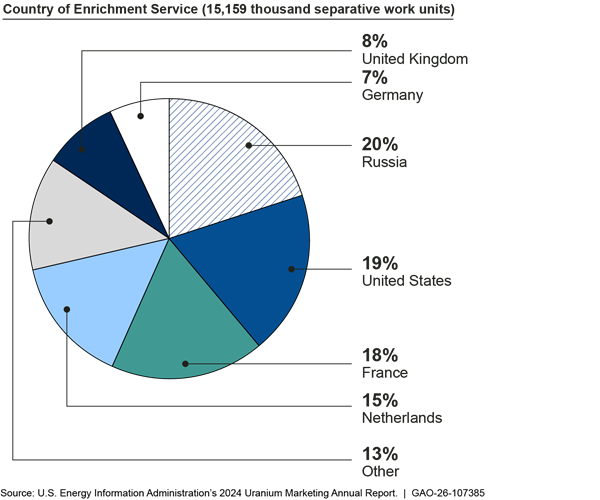
Estimates of Commercial Reactor Demands for LEU Are Generally Well-Established and Expected to Rise, but Near-Term Supply May Be Constrained by a Ban on Importing Russian Uranium
Existing commercial fleet is 96 large reactors requiring about 2,000 MTU of LEU per year, translating to approximately 15 million SWU per year
Studies are showing we are unlikely to be able to fill the Russian supply gap by 2028
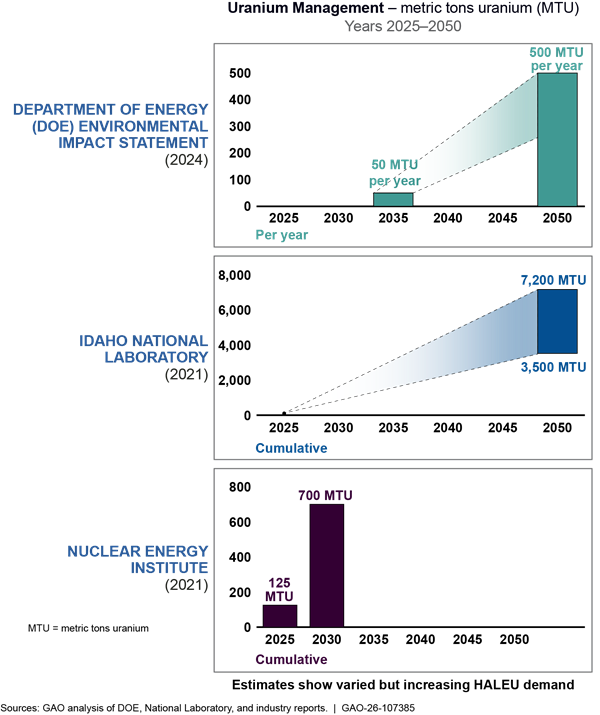
Demand Estimates for HALEU Vary but Are Generally Increasing and Projected Near-Term Supply Is Likely Insufficient to Meet Those Demands
Compares some studies and projections of the anticipated demand signal for HALEU to highlight the inconsistent estimates
It is anticipated that the DOE will likely not be able to provide the companies that have asked for HALEU with all of the fuel that they are requesting
21.2 MTU of HALEU will be available by 2028, and a total of 23.4 MTU will be available by the end of 2030
Demand from the companies that signed up for the HALEU availability program is anticipated to exceed what will be available. However, there is also the possibility that all the companies requesting fuel will not reach this stage where they’re ready to receive it, which might balance the equation
NNSA Has Developed Plans for Its Program to Meet Enriched Uranium Needs for National Security Missions
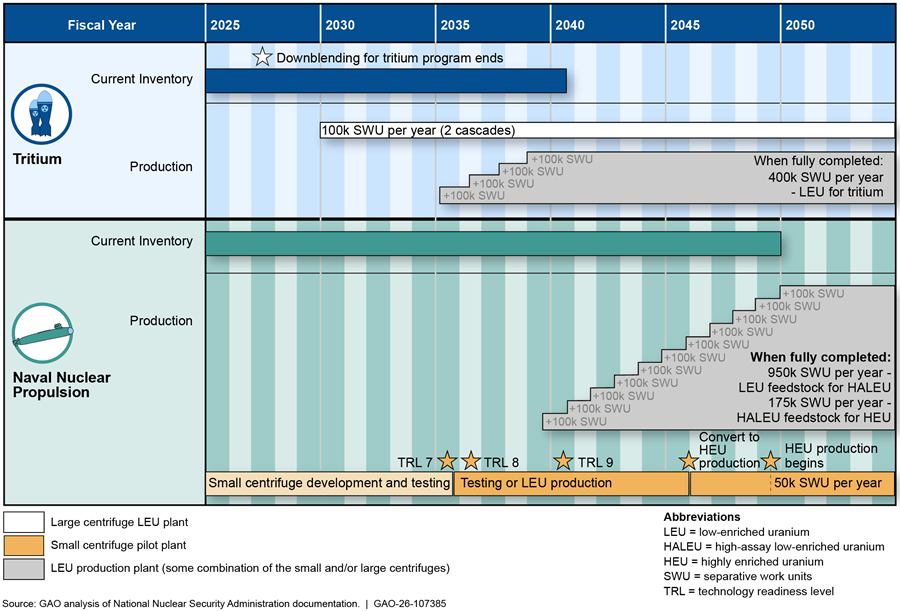
There is a four-pronged approach in place for how the NNSA will supply unobligated enriched uranium to meet national security needs, with 1.7 million SWU per year by the 2050s to meet the mission
Method 1: using current inventory to meet needs
down blending is ongoing and is expected to be completed by 2027, by which time they anticipate having a sufficient LEU inventory to supply the TVA reactors until the early 2040s for tritium production
Method 2: Deploying the large centrifuge technology
provides some context for the plan of utilizing centrifuges produced by Centrus at the Piketon facility
NNSA’s goal is to deploy one or two cascades at the facility consisting of 120 centrifuges each to partially meet the LEU goal, each cascade should produce 50,000 SWU per year
Method 3: Developing and deploying the small centrifuge technology
NNSA is planning to continue development of the smaller centrifuge design at ORNL and deploy the technology at a pilot plant in Tennessee
may produce LEU initially, but goal is to produce HEU
Anticipate NRC license for construction in 2031, with limited operations beginning in 2035
HEU enrichment beginning around 2049 with a capacity of 50,000 SWU per year
Method 4: Developing a Large-Scale Unobligated Enrichment Capability
this is the NNSA plan for the majority of SWU needed
this would be to produce LEU as feed stock for enrichment to HALEU, which would then serve as feed stock to produce HEU at the BWXT plant
would include an additional 400,000 SWU per year for Tritium LEU
goal would be 1.5 million SWU per year, starting in the 2050s
NNSA is taking the path of developing a new supply of unobligated enriched Uranium through commercial acquisitions instead of conducting capital acquisitions
NNSA Has Developed a Long-Term Cost Estimate for National Security Enrichment but Its Enriched Uranium Management Plan Does Not Include Required Cost Information
The four-part plan will require about $36.8 billion through 2052 and $140 billion through 2105
NNSA’s Program Planning and Implementation Plans Substantially or Partially Met Most Best Practices for Program Management
No additional notes
DOE Plans to Meet Some Near-Term HALEU Needs Using Downblended Material and Limited HALEU Production
Under the HALEU Availability program, DOE established the HALEU Consortium and, after receiving requests for fuel from 15 companies, the DOE conditionally committed to allocating fuel to eight of them
DOE may not be able to meet the demand from the eight companies
The limited HALEU production so far has been through the pilot program with Centrus with 0.9 MTU produced so far and on track for a total of 1.8 MTU this year
DOE’s Plans to Support Commercial HALEU Production Have Shifted from Incentivizing Companies to Enrich Uranium to Funding Companies to Build Enrichment Capacity
Report highlights the chicken-and-egg dilemma with building out HALEU capacity with no current significant demand
DOE has shifted from incentivizing expanding capacity by purchasing the produced HALEU to instead awarding funds directly to companies to build capacity
previous plan was to buy enriched uranium and then sell it back to the market as demand materialized with a goal of incentivizing production of at least 25 MTU of HALEU per year
DOE then shifted in August 2025 to awarding contracts directly to companies for task orders to build enrichment capacity
Current task orders include 1 MTU of enriched uranium being provided to the DOE for the HALEU Availability Program
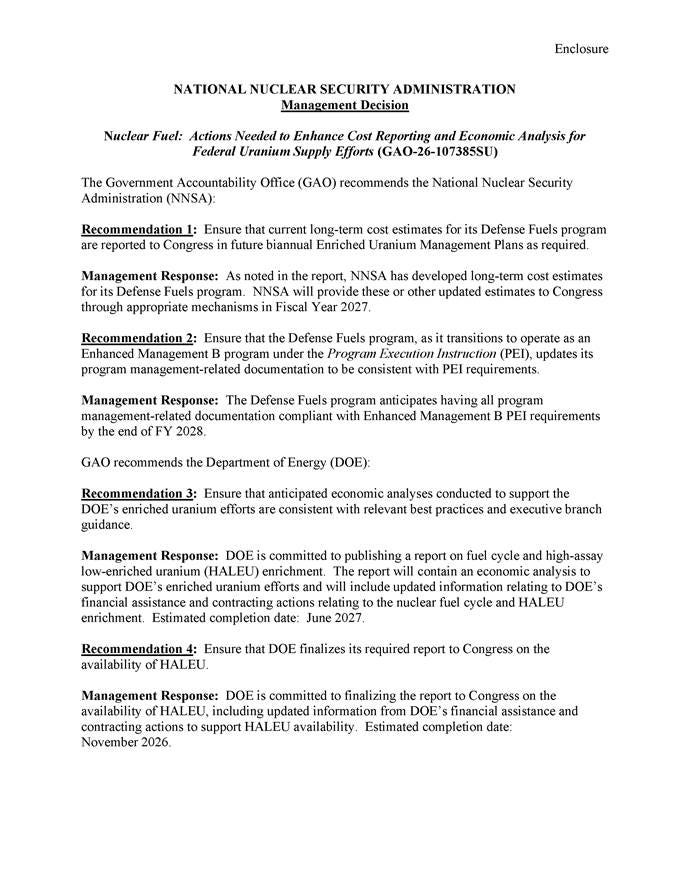
DOE issued a formal comment to the GAO report saying a report to Congress on the availability of HALEU will be completed in November 2026
DOE Is Also Supporting Increases in Domestic LEU Enrichment Capacity
Highlights the $900 million to Orano for LEU capacity
DOE’s goal is to incentivize 100 MTU of LEU production per year, which would only account for one quarter of the 400 MTU per year from Russia
DOE Has Not Conducted an Economic Analysis of How Its Efforts to Support the Expansion of Enrichment Capacity Could Impact the Enriched Uranium Supply Market
DOE does not currently have any published analysis showing how its current actions to incentivize capacity expansion will actually play out
DOE has issued a formal response to this comment. They intend to publish a report on the fuel cycle and HALEU enrichment, and it will contain an economic analysis of their department’s efforts, with an estimated completion date of June 2027
DOE’s Office of Nuclear Energy Has Not Finalized Key Internal Program Management-Related Documents nor Completed a Required Plan on Its Efforts to Support HALEU Availability
No additional notes
Don’t forget to subscribe for future nuclear industry updates!!!
NNSA Is Taking Steps to Mitigate Some Risks to Supplying Enriched Uranium for National Security
Concern for complexity of the larger centrifuges and cost to maintain
Large centrifuge assessed at TRL 8
Small centrifuge assessed at TRL 4
BWXT plant designed to get the small centrifuge to TRL 6
Domestic manufacturing capacity may be insufficient to produce the number of centrifuges required
A lack of domestic uranium mining is also noted as a potential problem
DOE Is Taking Steps to Mitigate Risks to Its Efforts to Support Commercial Enrichment
Report highlights how the HALEU market is still underdeveloped and how the buildup of that market will actually further constrain the LEU market because of how much feedstock is required to produce HALEU
NNSA and DOE Share Some Risks Relevant to Enriched Uranium Supply for Both National Security and Commercial Purposes that They Are Taking Some Steps to Address
Concerns exist about the lack of conversion and de-conversion capacity
Even though there’s been a lot of reductions in some of the timelines for licensing, apparently industry representatives and the NNSA are still unsure of how long NRC licensing will take for new fuel facilities
Significant concerns exist about workforce availability
Comments
Nothing yet. Say the first thing.
Sign in to join the conversation.