
There’s been plenty to talk about in the nuclear industry, but recent weeks have seen an impressive amount of activity at the federal level. Much progress has been made in the reactor and fuel pilot programs, civilian nuclear energy cooperation agreements have been signed and subsequently modified, and one of the most significant federal programs moves one step closer to organizing city-scale nuclear campuses.
Don’t forget to subscribe for future nuclear industry updates!!!
The DOE Reactor Pilot Program recently celebrated three milestone achievements, and the Fuel Line Pilot Program also saw progress.
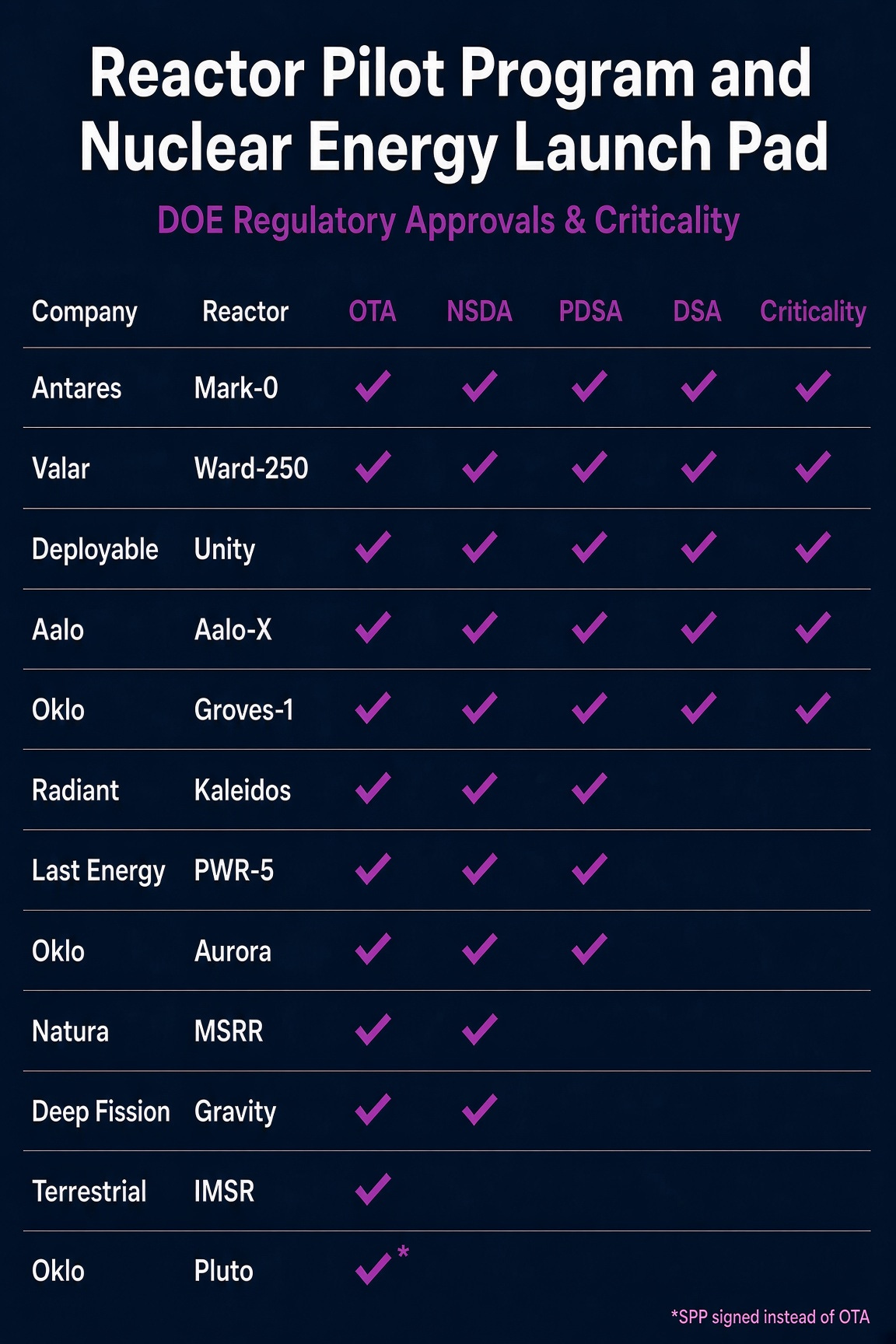
Natura Resources received approval for a Nuclear Safety Design Agreement (NSDA) covering its reactor at Abilene Christian University. Natura’s design is a 1-MWth liquid-fueled molten salt research reactor. The NRC previously issued a construction permit for the university research reactor, and the company eventually shifted over to the DOE regulatory pathway to enjoy potentially faster approvals.
Deep Fission received an NSDA for its Gravity reactor just last week. The company is progressing their pilot project in Kansas, where they will place a pressurized water reactor approximately a mile underground. Deep Fission has drilled a data-acquisition well and had a prototype canister delivered to the site.
Oklo recently celebrated reaching initial criticality on their isotope production reactor in Texas at the Groves site. This reactor stands out from the other four that have achieved initial criticality under the DOE RPP, as it will not be used to generate heat or electricity. It’ll be used to produce unique isotopes for use in various industries, including technology and medical fields.
Oklo has been striving to redeem themselves since the rejection by the NRC for their Aurora reactor design years ago. Their first Aurora reactor is still under construction at Idaho National Labs and is anticipated to achieve initial criticality sometime in 2027 or 2028. Receiving approval from the DOE to start up that reactor design will certainly complete their long road to redemption.
From the significantly less talked-about FLPP, Standard Nuclear received DOE approval for their Preliminary Documented Safety Analysis (PDSA) at two of their TRISO fuel-production facilities: SN-TN in Tennessee and SN-ID in Idaho. Standard says construction is substantially complete. Each facility is initially expected to add up to one metric ton of uranium in annual TRISO capacity, with as much as five metric tons collectively after scaling.
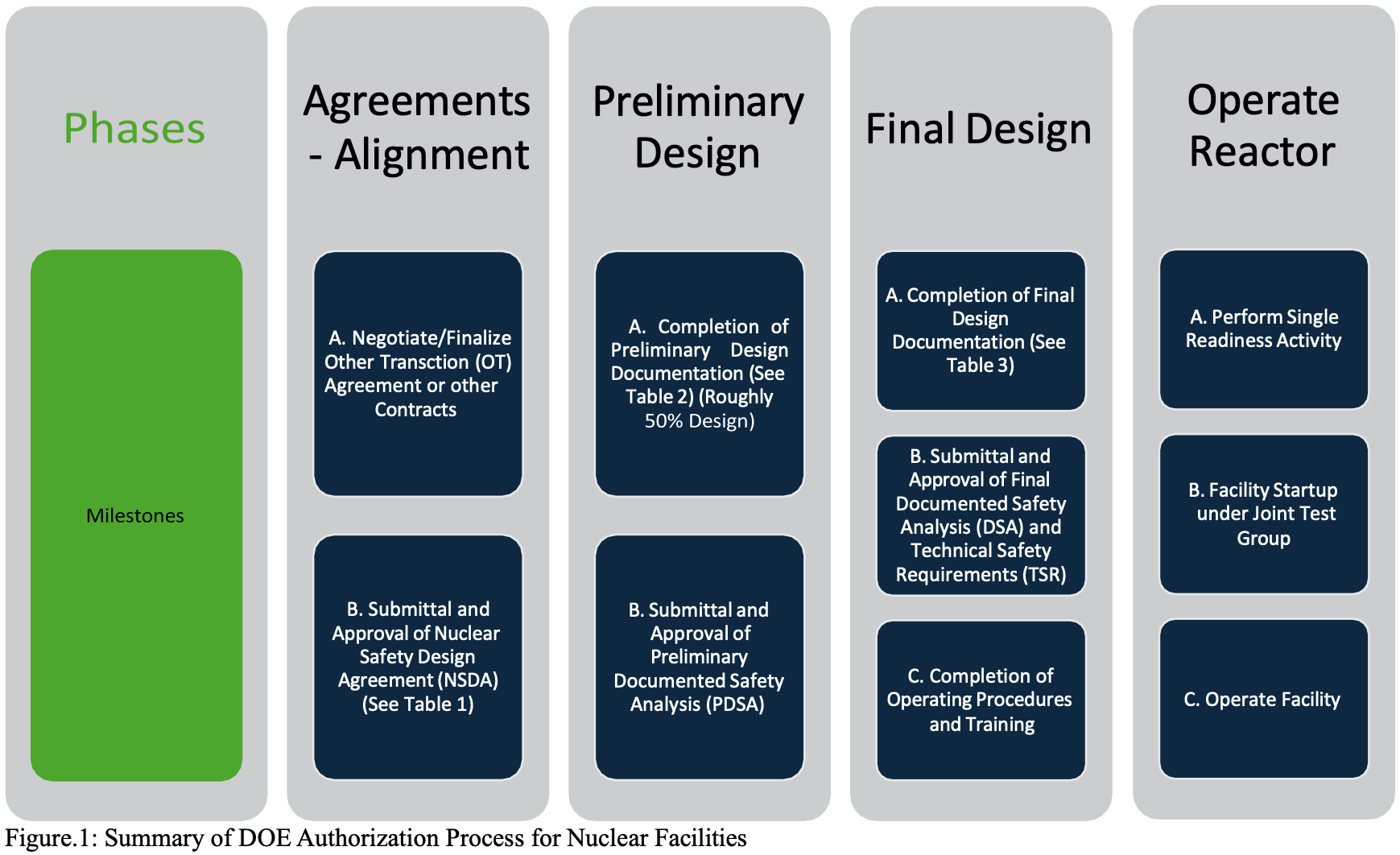
For some more detail on what exactly an NSDA and a PDSA are, here are the excerpts describing the different milestones from DOE-STD-1271-2025:
The purpose of the Nuclear Safety Design Agreement (NSDA) is to gain agreement on design requirements, safety analysis approach, regulatory engagement process, applicable regulatory requirements, and to identify the key safety decisions for the design.
The purpose of a Preliminary Documented Safety Analysis (PDSA) is to provide a comprehensive and preliminary assessment of the safety aspects of a nuclear facility or activity. The Contractor submits the PDSA to DOE for review and approval once the necessary analyses and system design detail has been performed (nominally the 50% design completion mark) and is provided in the format outlined in the NSDA. The significance of the PDSA is that it represents the first formal opportunity to look at the proposed design, safety case and associated SSC performance and classification requirements in an integrated manner.
The DOE conditionally committed HALEU to NASA and Radiant Industries, with NASA’s allocation intended to support the SR-1 Freedom mission to Mars and Radiant’s allocation to support a microreactor deployment at the Buckley Space Force Base in Colorado.
The first round of HALEU recipients was for X-energy’s TRISO-X, Kairos Power, Radiant, Westinghouse, and TerraPower. The second round, from about a year ago, was for Antares, Standard Nuclear, and Natura Resources.
The US and Saudi Arabia signed a Section 123 agreement in an effort to cooperate on the development of commercial nuclear power in Saudi Arabia. Unfortunately, as soon as the agreement was signed, there was significant pushback on some of the terms of the agreement, resulting in confusion as to its current status.
A Section 123 agreement is designed to allow the United States to help a foreign country stand up and operate a commercial nuclear industry. Without the agreement in place, there is no way for a company like Westinghouse to legally export nuclear technology, like an AP1000 reactor design or components, to that country.
On the surface, it sounds like the kind of thing that only the Sierra Club or Beyond Nuclear would be against. The US and its companies enjoy the profits of exports and a deeper relationship with the foreign country, and that foreign country enjoys enhanced national energy security and insulation from fluctuations of fuel prices for other sources of energy.
So why did this agreement receive so much backlash while other Section 123 agreements enjoyed wide bipartisan support? The problem is the enrichment of uranium.
As the day went on after the announcement was initially made of the agreement being signed, people became aware that the agreement included the potential for American enrichment technology to be exported to Saudi Arabia and uranium to then be enriched within the country. For most people, this is where things crossed a line in terms of concerns for nuclear proliferation.
The preference for the structure of a 123 agreement (for those concerned about nuclear proliferation risk) is to require the “gold standard”. This means that the country signing the agreement also pledges to not enrich uranium in the country. Instead, that country would purchase enriched uranium from the US and import the product, usually as fabricated fuel assemblies. In this structure, there is an extremely low risk for proliferation due to the country importing the product not holding the technology required to weaponize the enriched uranium.
In the 123 agreement signed between the US and Saudi Arabia, the opposite structure was put in. The two countries agreed to potentially perform an extensive study, which could be followed by the construction of an enrichment facility within Saudi Arabia. This means the enrichment technology required for raising the enrichment level of uranium would be located in Saudi Arabia instead of the US. This is where non-proliferation folks draw the line.
There was significant backlash across most of the places we could find commentary on the agreement. The agreement’s status was also thrown into disarray as President Trump made additional requirements for the agreement to put in place as the days went on, and he made statements on social media that no enrichment will occur in Saudi Arabia, contrary to the signed agreement.
As suddenly as the announcement was made, any news coverage regarding its status disappeared just as fast. There remains much confusion as to the current status of the agreement, considering it was signed by representatives from both countries.
The DOE has selected Idaho, Louisiana, Oklahoma, Tennessee and Utah as potential hosts for its Nuclear Lifecycle Innovation Campuses. The program is posturing itself as the biggest initiative in the nuclear renaissance to date.
The DOE and its proponents have stated the intent of the program is to house within one location the entire nuclear value chain, and then some. Each campus could potentially include:
mining
milling
enrichment
fuel fabrication
used-fuel reprocessing
waste disposition
advanced manufacturing
reactors
data centers
DOE says the proposed campuses could attract as much as $50 billion in capital investment, produce up to $10 billion in state and local tax revenue and create nearly 25,000 jobs.
The five states included in the announcements are contenders, not awardees. Secretary Wright signed MOUs allowing DOE and the states to continue exploring potential campuses. The final hosting agreements and sites, financing structures and participating companies remain to be determined.
Idaho and Tennessee were obvious choices given their historical and ongoing significance with the nuclear industry and their nuclear energy-focused national labs. Utah has been rather aggressive with some of their energy generation initiatives, primarily organized under Operation Gigawatt.
Louisiana seemed like a weird choice at first, but once you consider some of their manufacturing capabilities as well as the meaningful capacity of their ports, they could be a significant asset on the manufacturing side of the industry.
Oklahoma is definitely the odd ball. The state doesn’t have very much going on with the nuclear renaissance, but may just be willing enough to get involved that the DOE decided to include them in the final five. A state’s willingness to handle and receive used nuclear fuel and nuclear waste may have been a significant factor in choosing the finalists.
One of the pleasant side effects of the NLIC program is that it separated the pro-nuclear states from pro-ish nuclear states. There are an unfortunate number of states that are eager to enjoy the benefits of nuclear energy but are just as equally unwilling to deal with the responsibility of handling and storing the used fuel.
One of the most frustrating examples continues to be New Mexico, a state that currently hosts the only commercial-scale enrichment facility in the US. New Mexico famously has fought Holtec on the establishment of a used fuel storage facility within the state. Holtec actually won in the courts but ultimately abandoned the project as they saw that they would have to continue to fight opposition within the state at all levels for the foreseeable future. The state’s leadership literally bullied the company until they finally quit from exhaustion.
Comments
Nothing yet. Say the first thing.
Sign in to join the conversation.