
New Renaissance Notes: a monthly newsletter where we share insights about the intersection of culture, creativity and technology. We include our updates from New Renaissance Ventures - Europe’s first venture fund dedicated to the Creative and Cultural Industries.
If you haven’t subscribed yet you can join our journey here:
See here for our special previous edition ‘It’s time to let go and trust AI’
Exciting updates are rolling in from our portfolio companies:
nunu.ai launched their public beta, open for everyone to try. Nunu is automating these tedious workflows in game testing and have onboarded some of the biggest enterprises in gaming and beyond.
Mozart AI launched Studio 1.0, a Generative Audio Workstation for musicians that brings AI-generative capabilities and studio-level control in your browser.
Zibra AI launched ZibraGDS (Geometry Data Structure) in their public beta, now open for everyone. ZibraGDS is a high-performance, cinematic-quality, animated geometry compression and real-time rendering technology.
Later this month, Severin takes the stage at the Panathēnea Festival in Athens, an event quickly becoming the “who’s who” of the European tech scene. He will speak alongside the founders of AI giants ElevenLabs and Runway, leadership from Deel, and partners from world-class venture firms including Sequoia, Index, and Balderton.
We’ll also be at SXSW London during the first week of June and in Berlin a week later for SuperVenture. Reach out if you’ll be in town!
A child who has never struggled to draw something has never learned to see.
That’s not nostalgia. It’s not a complaint about screens or a pitch for pencils. It’s a genuinely unsettling thing to sit with as AI creative tools move from the studio into the classroom and homes, into the instincts of an entire generation.
We invest in AI creativity tools. We believe in them.
The tools are extraordinary. But so are their consequences…
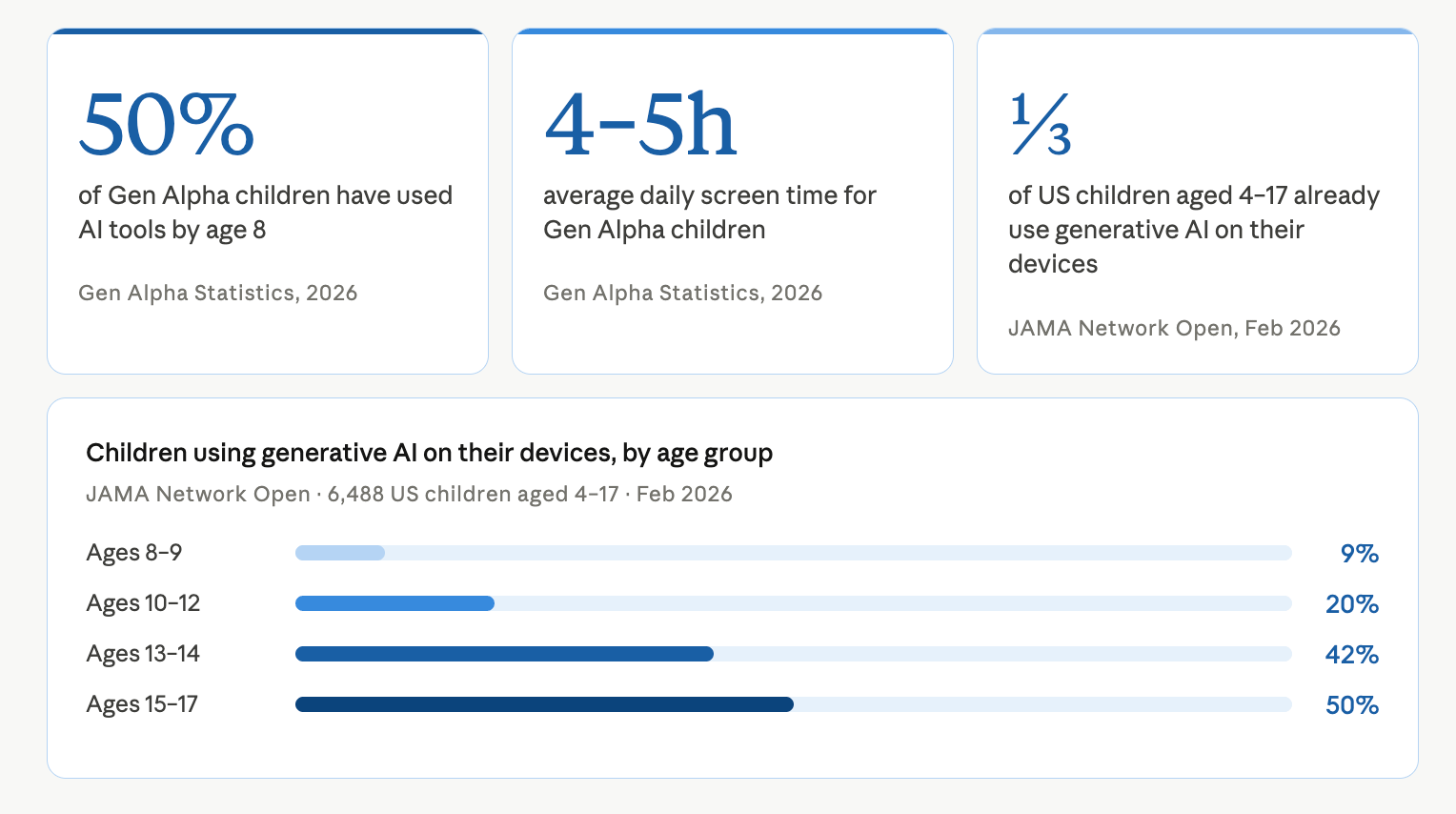
About 50% of Gen Alpha children have used AI tools by age 8. Let that settle for a second.
A study published in JAMA Network Open in February 2026, tracking 6,488 US children aged 4 to 17, found that nearly a third were already using generative AI apps on their devices. These are primary school children.
Meanwhile, Gen Alpha children spend an average of 4 to 5 hours daily on screens (more than most adults spend exercising, reading, or in face-to-face conversation across an entire week).
And teacher use of AI in schools has jumped from 34% to 61% in a single year.
When a 40-year-old uses AI to generate a mood board, write a first draft, or score a short film, something relatively benign is happening.
They’re offloading a task they already know how to do. The judgment is theirs. The taste is theirs. The machine is fast and they are steering.
When a 10-year-old does the same thing, something categorically different is happening. They’re not offloading a skill… because they never learned the skill in the first place.
This is the asymmetry that the current conversation about AI and creativity almost entirely ignores.
Adults who offload thinking to AI lose capacity they once built. Children may never build it at all. For children still forming the cognitive skills for evaluating the world, the effect will not be temporary, it will have a foundational impact on their thinking.
The Brookings Institution spent a year interviewing and running focus groups with more than 500 educators, parents, and students across 50 countries and reviewing more than 400 studies. Their conclusion, published in January 2026, was stark: AI poses profound risks to children’s social and intellectual development.
AI’s ease of use, combined with human tendencies toward shortcuts and the transactional nature of schooling, drives cognitive offloading and dependency. This fundamentally disturbs young people’s learning, particularly their mastery of foundational knowledge and critical thinking.
“It’s easy. You don’t need to use your brain.” - Student
That sentence is worth reading twice. The person saying it was nine years old.
Here’s the part that should keep anyone in the creative industries up at night.
Every major AI image model, music generator, and creative writing tool is trained on the same corpus of human expression. The same aesthetic patterns. The same cultural references. The same statistical definition of what a good composition looks like, what a compelling narrative arc feels like, what music should sound like in a given genre.
When adults use these tools, they push back. They have taste. They get frustrated when the output is generic because they can feel the genericness.
When children grow up inside these tools and form their creative instincts through them rather than before them, they may not develop the ability to feel that friction at all.
The model’s statistical biases become the student’s default framing. The model’s reasoning structure becomes the student’s reasoning structure. LLMs homogenise not just language but also perspective and reasoning strategies.
For an adult, that produces generic output.
For a child who never formed independent creative reasoning, generic becomes something far more serious. It becomes their baseline and their sense of what creativity is supposed to feel like.
The future? A generation of filmmakers, musicians, designers, and writers shaped by the same statistical centre of what creativity looks like. That’s not a creativity boom. That’s a creativity monoculture.
And it compounds the access problem that already exists. 52% of children in private schools report using generative AI, compared to just 18% in state schools. The children with the richest access to AI creative tools are also the children with the richest access to everything else (tutors, instruments, travel, cultural experience).
These are the very things that give a child enough of an inner world to push back against a model’s defaults. The children most at risk of having their imagination formed by AI rather than before it are the ones who have the least to counterbalance it with.
We don’t think the answer is to keep children away from these tools. That ship has sailed, and frankly we wouldn’t want it to.
The research is more nuanced than the headlines suggest. When researchers isolate active and creative screen use e.g coding, game design, video production, digital art - the outcomes flip. Children who spent time on creative digital activities showed higher scores on spatial reasoning, creative problem-solving, and persistence compared to peers with equivalent total screen time but lower creative use.
The distinction that matters is not whether a child uses AI.
It’s whether the child arrives at the tool with something to say. The tools that are genuinely working keep the child in the driver’s seat. AI as collaborator, not author (as we’ve said a million times by now). They amplify what’s already there rather than substitute for what hasn’t yet formed.
“AI makes me happy because I feel like I can liberate my creativity; it allows me to express ideas that would otherwise be stuck inside of me.” - A Brazilian teenager featured in UNICEF
That’s the version of this we’re investing toward. A child with ideas they couldn’t otherwise realise, not a child outsourcing the ideas themselves.
The issue isn’t screens. It’s what screens replaced.
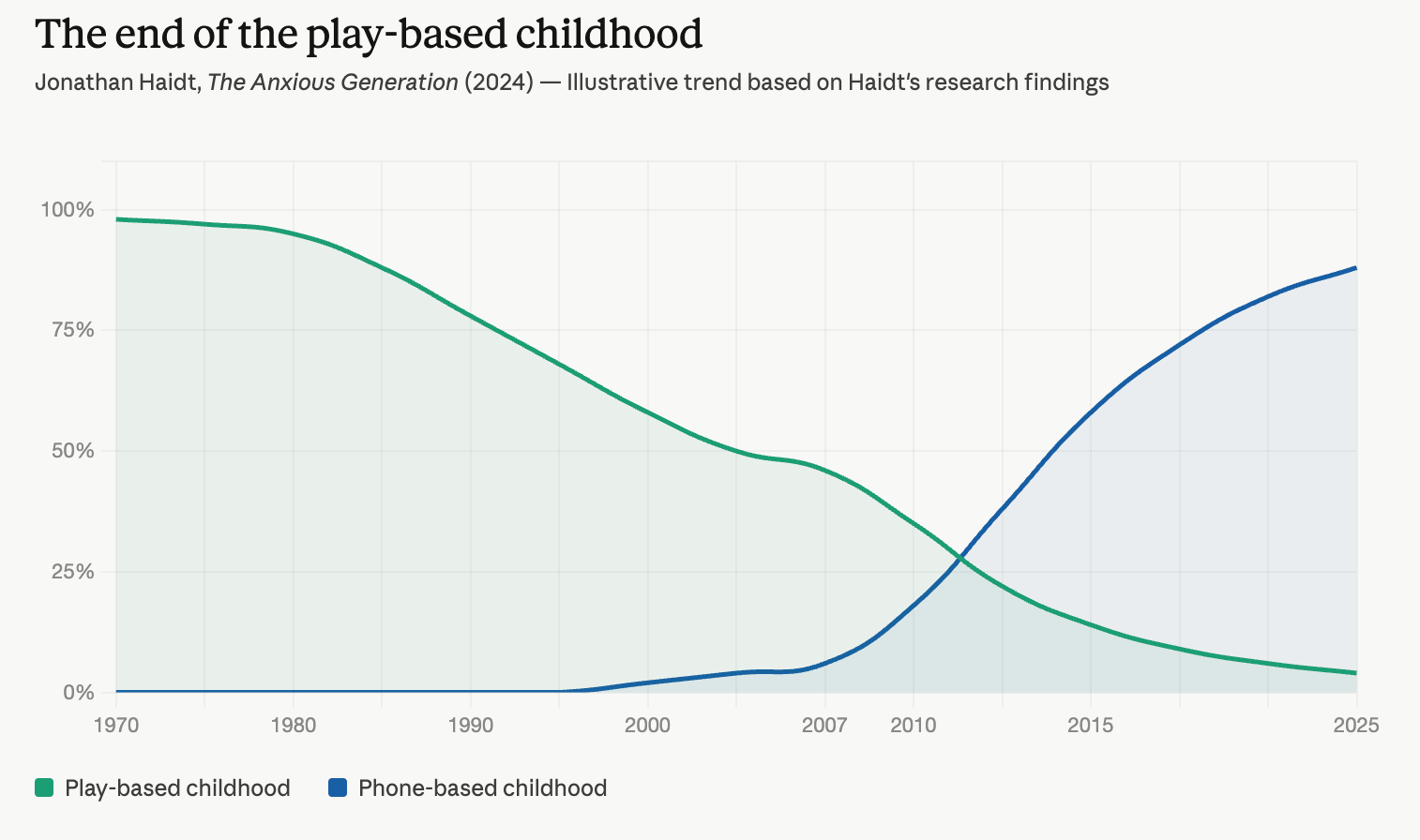
Social psychologist Jonathan Haidt’s argument isn’t anti-technology. He reasons that the play-based childhood, with its boredom, friction and unstructured invention, was colonised by platforms designed to capture attention rather than spark it.
The phone-based childhood didn’t just change what children do. It changed who they are while doing it: from author to audience.
That distinction is everything. And it’s what draws us to the companies building with that in mind.
This is part of what drew us to Nodi.
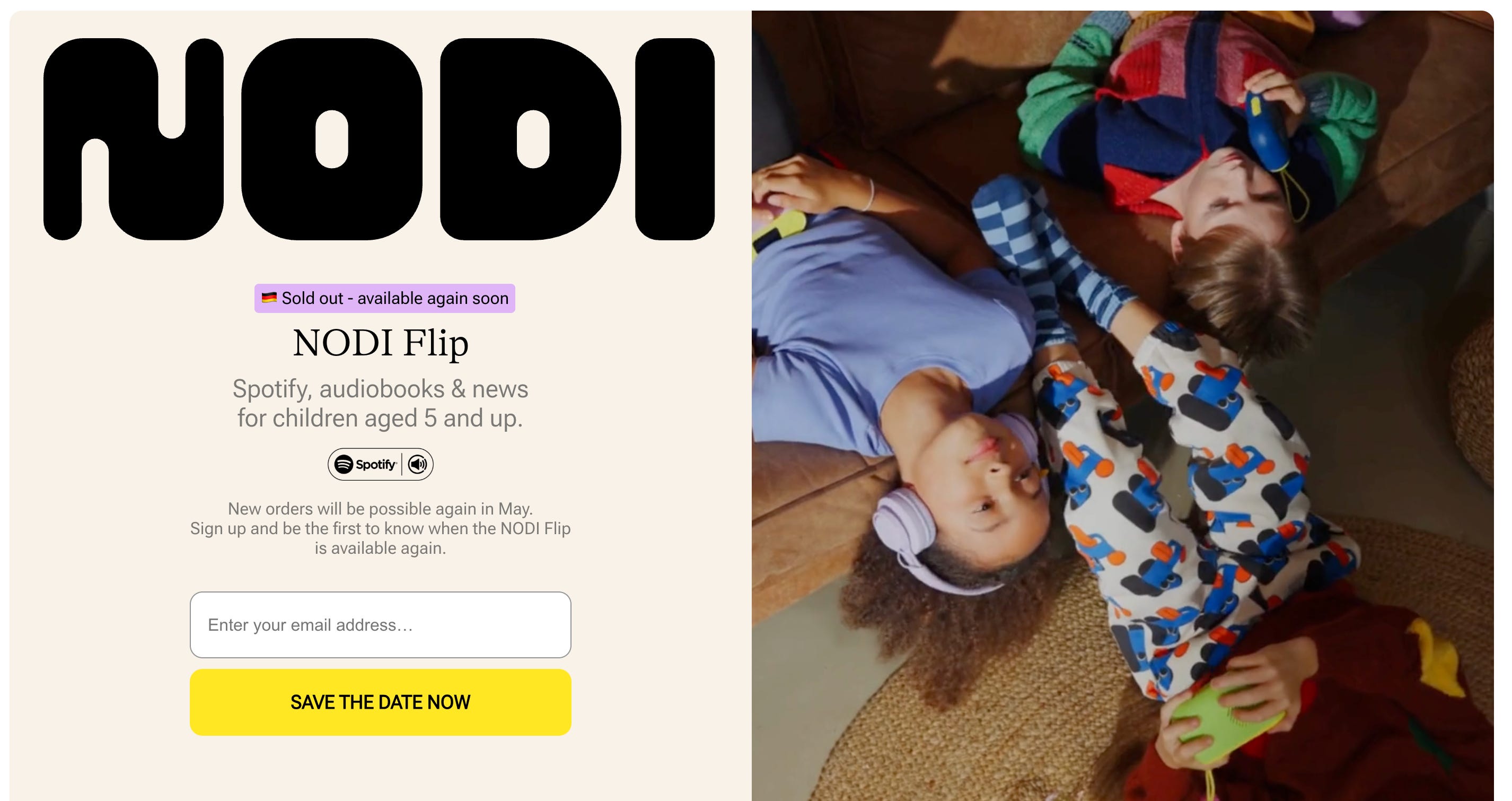
Nodi builds screen-free devices for children aged 5 to 12; not as a rejection of technology, but as a considered argument about what the right technology looks like at the right developmental moment. No browser, no video, no infinite scroll. Instead: audiobooks, music, and voice messages with parent-approved contacts. Covered by TechCrunch earlier this year, it’s one of a growing category of intentionally constrained tools that put the child in control of the experience rather than the algorithm.
They’re not alone. Yoto lets children navigate their own audio (stories, music, learning) without a screen, without the internet, without anything trying to keep them hooked.
Tonies goes further: children activate the speaker by physically placing a figurine on top, and with Creative-Tonies they can record their own stories and songs. Cosmo offers a first phone that connects kids to approved contacts and nothing else. No social media, no games, no scroll.
Then there’s the AI-native end of the spectrum. Miko positions itself as a kid-safe AI companion. Features include generative conversation, learning support, a collaborator that responds to the child rather than directing them. Loona takes it further still: a robotic pet that children interact with physically, blending play and technology in ways that keep the child as the one doing the playing.
And then there’s Moxie, the AI-powered robot companion for children that shut down in 2024. Whether it was too early, too expensive, or the wrong thesis entirely is worth asking. Our instinct: the product itself was genuinely thoughtful. But a robot designed to be a child’s emotional companion may have been solving for connection in a way that assumed the absence of it.
The pattern across the ones that work is consistent.
The best tools for children aren’t the most capable ones. They’re the ones that leave the most space for the child.
The question the creative industries need to start asking isn’t whether children should have access to AI creative tools.
It’s what we want them to be able to do without one.
Draw something imperfect and know why they like it anyway. Hear a piece of music and feel something they can’t quite name. Write a sentence that sounds like nobody else, because they spent long enough being nobody else before the machine arrived.
Taste isn’t downloaded. Voice isn’t generated. The weird kid with the strange vision, the one who would have grown up to make something genuinely new, needs to have been left alone with their strangeness long enough for it to become something.
We have every reason to believe AI won’t kill creativity of our current generation of children.
💙 It’s exciting to think we are handing children an infinitely capable creative collaborator. We call it opportunity.
Thanks for subscribing to New Renaissance Monthly - please feel free to share this newsletter with anyone you think would appreciate it! We welcome feedback so let us know your thoughts!
If you haven’t subscribed yet you can here:
For more regular updates, insights and resources follow us on Linkedin.
If you missed the past newsletters, you can catch up here.
No posts
Comments
Nothing yet. Say the first thing.
Sign in to join the conversation.