
New Renaissance Notes: a monthly newsletter where we share insights about the intersection of culture, creativity and technology. We include our updates from New Renaissance Ventures - Europe’s first venture fund dedicated to the Creative and Cultural Industries.
If you haven’t subscribed yet you can join our journey here:
See here for our special previous edition ‘Beyond Prompting: The New Stack for Creative Production’

March has been a busy month. We closed two deals (🤫 to be announced soon), gave a keynote on fundraising best practices in Munich, and headed to Berlin to host the new event series “take a trip into [AI x creativity].” Other exciting updates include:
✨ We have a new hire! Sofie joins us as our Operations Lead and will help strengthen the fund’s operations and support the growth of our platform, portfolio and community. Sofie embodies the very essence of the New Renaissance. With a background rooted in the traditional world of arts, she has spent the last several years masterfully bridging that gap into the tech and startup ecosystem. Whether she was navigating the strategic landscape at CzechInvest, immersing herself in the frontier of AI at AGI House, or supporting deep-tech ventures at Tensor Ventures, Sofie has proven that she knows how to build the infrastructure behind big ideas. We are super excited to have you on board.
🌐 Our portfolio company Massive Dynamic joined the first F/ai batch at Station F. 20 AI-native startups handpicked to scale fast, with direct access to Sequoia, OpenAI, Anthropic, Mistral AI, and more.
There’s a frustration that almost every creative working with AI knows but rarely says out loud.
You had a vision. The AI gave you something else. So you prompt again. And again.
You tighten the language, add constraints, chase the image that lives in your head until the whole process feels less like creation and more like an argument you’re slowly losing.
Here’s the uncomfortable question nobody in those conversations seems to ask: what if it’s not the AI’s fault? What if it’s yours?
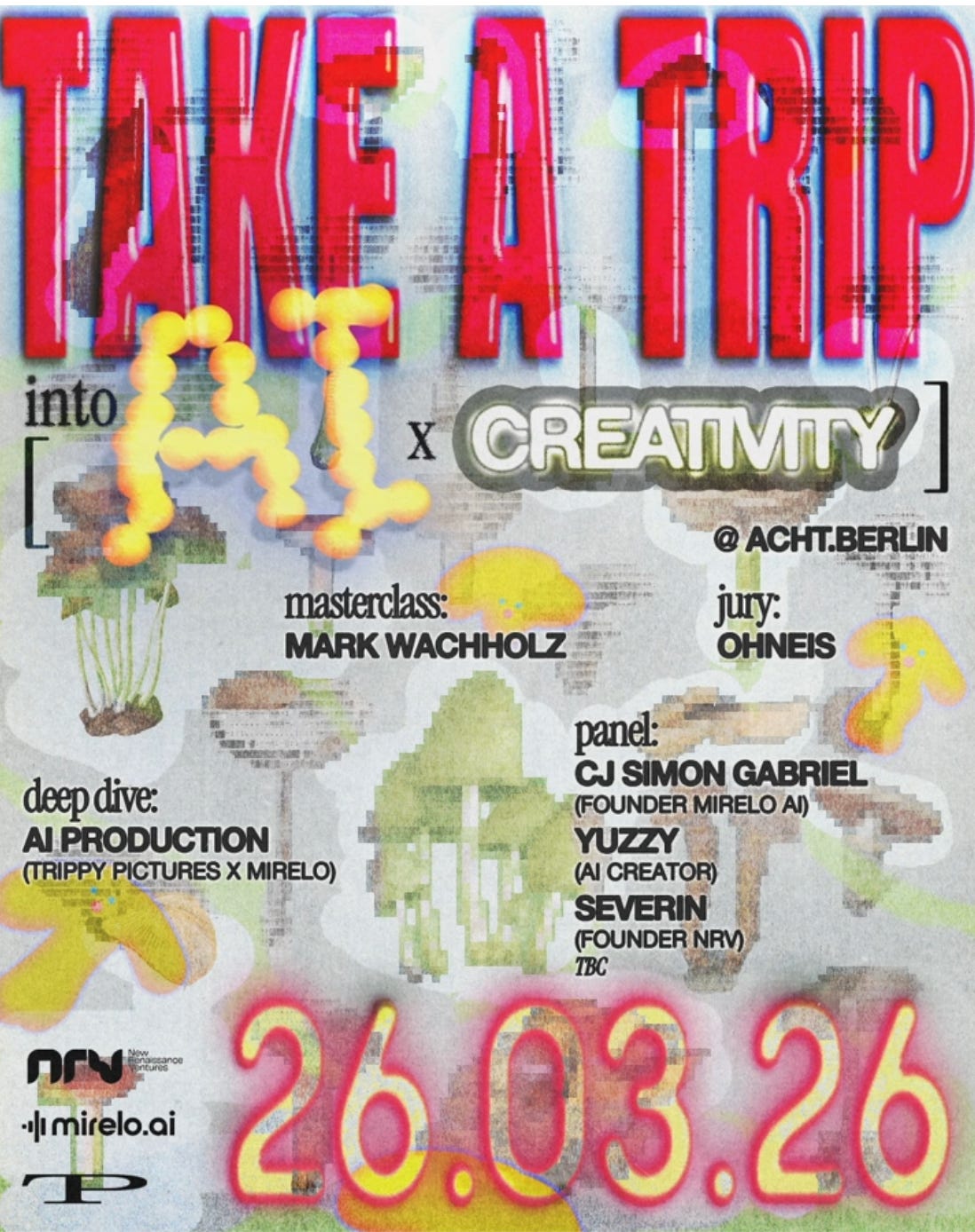
This was one of the core ideas that kept coming up last week when we brought 230+ creators, directors, strategists and founders together at Acht Kino Berlin. An evening co-hosted with Mirelo AI and Trippy Pictures. Part masterclass, part live case study, part conversation that kept going well past when it was supposed to end.
The idea that stuck with us most had nothing to do with a specific model or tool. It was about learning to let go.
There’s a concept in visual art called ‘found art’.
The practice of recognising creative value in something unintended. A rusted door. A shadow falling at a weird angle. Something the world made, not you. The artist’s job isn’t to manufacture it. It’s to notice it, frame it, and say: this.
Working with AI, at its best, is exactly like this.
The most interesting outputs aren’t the ones that precisely match your brief. They’re the ones that surprise you and that you’re curious enough, and confident enough, to actually follow.
The creators doing the most compelling work right now aren’t the ones with the tightest prompts. They’re the ones with the clearest sense of vibe, mood, feeling and the willingness to let the model take them somewhere they didn’t fully plan.
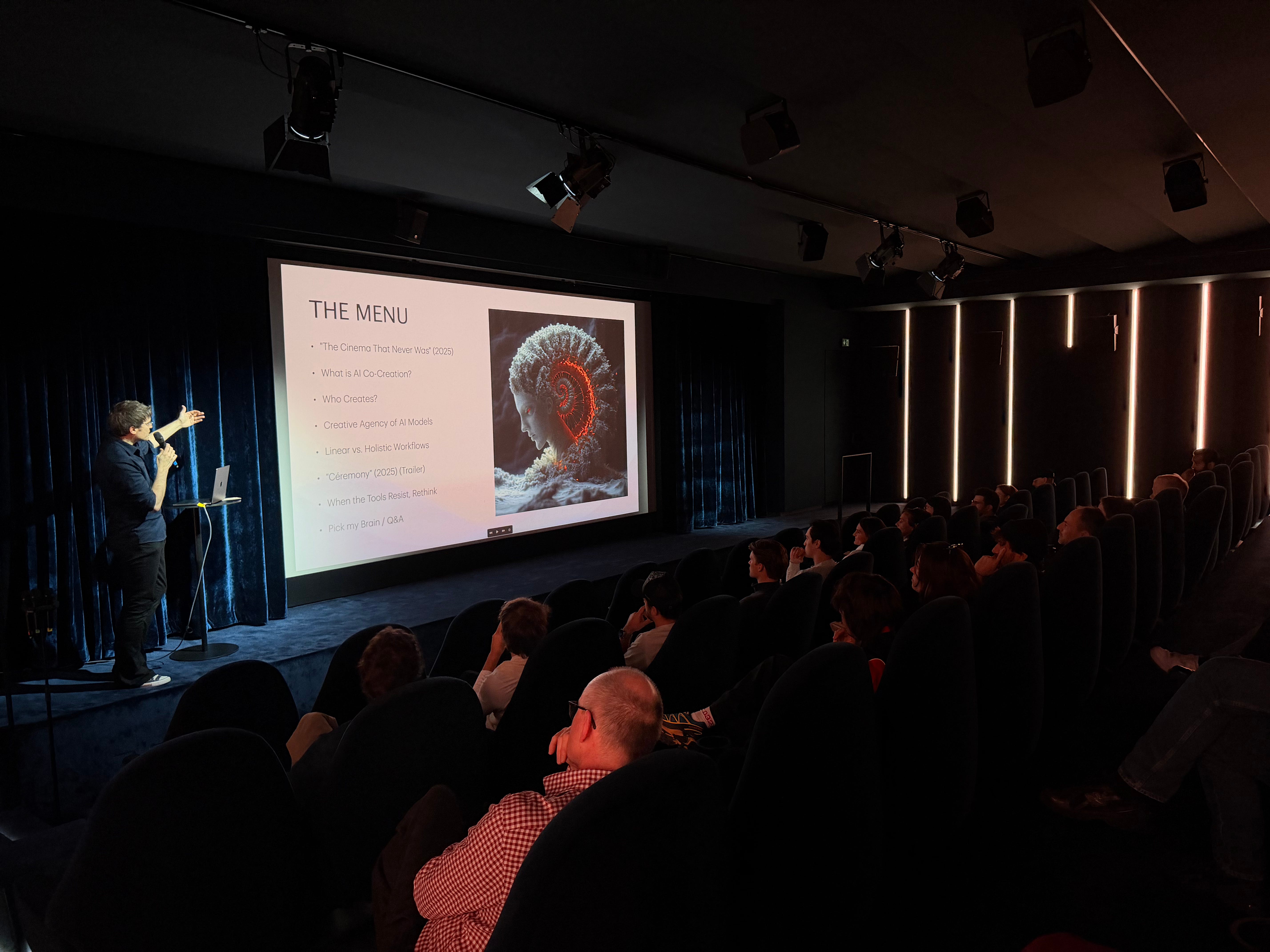
Enter, Mark Wachholz. A Berlin native who spent over twenty years writing novels, computer games and TV shows (including a German-American sci-fi series for NBCUniversal)
He's an award-winning AI filmmaker now, the kind who doesn't just talk about the tools but actually lives inside them. For the evening's masterclass, he brought a very recent, very concrete example: a short film made in under two weeks for the $1,000,000 AI Film Award run by Google and the Billion Follower Summit.
Not his first AI film. Not even close. But the one that best illustrated something he's arrived at through hard experience: adapt to the tools, play with their strengths, and stop fighting their limitations.
Google's video models won't generate children or minors. A lot of filmmakers would hit that wall and go looking for a workaround. Mark turned it into a creative decision and animated those characters instead. The limitation became the aesthetic. That's not a compromise. That's a director making a call. And it's exactly the kind of judgment that no model, however good, is going to make for you.
See his short film below on YouTube…
Plot twist: there is no film without sound.
Mirelo is building the audio layer for all visual content. Upload any video and within seconds their AI generates perfectly synchronised sound for everything happening on screen.
Speaking of people who get AI’s true power instinctively, it’s worth knowing a bit about who they actually are, because the origin story is a good one.
CJ Simon-Gabriel and Florian Wenzel met at AWS Labs as senior AI researchers. Two people who had every reason to keep building the things their field expected them to build.
Instead, they quit big tech and went after a problem almost everyone else had overlooked. While AI was rapidly transforming text, images and video, sound was being left behind. Still labour-intensive, still treated as an afterthought, still something creators spent hours on in stock libraries and manual syncing.
CJ and Florian found that infuriating. Partly because of the technical gap. But also, honestly, because of where they come from.
CJ has a degree in piano, organ and composition from the Conservatoire in Strasbourg and came very close to pursuing music professionally. His reason for building Mirelo is as personal as it gets: what if Mozart had lived longer — what else would he have made?
That question isn’t rhetorical for CJ. It’s a genuine ache. The idea that some of the greatest music in human history was left unwritten because time ran out is what fuels him.
Florian, for his part, plays electric guitar in an electro band in Berlin. These are not people who think about sound as a feature. They think about it the way musicians do: as the thing that makes you feel something.
The company they built just raised $41 million in seed funding co-led by Index Ventures and Andreessen Horowitz. Which is a fairly loud signal that the rest of the world is starting to hear what they’ve been saying.
And yes, we couldn’t help noticing the coincidence. One of our own portfolio companies is called Mozart AI. A London-based AI-powered DAW built to do exactly what CJ dreams about: give every artist the ability to finish what they started, at the speed of inspiration. The name isn’t accidental. Neither is the timing.
‘You Can Never Finish Art. You Can Only Abandon It.’ - Leonardo Da Vinci
For centuries that felt like the lament of a perfectionist who happened to be a genius. Today it reads like the most useful creative philosophy for the AI age we could possibly have stumbled upon.
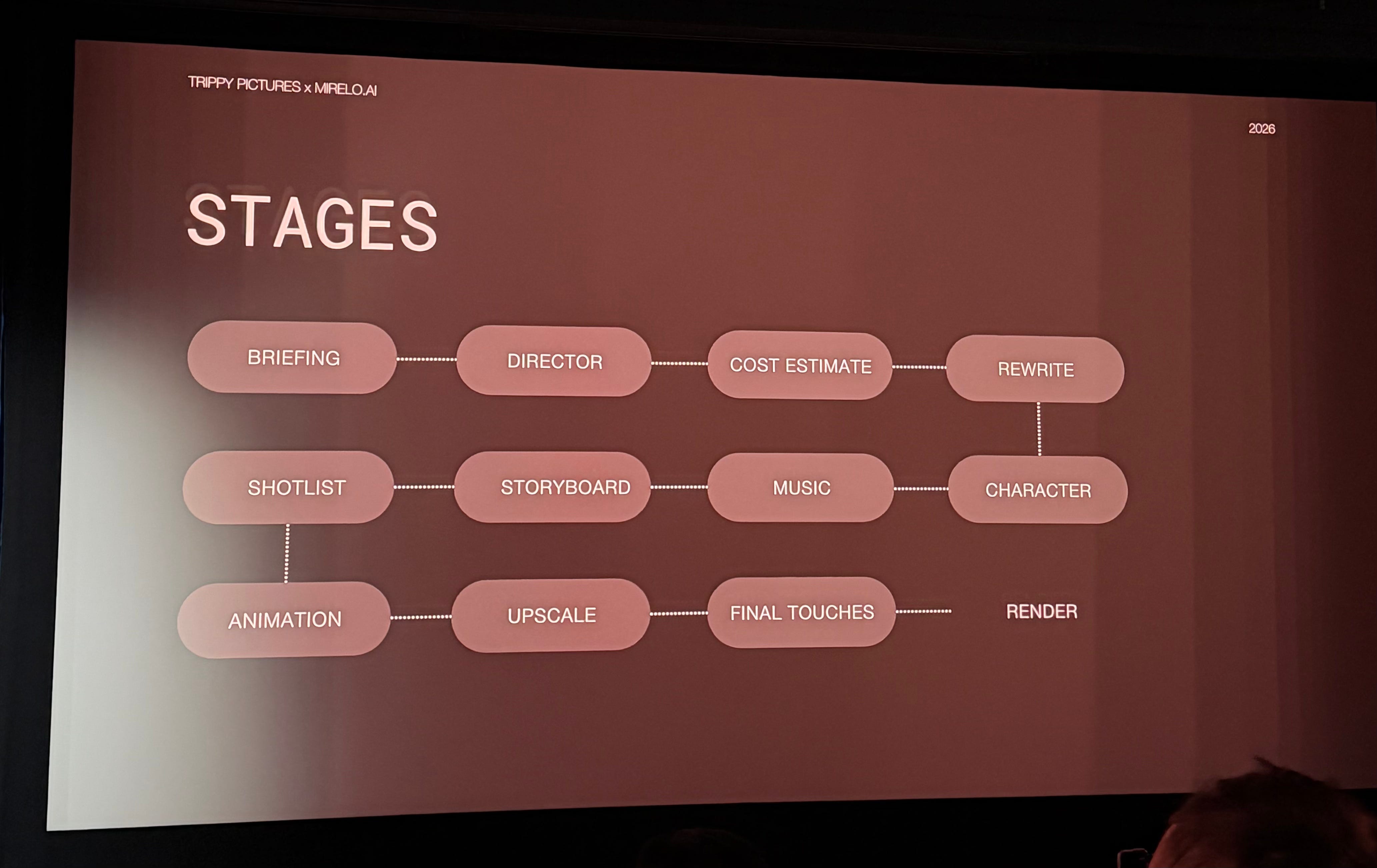
Trippy Pictures put their entire production process on a slide that night. Twelve stages, laid out cleanly across a cinema screen: Briefing. Director. Cost Estimate. Rewrite. Shotlist. Storyboard. Music. Character. Animation. Upscale. Final Touches. Render.
It’s a process that works.
It’s a process that big clients, the Samsungs of the world, know, trust, and frankly insist upon. Every stage exists for a reason. Each one is a checkpoint, a conversation, a moment where the human judgment gets baked in before the next thing begins.
And here’s the honest tension that hung in the room after that slide went up: how many of those twelve stages still need to exist?
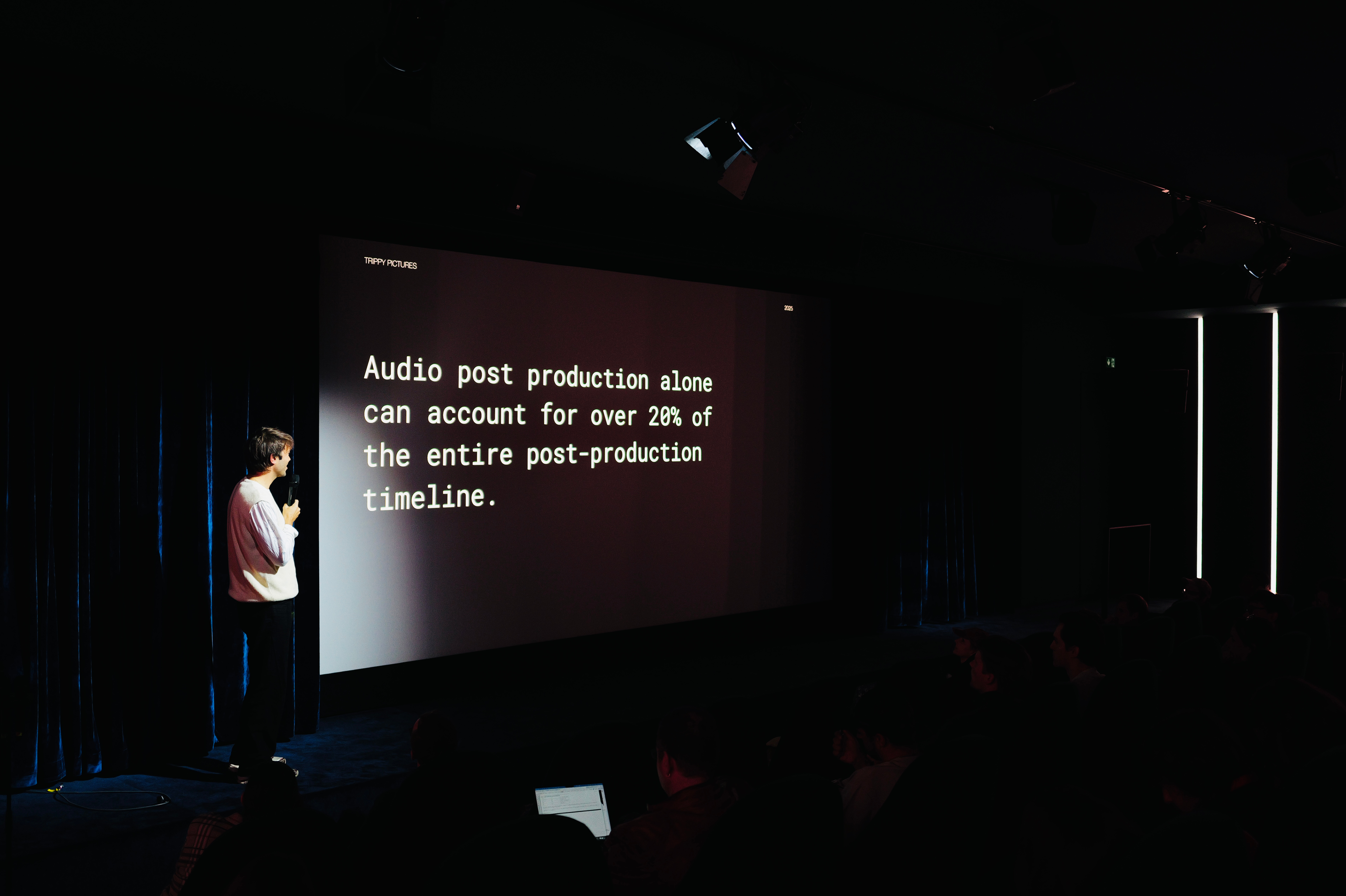
AI is already collapsing the distance between some of those steps: between a brief and a storyboard, between a character and its animation, between a rough cut and a final render.
What took weeks of back-and-forth is starting to take days. What took days is starting to take hours. The workflow that slide describes is being quietly renegotiated in real time, one tool at a time.
Wendelin, Trippy’s founder, was refreshingly honest about it. He doesn’t fully know how much AI will change his process. Nobody does.
The clients are still asking for the twelve stages because the twelve stages are what they’ve always asked for and large organisations are structurally slow to move. The process gives them comfort. It gives them control. It gives their legal team something to sign off on. But that comfort is built on a model of production that assumed certain things took a certain amount of time and those assumptions are evaporating faster than anyone predicted.
The question isn’t whether the pipeline gets shorter. It’s whether the people inside it are ready for what shorter actually means. Fewer handoffs. Fewer approval rounds.
Every generation of creative technology has brought this tension with it. Photography didn’t kill painting it freed it from the obligation of documentation and pushed it toward pure expression. Cinema didn’t kill theatre. Each time, the anxiety was real and the handwringing was loud. Each time, what came out the other side was richer than what existed before.
We’re at one of those moments again.
And the creatives who will define it aren’t the ones who master AI as a precision instrument. They’re the ones who learn to work with it the way a jazz musician works with improvisation. With structure and intention, yes, but with a genuine openness to where the music decides to go.
Trust the AI. Not blindly. But enough.
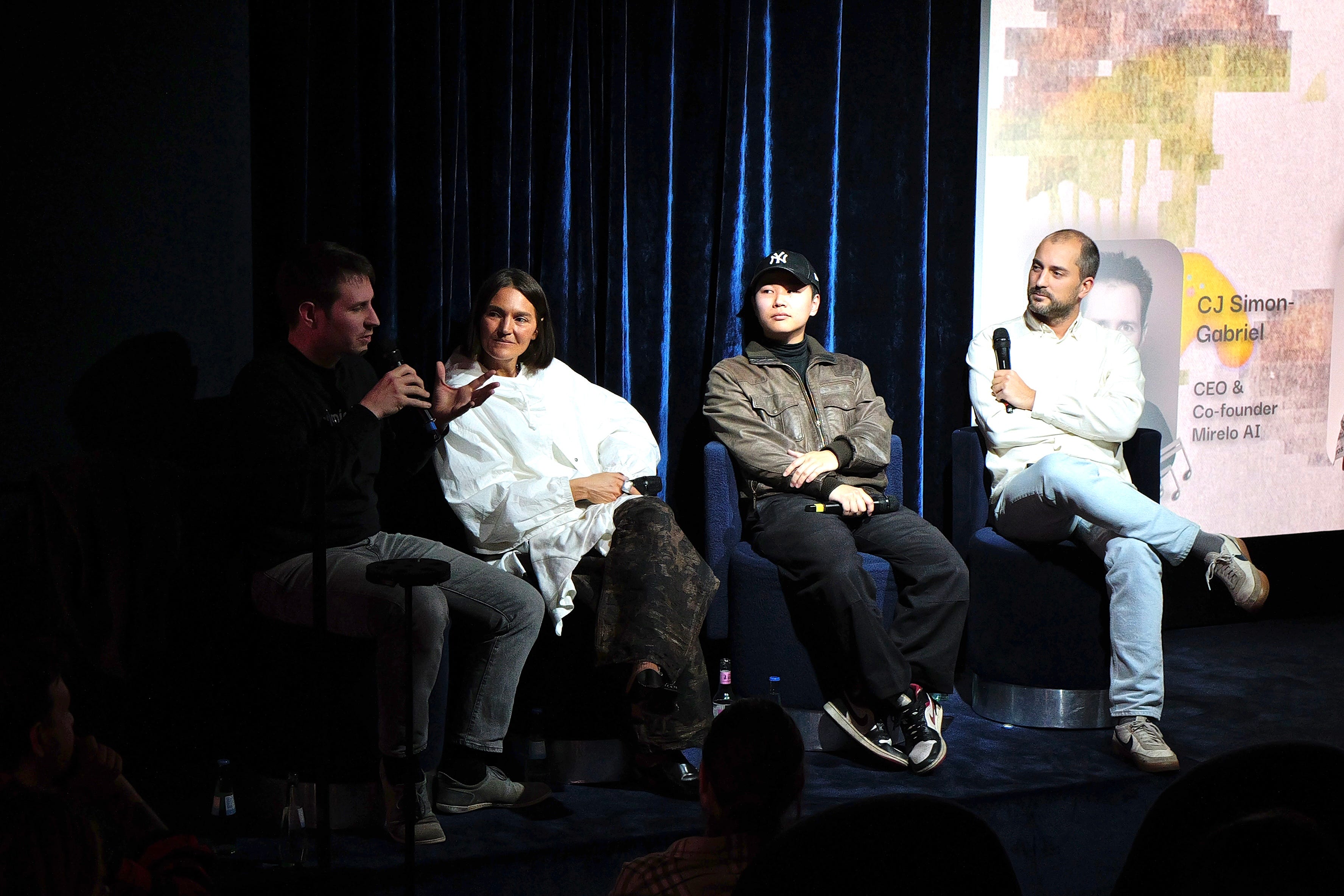
CJ Simon Gabriel (Founder, Mirelo AI)
Yuzzy (AI Community Leader)
Sevda Albers (AI Artist)
The three people on stage who are actually doing the thing, not theorising about it. And what came through, underneath all the nuance and the honest uncertainty, was something simple: optimism is a choice.
The people at the sharp end of AI and creativity, the ones building the tools and making the work, aren't trying to replace the artist. They're trying to free them.
If the founders and creators defining this space right now hold that as their north star, as well as everyone in the room, then the future of creative work looks less like a threat and more like an opening.
We love that AI is a democratising force. Anyone can create! We were excited to receive dozens of AI video submissions for our special award that is being judged by AI-native creator Ohneis652 and sponsored by our partner Fal.ai who will provide $1k credits. The winner will be announced via email soon!
Here’s what moved us the most about this evening…
In that room, 230 people who care deeply about creativity, craft, and what comes next there was a palpable sense of something historic being available right now, in this window, before it closes. A huge thank you to everyone who attended!
For the first time in human history, the ability to tell a story visually, cinematically, at scale, is no longer gated by budget. A filmmaker in Lagos. A designer in Bogotá. A musician in Berlin with a vision and no crew. They can make the thing now. Not a compromise version of it. The actual thing.
💙 That deserves to be celebrated.
Loudly, and soon, and before it becomes so normal we forget it was ever any other way.
Thanks for subscribing to New Renaissance Monthly - please feel free to share this newsletter with anyone you think would appreciate it! We welcome feedback so let us know your thoughts!
If you haven’t subscribed yet you can here:
For more regular updates, insights and resources follow us on Linkedin.
If you missed the past newsletters, you can catch up here.
No posts
Comments
Nothing yet. Say the first thing.
Sign in to join the conversation.