
Every year, Easter moves around a bit; it’s celebrated on the first Sunday after the Paschal full moon (that is, not the actual full moon, but the date the Metonic cycle predicts for it) — on, or after, the ecclesiastical equinox (that is, not the actual spring equinox, but March 21st, its date by tradition). This year, that meant that the Easter Vigil fell on April 4th, coinciding with the feast day set aside by the Episcopal Church for the Reverend Dr. Martin Luther King, Jr. So it was this year that on the day of King, Jr.’s assassination, untold numbers gathered in the dark, at the end of a long Lenten fast, waiting for the Resurrection.
This Sunday was the second Sunday of Easter, what the Orthodox call Antipascha, when the liturgy focuses on the appearance of Christ to the apostle Thomas as portrayed in the Book of John. On the night before he died (John writes) Jesus behaved disconcertingly. He washed his disciples’ feet; he said that one would betray him, and that Peter would deny him; he said that he was leaving, and soon. Thomas said to him, “Lord, we do not know where you are going. How can we know the way?” (John 14)
Three days later, Thomas is met by the disciples who proclaim they have seen their teacher risen from the grave. Jesus will not appear to Thomas for another week.
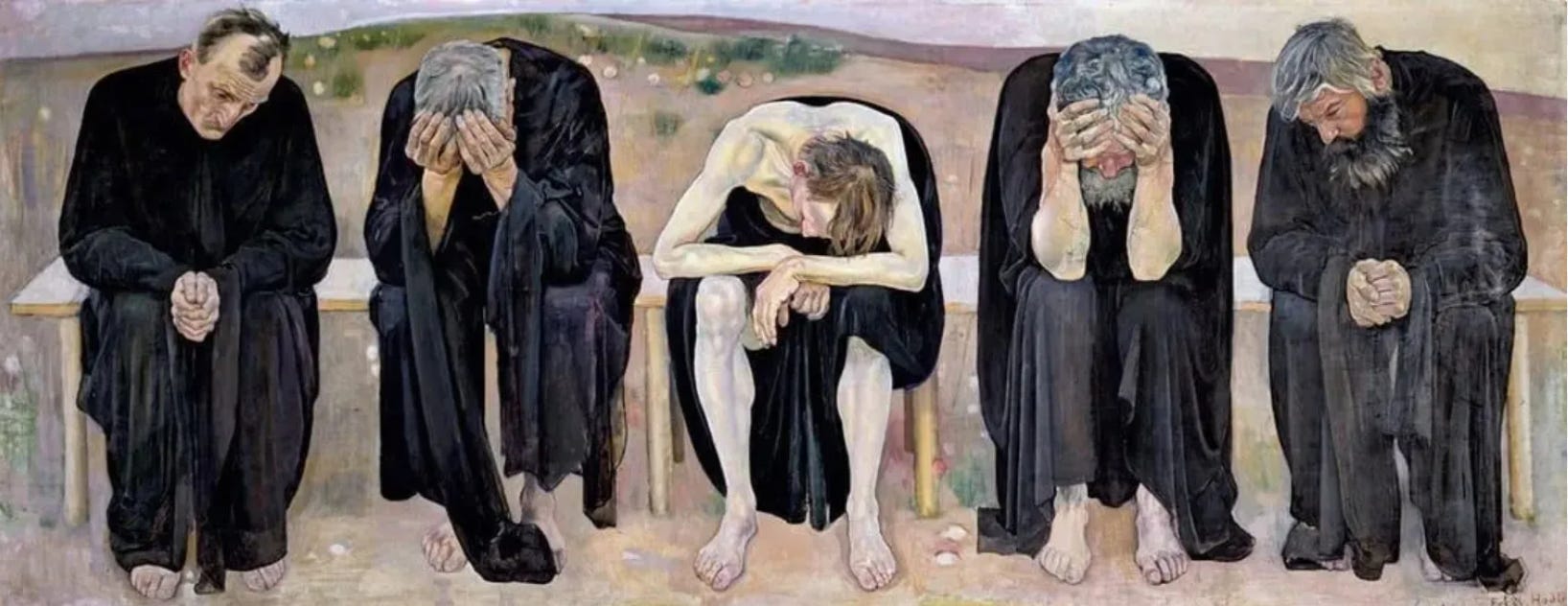
John writes the disciples were hiding for fear of the mob. I imagine Thomas stricken with grief and visceral fear. I read him as almost offended when he replies, Unless I see the mark of the nails in his hands and put my finger in the mark of the nails and my hand in his side, I will not believe. (John 20:25) He must have been very lonely. He must have thought his friends had gone delusional to cope with their world falling apart. Maybe he was tempted to hope, but dared not to, alone for seven days of a dark, Lenten vigil.
I wonder what would’ve become of Thomas had he not seen. What happened to those who, like me, loved Jesus the man, but never came to believe in a risen Christ?
Why do we wait for a Messiah?
Virginia Karnstein responds in an excellent reflection, “something happens: the messianic mentality in pop culture.” In contrast with our age’s mantra of “nothing ever happens,” she writes that the archetype
makes us ponder the notion that history’s deep freezing has left it brittle. As the forces of evil slowly amass and the ice creeps across the horizon, the messianic ideal tells us that Someone will shatter the stasis, erupt into history like … Wonder Woman. Piercing the no man’s land of the cosmos, the Messiah is the “something that happens,” absolute eventhood.
Wonder Woman puts its heroine in the midst of the first World War, “perhaps the most horrific ‘nothing ever happens’ situation in history.”
Men jostle and climb to meet the bristling fire.
Lines of grey, muttering faces, masked with fear,
They leave their trenches, going over the top,
While time ticks blank and busy on their wrists,
And hope, with furtive eyes and grappling fists,
Flounders in the mud. O Jesu, make it stop!1
And something does. “Diana … is the total eruption of the event into the doldrums, a golden singularity in the midst of grey sameness,” a redemption from the unending dread of history’s crushing wheel. The Messiah brings, embodies natality.
Hannah Arendt viewed birth, not mortality, as definitive of human life—“Only man, but no other mortal being, lives toward his ultimate origin while living toward the final boundary of death,” (Love and St. Augustine, p. 57). It is through my memory of where I come from and the context that I came into that I understand myself, seek meaning, and plan my future.
Moreover, whenever I act with purpose, I am bringing about something definitionally new, an addition to the world. This second natality “springs from the beginning which came into the world when we were born and to which we respond by beginning something new on our own initiative.” It’s just inescapably the case that the contributions of a new entity are novel. “Because they are initium, newcomers and beginners by virtue of birth, men take initiative, are prompted into action,” (The Human Condition, p. 177).2
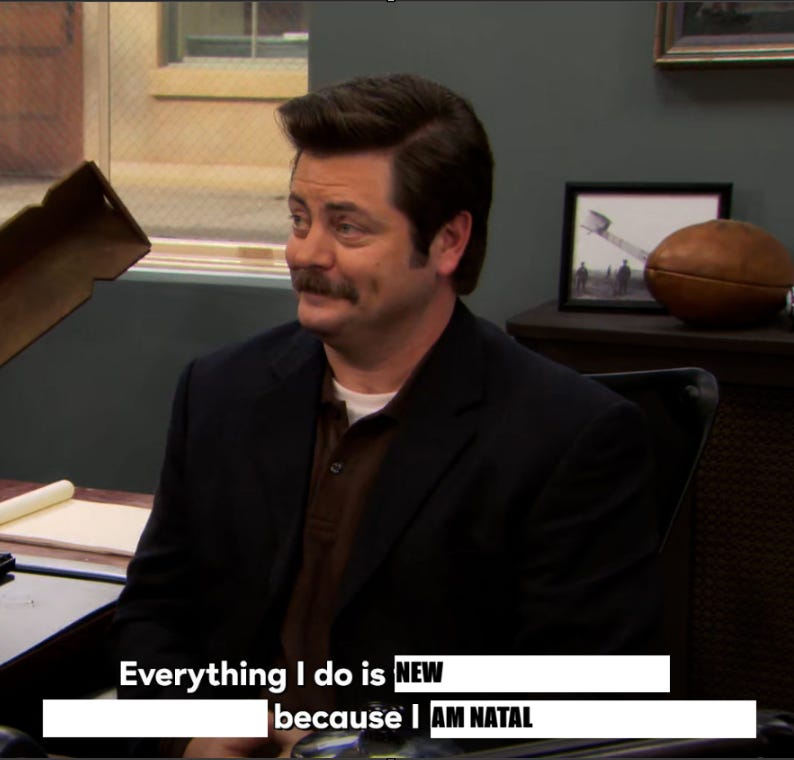
Virginia’s Messiah, Total Eventhood, is natality personified, the “eruption” of the New into the world.3 Jesus is said to have saved men from sin and death, and the Easter Vigil is the Messianic moment in miniature: the fast ending, darkness before dawn.
Virginia goes on to note that this is not all peace and light, and that the violence of discontinuity, the erupting Messianic Event would be fraught if actually realized.
[W]e often want someone, terrible or comforting, to intrude as the absolute event into our quagmire. Drain the swamp! Boil its waters, blast its trees, and let its scalding remains slosh forth and purify the land. Where is the One who can cast the thunderbolts that will do this deed? Whose inerrant scythe will reap the souls of the people we think are damnable? Not Adam Clay or Diana, certainly, but they give us our popcorn-greased approximations.
In the real world, the Great War ended, and that was good. But Virginia correctly notes that we remain “in the cultural wake of World War I to this day,” as from the ruins of that war came a second, even more terrible. Europe’s century of destruction was never escaped; it shaped everything that came after. Today’s fears of a third world war center on divisions directly downstream of the outcome of the second, and of the Cold War between its victors.
The outcome of any act is unpredictable, contingent, radiating boundlessly through time; and it goes on doing so because no action, once committed, can be undone. Unpredictability and irreversibility, the very conditions “from which the action process draws its very strength,” necessarily imprison the actor.
[M]en never have been and never will be able to undo or even to control reliably any of the processes they start through action … Nowhere, in other words … does man appear to be less free than in those capacities whose very essence is freedom. (Human Condition, p. 233)
“[T]he deeds of the past, whose ‘sins’ hang like Damocles’ sword over every new generation” constantly limit “our capacity to act.” This prison is precisely what one hopes the natality of the Messiah will deliver us from. But hopes can be misplaced. Far from catharsis, Total Eventhood would seem to impose on us “one single deed from which we could never recover … remain[ing] the victims of its consequences forever.”
The obvious example of this tension vengeance. Arendt defines revenge as “acts in the form of re-acting against an original trespassing,” whereby, she observes, “everybody remains bound to the process, permitting the chain reaction contained in every action to take its unhindered course.” Revenge is “the natural, automatic reaction to aggression,” so automatic so that Arendt notes the action-reaction cycle “can be expected and even calculated,” as when states seek escalation advantage, or blood feud cultures create proportionality norms to limit casualties.4 This example demonstrates why reactions lose “something of the original character of action,” the natality.
There is one response “which does not merely re-act but acts anew and unexpectedly,” forgiveness. Forgiveness is in a sense the choice not to re-act. It therefore retains the spontaneous, unexpected quality of natality; it frees “both the one who forgives and the one who is forgiven” by releasing them from this cycle, “the relentless automatism of the action process.” And because transgression against our neighbor is inevitable and almost constant, forgiveness is what allows us to go on living beside each other.
“The discoverer of the role of forgiveness in the realm of human affairs,” writes Arendt, of its natality, as a necessity to human community, “was Jesus of Nazareth.”
You have heard that it was said, ‘An eye for an eye and a tooth for a tooth.’ But I say to you: Do not resist an evildoer. (Matthew 5:43-48)
This connects Arendt back to Virginia Karnstein—the most Total natality is the one that totally escapes its attempts to imprison itself. “The fact that he made this discovery in a religious context and articulated it in religious language is no reason to take it any less seriously in a strictly secular sense.”
Like Diana transcending the mud of the Great War, forgiveness is a “golden singularity” releasing us from the grasp of our past, because forgiveness is the act of letting the past go.
It’s important to note that this is just a model, and only a partial one—Arendt is also discusses punishment as a means to ending cycles, and what to be made of those crimes we can neither punish nor forgive. She by no means suggests that forgiveness is always the right response, and spent much of her time focusing on the cases in which it was not.
But it helps me understand the success of Rev. Martin Luther King, Jr. in operationalizing forgiveness in politics, which has long struck me as a sort of miracle.
Virginia writes, “I think that many, many people, even atheists, crave a religiously inflected Messiah figure. They tend to look for it in a normal human.” Not being any exception, in college I looked for political exemplars. I ran into a snag when reading the autobiographies of Malcolm X and Martin Luther King. At that age, it was hard for me to understand why the hard-nosed by-any-means-necessary common sense of Malcolm failed him, compared to the monumental strides achieved by King. I was clearly missing something, so I kept reading. Hanes Walton, Jr.’s The Political Philosophy of Martin Luther King, Jr. was a key source, in addition to King’s writings.
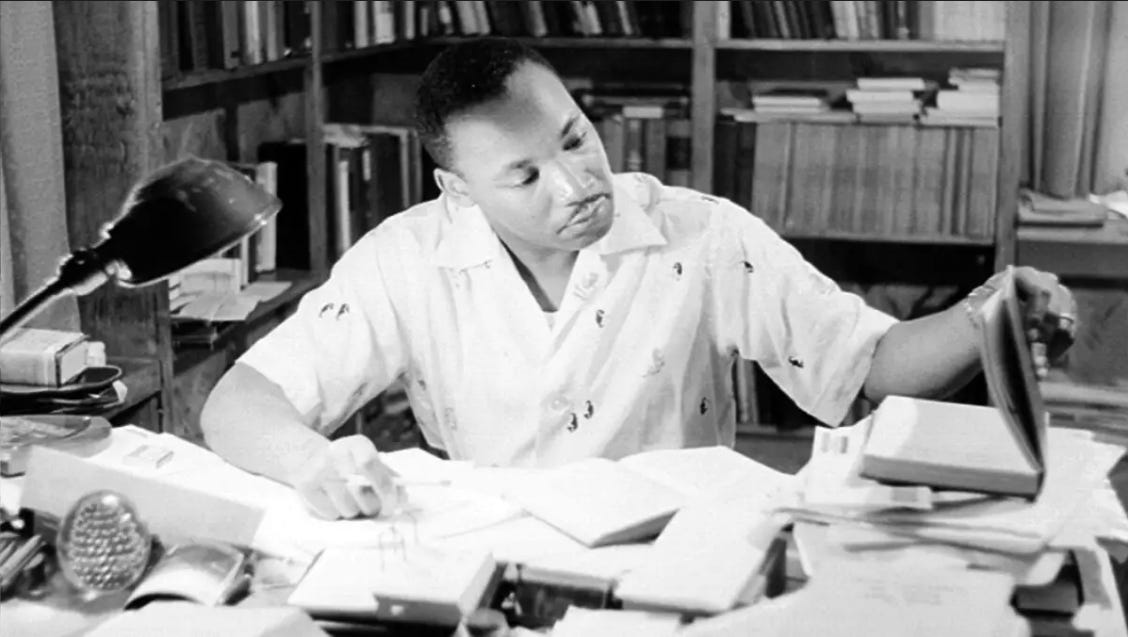
There’s a perfectly natural, “mechanistic” explanation for the miraculous effect of MLK’s political philosophy. The commitment to nonviolence “reaches the opponent and so stirs his conscience that reconciliation becomes a reality.”5 That is, it’s a gamble that the image of unearned suffering triggers an empathetic response. But what if you’re not lucky enough to get that response, I asked?
As King interpreted it, nonviolent resistance derives from the conviction that justice abounds in the universe, and that this justice works on the side of the nonviolent resister. He has, therefore, a deep faith in the future outcome of his struggle for justice since he carries with him the awareness that he has “cosmic companionship.” (Walton, Jr. p. 64)
In other words, for the atheist, he doesn’t really have an answer. Walton, Jr. wrote that, in King’s framing, “only with a living faith in God can the technique of nonviolence be employed with complete confidence and to the greatest advantage,” (Walton, 49).
This is around the point that, like Scott Alexander investigating the Fatima Sun Miracle, I began to feel “genuinely scared and confused.”
MLK wasn’t blindly optimistic. He was deeply familiar with “the reality of sin on every level of man’s existence.” But, he believed that nonviolent resistance was necessary because of its effect on the soul. “[T]he nonviolent approach does not immediately change the heart of the oppressor. It first does something to the hearts and souls of those committed to it.” It entails “a process of self purification … repeatedly ask[ing] ourselves, ‘Are you able to accept blows without retaliating?’”6 This willingness could only be achieved with a commitment to love for the oppressor:
As a technique, nonviolence would entail suffering, but suffering King believed to be a part of human nature and essential for spiritual growth. It was through suffering that the self-purification needed to develop one’s human nature in a positive manner was achieved. And, since spiritual freedom means the capacity to love all, it also means to suffer all. To rise to the highest reaches of the ideal of suffering love is to rise to the highest potential of one’s human nature. (Walton, 57-58)
And King often spoke and wrote about how he was acting for the salvation of white Americans, too. “Segregation distorts the soul and damages the personality. It gives the segregator a false sense of superiority,” (Letter). In Stride Toward Freedom, he wrote:
Since the white man’s personality is greatly distorted by segregation, and his soul is greatly scarred, he needs the love of the Negro. The Negro must love the white man, because the white man needs his love to remove his tensions, insecurities, and fears.
Walton ultimately summarizes this as Christ-like behavior. “Christ’s death upon the cross was perceived by King as a means by which the gates to paradise were opened.” So Martin invoked a massive theological weight when he said,
I realize that this approach will mean suffering and sacrifice … [even] physical death. But if physical death is the price that a man must pay to free his children and his white brethren from a permanent death of the spirit, then nothing could be more redemptive.7
To be clear, I didn’t convert on the spot or anything. But I had to grapple with the fact that a man who had accomplished incredible things did so on the back of a philosophy which was almost incomprehensible if you did not share its theistic axioms. King was the beginning of a long journey back into a loving fascination with religion, and an appreciation of Christian philosophy.
On the night before he died, Martin Luther King spoke at Mason Temple in Memphis, Tennessee, under the thunder of a storm. And he said,
We've got some difficult days ahead. But it really doesn't matter with me now, because I've been to the mountaintop. And I don't mind. Like anybody, I would like to live a long life; longevity has its place. But I'm not concerned about that now. I just want to do God's will. And He's allowed me to go up to the mountain. And I've looked over. And I've seen the Promised Land! I may not get there with you, but I want you to know tonight, that we, as a people, will get to the Promised Land! So I'm happy tonight, I'm not worried about anything! I'm not fearing any man! Mine eyes have seen the glory of the coming of the Lord!
He was shot the following evening.
Martin was referencing the story of Moses. Moses, the story goes, was not allowed by God into the Promised Land. He takes him to the mountain, and he looks over, and he sees the glorious land the Lord had promised to Abraham. “‘I have let you see it with your eyes, but you shall not cross over into there.’ Then Moses, the servant of the Lord, died there in the land of Moab, at the Lord’s command.” (Deut. 34). Christians regard Moses as a type of Christ, a precedent. The Messiah opens, is, the way. But not for himself. His is a love that suffered all, sacrificed all.
For it is written: I will destroy the wisdom of the wise, and the discernment of the discerning I will thwart. Where is the one who is wise? Where is the scholar? Where is the debater of this age? Has not God made foolish the wisdom of the world? (1 Cor. 1:18)
Half a century later, it’s the day before Easter.
I was nodding along listening to Ross Douthat’s recent interview with Bart Ehrman, a self-described Christian atheist, advocating for Jesus’ ethics as he understands them. Matt Whiteley pointed out in “Christians Should Learn Something From Bart Ehrman,” he’s making a case that differs subtly from the Tom Holland-ish argument which too often boils down to, “because our societies have been Christian, anything good about them rely on Christianity.” Ehrman’s argument (in this interview, at least) is that Jesus Christ was a historic philosopher with radical teachings which have become core to the way many people think about morality, and deserves veneration.
I was thinking about how I had heard on Christianity On The Spectrum’s podcast that Christians were instrumental in ending the previously widespread practice of infanticide, evincing a radical re-conception of what life is for. It’s difficult to argue from a place that prioritizes self-interest that you ought to value the life of a deformed or disabled child who will—materially—only be a drain on your house.
Lately, I’ve been thinking about how a sense of the inherent worth of the life of each person is a pretty delicate thing, and frequently inconvenient to the powerful. It’s been a bad couple of news cycles.
I don’t believe in God. I don’t believe Jesus rose from the tomb. I think, as Hitchens said after Pascal, I am so made that I cannot believe. But I do think that Christian thought has a strong tendency to get at ideas really important to human flourishing as I understand it, particularly in unintuitive ways.
Arendt, in Some Questions of Moral Philosophy, reminds us:
[O]ur current equations of goodness with selflessness … are a far echo of the authentic experiences of someone who loved doing good in the way in which Socrates loved the activity of thinking … The strain he put on his followers must have been beyond bearing, and the only reason we don’t feel this anymore is that we hardly take them seriously.
The teachings of Jesus are not always practical (good for him re: money changers, but isn’t selling sacrificial doves at the temple a useful service?). But I think that’s more reason to really cherish when something in line with the ethic survives, a candle light in what can feel like a very long, dark fast.
When I read about early Christian history, it’s easy to imagine myself as the Greek at the back of the church; maybe a God-Fearer, or a visitor to the altar of the Unknown God, hearing the message of Paul of Tarsus:
For Jews ask for signs and Greeks desire wisdom, but we proclaim Christ crucified, a stumbling block to Jews and foolishness to gentiles, but to those who are the called, both Jews and Greeks, Christ the power of God and the wisdom of God. For God’s foolishness is wiser than human wisdom, and God’s weakness is stronger than human strength. (1 Cor. 1:22-24)
Of course, I was also raised in church, so there’s one obvious reason all of this continues to resonate with me. I just have, as a matter of fact, patterned my thinking after what I grew up hearing. Some of it I later felt didn’t hold up; a lot of it did. So in a sense, getting back in church is just owning that. And it’s been good for me, too.
The first time Thomas speaks in the Gospel of John, Jesus has told the disciples they must return to Judea to Lazarus’ tomb “to awaken him.” The disciples, not unreasonably, fail to process the weight of what Jesus is claiming, and instead point out that an awful lot of Judeans would like to stone Jesus to death. But Thomas says, “Let us also go, that we may die with him.” (John 11: 7-16) Thomas isn’t any more understanding of Lazarus “waking up” than anyone else; it’s just if Jesus is going down, he’s going down with him. He goes to Judea not to raise a man, but very likely to die for one.
That sort of loyalty no doubt sets his character up to later plead, “Lord, we do not know where you are going. How can we know the way?” But you could also read it as showing Thomas as already living “as if there were no God,” preceding Bonhoeffer. Before Jesus has been betrayed, Thomas is already obedient unto death (Phil. 2), walking in love, the way of Christ Crucified.
Siegfried Sassoon, “ATTACK,” in Counter-attack and Other Poems, 1918.
“[T]he new beginning inherent in birth can make itself felt in the world only because the newcomer possesses the capacity of beginning something anew, that is, of acting. In this sense of initiative, an element of action, and therefore of natality, is inherent in all human activities.” The Human Condition, p. 9
I’m trying very hard not to make this essay also about Disco Elysium
No posts
Comments
Nothing yet. Say the first thing.
Sign in to join the conversation.