
A reasonable thing to ask about a musical is: “What’s the show about?” If we’re casually synopsizing to a friend, we might make quick reference to setting, plot, or a distinctive feature. e.g. “Hamilton is about the Founding Father during the American Revolution… but told through hip-hop!”, or “Legally Blonde is about a posh girl who goes to Harvard Law School” or “Fiddler on the Roof is about a Jewish father protecting his family in Tsarist Russia.”
But if we want to understand a musical more deeply — or discuss it with that friend at a diner after the show — we need to answer different questions. Who is the main character? What do they want? What’s in their way, and how do they deal with their obstacles? And on a broader level, what general idea about life is implied by all these showtunes? So now our responses might look like:
“Hamilton is about a revolutionary idealist who becomes morally compromised, and must ultimately find a way to reconcile personal and political integrity.”
or
“Legally Blonde is about a fashionista who applies to Harvard Law in a bid to regain a lost boyfriend, but who unexpectedly discovers self-actualization.”
or
“Fiddler on the Roof is about a father who wants the best for his daughters, but finds that doing so conflicts with his cultural traditions.”
Note that I’m not just itemizing plot points, but showing how they relate to a character’s mission or journey. Journeys of this kind are at the heart of most musicals. Sometimes the goals change (Legally Blonde) or conflict with one another (Fiddler), and sometimes the protagonist might lose sight of the prize and struggle to reconnect (Hamilton). But deeply-held wants are generally front and center, and the bulk of a show generally pertains to them. Hence all the singing.
The steps in between
Writing-professor types will often tell you that a story’s outline should follow the form: “A happens, and because of that, B happens. And because of that, C happens.” This produces a sense of forward motion, of cause and effect. If on the other hand it feels more like “A happens, and then B happens, and then, gosh, I dunno, I guess C happens” we can become fatigued trying to discern where the story is going.
For instance, if twenty minutes into Legally Blonde, Elle Woods left to cruise the Mediterranean, visiting historical sites and flirting with passengers, perhaps doing a little scuba diving, only to slide into her Harvard graduation in the final scene, we’d be a bit confused. Like… didn’t she really want to be a lawyer? Why is there a song about parasailing in Crete? We expect the body of the musical’s story to connect to the character’s overarching mission, not be a series of digressions. Even if the protagonist starts and ends in logical places, we also really care about all the steps (and songs) in between.
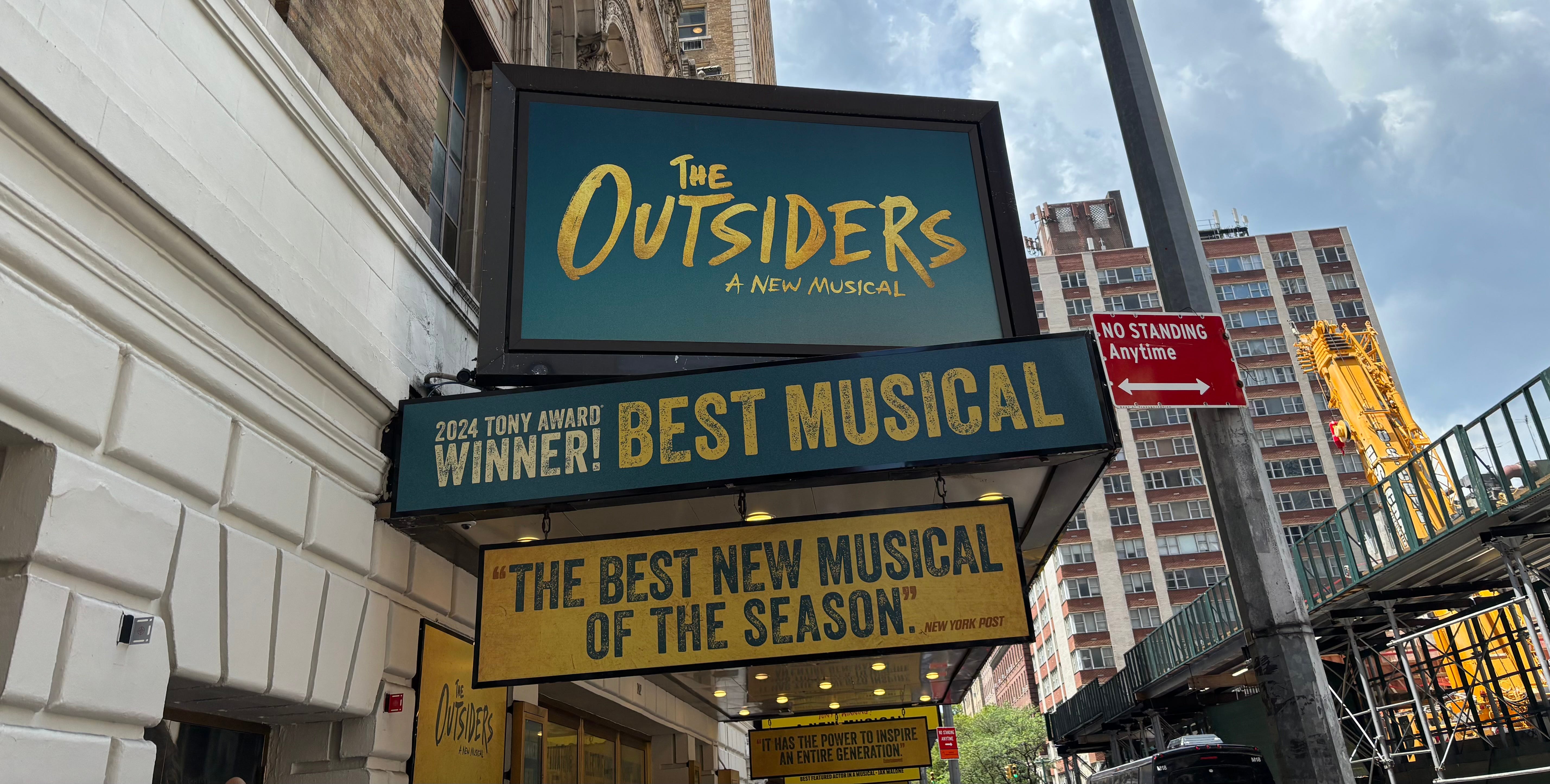
Bearing all this in mind, let’s consider The Outsiders.
Good ingredients
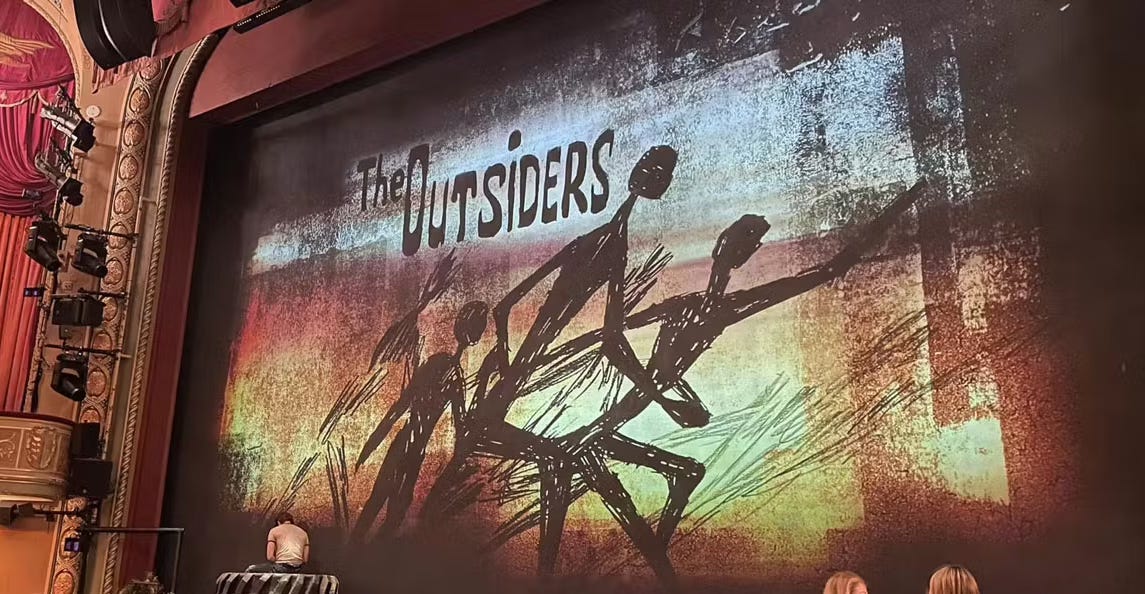
The Outsiders, currently on Broadway, is based on a novel which I haven’t read which was previously explored in a movie which I haven’t seen. In other words, I went in without prior knowledge or expectations; whatever I got out of the experience came from the musical alone.
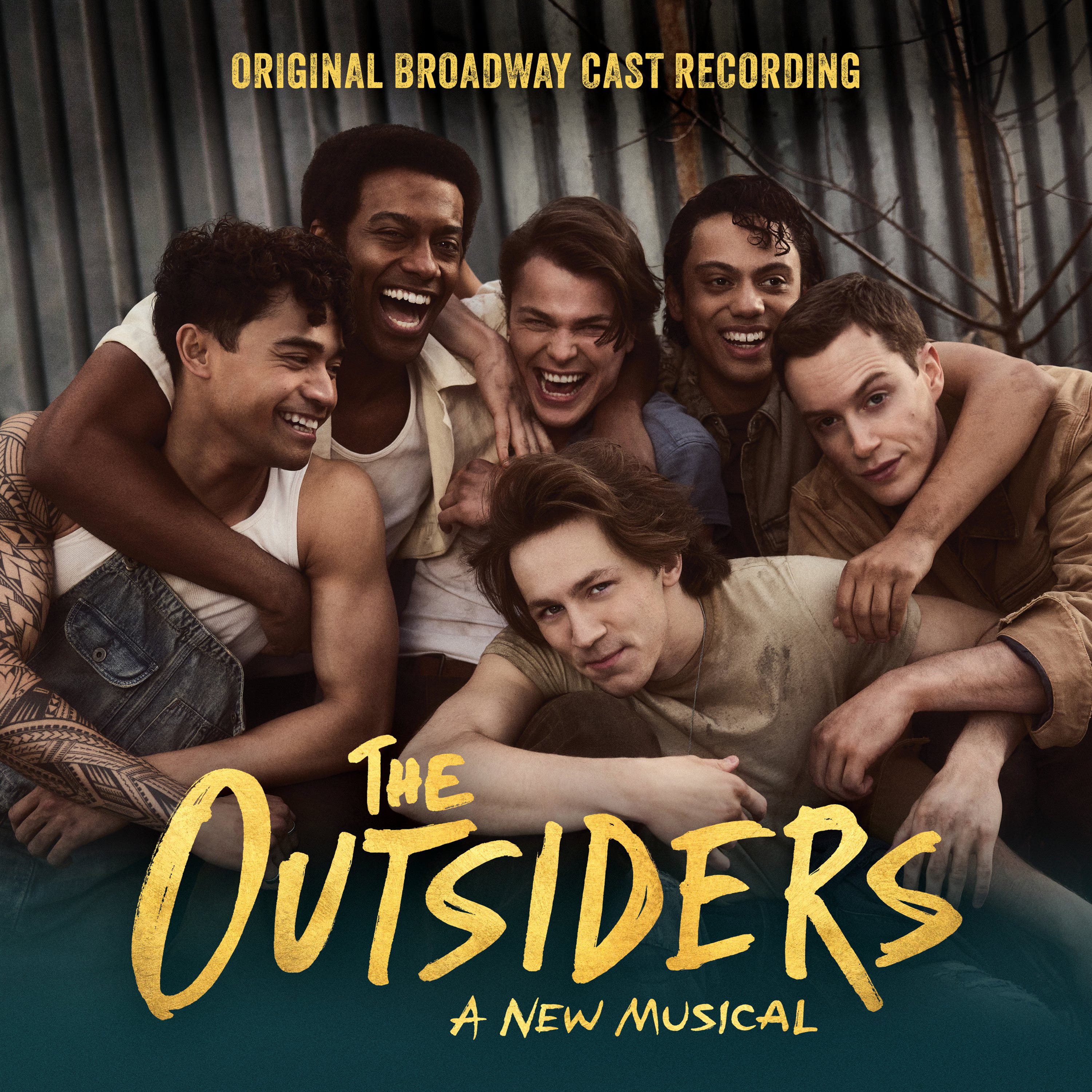
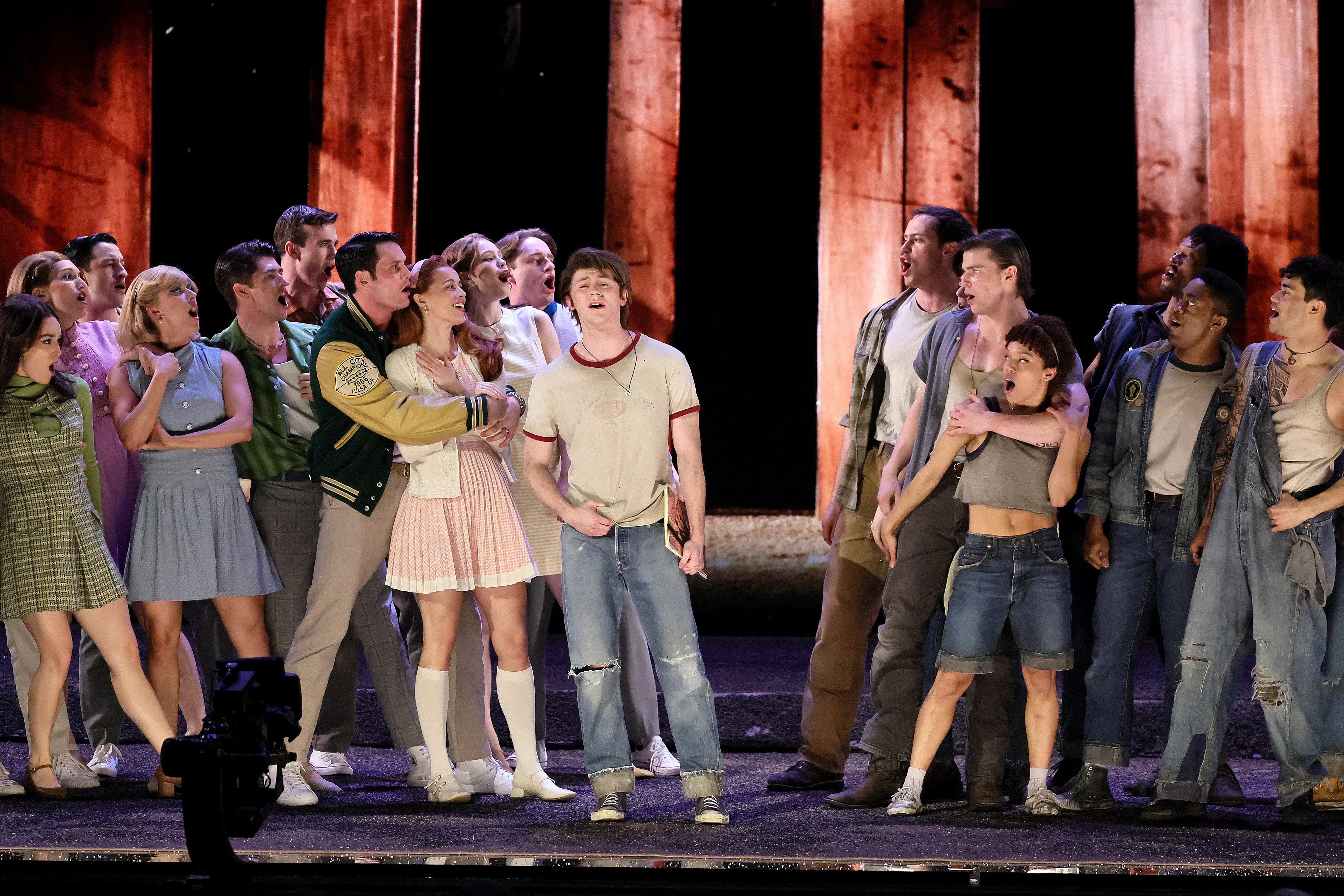
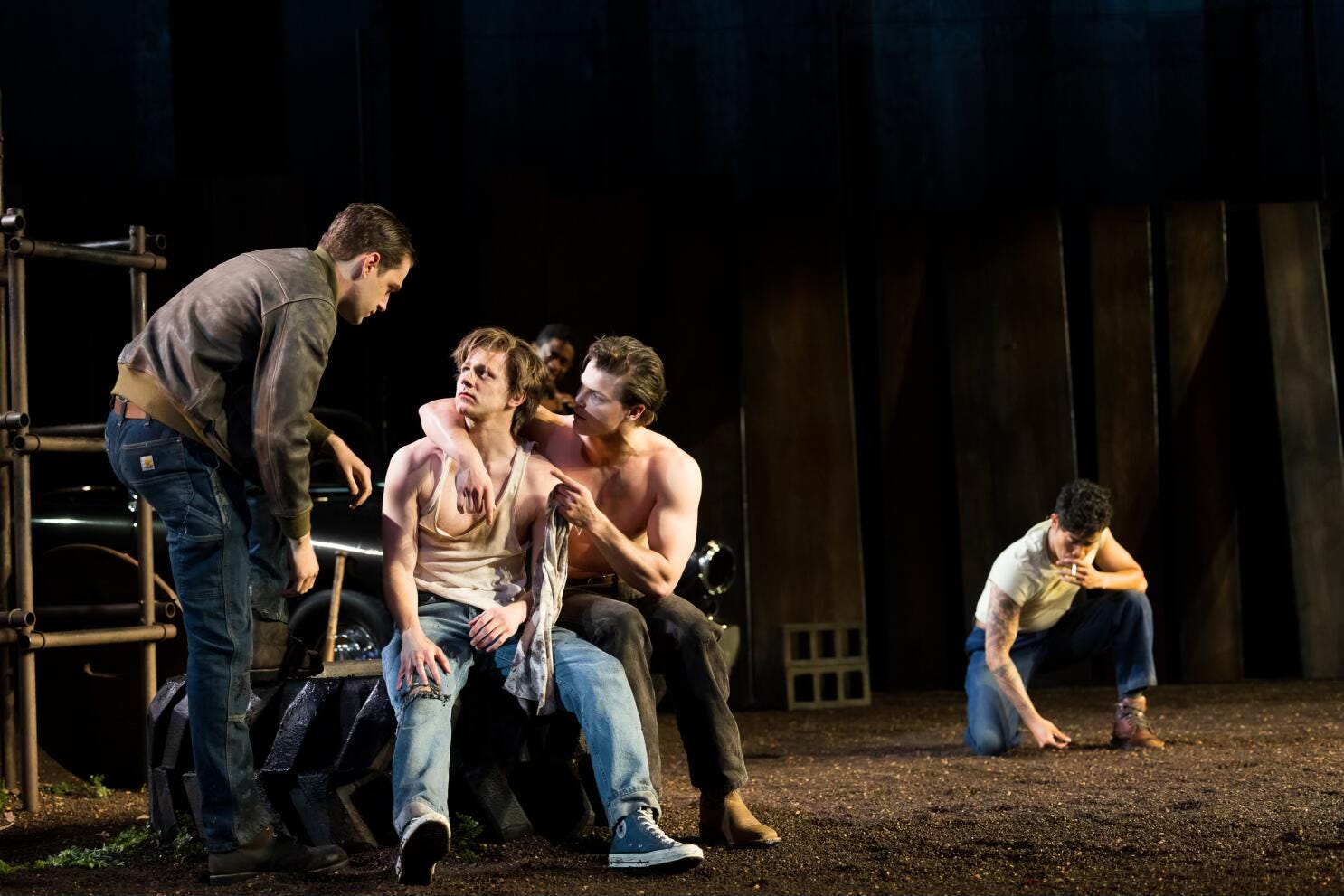
The show is set in mid-1960’s Tulsa, where two social castes exist in tense opposition: the posh Soces (arrogant and prone towards violence) and the lower-class Greasers (poor but bursting with camaraderie). Distinct among the Greasers, 14-year-old Ponyboy loves movies and literature, and aspires to be more than his meager environs permit. Ponyboy has zero surviving parents but does have a best friend (Johnny), two brothers who serve as quasi-dads (Darrel and Sodapop), a role model with a prison record (Dally), and even a fleeting love interest (beautiful Soce girl Cherry).
The show has a lot going for it. The characters are likable — at least, the ones we’re supposed to like are likable. The Greasers earn our empathy through their troubles: upper-class scions not only mock them, but occasionally gang up on them to administer beatdowns. The Greasers have little education and few prospects. Despite all this they maintain a sense of community, a mutually nurturing culture, and a lexicon of catchy nicknames.
Ponyboy has dreams we can get behind: to escape Tulsa, to experience film and literature, perchance to write novels. Not only that, he has a strong moral compass (as shown when he leaps into a fire to save some kids). He’s idealistic but confused, passionate but vulnerable, soulful as narrator but funny as well. A winning recipe for someone with whom we can bond.
The show’s score is appealing across the board, blending 60’s folk-pop, blues, and a more modern Broadway sound. Only a few tunes are memorable, but they’re all enjoyable, with agreeable lyrics. They fit the mood and the milieu. Well done.
The story is full of stuff: family struggles, gang melees, a smattering of star-crossed romance, blood brotherhood, family drama, fugitives on the run, trauma and recovery, churches catching fire. This being a Broadway production, the cast was fantastic and the staging creative, with gang rumbles and back-alley thrashings evoked through choreography, lighting, and sound design.
Sounds like I’m giving it a thumbs up, right? Well, sort of.
A scatterplot of a plot
Let’s pose our opening question: what’s the musical about? If I were hired to write a paragraph for Playbill I’d come up with something like: “In simmering 1960s Tulsa, young artistically-minded Ponyboy aspires to rise above class warfare and economic stagnation — but struggles against the realities of his environment.”
That’s me doing my best to get people into the theater. In reality, it’s hard to say what the show is about.
Is The Outsiders truly about young Ponyboy’s struggles to realize his artistic dreams and fulfill great expectations, per his “I Want” song? Look at what actually happens during the show. I’ll itemize major beats, along with my running interpretation of the show with each new development.
Spoilers ahead. If you want to maintain pure ignorance, jump to the end or buy a ticket.
Antagonism builds between Soces and Greasers. (Okay, got it, it’s a story about class struggle and the folly of gang violence, right? Like West Side Story?)
Darrel sings a lament about how he renounced his dreams so he could take care of his little brother. (Okay, got it, it’s like It’s A Wonderful Life, where we rediscover a life’s virtue through its impact on others?)
Ponyboy bonds with his BFF Johnny and role model Dally. (Aha, it’s a story about friendship through times of strife, like Stand By Me!)
At a drive-in, Ponyboy sticks up for rich girl Cherry, earning her attention. The two talk for hours, discovering unexpected depths and commonalities. (Aha! This is about two kids from conflicting tribes, stumbling into romance, which they struggle to maintain! Like Romeo and Juliet. Got it.)
Soce goons try to kill Ponyboy. Johnny defends his buddy. A Soce goon is killed in the altercation. Ponyboy and Johnny flee town. Ponyboy seems to forget about Cherry entirely. (Uh… okay, I guess… it’s a friends-on-the-run story? Fugitives from the law, testing the bounds of friendship? Kinda a male Thelma and Louise?)
Ponyboy and Johnny hide out in a church, which catches fire, seemingly from one of Ponyboy’s stray cigarettes. (Er… what? Where did this come from? There was no foreshadowing. This is a pure and then moment rather than a because of moment.)
The fire threatens a field trip full of school kids. Ponyboy and Johnny risk their lives to rescue the children. (Wait, didn’t they endanger the kids in the first place? Is this a redemption story, or…?)
Ponyboy and Johnny become folk heroes while Cherry clears them from murder charges by talking to the police. (Why on Earth didn’t she do this earlier?? Was it even necessary for the two to flee town?)
Back home, the Socs and Greasers are getting ready to rumble. Ponyboy gives the fight his blessing. Carnage ensues. (Okay, so I thought Ponyboy was a noble guy who rescues burning kids, but he hasn’t apparently grown morally, so what’s his trajectory again? Also, hey, didn’t he want to become an artist earlier? And why doesn’t he pick up the romance with Cherry, who got him out of a murder charge? Share a reprise of their duet? I mean, at least buy her a milkshake or something?)
The Soces are defeated in the gang fight and basically vanish. (So… I guess violence does solve some problems? If the Greasers can fend off the Soces, with one of their number bedridden no less, why didn’t they just do so at the start of the show?)
Johnny dies of injuries sustained while trying to rescue kids from the fire. Ponyboy sinks into depression. His brothers share a duet that can be roughly summarized thus:
Brother #1: Our brother is very sad. I’m giving up on him.
Brother #2: You shouldn’t.
Brother #1: All righty, I won’t.
Dally, distraught over Johnny’s death, kills himself. (If he’s supposed to be friend and protector to both Johnny and Ponyboy, then why would he abandon his remaining friend?)
An inspiring letter from Johnny, posthumously delivered, rallies Ponyboy out of his dolor. (This song is legitimately touching, and constitutes the best moment in the show.) Ponyboy resumes his efforts to be a writer.
At this point Ponyboy is exactly where he started — an aspiring artistic type who yearns to leave the hood — except that he’s flirted with a girl (whom he subsequently ignored), went on the run from the law (needlessly, because he was to be exonerated by said girl), encouraged a brutal gang fight, and lost his best friend, ultimately due to a fire that he himself apparently caused.
Limited expectations
So what is the show about, really? It’s enjoyable drama, and lots of stuff happens, but what ties it all together? How do you summarize it, other than by itemizing its plot beats like I did above, or with an abstract logline like I offered earlier?
Charitably we might say that Ponyboy needed something to write about, and that his adventures gave him that thing. But nowhere in the show did he tell us (or sing to us) that he lacked inspiration for writing. The lyrics to his I Want song (“Great Expectations”) suggest that there’s more to his life than meets the eye. There’s book imagery throughout, but at no point does he say, “I yearn to be a novelist but don’t know how”. So if that’s the conclusion, it wasn’t set up.
The story may have worked well in its original novel form, as novels can be modular and evolve unpredictably. It also might have worked well as a movie, where action scenes can be viscerally depicted and keep us immersed.
But this is musical theater territory, and musicals work best when they’re about people who want things (a lot) and try (very hard) to get that thing, either succeeding or else failing educationally. The Outsiders’ protagonist, likable as he is, is often a passive narrator, seemingly jumping from one desire to another. (The character of Cherry was squandered. I sat up straightest in my seat when I thought the romantic subplot was going somewhere and sighed deeply when she was sidelined.)
Though Ponyboy makes two or three big decisions, by and large stuff happens to him. (He would have been more compelling a character had he been the one who killed a Soce in defense of Johnny, rather than the other way around.) He surfs a tide of events, some of them unpredictable, and in the end seems no different a person than when he started — just sadder.
Something I like to say on this blog is that Not Everything Needs To Be a Musical. The Outsiders, in singing-and-dancing form, is sometimes fun but frustratingly inconclusive.
Postscript
Welcome to my recent influx of new readers, many of whom were referred by my friend and fellow Substacker Carrie-Anne Biondi. For those who weren’t, you oughta check out her blog Weekly Wonderings for its thoughtful and irrepressibly positive philosophical essays.
Comments
Nothing yet. Say the first thing.
Sign in to join the conversation.