
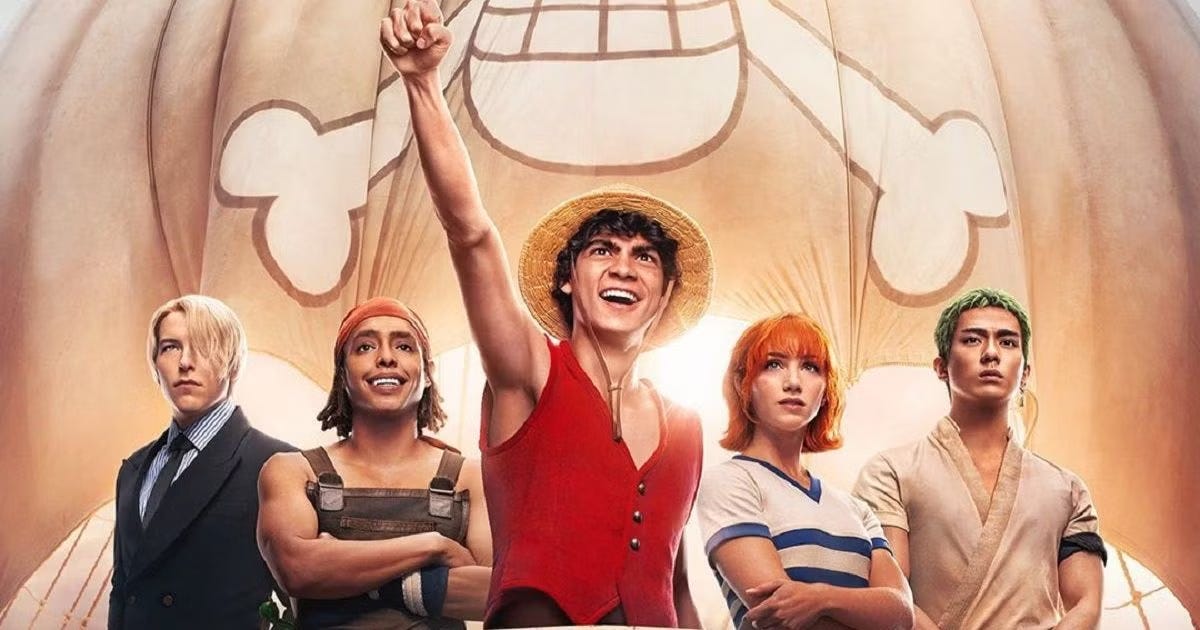
To be clear, I don’t think that the pirate fantasy One Piece should become a stage musical. For one thing, the Netflix show is gunning for twelve seasons, while the manga clocks in at 114 volumes and running. Even an epic musical can have only so many intermissions. Plus, the story’s super-powered characters, magical landscapes, talking whales, etc. could only be suggested on stage, evoking oohs and aah but not a deeper emotional response.
And there is a deeper response at work here. One Piece is emotionally engaging beyond what we’d expect from a zany nautical fantasy. Its imaginative world is entertaining, but also invests us in the well-being of its inhabitants. So happens, this is the same kind of bond that musicals like to create between audiences and their characters. So let’s see what lessons can be learned from this story from a different medium.
My name is Monkey D. Luffy and I am going to...
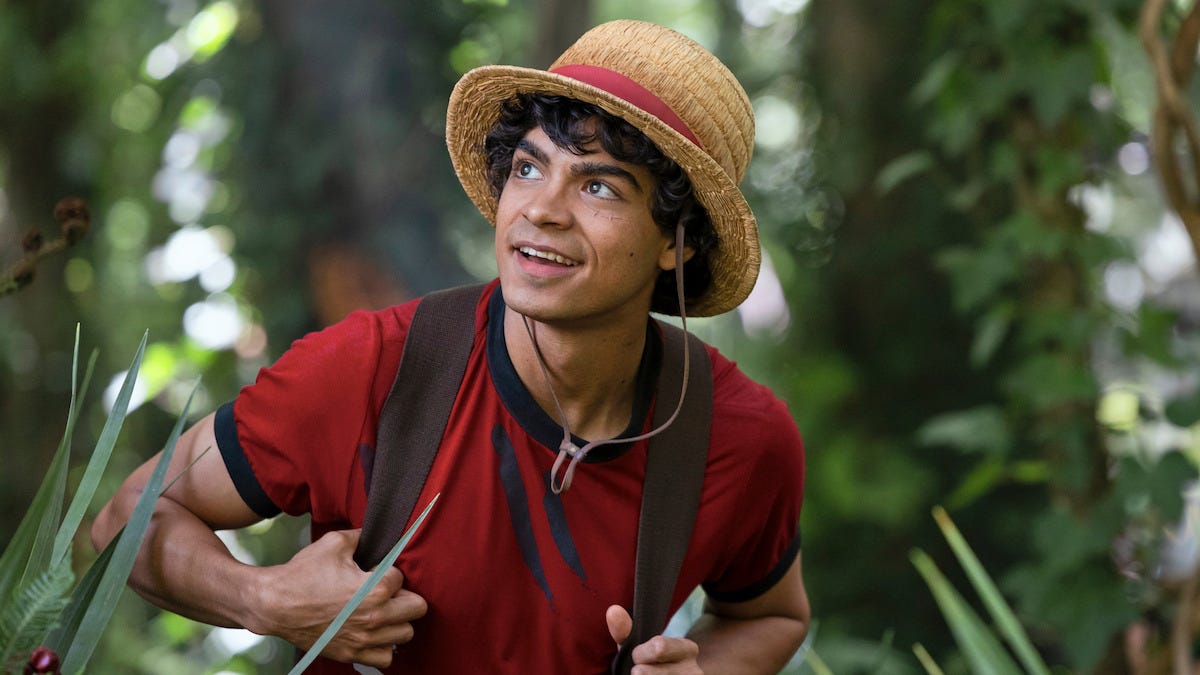
Anyone who’s watched One Piece can finish that sentence, possibly in their sleep. The show’s idealistic young protagonist makes it clear from the get-go that he means to find the titular One Piece, a coveted hidden treasure, and become king of the pirates. (Presumably the first achievement facilitates the second.) Luffy cheerfully asserts his intentions to anyone in earshot, be they friends or armed adversaries. Eventually he’s repeated his manifesto so often that his shipmates can recite it along with him.
No matter that we don’t know exactly what the One Piece is, or what being king of the pirates would entail on an administrative level. We do know that Luffy believes in that destiny, and with such unyielding enthusiasm that we can’t help but cheer him on. During his journey he faces considerable danger and frequent brushes with death, but at no point does he waver in his belief in his future. He even racks up a huge bill at a fancy restaraunt under the assumption that his IOU (as future king of the pirates) ought to suffice for payment. It never even occurs to him that things might be otherwise.
Here be storytelling lessons
What should musical theater creators note about Luffy?
He has a clearly-defined goal, which he announces at the outset of the story.
He never loses sight of that goal. All his actions can be tied to that particular want. At no point in the story do we ask, “Why is Luffy sailing against gravity up a mountainside, risking death in the mouth of a giant sea creature?” We know.
He exudes constant emotional connection to that goal, which in his case manifests as a kind of manic enthusiasm.
He is efficacious — meaning that his self-belief is at least partly justified.
Like Luffy, every musical’s hero needs a specific want that compels them to act despite formidable obstacles. A big, clear, overt passion, so strongly held that it can justify multiple songs. Without a driving motivation or opinion, a song would leave us with a question every musical strives to avoid: who cares? If the protagonist can’t find a sense of stakes in their own song, how can we?
Some examples of protagonist goals: Elle Woods wants to marry her boyfriend, then later wants self-actualization as an attorney. Tevye wants to raise his family in accordance with tradition, then later wants their happiness even if at the cost of that tradition. Alexander Hamilton wants political significance, then later wants to regain his integrity. Sweeney Todd wants revenge, then later, er, wants more revenge. Motivations can be noble or vile, and can change over time, but can’t be ambiguous. Not if they’re going to drive music.
You may be familiar with the “I Want” song archetype, wherein the main character belts about their passion around a show’s fifteen-minute mark. But the need for motivation reaches beyond that self-introductory number. Each song in a musical implies the statement, “Because I strongly want XYZ, I feel the following way about the current situation.”
Of course not every protagonist needs Luffy’s charming verve and overconfidence. That personality comes from a particular tale in a particular genre tradition. But musical theater writers should note how easy it is to emphasize with someone who makes their motivation strong and clear.
Relatability
Treasure and supreme executive power aren’t Luffy’s only priorities. The treasure-hunting project sets his trajectory, but as a dream it’s a bit abstract and intangible. When we meet him we think, “I dunno about this One Piece quest, but by gosh the kid’s panache is kind of infectious. I’m willing to see where his journey goes.”
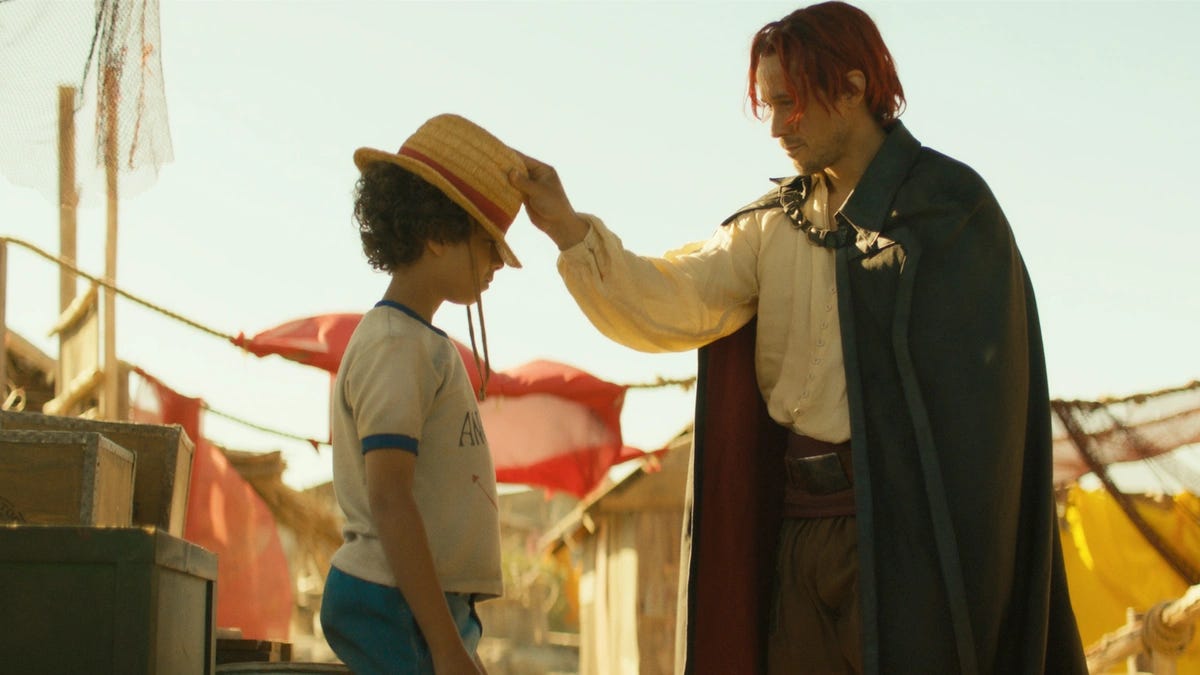
Left at that, Luffy’s mission might cease being satisfying over a few episodes. Fortunately, he also has a powerful secondary goal: abetting the dreams of his shipmates, who evolve into his circle of friends. Luffy bends over backwards, sometimes literally, to protect his companions from physical harm and help them self-actualize. He radiates mudita and is as passionate about his friends’ dreams as he is about his own. This is one of his most endearing qualities.
A resulting lesson for musical theater writers: not only should your main characters have clear goals, and not only should we understand those goals, but we should also be able to relate to them. We can’t like a main character, let alone tolerate their singing, unless we can in some way connect with their values.
In Legally Blonde, Elle Woods wants to self-actualize as a lawyer. That’s reasonable, right? We don’t need to be lawyers ourselves in order to root for her. In Memphis, Huey Calhoun wants to elevate R&B music to national appreciation. We don’t need to be R&B fans to admire his heart-on-sleeve gusto. (Though in a musical, I guess it helps.) Elphaba wants to hone her sorcery under the tutelage of the Wizard. Hey, we all know a grad student who moved cross-country to study with a star professor.

On the other hand, consider the 1980s musical Barnum. The titular impresario opens the show by declaring himself an outright huckster. Not a charming rogue we can quasi-admire, but a self-confessed bullshit artist. Worse still, he calls us, the audience, the people who paid for tickets to see this musical, a group of suckers.
From the standpoint of earning audience empathy, this is one of the worst opening numbers in musical theater history. Plus, the big end-of-act-one number is Barnum’s gathering up the courage to cheat on his wife. We can definitely understand what he’s after, but we’re probably not on board with his mission.
Musicals live or die by the wants of their main characters. While a deftly-written show can endear us to an ethically-challenged protagonist (think Gentleman’s Guide) a humanistic one will win our hearts more easily. In One Piece, Luffy isn’t a particularly complex character, but he is a relentlessly devoted good guy. Thanks to the writing (and a wonderful portrayal by Iñaki Godoy) he is extremely loveable as a result. Musical creators would be smart to note his example.
Sweat the world-building
A bonus lesson from One Piece concerns the show’s world-building and style. The show’s backdrop combines pirate adventure stories, superhero tropes, and mythological fantasy. The world is rich and fully in motion upon our arrival. There’s magic fruit, talking sheep, pirate factions, and geography that’s been mapped out in great detail. There’s some tell, but mostly show, and this greatly helps our immersion.
A stage musical doesn’t have the luxurious timespan of episodic TV, nor the visual toolset. A musical can’t dwell on backstory beyond brief glimpses, and even those need to be directly tied to present-tense stakes if we’re to remain interested.
Thus, a theater creator’s job is not to explain their world’s history to the audience, but to have already figured it out for themselves. That way, characters will feel like they’re on logical trajectories, and the bits of backstory offered to us will cohere with what’s onstage.
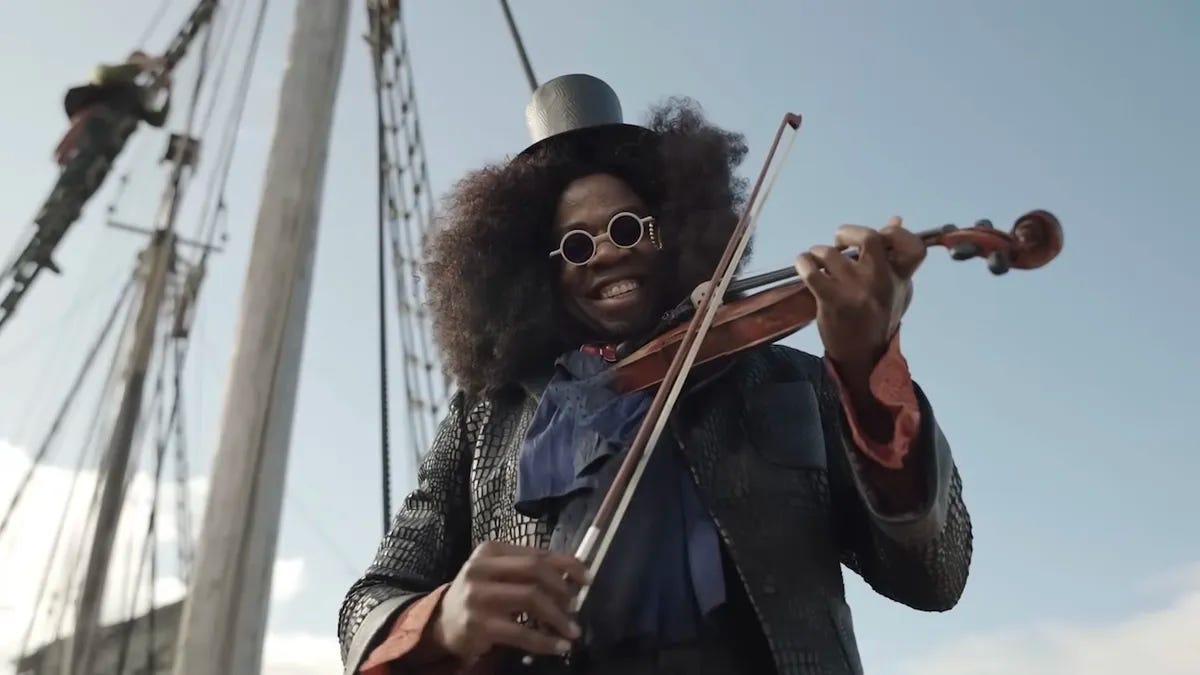
Another aspect of One Piece that’s well-crafted is style, visual and otherwise. The show’s denizens sport brightly-colored hair. Villains break the fourth wall to pose before animated wanted posters bearing their visage. An eccentric zaniness seems to infuse every corner of the world, yet does so without compromising sincerity or our sense of stakes.
We can think of successful musicals that offer similarly distinct aesthetics in visuals, language, and music. Some examples that leap to mind: Hadestown, Hamilton, Rent, Dead Bandit, The Lion King (I am not a fan, but hats off to its having a memorable onstage universe), Avenue Q (ditto), and Urinetown (ditto).
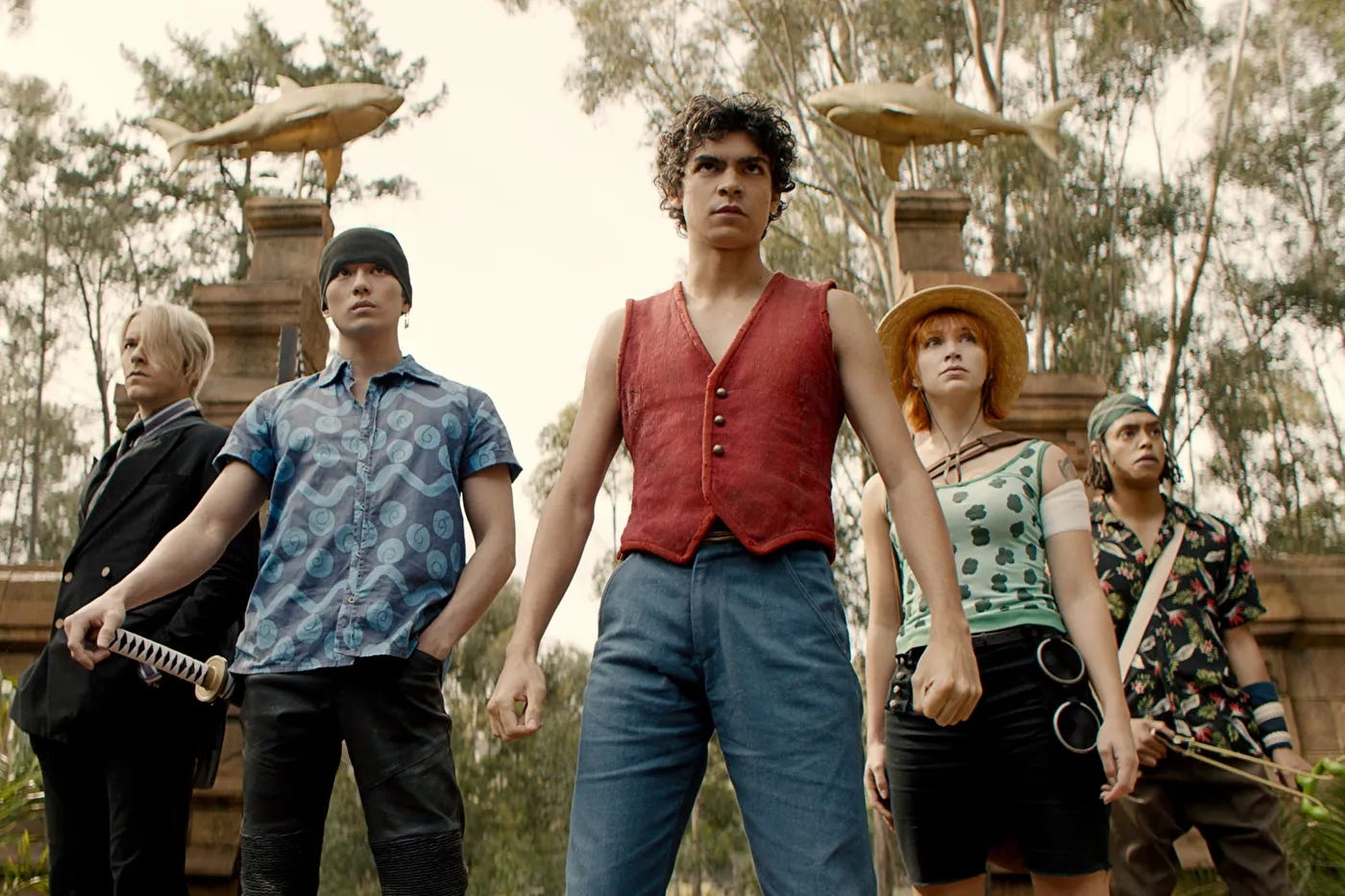
Thar be a good show!
If you’d like to check out One Piece, you can catch the excellent series of Netflix. There’s also the sprawling original comic, and the anime based on the comic, but for most people the Netflix show is a great introduction.
Comments
Nothing yet. Say the first thing.
Sign in to join the conversation.