
I frequent several online forums for musical-theater-creating types. I often come across posts like this:
Hi group! I’ve finished the script of my new musical about Maurice Kahn, personal assistant to Ghengis Kahn. I’ve written book and all the lyrics and just need a composer to write the music! DM me if interested!
Now there are things to commend here. First, there’s a desire to create a musical, which always warms my heart no matter the topic. Secondly, the author is starting with a complete story, rather than recording a concept album and hoping for the best. Thirdly, there’s an effort to combine forces with fellow creatives.
At the same time, I’m a little baffled, and maybe even concerned on the behalf of those making these posts, for a number of reasons.
Reason the first is a seeming lack of discernment. Collaboratively writing a musical is a long-term undertaking. In some ways it’s similar to starting a family. Imagine a comparable ad:
Hi group! I’ve achieved financial security and am ready to have a family of two! I’ve got the kids’ educational and career plans plotted out and just need someone to birth and mother them!
Much like an aspiring parent, an aspiring musicalist is staring down the barrel of years of hard work with little immediate financial return. They probably want to spend those years partnered with someone who is capable, temperamentally well-matched, and aiming for a similar long-term goal.
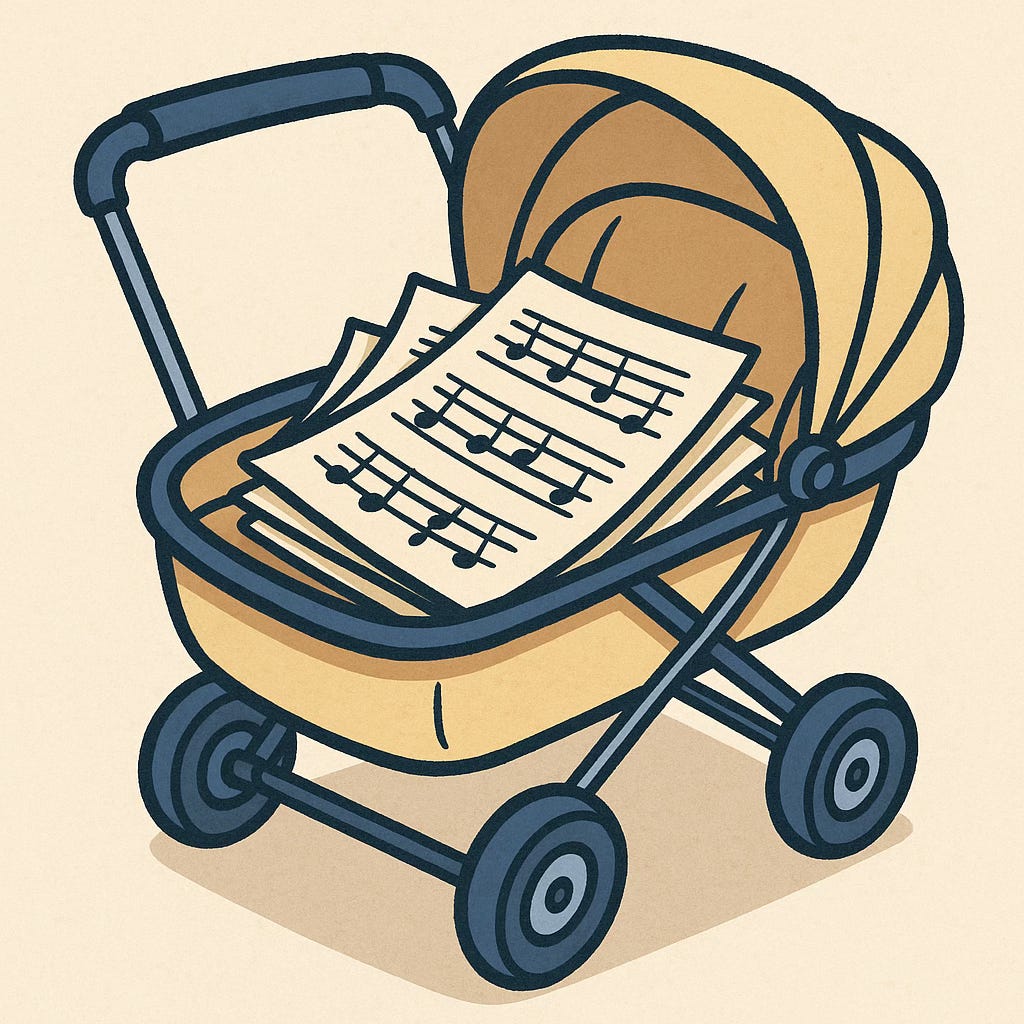
Moreover, both ad-writers probably care a great deal about the quality of the collaboration’s outcome. They don’t want their baby (metaphorical or literal) to have an unpredictable future; they want it to flourish and (metaphorically or literally) sing!
While there’s nothing wrong in fishing for either kind of partner online, one should have a well-thought-out list of criteria, and think about how the ideal partner might be found. Not casually announce an open call audition.
In both want ads here’s also certain naivety about how involved the collaborator is going to be. Saying that you’ve got the songs plotted and/or lyrics already written suggests that you already know where the songs go, and what they convey.
Figuring this out — a process called song spotting — is a huge, huge part of creating a musical. It involves facing big questions with non-obvious answers. Even seasoned show-writers iterate on their score via diligent (and collaborative) trial-and-error.
For example, you might workshop a musical to discover that, after an explosive start, things bog down. This might be because there are three ballads in a row. Or because a long number is assigned to a secondary character whom we just met. Or because we lost track of the protagonist’s focus when they started out singing about — to follow our hypothetical show — a passion for the Mongol conquest of Zhongdu, and midway switched to singing about a love of horticulture.
What I’m getting at is that if you haven’t found a composer, you probably shouldn’t have ossified ideas about where the songs fall, even if you’re also the lyricist. That discussion should happen in cahoots with your music-generating partner. (Just how you shouldn’t plan your kid’s schooling before you’ve even met your future co-parent. Or for that matter, the kid.)
Musical bookwriters sometimes err in thinking that songs are episodes you add to a complete script, like having a musical guest pop up midway through an episode of Saturday Night Live. I think these writers are worried about music changing their hard-written stories, and so demarcate safe spaces between pages with notes that read “music goes here!”
The way it actually works is that music is going to change the heck out of their hard-written stories. Chunks of script will be tossed aside, forever replaced by showtunes. Timelines will compress or expand as music makes a yearlong montage fly by, or a flashbulb revelation linger for three minutes. The tone of the book itself may be retrofitted to match the zest or dreaminess or poignance of the newly-created score.
If you want tight control of your own text, do not under any circumstances write for musical theater. That’s true even if you’re a wunderkind who writes book, music, and lyrics; you’ll find your music-self constantly sending your pages back to your bookwriter-self for rewrites and/or incineration.
When I score a film, I’m part of post production. I’m brought aboard towards the end, when the film’s been (at least mostly) edited. And that works, because film music provides emotional support for an existing narrative.
But a film is a story with music. A musical is a story told through music. Its composer isn’t someone you bring on towards the end of the process for some extra pizzazz. They’re a collaborator, a fellow dramatist who should be there early on, and sought out mindfully.
When I was nearly finished with this post I came across a great example of a “help wanted for musical” post. With the poster’s permission I’m reproducing it here.
Samuel Wearing posted the following want ad for a theatrical composer/arranger on 9-3-25 (here’s the original link):
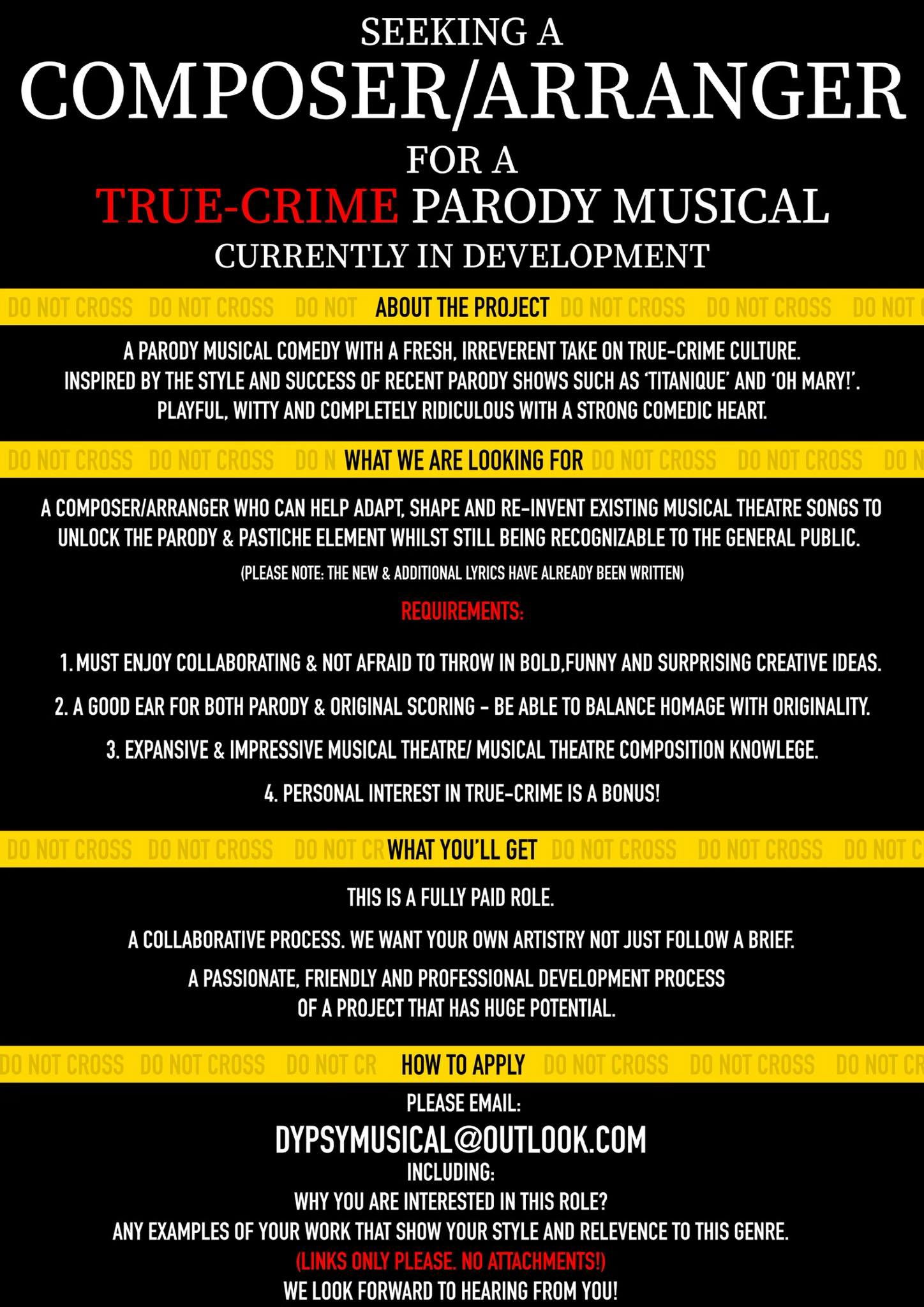
Among the things he does right:
Clearly indicates the genre and tone of the in-development show. (The ad itself has a clever “police tape” visual motif.)
Lists the desired qualifications of the candidate composer.
Details the nature of the work to be done.
Outlines expectations for the collaborative relationship.
Provides a submission method, and describes what’s expected.
Offers some money!
I hope that Samuel finds his ideal composer (if he hasn’t already) and thank him for allowing me to end this post on a positive note.
Comments
Nothing yet. Say the first thing.
Sign in to join the conversation.