
Hi friends,
Hope you’re having a beautiful day.
If you haven’t seen me before, I’m Elin and I talk about all things storytelling. I’m currently doing a classics challenge, where I’m reading all six of Jane Austen novels before the end of the year.
Starting, of course, with Jane Austen’s first novel, first published in 1811, Sense and Sensibility.
When I say regency era and gossip, you might start hearing Julie Andrews’ voice from Bridgerton start playing in your head. And those references I (that I have seen) have mainly been to Gossip Girl.
Not that Bridgerton has ever prioritised historical accuracy anyway, but funny enough, when it comes to gossip, that’s one historically accurate thing Bridgerton captures the essence of. But who did it first? The one and only Jane Austen.
In her first book, Sense and Sensibility, the story of the Dashwood family and sisters Elinor and Marianne. Gossip, one’s conduct around gossip, and the social repercussions of it sit right at the centre of the story. It intertwines with every character and plot point, but it also highlights how each character approaches and regards themselves in relation to gossip.
Pour a cup of tea. Let’s get into it.
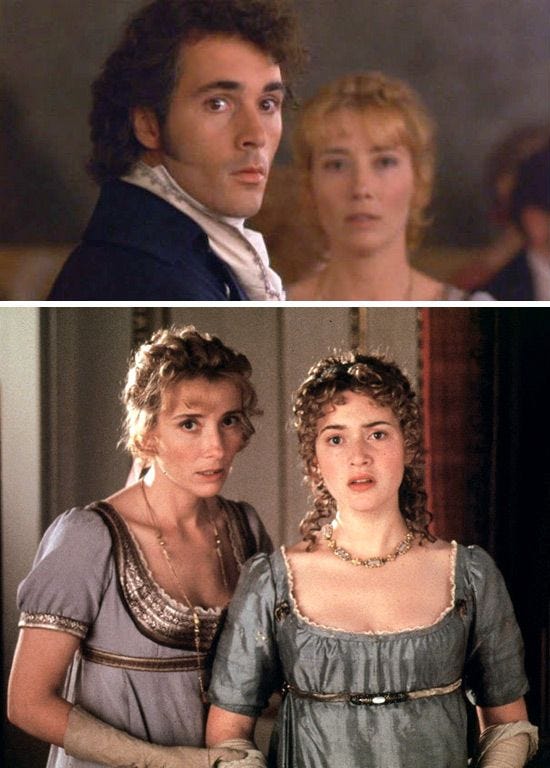
After the Dashwoods lose their father, Henry, they’re forced to move to a smaller accommodation, Barton Cottage in Devonshire, offered to them by a distant relative, Sir John Middleton. Before they move, they’re introduced to Edward Ferrars, son of the late Mr. Ferrars and brother to their half-brother’s wife. He and Elinor quickly form an attachment, but it’s discouraged by Edward’s mother, Mrs. Ferrars, and he goes away to London.
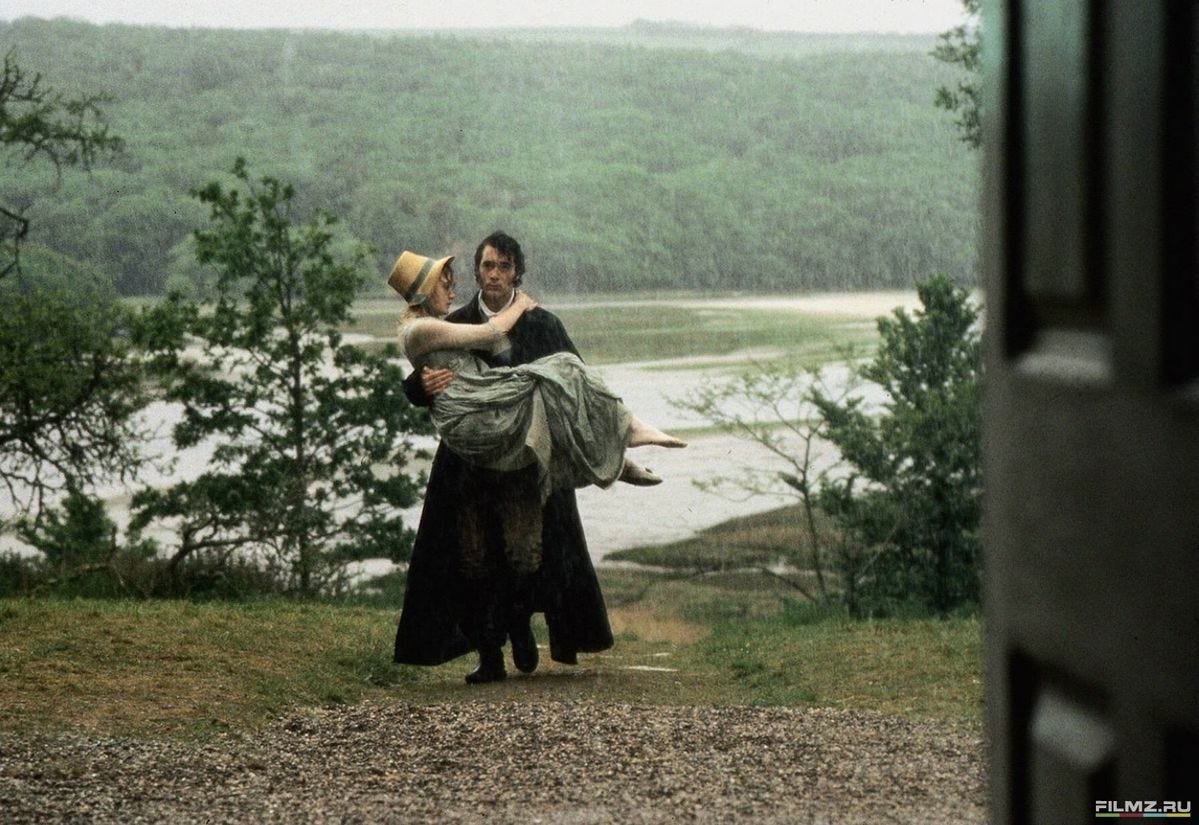
At Barton, Marianne, out on a walk in the rain, twists her ankle and is swept up (literally) by the dashing John Willoughby. Around the same time, the sisters meet Colonel Brandon, an older, reserved friend of Sir John's, who's taken with Marianne, though she dismisses him as too old and too dull to be a romantic prospect, especially next to Willoughby. But then, just as suddenly as he arrived, Willoughby leaves for London with no explanation and no promise.
Meanwhile, Elinor is confided in by Lucy Steele, a new acquaintance, who reveals she is secretly engaged to Edward and ask of Elinor to keep their secret. Elinor is left carrying this knowledge in secret, even as her own feelings for him remain unresolved and unspoken.
Marianne and Willoughby cross paths in London at a party, and to Marianne’s distress, barely acknowledges her, then coldly returns her letters and affections. Colonel Brandon confides in Elinor about how Willoughby had seduced and abandoned Eliza, Brandon's young ward, leaving her pregnant and disgraced. That why he left Marianne was because he had been cut off by his aunt over the scandal, Willoughby chose to engage himself to a wealthy heiress instead.
The party travels to Cleveland, where Marianne, still in heartbreak, catches a serious fever from wandering the grounds in the rain, and nearly dies. Colonel Brandon finds her.
As Lucy Steele’s engagement to Edward becomes public knowledge, it makes Mrs. Ferrars furious and they disinherits Edward in favor of his younger brother, Robert. Lucy, ever the opportunist, pivots almost immediately to Robert instead, securing the family fortune.
Edward comes to Elinor to explain himself and confess his love for her. She and Edward marry, and Marianne who slowly comes to appreciate Colonel Brandon, marries him too.
Gossip drives most of the plot forward in this story, either through information passing from person to person, or through a character behaving in a way that will be viewed as gossip-worthy behavior.
It’s easy to think that Mrs. Jennings, who’s the most prominent gossiper in the novel, is the key focus of this as she’s chattering, matchmaking, speculating out loud about everyone’s business. But gossip runs as much through the other characters, just more subtly.
Marianne, who self-admittedly wears her emotions on her sleeve, opens herself up in a way that allows for scandalous discourse, something Elinor comments on as unwise, given how people will talk about her. Marianne answers that she has nothing to hide and no interest in hiding it.
Elinor herself holds a moral high ground in her behaviour toward gossip, but is impacted and affected either way. By her own high sense of discretion, when she’s told Lucy Steele’s secret, she keeps it, even though it’s to her own detriment, hindering her ability to seek her own happiness or comfort from other people.
The novel, in my opinion, doesn’t offer us a clear view on the act of gossiping, whether it’s encouraging it or condemning it. I think it’s used more as a tool to display the era’s social structures and conduct, and how it impacts people across different classes, ambitions, and situations.
Mrs. Jennings gossips freely and faces no real consequence for it; Marianne is nearly destroyed by being gossiped about and Elinor is punished by her own restraint.
What do you think Jane Austen is trying to say about gossip? I’d love to hear in the comments
This essay was inspired by the brilliant podcast, I highlight recommend giving it a listen.
Join 6K+ writers, readers, and storytellers as we nerd out over our favourite books, films, and shows, break down the storytelling behind them, and help each other become better writers while pursuing our own creative projects.

Want to start writing?
I’ve created free digital workbooks, writing tools, and resources based on what has helped me write my novels and what I learned through my journalism degree.
Let’s connect:
💌 Reply to this email, I’d love to hear your thoughts
📱 Come say hi on Instagram
If you enjoyed this essay, feel free to like, comment, or share it so more writers can find this little corner of the internet.
Thanks for reading; I’m so glad you’re here. x
No posts
Comments
Nothing yet. Say the first thing.
Sign in to join the conversation.