
What if the block you have been stuck in for months has nothing to do with your skill, and everything to do with the fact that you are still trying to cut the film that lives in your head instead of the one that actually exists on your timeline?
This week, for the first time I can remember, a mainstream director stopped to spotlight the work of post on camera. And an assistant editor got invited to sit across from the guys behind Ted Lasso and talk shop about the cuts that made their biggest scenes land. I’ll give you the full spotlight at the end but it also cracked something open in me because for once someone outside of post was actually paying attention to this part of the art form.
Today I want to share more in depth about the creative process of an editor. At the end are three of my biggest takeaways after spending 16 years in the part of this industry no one talks about, but hopefully, that is starting to change.
Most of you have been reading along with my NonDē film journey, Before We Knew, Back in June I wrote about the 30 days I had to throw together a rough cut, or repay a 10k grant. I also wrote about how rough cuts are supposed to SUCK. Like make you question every life decision you’ve ever made.
Anywhooozle…the rough cut/rough assembly/stringout, whatever you want to call it. Is the first time you’re seeing your film in visual form. It’s lived fully in your head up until now and this form does NOT match that form at all. What I do not think we talk enough about is the difference between editing as a hired operator with everything prepped and every ingredient measured and laid out vs editing your own NonDē film when you are also the producer, assistant editor, storyteller, and working a full time job on the side (with a family.)
Both of those roles are valid but each requires a different skill set, even if the title is the same.
Everything on my film has taken me ten times longer than I wanted it to. I had a conversation with my director yesterday where I flat out apologized to him, I told him I felt guilty for not showing up to the process of this film like I do with my paid projects.
He was the best possible creative partner in that moment. He was not fazed at all, He told me we were good, and that we should just keep moving. That response gave me so much relief. He understood.
The past couple of years in my life have been wrought with life things. You know what it’s like, unexpected death, hospital visits, bills. This all meant that I was not able to dig into the script like I had imagined I would be able to or how I wanted to and it meant we ended up shooting a script that left me with questions in my head still unanswered.
Questions that I am still trying to answer as I’m working on telling this story in the edit in a way that will convey all the necessary seeds of storytelling to hold an audience’s attention.
So I have been sitting here with this rough cut that is, honestly, awful. Trying to find my way into the bigger themes. We have fate vs choice, pain vs pleasure. We have two characters who grew up in the same town and never once met, they live in two different worlds. I know these characters inside and out on paper, my director and I both did deep character work before we ever shot a frame.
But once you hand your characters over to actual humans to embody them, they change. They aren’t 100% the people you imagined anymore. Figuring out the why behind the characters on your screen is different job than figuring out their why on the page.
This week I finally sat with the footage long enough to let that click. I spent hours on the open, watching my rough assembly which didn’t have any version of the opening sequence we had imagined so getting a chance to build that out was therapy.
We had always talked about using time and memory as an element and not telling the story chronologically.
I think the thing that has always fascinated me the most about editing is the way meaning can change by just abutting one clip against another in different order. You can go from happy to sad, tension to peace. It’s truly incredible and it’s not just putting footage on a timeline it takes a true artist to hold an entire film of footage in their head and be able to translate that through their hands on to the screen.
THAT IS ART.
You find the story that will invite the audience into this journey. You tell it in the way that gives the audience just enough of the characters to raise questions they want answered, and then the art is in how and when you answer those questions. That is what makes the experience of watching a film unfold so enjoyable, and what will keep them connected.
So here are the three things I promised you at the beginning of this article.
Release the characters you wrote, and watch the characters you actually filmed as their own people. Figure out what is true and authentic for THEM on screen, even if it does not match what you had originally planned on the page.
Be open and honest with your creative partners about where you actually are, not where you wish you were, and if you are the one receiving that honesty, receive it without taking offense. Collaborative art asks people to bury their soul in front of you. Finding partners you can be that raw with, without fear of being rejected for it, is a very big deal. I am deeply grateful for a producing partner and director with whom we all hold that safe space for one another.
Lastly, just start. Get something, anything, onto the timeline. Watch it. Hate it. Keep going. You will never see what is not working, or what is, until you have a rough cut to react off of. Editing is a giant puzzle, thousands of pieces, with no picture on the box, and you are also figuring out what the missing pieces need to look like as you go. You will never get there if you refuse to start placing pieces down and testing whether they fit. It’s all part of the process.
Now go do the thing. What is the thing that holds you back the most?
Until next time,
Shawna Carroll
HUGE SHUT OUT to Destin Daniel Cretton, who took the time to speak with one of the 1st Assistant Editors on Spider-Man: Brand New Day…and then post a genuinely wonderful segment on Instagram showcasing the work of post production. This is the first time I can remember a director on a major mainstream film picking up his phone highlight this work. Truly THANK YOU!!!
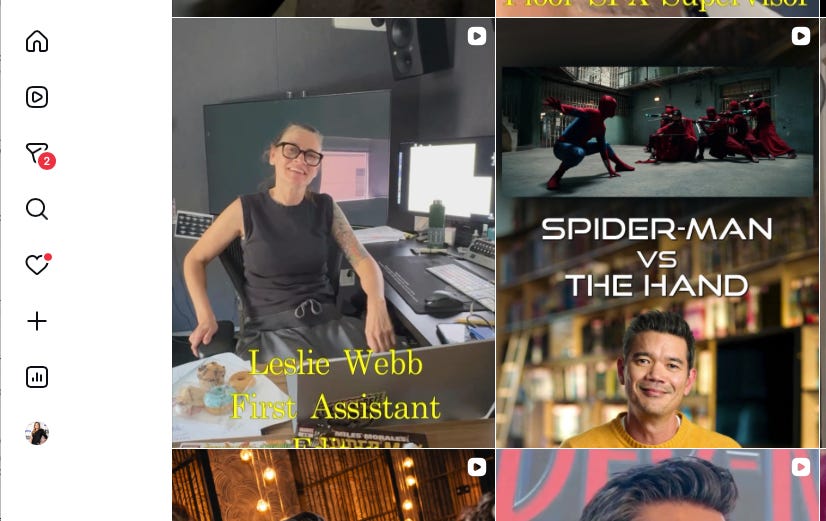
And in the same week a content creator Bella Roberts who is an assistant editor working her way up to the editor’s chair, was invited to interview Jason Sudeikis and Brendan Hunt, two of the creative minds behind Ted Lasso, about their work with editors Melissa McCoy and AJ Catoline, along with music editor Richard Brown, three names that would almost never get a spotlight. They were able to immediately think of a scene where the work in post production elevated the emotion way beyond what they had envisioned.
One thing I particularly enjoyed after watching the first episode of this new season, was seeing Melissa’s name come up on the credits as a Co-Producer. Which as an insider I can tell you that credit means she played a significant role in shaping the story in the edit as a whole and I am incredibly proud of the team for pushing for and giving her this credit. It is well deserved.
Comments
Nothing yet. Say the first thing.
Sign in to join the conversation.