
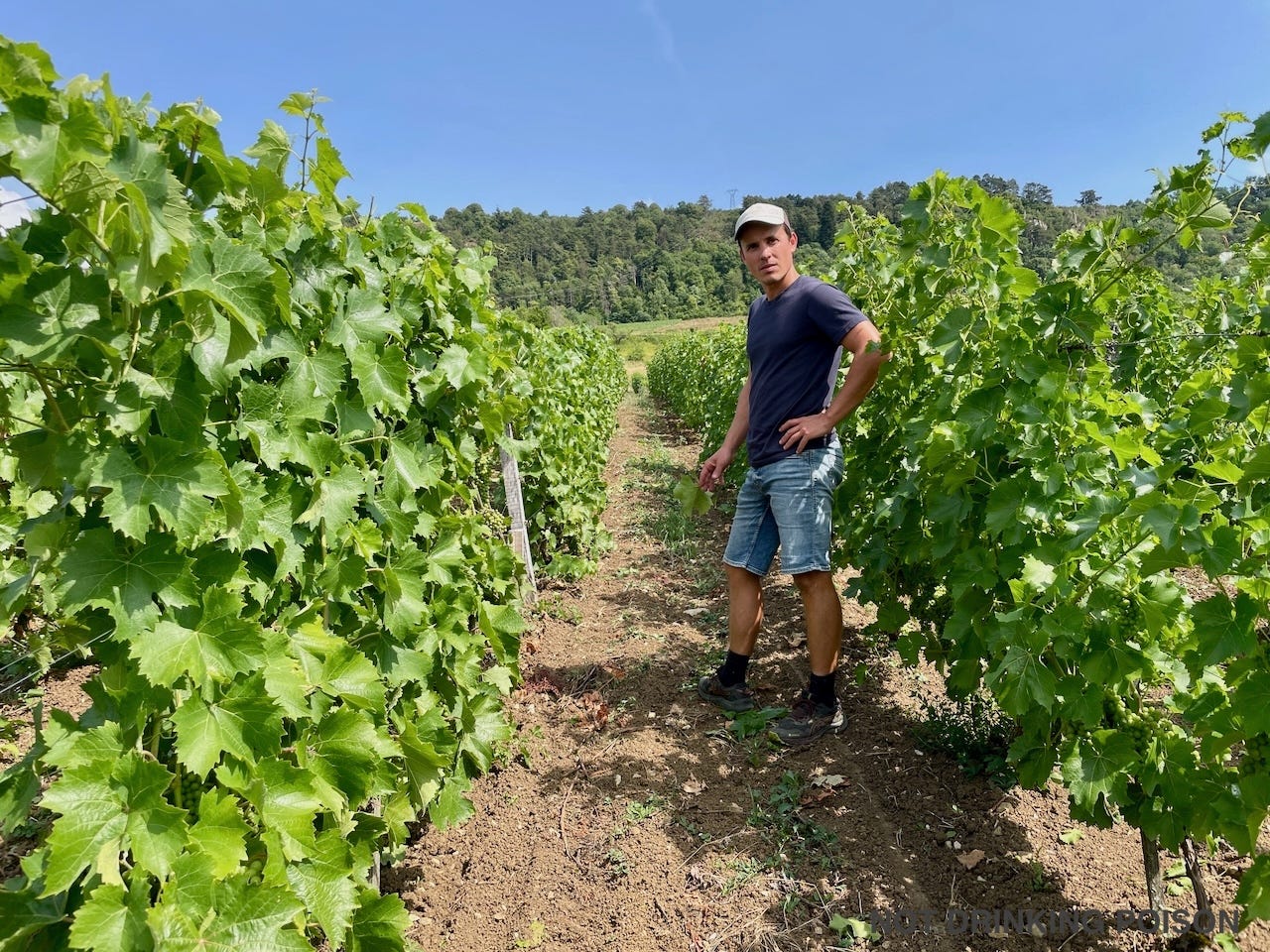
Poligny vigneron Valentin Morel has emerged in recent years as one of French natural wine’s foremost proponents of the adoption of hybrid grape varieties, alongside colleagues like Didier Grappe and Lilian Bauchet. Morel’s book, Un Autre Vin (Flammarion, 2023), now published in English (translated by yours truly) as Another Wine (TTC Editions, 2026) promises to bring his reflections on the potential of hybrid grape farming to a wide new audience - even as his own output of actual wine from hybrid grapes remains, by his own admission, quite limited. (There is a white, entitled “Hommage à La Canaille,” and a red, “Quand les Cigares y Changeront d’Bouche,” both minuscule in production.)
Morel studied international law and initially pursued a career at the Prefecture of the Rhône Department in Lyon, working as a legal officer for inter-ministerial coordination. His decision to follow in his father’s footsteps as a vigneron predates his discovery of the natural wine community, which he came to know only during subsequent viticultural studies at Rouffach in Alsace, where he found himself classmates with future Auvergne vigneron Vincent Marie and future Lorraine vigneron Stéphane Cyran. Nothing if not a quick student, Morel embraced natural winemaking wholeheartedly. He established his own estate, Les Pieds Sur Terre, in 2014, overseeing organic conversion of his father’s former vineyards and producing all wines without filtration, sulfitage, or other additives. Les Pieds Sur Terre today comprises 8ha of vineyards, of which 1ha consists of experimental hybrid plantations, of grapes including cabernet jura, solaris, seyval blanc, chambourcin, sauvignac, and souvignier gris, among others.
As a Jura vigneron advocating for hybrid grapes in an age of Jura-mania, Morel today finds himself - like his neighbor in Saint-Lothain, Didier Grappe - astride an ideological fault-line within natural wine circles. Scores of highly accomplished natural Jura vignerons would certainly prefer to sit back and enjoy the hard-earned acclaim nowadays accorded to Jura vinifera varieties like savagnin, poulsard, and trousseau. But Morel is not only more reflective than your average Jura vigneron, but far more apt to clearly communicate his reflections, often in political terms. It makes his career particularly exciting to follow.
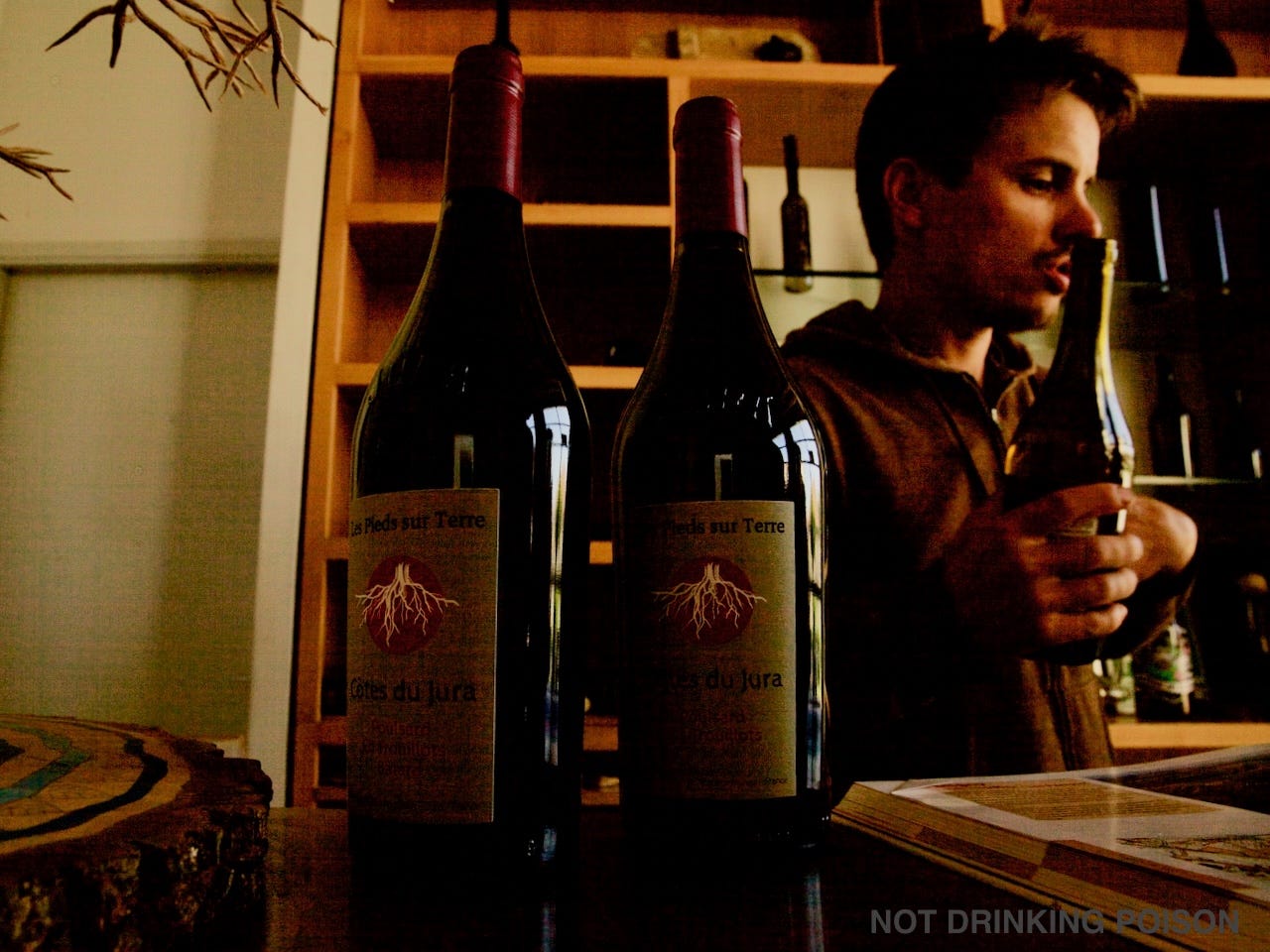
The following interview was conducted on July 15th, 2025. It has been condensed and edited for clarity.
NOT DRINKING POISON: Before taking responsibility for part of your father’s estate, did you work for other wine estates?
VALENTIN MOREL: No. I was working at the Prefecture du Rhône in Lyon, from 2010-2012. Then when I decided to change careers, I did a BTS (Brevet de Téchnicien Supérieur), because you’re not born with all the technical knowledge just from being a vigneron’s son. I did my studies at Rouffach in Alsace, and Vincent Marie was in the same class. He was doing internships with Patrick Meyer, and Bruno Schueller, and he explained it all to me. So it was thanks to them [that I got into natural wine]. All the Jura guys like Pierre Overnoy and Michel Gahier, I actually learned about them in Alsace!
Then when I came back to the Jura I didn’t know anyone. That all came later. Really what helped me was the association Le Nez Dans Le Vert. There’s really a spirit of solidarity and teamwork. They really helped me, with organic conversion as well.
So the estate wasn’t in organics when you arrived?
It was me who converted to organics. But my father had stopped using chemical herbicides in 1999. My father is an ecologist [in his way]. The problem is the Jura is still a rainy wine region, and he was sixty and he didn’t have the energy to convert to organics. So he still used systemic products for fungal maladies, oidium, etc. But the soil work was rather well done.
Having seen both treatments at work - systemic synthetic products and contact organic products - would you say the former are really more effective?
Comments
Nothing yet. Say the first thing.
Sign in to join the conversation.