

When I was just a theatre kid in my senior year of high school, my friend’s dad pulled me aside. He was the CEO of a publicly traded tech company and (surprisingly to me) genuinely interested in our theatre lives. Not just “what’s the name of the skit you’re working on” interested. He wanted to know our favorite acting techniques, our audition monologues, and the conservatory programs we were applying to.
“You know, my wife and I met in theater school.” He tells me one afternoon. “Best training we ever had for business. You’re going to make one heck of a businessman someday.”
I’d never felt so insulted in my life.
Because what I heard, obviously, was: you’re going to be one heck of a failed actor.
Fast forward a decade. I’ve got a theater degree from UCLA, a graduate degree in acting from Delaware, and I’m living my dream as an actor in Chicago when a grad school friend calls. She needs help with a professional development course for a company downtown and thinks I’d be a great fit. She says, “It’s basically about using an actor’s voice in a business leadership environment.”
I think of the insult from high school. I say yes.
She mentions the company’s name. It’s McKinsey. I say, “Who are they? What do they do?” That was my business acumen in 2007.
Turns out the “insult” bore truth. And as an Executive Coach over the past close to two decades — with clients on six continents virtually, five in person; having taught storytelling and leadership development programs at Harvard Business School and Harvard’s Executive Education programs — I’ve landed on this truth: the way you show up when you’re speaking says more about what you’re saying than the words themselves.
Most founders spend 99% of their prep time on what they’re going to say. I’m here to shift some of that focus from the ‘what’ to the ‘how’.
Table of contents
What “engaging presence” actually means
The 55-38-7 breakdown that changes everything
The inform paradigm is killing your pitch
Actor’s intent: the framework I use with every founder
What about the five-minute pitch?
Show up now
When I ask people what they notice when someone walks into a room with an engaging presence, I always get variations on the same list: eye contact, a smile, energy, the pace of their walk. Physical things. Visible things.
But the most important observation in that list is always the one you can’t see: how they’re listening. You feel it. You can’t put your finger on it, but you can tell when someone is genuinely tuned into the room versus when they’re waiting for their moment to speak.
There’s something else, too. When someone is truly engaged, it’s contagious. They smile, and then you’re smiling. They lean in, and the whole room leans in. One person’s presence can lift the energy of everyone around them — not because they performed, but because they were present.
Some of the traits we associate with engaging presence — warmth, expressiveness, ease in a crowd — do come more naturally to extroverts. I won’t pretend otherwise. Getting your energy from connecting with other people gives you a built-in advantage here.
But some of the most compelling communicators I’ve ever encountered are deeply introverted. And what I’ve found is that when an introvert chooses to show up with that kind of presence — because it doesn’t come instinctually — the impact is often more powerful. People can tell they’re making an effort. It lands differently.
Decades ago, a Professor at UCLA named Albert Mehrabian conducted a fascinating study which, in essence, answered the following question: What allows communication to last in the absence of the speaker?
Is it the content itself? The power of your voice? Your body language?
He found it wasn’t equal. It was 55% body language, 38% voice, and 7% content.

My wife is a statistician. She was not pleased when I showed her that slide. Yes, it makes it look like you can ace the test with barely any content at all!
But that’s not the takeaway. The takeaway is this: the 93% — how you use your body and your voice — is what gives your audience access to the 7%. It’s not either/or. Your delivery isn’t separate from your content. It’s the vehicle for it.
Here’s the problem I see in almost every pitch, every board presentation, every keynote: founders spend the overwhelming majority of their prep time on the content side. The deck. The data. The structure. And then — maybe — at the last minute, there’s a passing thought: “That guy in the webinar said something about gestures. Maybe I’ll try that.”
A small shift here can make a massive difference. What if you spent 93% of your prep time on the content instead of 99%? And then spend the rest on how you’re going to use your body and voice to connect with the room?
I’d be out of a job. But your pitch would be a lot better.
Let me show you what most decks look like as a communication framework:
Present the problem. Explain why it exists. Show the current market solutions. Explain why they’re failing. Provide evidence that customers are desperate for a change.
Present. Explain. Show. Explain. Provide.
Read that list again. Notice anything? There’s no change. It all sounds the same. And if how you’re saying things isn’t changing, you’ll lose your audience’s attention.
This is what I call the inform paradigm. And it’s where most founders live by default.
Now compare it to this: Instead of presenting the problem, you invite your audience to experience the problem. Instead of explaining why it exists, you alarm them. Transform your deck from one that informs to a story that moves your audience to action.
When actors approach a piece of text, they don’t ask: Should I say this line loudly or softly? Should I slow down here? Those are self-focused questions. They get you in your head. And the moment you’re in your head, you’ve lost your audience.
Actors ask a different question: how do I want this person to feel?
I’ve been using this technique — what I call actor’s intent — with founders for close to a decade. The idea is simple. Before you speak, don’t think about delivery mechanics. Think about your intention with the audience. Do you want to challenge them? Intrigue them? Alarm them? Encourage them? Command them?
I have a thesaurus of action verbs that I literally use as my mouse pad. It’s that central to my work.
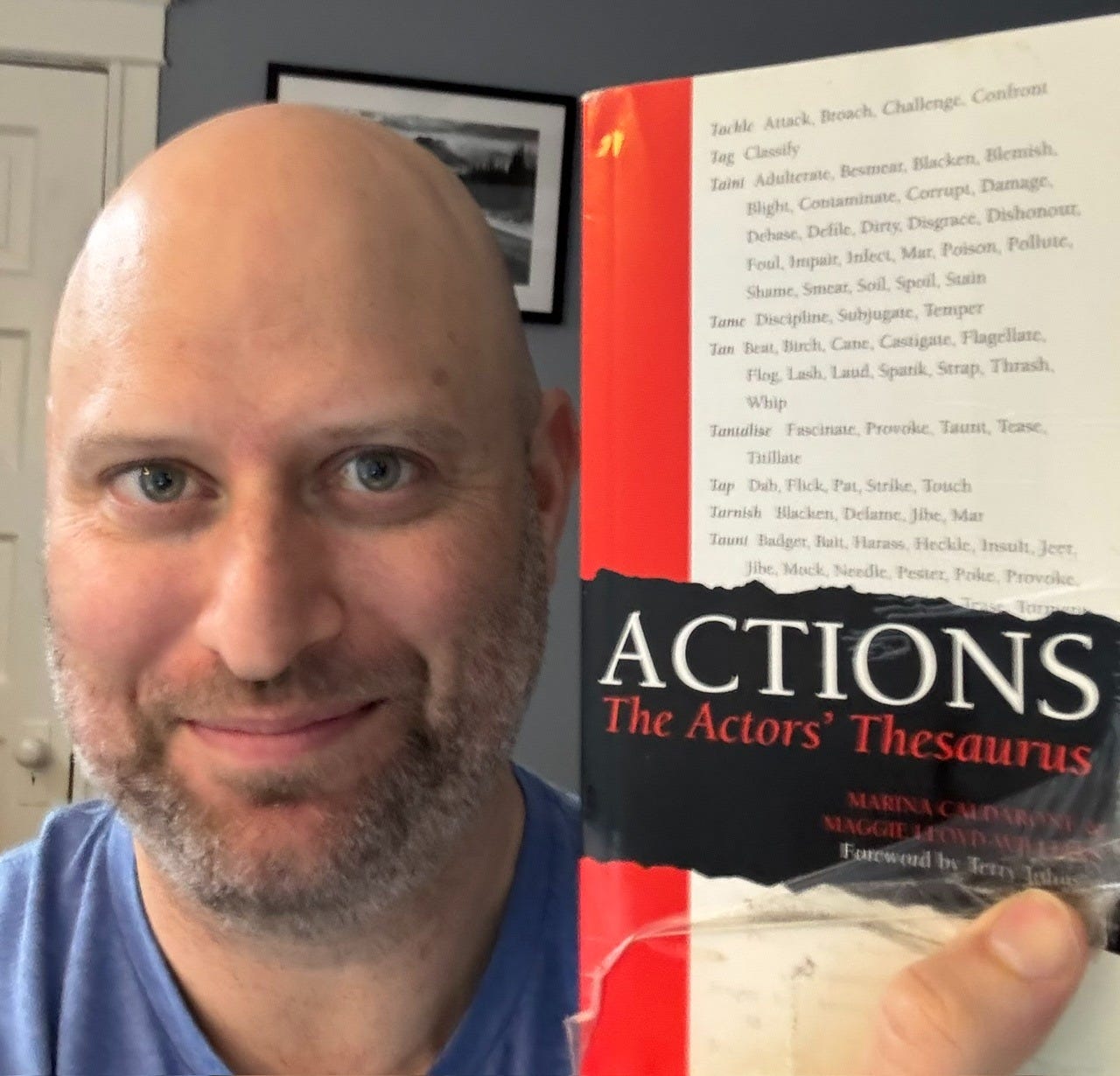
The verbs on that list aren’t neutral — they’re alive. When you speak with the intention to alarm someone, something changes about how you use your body and voice without you having to think about it. The intention does the work.
But here are two words that are specifically not on my curated list: “inform” and “educate.”
Those aren’t intentions, they’re outputs. They tell you what you’re delivering, not how you’re connecting. You can inform someone by encouraging them, intriguing them, or even amusing them. But you can’t just decide to “inform” someone and expect your audience to feel anything.
One of the founders in the masterclass I recently did on this topic with Not Another CEO walked me through his opening pitch. It was clear, well-structured, and forgettable. He hit all the right points. He told me about his company, their tech, their enterprise clients. Clean. Logical. Completely in the inform paradigm.
So I asked him: why do you care about this problem? He’d spent time as a head of marketing working with agencies. I pushed him to get specific. What made it hell?
He lit up. He told me about being bombarded with 40-page PDFs full of vanity metrics. About agencies hiding their failures. About feeling confused and helpless while watching consumer marketers just... thrive.
That’s a pitch. That’s a person. The information didn’t change, the humanity did.
When I asked him to redo the opening with that foundation, he started with: “I remember when I used to be in your shoes.” Six words. Everything changed. As one participant put it: “It completely shifted from here’s someone trying to sell me something, to here’s someone trying to help.”
In another moment from the session, a founder was pitching his AI consulting practice. His default was to encourage and excite, and he did it beautifully. But his warmth was so consistent that it created a kind of flatness. There was no change.
I asked him to try a different intention: command. Tell your audience they need to act now. Make them feel urgency.
He was uncomfortable with it. Command felt out of character, almost aggressive. But he tried: “All of us are going to be replaced: either by AI, or earlier by someone who is using AI. Your business will be disrupted by newcomers who build everything with agents. If you don’t do it now, your lunch will be eaten by someone else.”
The room felt it. Someone said there was conviction — and that they felt compelled to hire him, not scared of him. Another said: “I actually felt urgency.”
The CEO’s reaction: “It’s a little hard, but I’m sure I can get used to it.”
That discomfort is the point. If you only pull from a handful of intentions, you’re not creating change. And without change, your audience drifts.
Almost every time I do this work, someone asks: can introverts actually do this? Is this just a personality thing?
Here’s my honest answer: there’s probably a built-in advantage for people who get energized by connecting with others.
But I’ve watched introverts become exceptional communicators precisely because they’re so purposeful about it. When someone who doesn’t always lead with warmth or energy shows up with both, it lands harder. People feel the effort. They feel chosen.
One of the more practical questions I get is about time. If making it personal takes time — if you’re reenacting your origin story, building geography between pain and solution — how does that fit in a five-minute window?
A few things.
First, you need different versions. Two minutes, five minutes, 10 minutes, 30 minutes. Know what you’re cutting and why for each.
Second — and this is crucial — I don’t want you to do your whole pitch in five minutes. I want you to leave breadcrumbs. The goal of a short pitch isn’t to cover everything. It’s to make someone want to ask you questions. If you’ve made them feel the pain, and you’ve hinted at your traction, and you’ve told them you’re raising to get from 10 logos to 100 — that’s a breadcrumb. The phrase “tell me more” is worth more than another minute of you talking.
Here’s the uncomfortable truth about why VCs give you five minutes: people are not good at pitching. And so investors do the worst thing possible — they give you less time, which makes the pitch worse. Your job is to be good enough that investors want more time with you.
And you will hear ‘no’. A lot. But that’s part of the job. Your job is to pitch. Your job is to be comfortable hearing ‘no’ while being confident you’ll hear ‘yes’. And when you get your ‘yes’... you get to go back to your job of running the company.
What I’ve learned from working with thousands of leaders across six continents is that the people who move rooms — who close their Series A after months of struggle, who turn skeptical VCs into believers, who get their teams to actually follow them — are not the ones with the best decks. They’re the ones who’ve learned to show up.
They don’t perform. They don’t fake it. They show up authentically.
In Mike Lipkin’s words:
Who you are being when you’re saying what you’re saying; says more about what you’re saying than what you’re saying.

You already know how to access an engaging presence. You’ve done it. Think of the conversations where you felt fully alive, where the room was with you, where time disappeared. That version of you is already there. The work is learning to access it on purpose — with a VC who’s seen a hundred pitches this week, in a board room where the stakes are high, in a customer call where you need them to feel the problem before they’ll ever buy the solution.
If this work interests you, I’m easy to find. My email is markdannenbergcoaching@gmail.com, and I’m always happy to connect with founders.
No posts
Comments
Nothing yet. Say the first thing.
Sign in to join the conversation.