
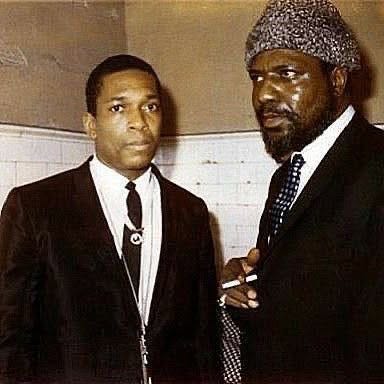
I’m no John Coltrane scholar, but I have participated from my moon base here in North Philly. When I first arrived from NYC 4 years ago, I was asked to do a talk on Coltrane’s astrology chart at a Coltrane symposium. I’m playing at a Coltrane tribute here on September 19th. I often think about how Coltrane made the move from Philadelphia to NYC, while I made the move from NYC to Philadelphia. When I play NYC now, I travel what has been dubbed “The Coltrane Commute” but in reverse. I was just there last night with Ras Moshe Burnett. When I was working for Instacart, I ended up with a delivery right near Coltrane’s Philadelphia house. It was raining hard, but I pulled up and took pictures. The well known row houses in Philly and Baltimore, that’s what Coltrane had, and that’s what I live in now, a row house. I’ve learned the folks here are very proud that Coltrane came up here. I did another delivery and had Coltrane playing softly on my phone in my pocket. A nice older lady opened the door and she instantly sang his name, telling me that when she was a kid, Trane and his friends would be practicing in her kitchen!
I’ve been drawn to take a closer look at Coltrane’s time in Philly before New York. To think he was making this commute to work for Dizzy Gillespie and Johnny Hodges while battling a heroin addiction boggles the mind.
It started with Coltrane joining Dizzy Gillespie’s big band in September 1949, to play lead alto. Paul Gonsalves was the main tenor soloist as I’ve chronicled here in my stack. Dizzy was playing commercial material but still making it hip, as a mater of survival. In his book To Be or Not to Bop, Dizzy said “The bebop fad ended because the press could kill anything it created.” As he elaborated, “Our music, modern jazz, continued and grew. Miles ushered in an innovation that the press immediately smeared with the term cool jazz.” When Dizzy had to downsize in June 1950, 24 year old Coltrane got the call to join Dizzy in a small group on tenor saxophone.
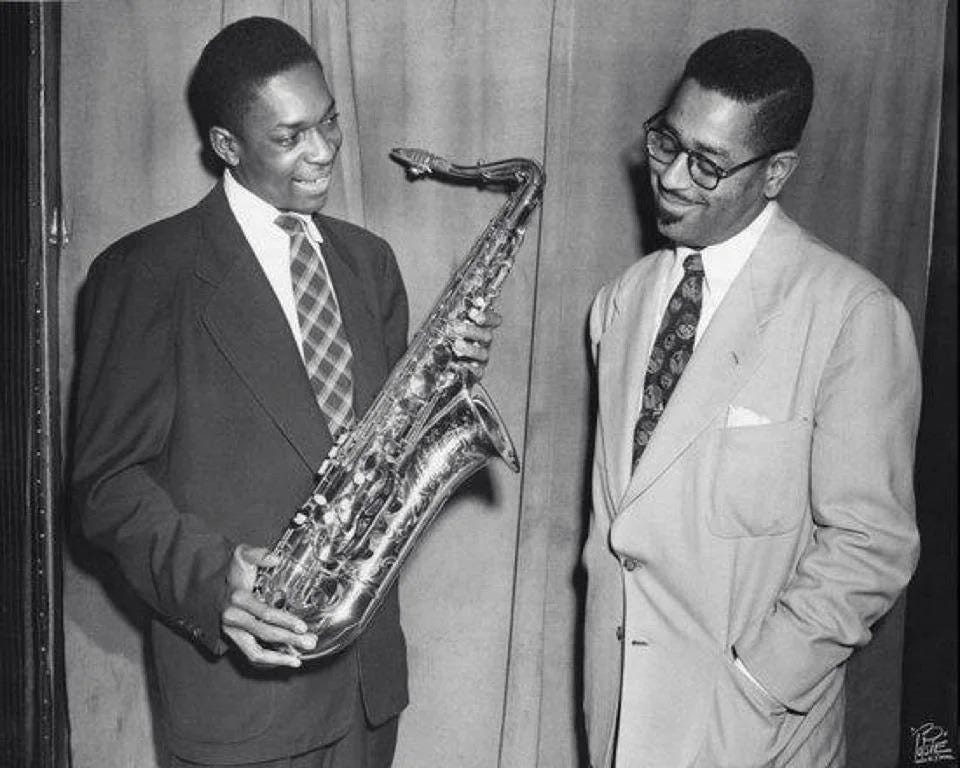
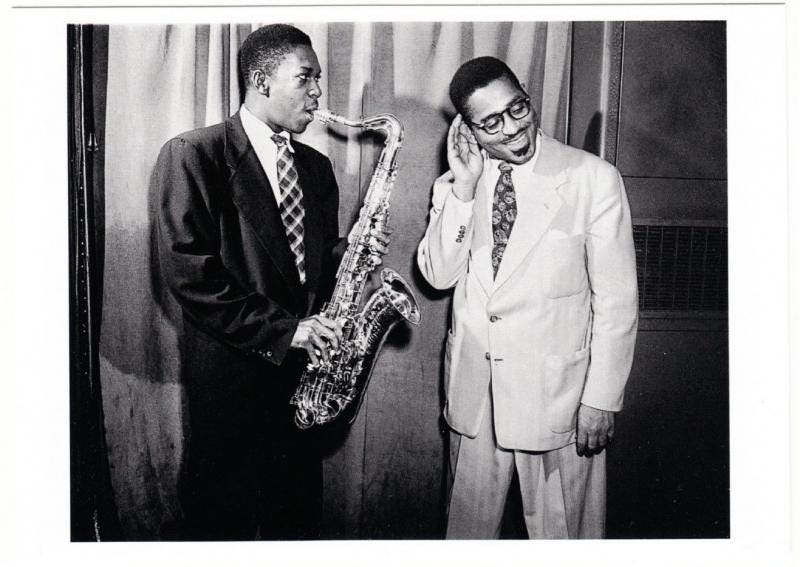
From January 1951, we have a live broadcast of Dizzy and Trane. Right off Dizzy is burning it up, and Coltrane holds his own with fluid chops with a Bird influence. There is where I had to immediately pause and consider that Coltrane was essentially in Bird’s chair. While Bird and Diz were working independently of each other in January 1951, Diz had Trane, and Charlie Parker had one of his last live performances with Miles Davis at the Hotel Diplomat. Proof that this is Miles here can be found by listening to April in Paris, and what a trip to hear Bird play Caravan!
Back to Coltrane with Dizzy, he was entrusted with the break and solo on Tunisia. The urgent vocal upper register sound that we know from Trane is there as he meets the moment. On Birk’s Works, the advanced harmony hasn’t arrived yet, but that sound and feeling is Trane. The real trip is to hear the strong influence of Dexter Gordon. Coltrane was open about it, but it’s striking to hear it so clearly. In March 1951, Coltrane was in the studio with Dizzy for We Love To Boogie. Coltrane has the lead solo, and the first chorus is all him. I was struck to hear a Pres moment on the second chorus. While the Dexter and Pres influence moments are present, they are isolated, and Coltrane worked through them. I’ve read commentary like “Coltrane wasn’t Coltrane yet” I disagree. His sound and rhythm are there. He was growing in search of truth through his craft. Incredibly, also in March 1951, is the time Miles Davis hired both Coltrane and Sonny Rollins (with Bud Powell and Art Blakey!) for a dance job at the Audubon Ballroom.
From the book Coltrane on Coltrane:
“See, I stayed in obscurity for a long time, because I was happy to play what was expected of me, without trying to add anything. I saw so many guys get fired from bands because they tried new things that I was somewhat disgusted to try anything else! I think it was with Miles Davis, in 1955 that I started to realize what else I could do.”
“What I didn’t know with Diz was that what I had to do was really express myself.”
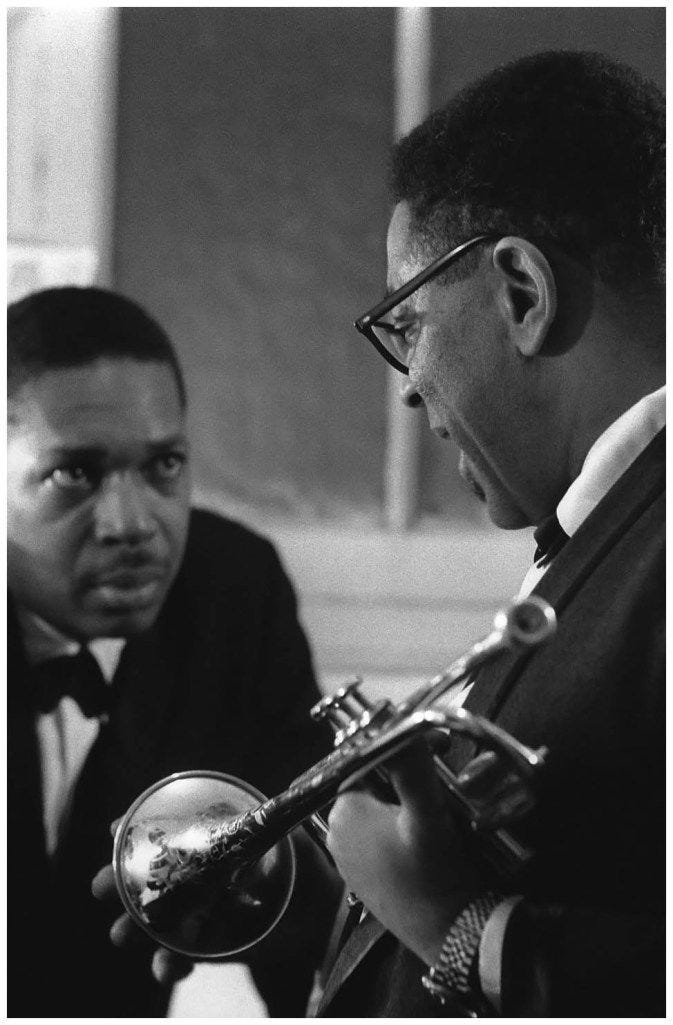
10 years later in 1961, Coltrane as a leader was paired with Dizzy for a European tour. Though he was more fully actualized, the learning continued:
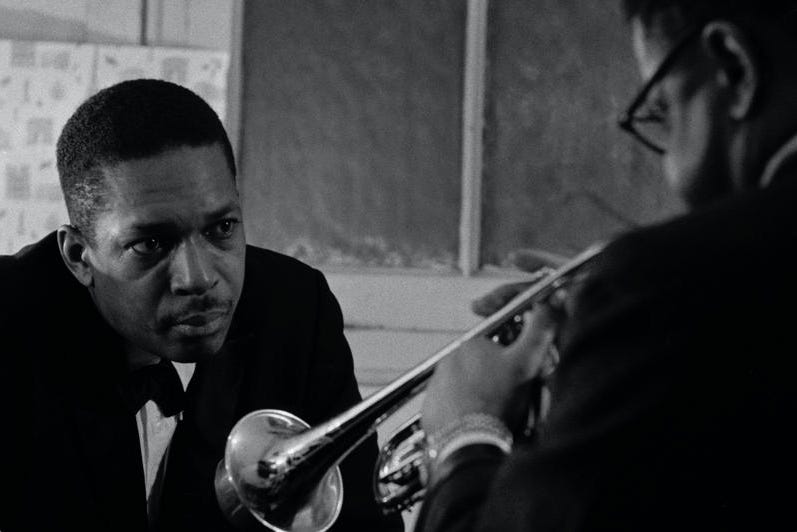
While still living in Philadelphia and working in Philly and NYC, Coltrane joined alto saxophone king Johnny Hodges in the Spring of 1954. Hodges had left Duke Ellington from 1951 through 1955. While Coltrane didn’t record solos in the studio, a live date exists from that summer, believed to be in California. Coltrane was hired as the only other saxophone (tenor) and expected to play a specific contrasting role. Here was 27 year old Coltrane with the Ellington greats Hodges, Shorty Baker, and Lawrence Brown, but without Duke. Incredibly, Call Cobbs, the piano player known from playing with Albert Ayler much later is on piano.
On Thru for the Night, a laid back strut, after a mellow solo by Baker, Coltrane plays double time swing, leaving almost no space, in sharp contrast to the older guys. Hodges was in his mid 40’s. It’s an aggressive move and Coltrane is getting closer to himself.
Castle Rock will make you flip your wig. One of the expectations of the gig, a rhythm and blows blow out. It’s well known that Trane walked the bar as a working musician, but here you actually get to hear him do it, standing with the ex-Duke low key renegades. The low B-flat SLAMS and the BIG BLUES on top, Trane does the job. The thing is you can hear that’s it’s him doing it. As ever, when Coltrane held out notes in the upper register, his voice is unmistakable.
Back to the mellow strut, on In A Mellow Tone, Coltrane follows solos by Hodges and Baker. He’s still amped from Castle Rock and swoops in with loud swing playing. Some of the phrasing we know from his later years comes through with a little of his sweeping double time towards the end. Lawrence Brown follows right in the pocket with his complete uniqueness. Another mind bender is that after all that blowing, Hodges gave Coltrane a ballad feature on Don’t Blame Me. I was again struck by the vibrato and still present shades of Dexter Gordon. It’s a short and somewhat declarative, semi-dramatic rendition, a pleading to not be blamed. There are absolutely shades of Trane here.
In the book Coltrane on Coltrane again, Trane spoke about the experience.
“I enjoyed it. Yeah, I enjoyed it. Yeah, we had some true music, you know. [ Laughs ] Lawrence Brown, I like him immensely.”
“We played honest music in this band. It was my education in the older generation.”
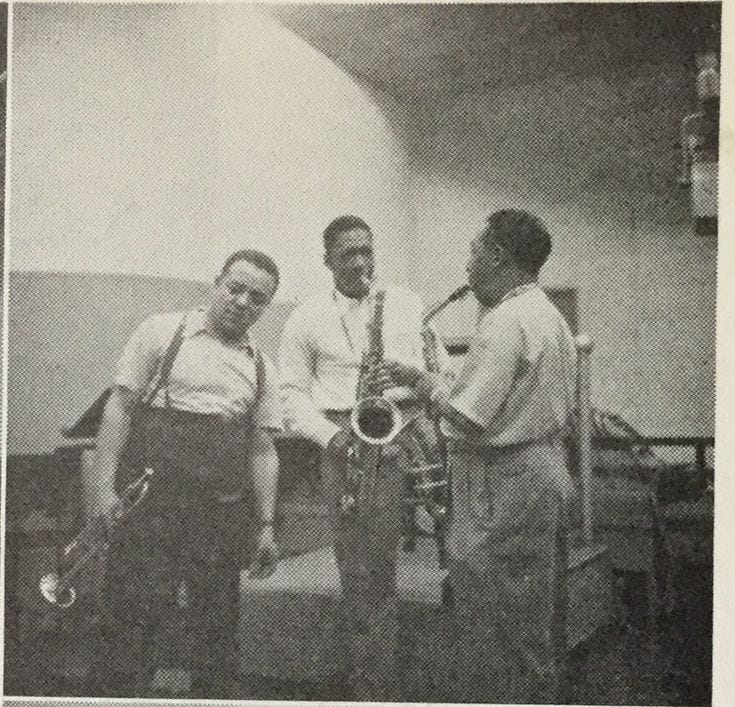
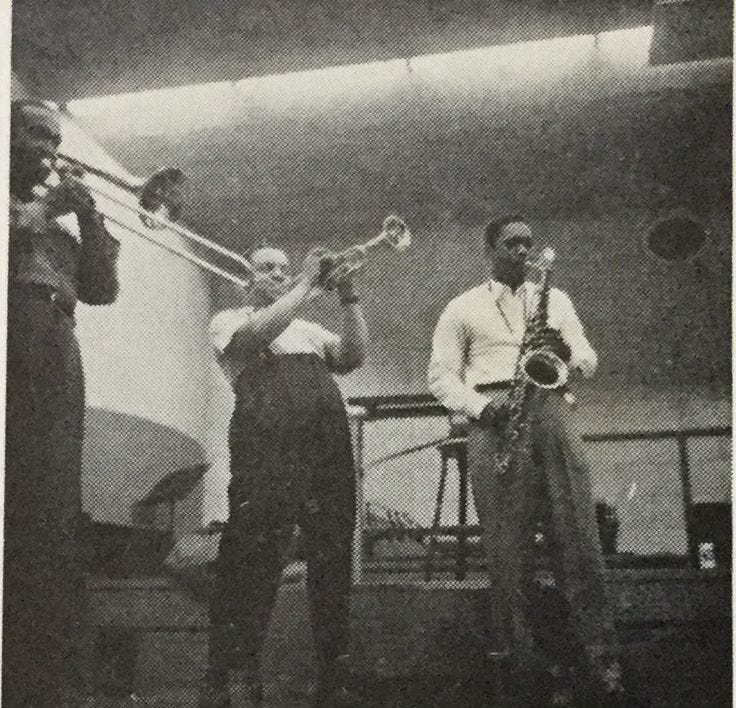
Coltrane is on record saying that Hodges was his first inspiration on saxophone. Years later after Coltrane recorded with Duke Ellington, Johnny Hodges, who had put an indelible stamp on the composition In a Sentimental Mood as a member of the Ellington band, told producer Bob Thiele that Coltrane’s version was “the most beautiful interpretation I’ve ever heard.” – Ted Gioia.
To think that after Dizzy Gillespie and Johnny Hodges, Coltrane was still growing and seeking guidance. Miles Davis and Thelonious Monk were next, as is well documented. Only then did he truly plant his flag after the crucible with Miles.
John Coltrane had no time to waste, and he felt he had already held himself back battling addictions. When asked about his astrology he said:
“I have my moon in conjunction with Mars In Taurus, in direct opposition with Saturn, the deadly planet, in Scorpio, the sign of death! Also I have my ascendant and my Venus in the sign of Virgo; three bad aspects of my birth chart. I won’t live to be very old!” (John Coltrane His Life and Music by Lewis Porter p-256)
I’ve placed the last sentence in italics myself, as this is a haunting statement. Just how much of this belief did Coltrane carry as part of his music? He was right of course. Death is the most elusive mystery of astrology and life, but on some level, had he accepted that he only had a short time to exist here? His legendary practicing makes sense from a perspective like that. The astrology supports his statement on his later music that he had no choice other than to play it. It’s the sound of extreme transformation. Here’s a good time to pass the baton to Lana Jackson at The First Wave.
People are receiving John Coltrane’s messages today more than ever. If the world is truly experiencing a spiritual awakening, then his music is right there for people that are ready. While he was canonized in 1982, I feel that John Coltrane lived a life of profound humanity. He spent many years studying, practicing, and seeking guidance. Can anyone in jazz conceive of the idea that Dizzy Gillespie, Johnny Hodges, Miles Davis, and Thelonious Monk were all his on the bandstand mentors? Has anyone been more ready than John Coltrane when he formed his great quartet? As is well known, his search continued right into Interstellar Space.
I have not modeled my life after John Coltrane, but I cant escape the parallels. Hildred Humphries, Roy Campbell, Sabir Mateen, William Parker, William Hooker, Guiseppi Logan, Bern Nix, Daniel Carter, Charles Gayle and Ornette Coleman were and are all in person mentors. I’m here in Philadelphia playing in Philly and NYC. At 56 I’m ready for my own bust out. Even though I’ve always had a full time job, I came here to actualize my music as well. I’m not on a timer though, or am I?
Either way, I don’t worship John Coltrane. I see his life as a testament, a creed:
Do the work.
Discover the truth.
Get better every second of every day.
TBC at the Vision Festival 6/28 with Daniel Carter and Black Octopus. I joined three other musician-writers to write about DC here.
For the Rose.
No posts
Comments
Nothing yet. Say the first thing.
Sign in to join the conversation.