
Through my relationship with Mahakala Music, I continue to encounter devoted musicians that are not on the NYC or Philly scenes. Here’s to the musicians holding it down in Baltimore, Washington D.C., Boston, Detroit, Minnesota, Los Angeles, Memphis, the mid-west, and beyond. Over the years I’ve seen many musicians pass through the NYC scene and tap out as a matter of survival. After an experience like that, some eventually let their music quest fade. I’ll never forget a guitar player I met working at Tower Records who after 2 weeks of living in the city hit a wall and bounced, never to return. I’m not throwing shade on NYC (Congrats KNICKS!) My people there are still on the front line and finding a way, and Mamdani is on fire like a great transformative musician. I see him as the first true leader of a future that we all have no choice but to reach. Mamdani is changing without destroying, he’s building, not breaking. Back to music, there’s a long history of musician survivors that existed underground most of their lives in NYC. Whenever this subject comes up when I’m with my fellow music practitioners, the name Ken Simon will always come up. Ken would want people to remember his music, not his appearance on The People’s Court, his getting fired by Cecil Taylor, or how he terrorized us at the Sam Ash counter over reed discounts. The stories about Ken are legendary and I need a full stack to flesh it out.
There are also very special musicians who build, develop, and practice their craft without ever having the need to live in the NYC cauldron. Musicians who plant their creative flag outside the big scenes doesn’t mean that they’re not a vital part of the music. Here’s the great Aaron Martin Jr. leading off The 12 Houses play the Blues right next to and before the late great Claire Daly. Aaron would make the trip all the way from his home base in Washington, D.C. to play with us. He had a deep history there. Hasan Abdur-Razzaq was a great alto saxophone player based in Columbus Ohio, both a prolific visual artist, and a lifelong devotee and practitioner of free jazz. Razzaq comes from the Cleveland scene of the late 1960’s that produced the Ayler Brothers, and cellist Abdul Wadud, amongst others. I hope folks will take a listen.
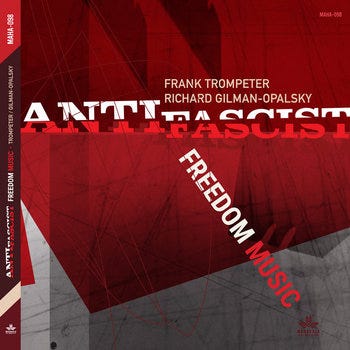
Coming down the pike on Mahakala, I’ve encountered saxophonist Frank Trompeter and drummer and percussionist Richard Gilman-Opalsky and their new album Antifascist Freedom Music. Richard was in NYC for a period and crossed paths with my friend Ras Moshe at a music protest. He was also on the ABC No Rio scene. Life called him to Springfield, Illinois. Richard was hesitant to leave without knowing he could keep playing his music out there until he discovered Frank, where as he described it, they felt an instant fire connection. Frank is a Chicago native and into Mars Williams. Upon first listen, I felt an extreme intensity coming from the duo. I in fact heard a level of urgency that I rarely encounter even in the NYC underground to be honest. This music is not about exploration and abstraction of sound. As Richard explained, he wished that the music could be force listened to by the ICE murderers right before the executions of Renee Good and Alex Pretti, and that the music would have made them lay down their guns. Richard said that when they hit the studio, George Floyd, Renee, Alex, and the reality of Chump’s America was on their mind and boiling over. The recording is very much an in the moment flashpoint reaction. Richard noted that Fascists hated jazz and that he plays percussion instruments that were banned in Nazi Germany.
In contrast to the energy of the music, on our interview Richard sounded peaceful but just as serious. He side he gravitates towards music that pushes and leaves you empty. He tries to separate and protect the music but is getting comfortable with musical honesty. Richard cited Sun Ra as an inspiration and said he believes in the idea of music for a different world. Ra seemed to not only point out out that he wasn’t part of this world, but that somewhere out there is what the world could be if we could dispatch all this hate and ignorance. Richard cited the great David S. Ware and Milford Graves as profound influences in musical and spiritual honesty, and in being unstoppable forces of music. Richard also loves the wizardry of the great drummer Marc Edwards. He also cited Charles Mingus album Let My Children Hear Music. He opposes people not stating overtly that jazz is Black music, and the fact that all musicians today, by and large, their hero’s are Black. Besides teaching political theory at the University of Illinois, Richard teaches revolutionary politics in prison. In prison he’s seen that no music is allowed as the goal is to inflict pain on the inmates non-stop. Richard himself plays music every day, admittingly at times as self-therapy. He describes himself as a lifer in the music liner notes and knows in his heart that he is never going to stop.
Frank Trompeter believes in what America could be, which led to the piece titled Lift Every Voice and Scream, where he deconstructed the Star Spangled Banner. Frank plays soprano, alto, and tenor saxophone on the album. He is a full time believer in his music with Richard as evidenced in the title on the piece Another Twenty Years. This piece brings out Franks soprano voice starting on a peaceful island within the maelstrom before the crashing tidal waves are summoned.
You can join Richard and Frank on the front line on Antifascist freedom music, released fittingly on July, 4th 2026. Repeated listening is suggested to digest the depth. There’s 2 kinds of records. Those you hear once and you’re good, and those you come back to, the ones that are on to something, possibly something the listener can discover about themselves in the process. The music here calls you back.
To bring it full circle back to the off the grid music warriors out there, Richard hipped me to the incredible alto saxophone of John Gruntfest, also known as “Waveman.” Gruntfest has been out there living the music since the 60’s. He told Richard he gave up on recognition and decided to focus on the music long ago. Upon listening to Gruntfest, I heard a level of alto I have only heard reached by Sabir Mateen. In my own life my closest collaborators have all given their lives to music, no matter the cost. Speaking of, I just played with Philadelphia tenor legend Terry Lawson last night at the Black Squirrel. TL is one of my main music partners here in Philly. Terry toured with Roy Haynes back in the day, playing Slugs, and the legendary Apollo theater. Like everybody in my stack today, Terry is music from then, now, and forever more. Here is Terry on fire with Jamaaladeen Tacuma, Mary Halvorson and Tomas Fujiwara!!
Finally, I’ll be with Daniel Carter, in celebration of DC, to close out the Vision Festival this year. Next stack I’m going back in time again to take a closer look at John Coltrane with Johnny Hodges and Dizzy Gillespie.
For the record, I may use A.I. as a research tool, but I will never, ever, let A.I. write for me. Subscriptions are both needed and appreciated.
Peace
ML
For much much more on free jazz history in Cleveland and Detroit, check out the book I Hear Freedom by Cisco Bradley
No posts
Comments
Nothing yet. Say the first thing.
Sign in to join the conversation.