
I’ll be talking about Atlantic Yards at about 11 am on Wednesday, Aug. 12, on WBAI, 99.5, on Living for the City, hosted by Michael Haskins. My segment should last about 30 minutes.
Since the “Town Hall” Q&A (my coverage) on July 13, it seems like Atlantic Yards (aka Pacific Park) has entered a lull, with no publicly announced events or new documents.
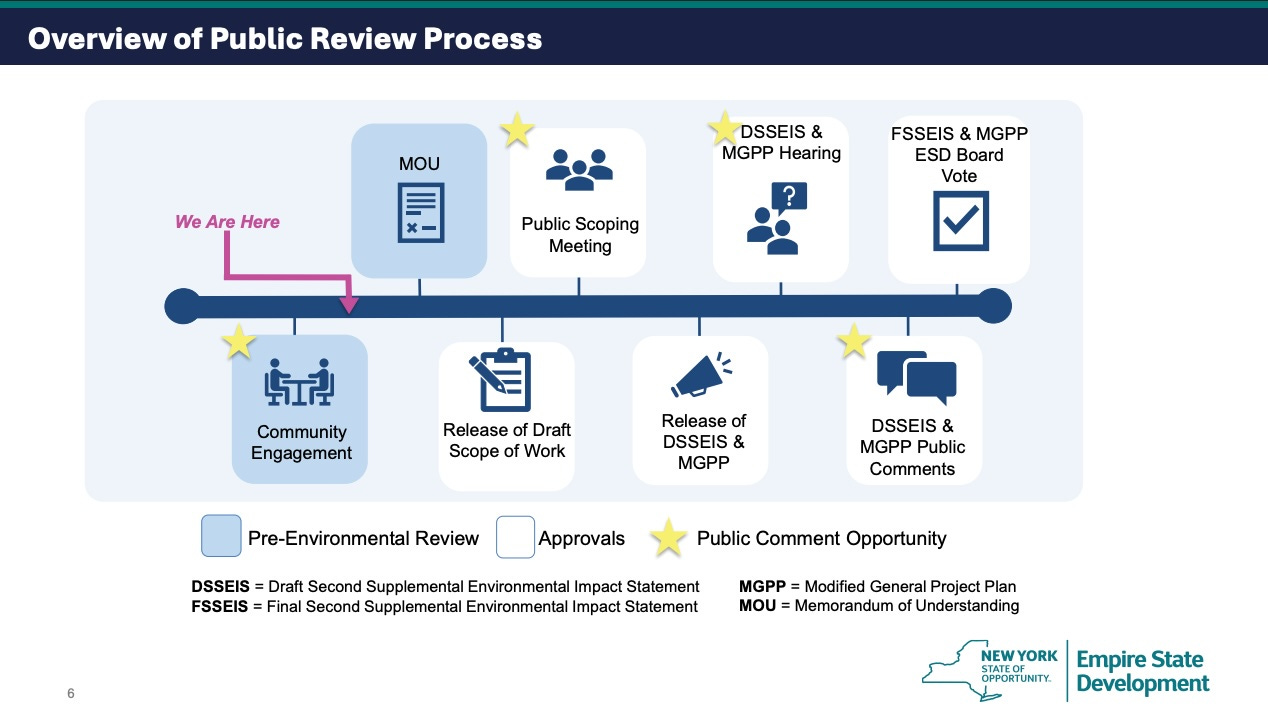
Actually, much is happening behind the scenes, positioned to move the project forward, with an 18-month public review process set to start at the end of the month.
That could mean construction starts in 2028, with the first building—or buildings—with 25% low-income affordable units opening as early as 2031.
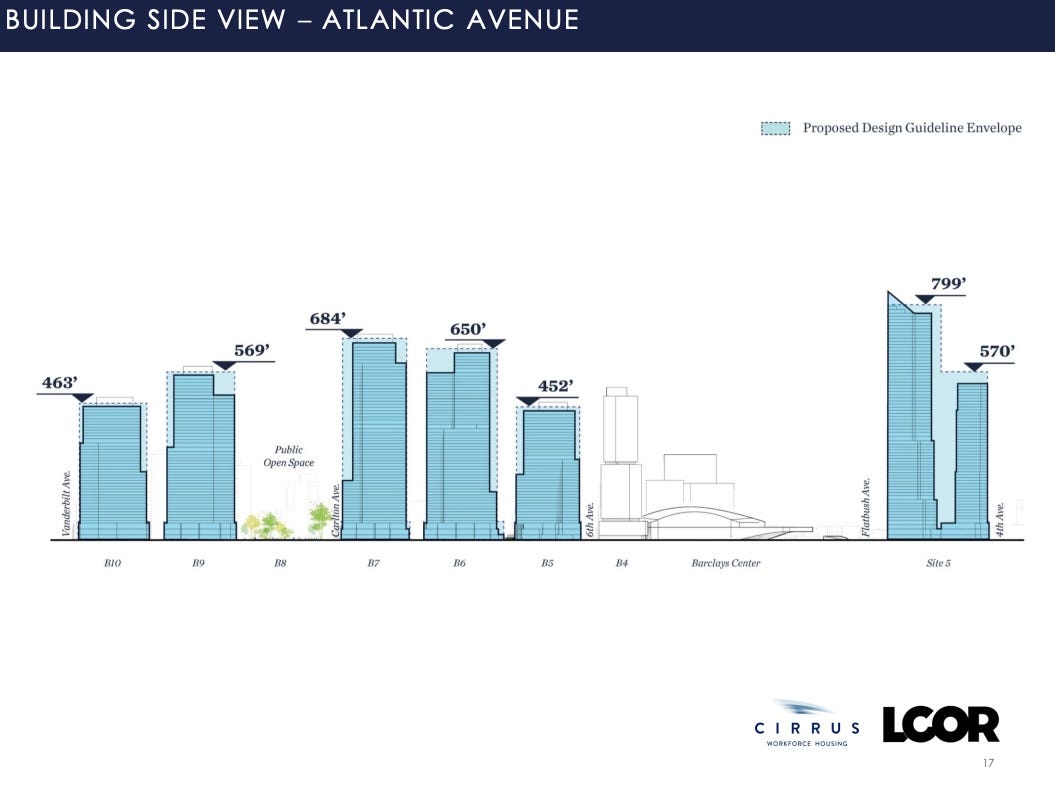
Quick recap: developers Cirrus Workforce Housing and LCOR, who took over the stalled project last October, aim to make it viable by adding 1.6 million square feet and 2,382 apartments beyond the originally approved scope.
They plan seven larger towers across six parcels, adding 5,600 units to the 3,212 already constructed, for a total of 8,812 apartments. (A total of 6,430 units is currently approved.)
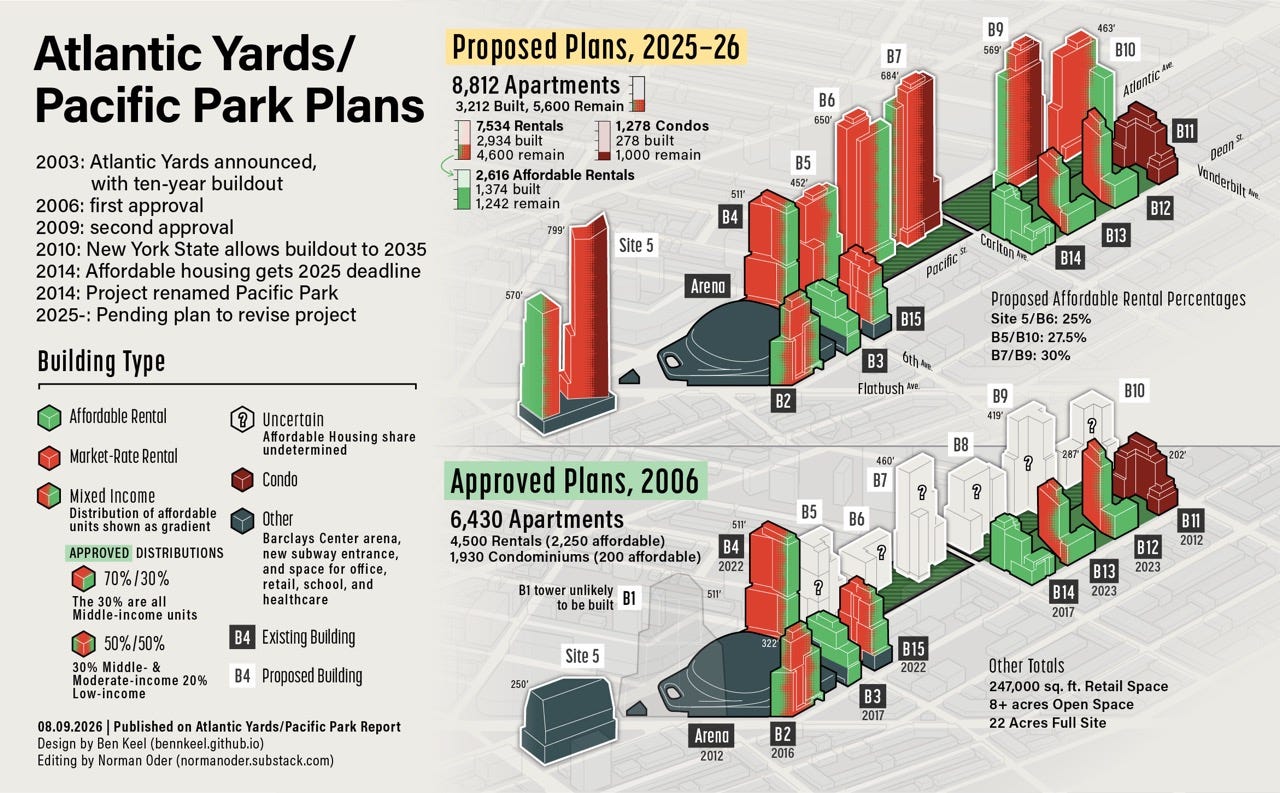
Among the 5,600 apartments, 1,242 would be below-market affordable units. However, that would deliver only 366 more than the 2,250 units approved in 2006, for a total of 2,616.
Among the 5,600 apartments, 4,358 would be market-rate. That would deliver 2,016 more units than the 4,180 approved in 2006, for a total of 6,196.
So the new bulk and subsidies, said to be justified because of the complex site and the challenges of building over a railyard, would disproportionately support market-rate apartments.
Their plans rely on New York State granting an indirect subsidy, 1.6 million square feet of additional bulk, plus $700 million in direct subsidies—of which $175 million has been approved—to build a two-block platform over the railyard.
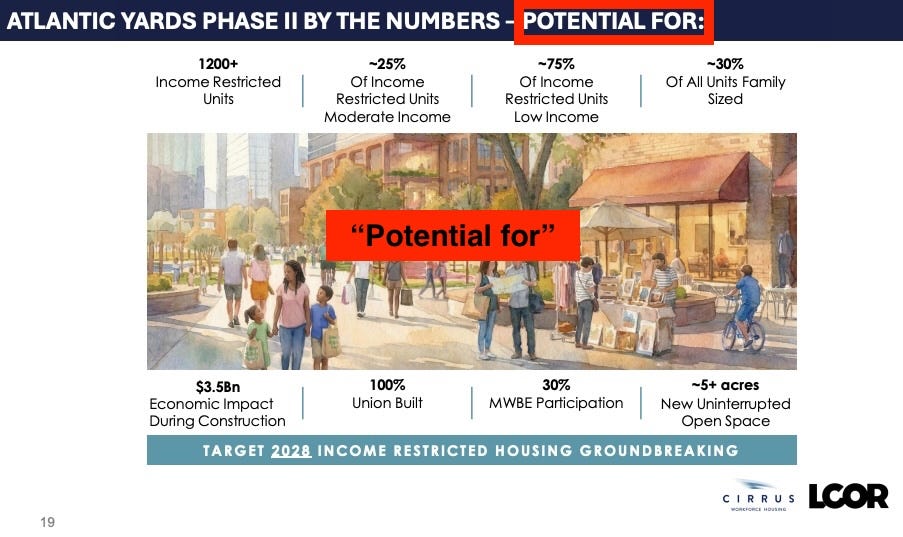
At least that’s what they say, including that best-case opening by 2031 and project completion by the end of that decade. After all, the developers’ own slide above uses the word “potential,” which is an understandable and significant caveat.
These and other promises have yet to be memorialized in a binding document, a Development Agreement, and the non-binding MOU described below has been kept under wraps.
Notably, Empire State Development (ESD), the state authority that oversees/shepherds the project, has signed a (non-binding) Memorandum of Understanding (MOU) with the project developers.
Or, perhaps, maybe the MOU’s only with Cirrus, since an ESD letter last year about a potential MOU went only to Cirrus.
What’s in the document? Have the plans for affordable housing and the timetable predictions made at public meetings been memorialized?
Are there any measures for accountability and, given ESD’s record of waiving penalties, reasons to trust those measures? (For example, could an independent entity oversee project promises?)
We shouldn’t have to ask. The state should make the document public, though it’s fallen back on telling those curious to file a Freedom of Information Law (FOIL) request, which could take a while.
So far, representatives of the coalition BrooklynSpeaks and Assemblymember Jo Anne Simon have called for the release of the document. It’s low-hanging fruit. It should be a “no-brainer,” to quote, in a different context, Cirrus Managing Principal Joseph McDonnell.
Recently, ESD has hired the consultant BJH Advisors to assess the financial viability of the new developers’ plan. It’s unclear what the report says, or whether it would be released.
BrooklynSpeaks has asked, “Will ESD commit to providing an independent financial analysis reconciling project cost, subsidy and public benefit?” I’d be surprised if it goes that far, but we should see.
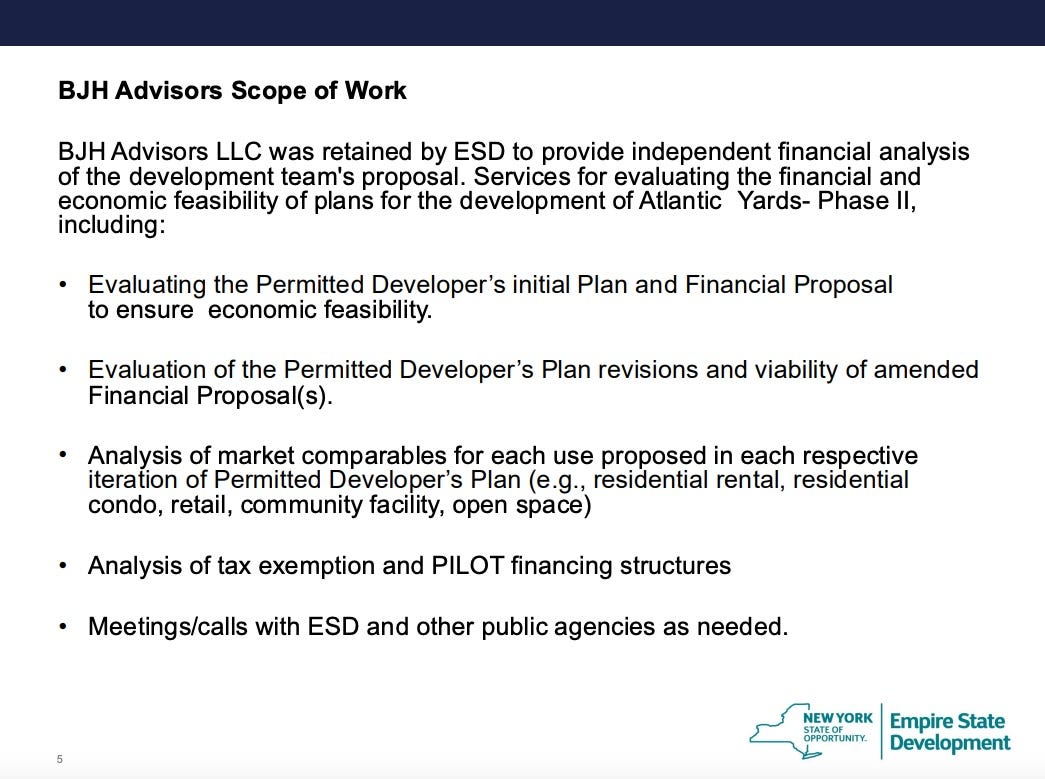
This report is also worthy of public scrutiny. After all, two previously commissioned reports from consultant KPMG were marred by wild mistakes, big gaps, and fallacious predictions.
In other words, is this new report just a cover-your-butt document to supply the “rational basis” for ESD to approve the project and resist judicial scrutiny? Or is it a serious analysis, infused with the humility Atlantic Yards’ checkered history should induce, offering a range of scenarios?
By the end of the month, ESD, via its ubiquitous environmental consultant AKRF, should issue a Draft Scope of Analysis for the project’s environmental review, known in this case as a Second Supplemental Environmental Impact Statement (SSEIS).
The document will lay out the issues to be studied in the Draft SSEIS and will prompt a public hearing, likely at the end of September, to gather comments, which will help refine the Final Scope of Analysis.
Will the Draft Scope include new, meaningful information or images? Possibly. Stay tuned.1
Also, as indicated on the slide above, ESD plans various meetings/conversations with elected officials and local groups, as well as public design workshops on open space.
ESD is ”beholden to and controlled completely by the Governor,” observed Elizabeth Marcello, a Hunter College academic who wrote the “Open ESD” report in 2023 for Reinvent Albany, in a Dec. 3, 2024, discussion of Penn Station plans. “The idea that the board of Empire State Development acts in the best interest of the public is total nonsense.”
I hadn’t noticed an online update to the New York Times’s coverage, first published online Monday, June 29, and then Tuesday, June 30, in print, of project changes:
Casey Berkovitz, a spokesman for Mayor Zohran Mamdani, applauded the plan in a statement on Tuesday. “It’s encouraging to see a path forward for Atlantic Yards, a project that has the potential to deliver thousands of new homes, including affordable homes, alongside good-paying jobs for New Yorkers,” he said, adding that the mayor’s administration would “continue working with state and local leaders to build the housing our city urgently needs.”
That’s pretty weak, especially for a professed Democratic Socialist.
“Thousands of new homes” translates as “we prioritize supply above all,” while “including affordable homes” doesn’t grapple with the disproportionate support for market-rate units.2
Is there any willingness to grapple with density, such as the Site 5 parcel catercorner to the arena, which would have an astounding 1,403 apartments and 1.45 million gross square feet of bulk on a parcel little more than an acre?
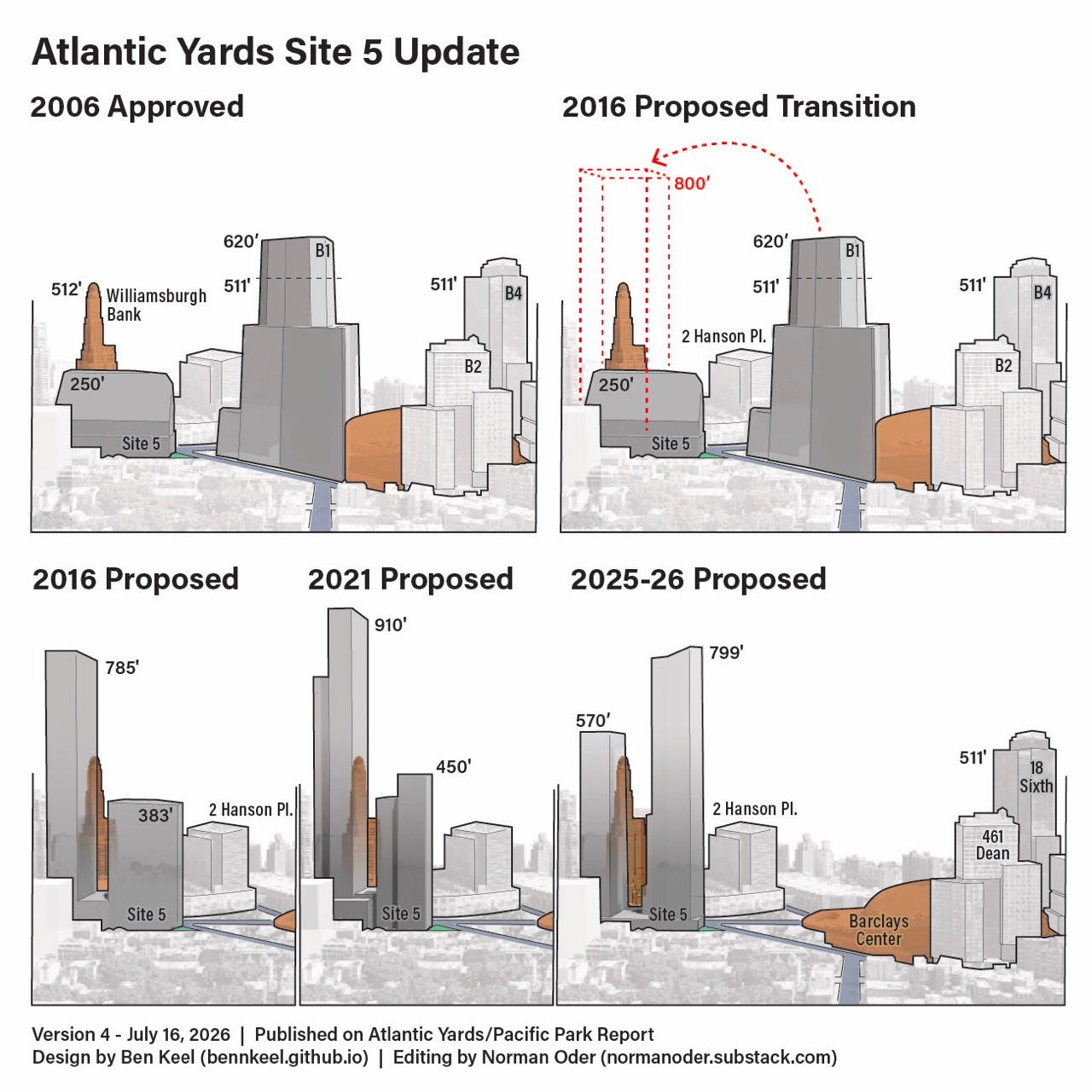
Moreover, the Mayor’s statement doesn’t acknowledge the significant public resources for the project: direct subsidies and free vertical “land.” Wouldn’t they want a cost-benefit analysis? After all, whatever gets built would provide “good-paying jobs.”
Meanwhile, Cirrus (without LCOR) has ramped up its lobbying. A filing with New York State shows that the firm Bolton-St. Johns will be paid $35,000 per month for the year starting July 1, 2026, up from $20,000 per month.
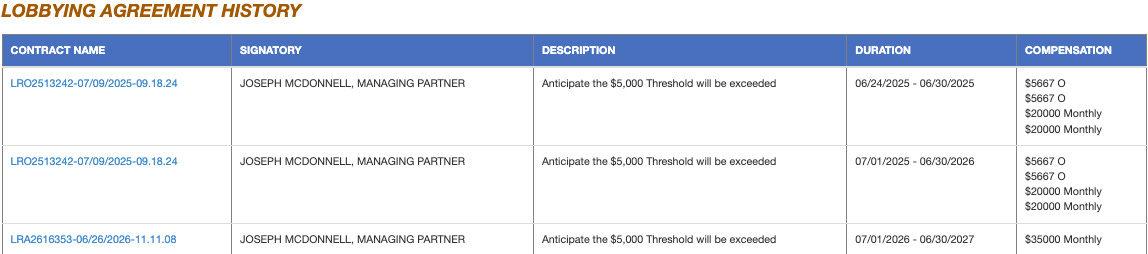
A report from Bolton-St. Johns, covering the first half of 2026, indicates that it has lobbied
Empire State Development CEO Hope Knight
New York City Deputy Mayor for Housing and Planning Leila Bozorg
Brooklyn Borough President Antonio Reynoso
Assemblymember Bobby Carroll
Assemblymember Jo Anne Simon
Assemblymember Edward Braunstein
Assemblymember Linda Rosenthal
Sen. Jabari Brisport
Sen. Brian Kavanagh
Attorney General Letitia James
It’s understandable that they would lobby ESD’s Knight and the city’s Bozorg, since they want concessions and support.
Borough President Reynoso, given his office, deserves a briefing, as do local elected officials like Carroll, Simon, and Brisport. (Where’s Assemblymember Phara Souffrant Forrest?)
Why would they also lobby legislators Braunstein, Rosenthal, and Kavanagh?
Well, I can’t be certain, but Braunstein, who represents the Queens neighborhood of Bayside, chairs the Assembly’s Corporations, Authorities and Commissions Committee, which oversees ESD.
Rosenthal, who represents Manhattan’s Upper West Side and parts of Clinton/Hell’s Kitchen, calls herself a “leading advocate on affordable housing” and chairs the Assembly’s Committee on Housing.
Kavanagh, who represents Lower Manhattan, chairs the Senate’s Committee on Housing, Construction and Community Development.
Do they know about the project’s affordable housing plan?
Why lobby Tish James, who, when representing the 35th District in the City Council, was a fierce opponent of the project? Well, she doesn’t represent such a narrow constituency today, and she’s always supported, at least conceptually, the project’s affordable housing.
Does that mean she’d endorse the project’s affordable housing? Or the jobs for union workers and local MWBEs? Surely she’s mindful that Cirrus is supported by the pension funds of construction worker unions, all of which could be friends—or enemies—in future elections.
Well, the lobbying report indicates a “briefing related to Atlantic Yards project with Attorney General and clergy.” That sounds like a cousin of the failed Atlantic Yards Community Benefits Agreement.
Separately, Cirrus’s in-house team, including Co-Managing Principals Joseph McDonnell and Anthony Tufariello, has reported, in the city’s database, lobbying in 2025 on a “development project in conjunction with New York City.”
Is that Atlantic Yards, which is not really a development project in conjunction with the city?
Possibly, since they’ve lobbied 35th District Council Member Crystal Hudson and 39th District Council Member Shahana Hanif, as well as Borough President Reynoso, then-Comptroller Brad Lander’s office, and the Mayor’s Office.
Then again, they also lobbied various staffers at the city’s Economic Development Corporation and the New York City Housing Authority. Could that be, instead, regarding the city’s RFP for the Flushing Airport site, which Cirrus won with LCOR?
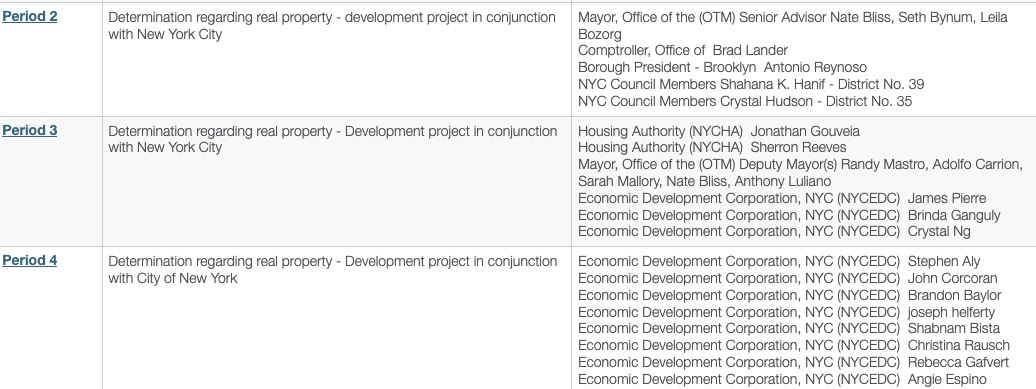
This year, they lobbied the Comptroller’s Office, the Mayor’s Office, the Department of City Planning, and the Brooklyn Borough President’s Office, all regarding “workforce housing,” as shown in the screenshot below.
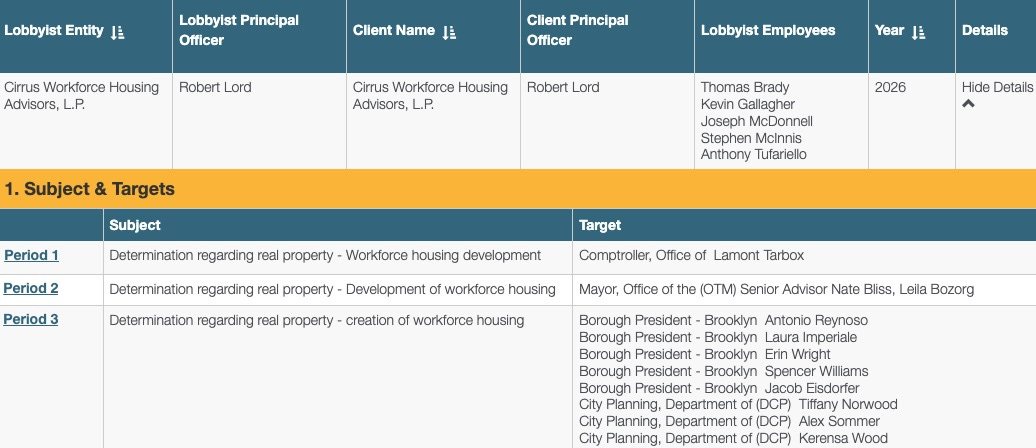
That’s a bit confusing. Cirrus’s announced workforce housing efforts are otherwise in Queens. Unless there’s another Brooklyn project pending, this was about Atlantic Yards. But is it really a workforce housing project?
Two decades ago, the Sept. 16, 2005 Draft Scope of Analysis for the original Atlantic Yards EIS became the March 31, 2006 Final Scope of Analysis, six and a half months later. Of course, there was an arena included, so it’s plausible that the lag time now would be less.
That Final Scope indicates new material in underlined sections.
For example, it noted that several comments requested analyses that are beyond the scope of this project’s SEQRA review, such as:
The DEIS should include (1) an assessment of the project’s financial viability, (2) a pro forma for the project, and (3) information on the “true value” of the project accounting for costs related to displacement, replacement costs of affordable housing, direct and indirect subsidies to the developer, net job gains or losses, and intangible costs.
An assessment of a project’s financial viability is not subject to SEQRA, nor is a pro forma required as part of the environmental review. The EIS will contain a description of the project’s potential economic and fiscal benefits; this analysis will account for fiscal incentives and will disclose, to the extent known, the public funding for the project. The EIS will also include an analysis of the project’s potential to result in both direct and indirect residential and business displacement and will also provide information on the project’s affordable housing component
The Final Scope also noted that design changes had meant various program
modifications subsequent to the release of the Draft Scope. These include:
Adjustments to the program have resulted in a proposed project that is roughly 475,000
gross square feet (gsf) smaller than as originally described in the Draft Scope;Addition of a publicly accessible covered pedestrian space. This “Urban Room,” located at the Flatbush Avenue and Atlantic Avenue intersection, would be a highly transparent, grand civic room containing meeting space and cafés as well as ticket windows for the arena, access to the arena and other uses on the arena block, and connection to the Atlantic Terminal mass transit complex;
Private open space on the arena rooftop has been reduced from approximately 52,000 square feet to approximately one acre;
Widening of the west side of 6th Avenue at the mid-block between Atlantic Avenue and Dean Street to accommodate a drop-off lane; and
Based on refinements to the construction phasing, the Phase I analysis year has been modified from 2009 to 2010. Although major components of the Phase I plan, including the arena, will be completed and operational by the fall of 2009, completion of the remainder of the arena block and Site 5 is anticipated to occur in 2010. Thus, for EIS impact assessment purposes, the Phase I build year analysis has been moved to 2010. The Phase II analysis year remains the same at 2016.
I’d note that today, the developers want vastly more square footage; the Urban Room was discarded when towers were decoupled from the arena (and the state didn’t enforce a penalty), and the arena rooftop was never publicly accessible.
Of course, the 2010 and 2016 analysis years, regarding completion of the project’s phases, were not close to being met.
Berkovitz, who has a background in both policy and political communication, previously served on the board of Open New York, the YIMBY group that prioritizes new housing supply, “from social and government-subsidized housing to market-rate options.”
Mamdani, despite his focus on a rent freeze and citations of social housing, is on board with the supply solution.
A focus on supply, however, shouldn’t blind supporters to related issues, like the economics of the deal and the limits of density. “While dense and walkable mixed-use neighborhoods are in high–demand and often result in increased property values, there is a point where an increase in density negatively impacts the quality and livability of the environment,” the New York City Economic Development Corporation said in its 2017 Sunnyside Yard study.
No posts
Comments
Nothing yet. Say the first thing.
Sign in to join the conversation.