
So I finally got a look at Art on the Hour, a new series—planned through Spring 2027—with “60-second digital works by internationally recognized artists” at the beginning of each hour, “broadcast on Barclays Center’s renowned Oculus screen in Ticketmaster Plaza, directly outside the arena.”
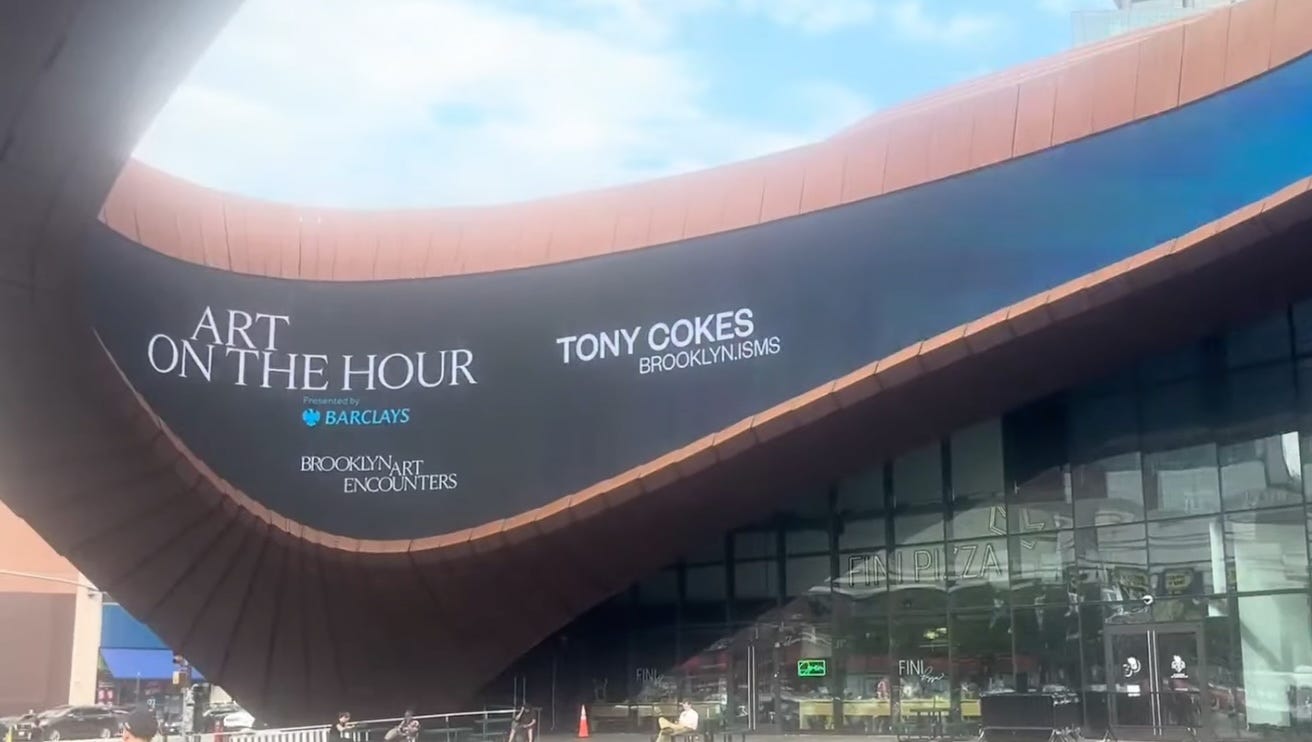
As far as I can tell, the series, which aimed to weave the contributors’ “art into the daily rhythm of the city” rather than be limited to “traditional gallery settings,” hasn’t made many people stop and look. (Of course, arena-goers waiting to enter may be a captive audience.)
I’ve seen two in person. Tony Cokes’s “Brooklyn.isms,” was underwhelming, while Charles Atlas’s “Painting By Numbers,” was entertainingly trippy.
The other two examples I saw on video. While “The Apple” struck me as colorful but disjointed, ”Mooniyang” was visually compelling. Maybe black-and-white works are best? (Videos for all are below.)
Note: while each video is introduced with a screen identifying the artist and the program “Art on the Hour,” no screen appears after the video—a missed opportunity, I think, to alert casual viewers.1
While this is a creative idea, at relatively little cost—if any?—to the producers/promoters, it suffers from the inevitable encroachment of commerce on art.
First, the series was “created in partnership with Barclays Bank.” That means the arena-naming rights sponsor, Barclays, helped pay for it and gains an attendant halo. “No progress without profit,” to cite a theme from Matt Sullivan’s book on the pandemic-era Brooklyn Nets.
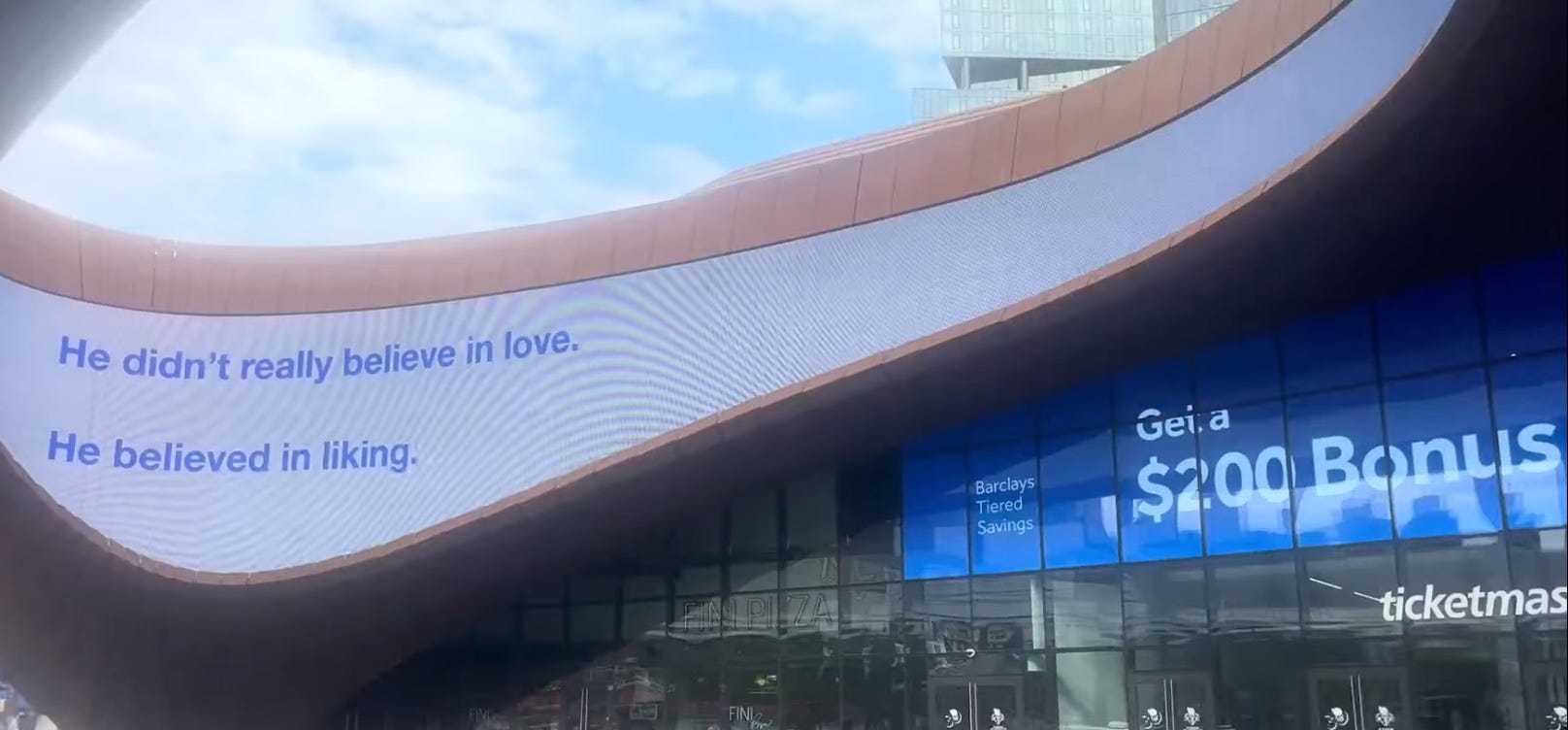
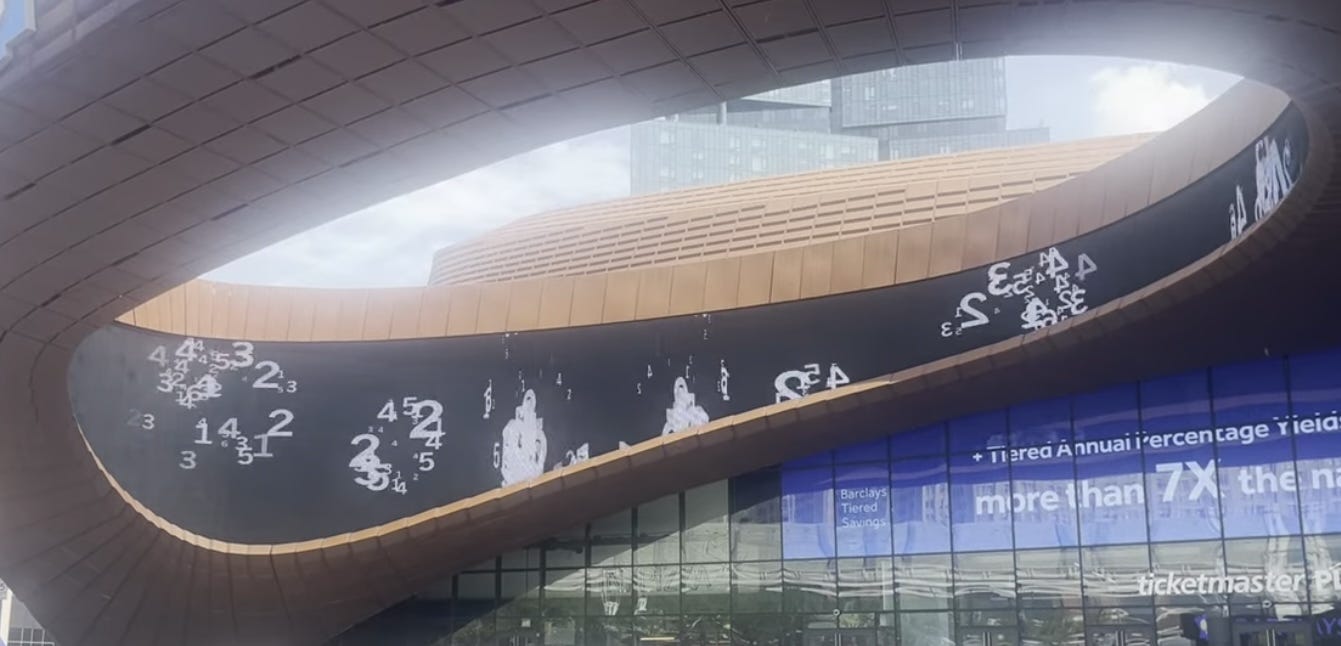
More importantly, the art is limited to the oval oculus itself. The adjacent rectangular LED video “wall,” over the arena’s entrance doors, continues to blare programmatic advertising.
That can produce some curious juxtapositions, such as the text below from Cokes’s work, purportedly inspired by Andy Warhol, adjacent to advertising for Barclays’ savings accounts.
Or the exploding numbers from Atlas’s work, below, contrasted with a single number selling that same Barclays savings account.
That “wall” was added in 2020 by the latest owners of the arena operating company, Joe and Clara Wu Tsai. When the arena opened, there was no such valuable digital signage.
It’s a missed opportunity to focus viewers on the art. They could have the “wall” go dark for one minute or even—as they sometimes do—co-broadcast the image from the oculus.
Or simply post a static credit that identifies the artist, the work, and “Art on the Hour.”
It’s all part of a program called Brooklyn Art Encounters, which, as I’ve written, also serves to bolster the Barclays Center as a business. Some art, for example, attributed to the Social Justice Fund—the philanthropic entity started by arena operators Joe and Clara Wu Tsai—also serves to promote the arena or the New York Liberty.2
“Everything we do is rooted in the creative spirit of Brooklyn,” according to the Brooklyn Art Encounters announcement, “reflecting the borough’s vitality while engaging a global artistic community.
In an alternate universe, Art on the Hour might allude to larger political issues, like the Ticketmaster monopoly, as I wrote.
Let’s look at Painting By Numbers, by New York-based Charles Atlas, described as “a pioneering figure in the creation of time-based visual art for over five decades, extending the limits of his media and forging new territory in a far-reaching range of genres, stylistic approaches, and techniques.”
The description:
The work treats the numbers 1 through 6 as characters, choreographing them in intricate patterns across the screen. Its title plays on popular paint-by-number kits, with digits swirling like brushstrokes as they expand and contract into geometric and abstract forms. Adapted from a three-channel installation for the Barclays Center oculus screen, the numbers move in unison, split apart, and regroup in a graphic study of order and chaos.
I thought it was entertaining and absorbing, though probably better in a more enclosed space. Those numbers really want to explode off the screen. My letter grade: A-.
Now check out Brooklyn.isms, from Providence, RI-based Cokes, a MacArthur Foundation “genius” award winner.
From the explanation:
In Brooklyn.isms, 2026, Cokes draws upon appropriated sayings written by and about American pop artist Andy Warhol, exploring the Warhol’s life and legacy through the resampling of found text. Revisiting an earlier iteration of the work, Pittsburgh.isms, 2022, presented at the 58th Carnegie International in Pittsburgh, Pennsylvania, Cokes uses Warhol’s first major commercial commission, a Glamour article titled Success Is a Job in New York (1949), as a point of departure. Through this engagement with Warhol’s words and images, Cokes highlights the two localities that most shaped Warhol’s career: Pittsburgh, where he was born and raised, and New York, where he emerged as one of the most prolific artists of the twentieth century.
As far as I can tell, the sole reason to call it Brooklyn.isms, rather than, say, Warhol.isms or Banal.isms, is the setting. The focus on text, whatever the colors, sacrifices the opportunity for more creative digital art. My letter grade: D+.
Why call it Brooklyn.isms, rather than Warholi.isms or Banal.isms?
What’s the point of subverting the title of that Warhol-illustrated article, “Success Is A Job in New York”, by adding the word “Not”? Is this a message to Cam Thomas or other departed Brooklyn Nets players?
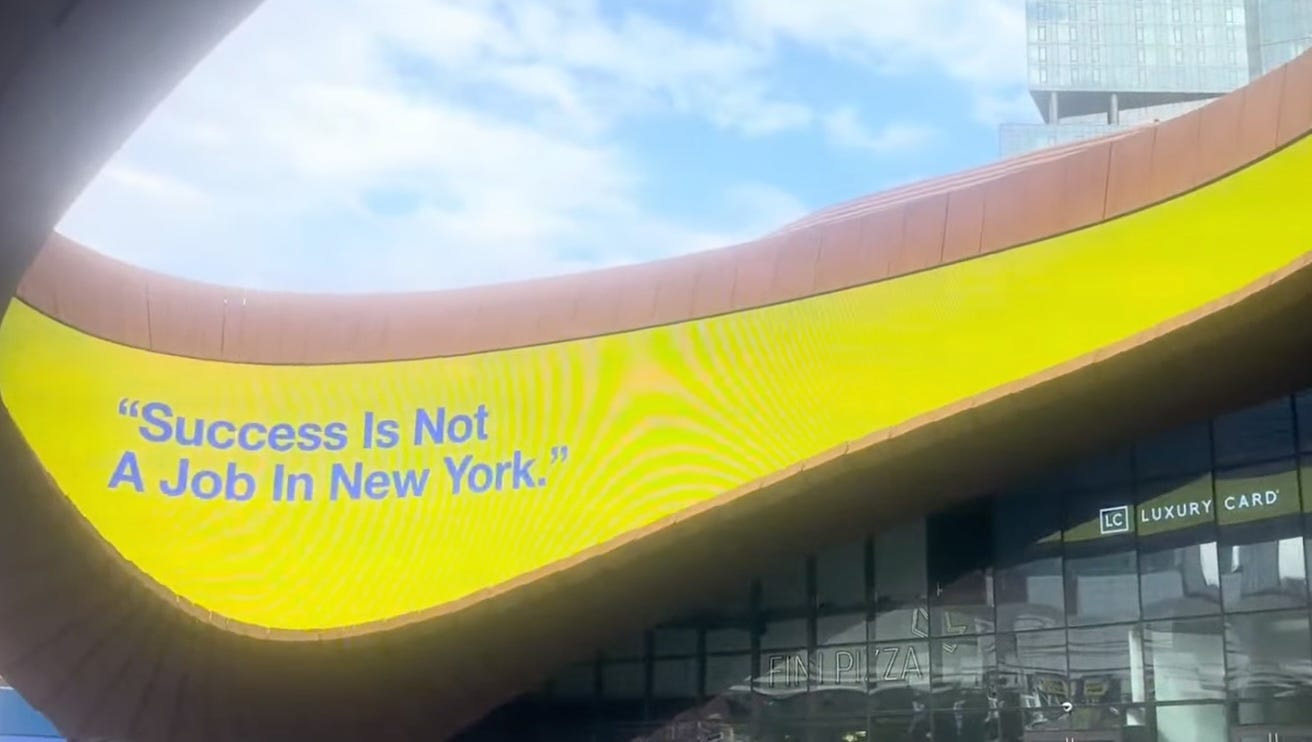
The tactic of “draw[ing] upon appropriated sayings written by and about” Warhol leaves the artist a huge amount of leeway to revise even those “appropriated sayings.”
Most of the text, as far as I can tell, is Warhol-like, but not direct quotes, explained in the footnote below.3 So it seems rather derivative. Again, such art—found poetry?—hardly takes full advantage of the video screen.
The Apple is from New York-based Sara Cwynar, who, “[w]orking across photography, film, and installation… she explores the circulation, accumulation, and reinterpretation of visual culture.” (Video from Brooklyn Art Encounters.)
From the description:
The Apple draws inspiration from the pioneering surrealist films of Man Ray, whose works used dreamlike montage, unexpected juxtapositions, and symbolic imagery to disrupt conventional ways of seeing. Reinterpreting these strategies through the lens of contemporary image culture, Cwynar assembles a sequence of recurring motifs drawn from her broader body of work. The Apple features the artist’s longtime muse, Tracy Ma, alongside a constellation of objects sourced from footage produced for earlier films, including apples, perfume bottles, and clouds. In a dreamlike montage, these familiar images are detached from their original contexts and re-presented as symbols circulating through systems of desire, aspiration, and consumption.
My take: the tripartite formulation is hallucinatory and colorful, but a little too busy, especially since the segment at the right end relies on the narrowest slice of the screen. My letter grade: B-.
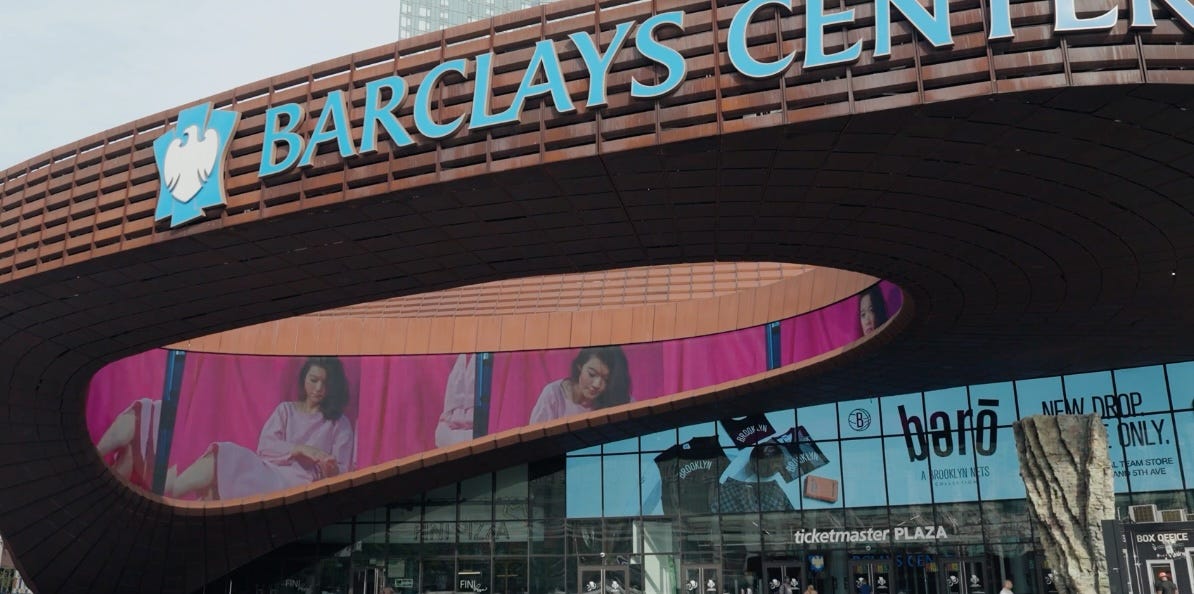
That said, the “unexpected juxtapositions” are again compounded, in a deeply ironic way, by the adjacency of the wall of advertising, as shown in the screenshot below, juxtaposing that colorful video and an ad for Brooklyn Nets merchandise.
Mooniyang is from Caroline Monnet, “a multidisciplinary artist of Anishinaabe and French ancestry, originally from the Outaouais region, who lives and works in Mooniyang/Montreal.” (Video from Brooklyn Art Encounters.)
From the description:
[This] unfolds as a sequence of shifting black-and-white patterns that continuously form, dissolve, and recombine across the Oculus screen. Built from a vocabulary of geometric shapes, the animation draws on Anishinaabe design motifs, translating them into a contemporary, time-based language.
Of Anishinaabe and French ancestry, Monnet often revisits forms of Indigenous knowledge through digital means, finding inspiration in Anishinaabe patterns found on regalia, textiles, birch bark baskets, and beadwork. As the composition evolves, the patterns suggest multiple readings at once: coded systems, architectural grids, or aerial maps of land divided and reorganized.
My take: this is a compelling visual work, and a good use of the digital canvas. The forms maintain structural integrity, keeping the eye focused on the work as a whole, especially in the central area. It’s almost enough to distract viewers from the adjacent advertising. My letter grade: A+.
Another arts-related announcement emerged recently, from longtime arena collaborator BAM, the Brooklyn Academy of Music.
From the Brooklyn Academy of Music:
BAM proudly joins forces with two iconic Brooklynites—filmmaker Spike Lee and Clara Wu Tsai, owner of the New York Liberty and the Brooklyn Nets—to present Playback: The Brooklyn Watch Party, a two-day celebration of the artists, storytellers, and communities that have made Brooklyn one of the most culturally influential places in the world. Created by filmmaker and producer Nicholas Ma (Won’t You Be My Neighbor?, Unfinished Business) and special guest curators, this inaugural festival includes screenings of repertory films, pop-up activations, a free street fair, and so much more—head to playbackbk.com and sign up to receive updates.
Note that Clara Wu Tsai was described as “owner” of the Liberty and the Nets, erasing the role of her husband, Alibaba Chairman Joe Tsai. This is part of a pattern I described with the couple’s Social Justice Fund.
Note: this announcement surfaced just before the Tsais disclosed to the New York Post’s PageSix that they were divorcing after 30 years. (I suspect both disclosures were timed strategically.) The paper respectfully quoted a spokesman:
“Over the years, their relationship evolved into more of a partnership, one of running their businesses and raising their children together. While they have grown apart, their divorce is amicable and their relationship remains a strong, professional partnership.
“Their decision will not affect the business operations of Brooklyn Sports and Entertainment, the Brooklyn Nets or the New York Liberty.
No mention was made of the division of assets. As NetsDaily has pointed out, it does not make sense to sell the Nets, as team values are rising steadily.
Note that BAM, whose board was once chaired by original arena developer Bruce Ratner, has long been a willing collaborator with the Barclays Center.
And sure, it’s a coup to get iconic Brooklynite (well, he’s moved away, but his studio’s here) Spike Lee involved. From a press release posted by Broadway World:
“With Playback we are setting out to create a new kind of film festival—one that brings together people who share a love of storytelling through film,” said Clara Wu Tsai. “Spike has put Brooklyn on screen for decades, and BAM has served as the borough’s cultural hub for over a century. There is nowhere else like Brooklyn, nothing like the energy of this borough, and this festival will highlight all that makes our community unique.”
“At BAM, we believe the arts are essential to a thriving civic life—bringing people together, sparking dialogue, deepening understanding, and strengthening the bonds that connect us to one another and to our communities,” says BAM President Tamara McCaw. “The inaugural Playback: The Brooklyn Watch Party embodies that belief, celebrating the creatives and communities that make Brooklyn such a dynamic cultural force. We are honored to partner with Clara Wu Tsai, Spike Lee, and so many remarkable collaborators to create a festival that not only showcases Brooklyn’s extraordinary creative spirit, but also invites people to gather, celebrate, and share in the vibrancy that defines the borough.”
Let’s see if this festival gets attributed to the Tsais’ Social Justice Fund, as with some other artistic endeavors.
According to Broadway World:
Friday, November 6 will be a night of music, poetry, film, and talks at BAM’s Howard Gilman Opera House in celebration of the inaugural guest curators.
Saturday, November 7 will bring the festival into the cinema and onto the streets. The guest curators will program a slate of movies, each with special guest appearances. A free afternoon block party at BAM will feature live music, local food, and community activations. That evening, the Opera House will host a special screening of CROOKLYN, with appearances by Spike Lee, Alfre Woodard, and more special guests/
Yes, I asked my “art advisor” to read a draft of this article and offer feedback.
This is not (yet?) credited to the Tsais’ cleansing Social Justice Fund. That might compound cognitive dissonance.
I ran the quotes through ChatGPT and excerpt the LLM’s response to those phrasings.
“It’s hard to look in the mirror. Often there’s nothing there.” Not verified but “it does sound very Warhol-like.”
“He didn’t really believe in love. He believed in liking.” Not verified, but it sounds like “a description of Warhol by someone else.”
“Buying is much more American than thinking, And she’s as American as they come.” Not verified but “stylistically very Warholian.”
“She really likes to work a lot. It makes time go by faster.” Not verified “but sounds like Warhol’s conversational style.”
“Everybody is creative.” Often attributed to Warhol, but not verified.
“He didn’t want to talk about negative things.” He said something similar, but in the first person.
“You can’t prepare for anything.” Not a direct quote, but he spoke similarly.
“If you’re going to make movies, you’ve got to have sound.” This is attributed to Warhol.
“Success is finding a way to do exactly what you want to do wherever you are.” That sounds a lot like Tony Robbins, while Warhol spoke in “much more ironic or commercial terms.”
No posts
Comments
Nothing yet. Say the first thing.
Sign in to join the conversation.