
An extract from my book And What Do You Do?, published by Biteback Publishing, Published in 2019 and updated in 2021
‘Dix mille sur le noir.’ The society playboy that was the Duke of Windsor was hitting the gaming tables hard. It was 1940, and the duke, still officially a serving military officer, was rather more interested in the black of the roulette wheel in glamorous Lisbon than in the blackouts that had fallen like a shroud over grime-filled London.
In London, the black that had interested him was elsewhere. It was to be found in the nasty British fascist organisation that was set up to mirror the German Nazi party, the Blackshirts, with its leader Oswald Mosley, a sort of bargain basement version of Adolf Hitler.
Edward VIII, before, during and after his short reign of 325 days, revealed himself as not just a Nazi sympathiser, but as someone who was a source of much useful information for the Axis powers. Had he been an ordinary mortal rather than a member of the royal family, it would not have been surprising to have seen him charged with treason in the trials that followed the end of the Second World War.
The Duke of Windsor, as he became upon abdication, was politically far to the right, but also far from the only member of the royal family in the 1930s to express pro-German sentiments, to have a grudging admiration for Hitler and to espouse appeasement in the face of Nazi aggression across Europe. He was merely an extreme expression of that tendency.
That the British royal family should be sympathetic to Germany should shock nobody. After all, they are a German royal line. Queen Victoria even died in the arms of the German emperor, her grandson, on the Isle of Wight in 1901. Referring to that episode, the Kaiser wrote thus to George V in 1911: ‘Those sacred hours have riveted my heart firmly to your house and family, of which I am proud to feel myself a member.’ He signed the letter, ‘Your affectionate cousin and friend, Willy.’
So close were the family connections between the British and German royal families that, when the First World War began, the Kaiser still held the rank of Commander-in-Chief of the Royal Dragoons, while the German crown prince was Colonel of the 11th Hussars. The Kaiser also held the rank of field marshal.
The matter was raised by the King’s private secretary, Lord Stamfordham, with the War Office on 9 August 1914. Replying, Sir Reginald Brade wrote: ‘Personally I would have disposed of the issue by not raising it.’ George V, even some weeks into the war, refused to act.
Stamfordham wrote on 12 August: ‘The King has decided that the names of the German Emperor and the Crown Prince of Germany shall remain on the Army List as heretofore.’
The same view was taken of the fact that the Kaiser and Prince Harry of Prussia bore the rank of Admirals of the Fleet in the Navy List. Two days later Stamfordham wrote to Lord Roberts, the highly respected soldier who had for years before been warning of the militarisation of Germany, about the honours bestowed on the Kaiser and his family: ‘His Majesty [George V] is strongly against the return of Decorations. It would be impossible for instance to send back their Garters or for the King to return the Black Eagle.’
But the issue would not go away, and finally came to a head that October. On the first of the month, Stamfordham received a note from the War Office pointing out that the Austrian Emperor was Chief of the 1st Dragoon Guards, and that the Duke of Albany was serving in the German army while being Chief (actually Colonel) of the Seaforth Highlanders. The following day, the King finally agreed to remove names, but, in an attempt to bury the issue, made it clear he ‘does not wish any order promulgated to this effect, and nothing to be done beyond omitting these names’, as Stamfordham put it in a letter to Winston Churchill, then First Lord of the Admiralty. The reluctance of the King to take any action on this front could very well be explained by the fact that the British and German royal families were heavily intertwined.
Until the end of the First World War, it was standard practice for members of the British royal family to marry only other royals, the continuation of a practice that had cemented political alliances for centuries past. The British Empire under Queen Victoria and the German Empire under Kaiser Wilhelm II were, along with the Romanovs in Russia and the Habsburgs in Austria, the great imperial monarchies of Europe, so it is hardly surprising that there was a great deal of intermarriage between Britain and Germany. It might even be termed incestuous.
The military positions in the British armed forces held by the German and Austrian emperors may have finally been disposed of some months into the war, but other matters took even longer to deal with. One running sore was the presence of Garter flags honouring the Kaiser and other German relatives which hung in St George’s Chapel in Windsor. The fact that it was standard practice to pray twice a day for all Knights, including, therefore, the German Kaiser and Austrian Emperor, only exacerbated matters.
On 12 May 1915, the Dean of St George’s Chapel received a letter from a Mr Arnold White, described by Stamfordham as ‘a somewhat prominent pressman’. The letter warned: I have reason to believe an attack will shortly be made upon St George’s Chapel and an effort will be made to remove the eight peccant [offensive] banners by physical force … the only way to avoid a collision between the authorities and the people is the removal of the German banners.
The Dean notified the Palace, telling Stamfordham that ‘it would be most unfortunate if anything like a riot or a disturbance were to take place in the Chapel’. The next day Stamfordham told the Dean that the banners would be removed and added, ‘If I might suggest, would it not be better to take no notice of Mr. Arnold White’s letter.’ Notwithstanding that we were at war with Germany and Austria, the removal of the banners was not undertaken with exuberance but reluctance. The King in fact made clear that ‘none of the Plates of the said Knights are to be removed’ from the chapel. These were to all intents and purposes hidden from view, which is doubtless why they were allowed to remain.
An even bigger issue remained to be dealt with – the family name of the British royal family was a German one: Saxe-Coburg-Gotha. This survived well into the First World War until in 1917 George V decided, in the light of public mutterings and his fears for his own throne, on a rebranding exercise, and, abracadabra, the House of Windsor was born. At the same time, in Parliament, the Titles Deprivation Act 1917 removed German relatives from the succession line to the British throne. Name change or not, the German sympathies of the royal family continued, and how could it be otherwise when the people remained the same? Most pertinently in 1917, George V’s wife Mary was German.
She had been Mary of Teck, a German princess. The majority of family members spoke excellent German. George V was actually the first monarch since 1714 not to be a fluent speaker of the language.
By contrast, his predecessor, Edward VII, had never learnt to speak English without a German accent. It is perhaps fortuitous that there were no regal radio or television broadcasts possible in those days.
The present Duke of Edinburgh, Prince Philip, is directly descended from Victoria’s daughter, Princess Alice, the Grand Duchess of Hesse-Darmstadt. Both he and the present Queen are German speakers.
Edward VIII was therefore mainstream in his tilting towards Germany.
As Prince of Wales he had spent his summers up to 1913 at Kaiser Wilhelm’s Bernstorff Palace. Unsurprisingly, therefore, he spoke fluent German, and indeed was somewhat irritated when, on meeting Hitler many years later, the Führer insisted on using an interpreter. ‘Every drop of blood in my veins is German,’ he was to assert to Diana Mitford. Hitler’s ambassador to Britain, Joachim von Ribbentrop, called him ‘half-German’. The German influence is still felt to this day. The British royal family celebrates Christmas as it always has – the German way – with presents opened after afternoon tea on Christmas Eve.
Amongst the royals in the 1930s, there was some alarm at what had befallen monarchies across Europe. Even before the First World War, a discernible trend away from monarchy had appeared, with abolition in Portugal and China. The war would accelerate this, with monarchies falling like diamond-encrusted dominoes. It was not just the Kaiser who lost his throne. The centuries-old Habsburg Empire in Austria-Hungary also came to an end, as did the Greek monarchy in 1924 (although it was recreated later before being finally abolished in 1973). Most dramatic were the events that unfolded in Russia. Here too there were family connections, with Tsar Nicholas a cousin of George V, and also a holder of high honorary ranks in the British armed forces. Indeed the King wrote to the Tsar in December 1915 to say he was ‘anxious’ to appoint him ‘a Field Marshal in my army as a mark of my affection for you’. The Tsar accepted the offer the following month. The Russian Tsar and the British King kept up a friendly, almost intimate, correspondence during the war, and when the Tsar was forced to abdicate in 1917, the King immediately sent him a personal message: ‘I shall always remain your true and devoted friend as you know I have been in the past.’ But the affection of the King went only so far. The new Russian government was keen to get the Tsar out of the country and to England as soon as possible, a suggestion the British government agreed to. The King, however, was hesitant. His private secretary, Lord Stamfordham, wrote to the foreign secretary, Arthur Balfour on 30 March 1917: As you are doubtless aware the King has a strong personal regard for the Emperor, and therefore would be glad to do anything to help him in this crisis. But His Majesty cannot help doubting, not only on account of the dangers of the voyage, but on general grounds of expediency, whether it is advisable that the Imperial Family should take up their residence in this country.
Balfour replied two days later: ‘His Majesty’s Government thought it preferable, the initiative having come from the Russian Government, that the Imperial Family should come to England.’ But the King would not let go, and he sought to persuade the government to withdraw the offer of sanctuary. Three further letters winged their way to Balfour. The first, on 3 April, had reluctantly conceded that constitutionally the King had to accept the advice of his ministers, but by 6 April, he had changed his mind. The second stated: ‘Every day the King is becoming more concerned about the question of the Emperor and Empress of Russia coming to this country.’ The third, with the King now agitated, followed later the very same day: He must beg you to represent to the Prime Minister that from all he hears and reads in the Press, the residence in this Country of the Ex-Emperor and Empress would be strongly resented by the public, and would undoubtedly compromise the position of the King and Queen from whom it is generally already supposed the invitation has emanated … we must be allowed to withdraw from the consent previously given to the Russian Government’s proposal.
Shortly afterwards, Balfour received a lurid letter from a privy counsellor, the Rt Hon. E. G. Russell: ‘If the Ex-Czar and Czarina come to live here we shall have a Revolution, and remember that I warned you.’ The pressure worked and Balfour buckled. A telegram, headed ‘Personal and most confidential ’, was sent to the British ambassador in Petrograd: There are indications that a considerable anti-monarchical movement is developing here including personal attacks upon the King. Part of the ground of the attacks is that he has supported the ex-Emperor and King Constantine of Greece. It is thought if the Emperor comes here it may dangerously increase this movement…
The ambassador in his reply of 15 April acknowledged this point, but added, ‘If there was any indication of counter-revolution His Majesty’s life [that is, the Tsar’s] would be in serious danger.’ But the King prevailed and the Tsar was kept out of England, and in fact out of any country, for the delay proved fatal for the Tsar and his family. They were rounded up, taken to the countryside and executed by firing squad. If George V, the Tsar’s ‘true and devoted friend’, had immediately agreed the Russian royal family could come to England, they would very likely have been able to escape before the net closed in.
Britain was thus the home of the last great imperial monarchy left standing, and the royal family experienced a new vulnerability, no longer being able to take the permanence of monarchy for granted.
Nerves were further jangled by the transformation in 1931 of Spain into a republic. This feeling of vulnerability was heightened by the social changes that were sweeping Europe, most notably by what was seen as the Bolshevik threat from Russia, and at home the arrival in 1924 of the first ever Labour government.
The response from the British royal family, always a conservative institution, was to embrace those who could head off social revolution, while also seeking to dull the radicals by coaxing them inside the tent where possible. The British royals, through their relatives, were painfully aware of the chaos that existed in the Weimar republic in Germany, and came to see Hitler and the Nazis both as a stabilising influence in that country, as well as one that could head off any further leftward drift. Nazi Germany represented a useful bulwark against Bolshevism. As the 1930s wore on, another consideration came into play: the threat of another major European conflict. The British royal family, with 1918 still fresh in their minds, were fearful that another war would prove fatal for the Empire, and constitute a grave threat to the future of the monarchy itself.
Their fears were well grounded. The Second World War, when it came, generated a further loss of monarchies in Europe, with those in Yugoslavia, Romania, Bulgaria and Albania being consigned to history. And the war did indeed deliver a body blow to the British Empire.
Atlases which not long before had shown a quarter of the world painted pink were horribly out of date within twenty years. The empire had all but shrivelled to nothing.
Then there were the family ties that abhorred the notion that Britain and Germany could once again be in conflict. These ties were astutely reinforced by Hitler, who used royal relatives to seduce key members of the family. He even deployed Friedrich William, the son of the last Kaiser, to act as an emissary. As well as proving effective in opening Palace doors, these German relatives gave a cloak of respectability to the thuggish Nazi regime. One key emissary was Carl Eduard, Queen Victoria’s grandson and Duke of Saxe-Coburg and Gotha (but not Windsor). An openly strong supporter of Hitler, he spent Christmas 1933 at Sandringham with George V and his German wife, Mary, and was a regular visitor to Buckingham Palace throughout the 1930s. The fact that he had become a ‘traitor peer’ as a result of the 1917 Act seemed not to weigh with his British hosts. George V’s body was barely cold when Carl Eduard went to see his cousin, now Edward VIII. He would sit on Edward’s table for the dinner that followed his father’s funeral, having followed the coffin dressed in his Nazi uniform.
And it was Carl Eduard who was to host the Duke of Windsor’s controversial visit to Germany in 1937, a visit that included a nice friendly tête-à-tête with Adolf and which was overall a huge propaganda success for the Nazis. A month after the visit, Carl Eduard was invited round to tea by Queen Mary. He was also received by the King, by then George VI, and regularly dined with the Prime Minister, Neville Chamberlain. For his efforts to keep the royal diplomacy going, he was paid 4,000 Reichsmarks monthly by Hitler, the equivalent of about £16,000 today. After the war ended, Carl Eduard was arrested by the Americans, to whom he made the astonishing assertion that ‘No German is guilty of any war crimes.’ He was eventually allowed to go free following pressure from Buckingham Palace.
Queen Mary believed fervently in the aristocratic code of loyalty to one’s roots, which, in her eyes, meant trying to patch up the divisions between the German and British branches of the family that the Great War had created. Her main complaint about Hitler was that he spoke German badly. George V himself also felt strong ties to his German relations, and a good many attended his silver jubilee celebrations in 1935. It seems they needed little pushing to attend, and the British royals little persuasion to welcome them. The King was not unsympathetic to German demands for revisions to the Treaty of Versailles and other concessions consistent with appeasement. He was not, however, enamoured of Hitler, whom he regarded as common, a tad absurd and yet also dangerous. He found his ‘Jew-baiting’ distasteful.
Generally, the old right in Germany was only too keen to embrace Nazism. According to Jonathan Petropoulos in his book Royals and the Reich, between a third and a half of Germany’s princely families, around 270 in number, joined the Nazi party, a higher percentage than for any other grouping in society. And the historian Stephan Malinowski counted 3,592 members of 312 old aristocratic families who enlisted, more than a quarter of them doing so before 1933. A number of these Nazi aristocrats were related to the British royal family. For example, of the four sisters of the present Duke of Edinburgh, all had married German princes, and three of those became leading Nazis. One served as an SS Colonel on Himmler’s personal staff. The duke even attended the funeral of one sister, Cecile, in Nazi Germany in 1937, when he was sixteen. He was captured for posterity with other relatives who were dressed in SS and brownshirt uniforms. Another sister, Sophie, had a son, Karl Adolf, named in praise of the Führer. Meanwhile, an uncle, Prince Christoph of Hesse, headed up Göring’s telephone-tapping operation that was to become the Gestapo.
None of these German relatives would make the invitation list for Philip’s wedding to Elizabeth in 1947. Also excluded were the Duke and Duchess of Windsor. The inconvenient past, much of it quite recent, was to be airbrushed out. Philip’s mother was invited – she could hardly not be – but it helped that her hands were clean. She was deeply religious and during the war had hidden a Jewish family in her Athens home.
I wonder what went through Philip’s mind when, many decades later, his grandson Prince Harry was photographed wearing Nazi regalia, apparently for a laugh. The photos appeared in the press just before a commemoration service was held for the more than one million people who were killed at Auschwitz. Together, these considerations – the family ties, the fear of Communism, the grudging admiration for the order Hitler had brought to Germany, and the desire to avoid another war with the threat that posed for the survival of both the royal family and the empire – led to a markedly pro-German, and so by definition a pro-Nazi, attitude across the royal family and strong support for the concept of appeasement.
It was the predominant royal view that there should be an accommodation reached with Hitler that encouraged the Germans to channel their aggression and desire for Lebensraum eastwards, and that Britain should stay out of any conflict in return for Hitler agreeing to leave the British Empire untouched. They may not have all shared Edward’s enthusiasm for Hitler, but when it came to a choice between the German dictator and the Bolsheviks, they were in no doubt that Hitler was the lesser of two evils. The lead from the royals in turn influenced a great many occupying positions of power and influence in this country. Kim Philby, already spying for the Soviets, compiled a list of Establishment figures in government and elsewhere who were sympathetic to the Nazis. It ran to several pages. Notable amongst the cheerleaders were the Fleet Street magnates Lords Rothermere, Beaverbrook and Kemsley, proprietors respectively of the Mail, Express and Telegraph. While the Duke of Coburg concentrated on his royal relatives, a German princess, Stephanie von Hohenlohe, was deputed to maintain good relations with Lord Rothermere. It was time well spent. When Germany occupied the Sudetenland in 1938, Rothermere sent Hitler a personal note of congratulations, calling him ‘Adolf the Great’. The Daily Mail followed the Nazi line like a panting dog following its master. Rothermere even paid to secure access to Hitler. Goebbels called him ‘our most reliable press magnate’. The Mail did break with the anti-Jew purism of the Nazis in one regard, however. They were prepared to accept money from Jewish advertisers.
It was to Beaverbrook in 1940 that the Duke of Windsor turned when he wanted help to kick-start a peace process with the Germans, hoping Beaverbrook could enlist City support. He was not alone in wanting to pursue this line. It was a view shared with, amongst others, Lord Halifax and Rab Butler. Nevertheless, with Britain by now at war with Germany, to seek to take steps to actively undermine and contradict the official position of the British government was little short of treason, even if the desire for peace was well intentioned. The initiative ran into the sand. As Karina Urbach reveals in her comprehensive work, Go-Betweens for Hitler, Lord Kemsley was sent to Germany in the summer of 1939 by Prime Minister Neville Chamberlain, and without Cabinet knowledge or approval. His task was to reassure Hitler that the talks then underway between Britain and the USSR into which Chamberlain had been forced were only for show and not genuine. It probably helped the mission that Lady Kemsley, who accompanied her husband, told her German hosts that ‘only the Jews wanted to bring about a war between Germany and England’. Meanwhile, Hitler’s plans for further conquests were well advanced, and, within weeks, Britain and Germany would be at war.
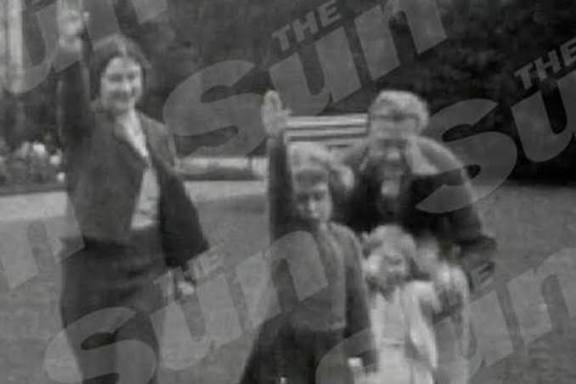
So the consistent line that came from Buckingham Palace throughout the 1930s was one in favour of appeasement. It was a view shared by George V and his wife Mary, and his four sons: Edward VIII, the Duke of Kent, the Duke of Gloucester and George VI. There was no prominent member of the British royal family advocating the sort of robust line being advanced by Winston Churchill. Of the royals, Edward VIII was in a class of his own. His position was not merely to support appeasement, but to embrace to a large degree the vile philosophy of Nazism. His enthusiasm began early. The Sun in 2015 secured and published stills from a ciné film taken at Balmoral that the royal family would have much preferred never to have seen the light of day. Under the sardonic headline Their Royal Heilnesses, the stills, dating from 1933, show the future Edward VIII encouraging the young Princesses Elizabeth and Margaret to give a Nazi salute, and indeed the future Elizabeth II, then aged just seven, is shown doing just that. Now, nobody can possibly blame the young princesses for innocently following the cajoling of their uncle. Indeed we can feel angry on their behalf. We can, however, look critically at Edward, who was clearly already enamoured of the Nazis, and critically at the future Queen Mother, also pictured giving a Nazi salute. She would not have wanted to look the East End in the face with that image. Already Prince of Wales, it was clear both that Edward was not just supportive of the Nazi regime, but that he felt he had the right to speak out, whether or not what he said was in agreement with the official government line. He publicly suggested that Britain should extend the hand of friendship to the Nazi regime, and was strongly told off by his father, George V, for his unconstitutional behaviour. The admonishment was wasted.
In January 1936 as he was ascending the throne, he told an American diplomat, James Clement Dunn, that he intended to diverge from his father’s policy of blindly following Cabinet decisions. On the contrary, it was his duty to intervene when the Cabinet adopted a course of action which he believed was against British interests. Those who favour the hereditary principle of monarchy have to accept that the roll of the dice can turn up someone entirely inappropriate, dangerous even, like Edward VIII, just as easily as someone steady and diligent like George V. Here, over the course of one year, was a violent transition from a conscientious constitutional monarch to an unpleasantly right-wing loose cannon with little respect for constitutional niceties.
Anthony Eden tartly observed that while George V knew much but interfered little, Edward VIII knew little but interfered much. ‘Who is king? Baldwin or I?’ Edward is reported as having said to the Duke of Coburg, who was enquiring about the views of the Prime Minister.
And the new king added: ‘I myself wish to talk to Hitler and will do so here or in Germany.’ In the event, he met him the next year, but only after his abdication. He had indicated a wish to attend the Berlin Olympics, which took place during his short reign, but presumably was arm-twisted out of this. Plenty of British aristocrats sympathetic to Hitler did go, though.
Edward even went as far as to threaten abdication if Baldwin instigated military action in response to the illegal German occupation of the demilitarised Rhineland that year. Actually, it is doubtful that Britain would have intervened in any case, though historians now recognise that Hitler was taking a big gamble and if Britain and France had stood up to him here, he would almost certainly have had to withdraw, and that would have changed the dynamic in Berlin markedly. Edward thought that the Blackshirt movement was ‘a good thing’, and he and Wallis Simpson were close friends with the Mosleys. Mrs Simpson, who was even keener on the Nazis than Edward, sent a congratulatory message to the couple on the occasion of their wedding in Berlin, held at the home of Joseph Goebbels and in the presence of Hitler. The friendship worked both ways. Mosley’s fascist January Club was in March 1935 renamed the Windsor Club. And after the King’s abdication broadcast, 500 Blackshirts congregated outside Buckingham Palace, where they gave the Nazi salute and shouted, ‘We want Edward’. The friendship between the Windsors and the Mosleys was to become even stronger after the war ended.
Edward’s short reign was a worrying one for the government. Apart from the King’s dangerously pro-Nazi leanings and his disregard for long-established constitutional conventions, he was simply not prepared to knuckle down and carry out his duties properly. He had been asked to open what would be the new Royal Infirmary in Aberdeen, where, incidentally, my mother later worked as a nurse and where I was born. The King, however, had cried off, saying he was still in mourning for his late father, an unlikely justification at any point, given how they disliked each other. The excuse was shot to pieces when, on the day he had been due to undertake the opening, he was spotted at nearby Ballater Station to meet Wallis off the train and escort her to Balmoral. It was a public relations disaster.
His red boxes, delivered to him daily at his residence at Fort Belvedere in Windsor Great Park and containing the most sensitive government information, were often left open and lying around at home for any guest to inspect, if they were minded to. This carelessness extended to conversations too, and he seemed to regard any information he had come across, no matter how sensitive, as suitable for dinner table talk. This might have mattered less if he had not had as his milieu a coterie of dubious Nazi sympathisers. And nobody was more central to this coterie than Wallis Simpson. Moreover, she bore no love for the royal family, who had made plain their disapproval of her from the start. Not only was she a divorcee, but she was American. How unpleasantly and distastefully nouveau. She had also spent a colourful period in China, detailed in a dossier put together for Baldwin, which unsurprisingly has now vanished without trace.
According to the royal author Kenneth Rose, George V regarded her as ‘unsuitable as a friend, disreputable as a mistress, and unthinkable as a queen’. His private secretary went further, describing her as a witch and a vampire. Wallis undoubtedly had a close friendship with von Ribbentrop, which many believe was of a sexual nature. Her physical appearance was not in fact dissimilar to that of Ribbentrop’s wife back home. Andrew Morton’s book 17 Carnations is so named after the flowers that the German is alleged to have sent to the duchess every day, believed to represent one flower for every time they had made love. Other historians dispute this, however. She was also having an affair with a married car salesman called Guy Trundle. And of course Wallis herself was still married to husband Ernest until not long before her wedding to Edward, only filing for divorce in October 1936. It might be seen as a consolation prize that Edward managed to get Ernest accepted into his masonic lodge.
Edward’s reign ended with a syrupy broadcast, telling the nation that he could not continue as king without the woman he loved at his side. While that was indeed how he felt, the more interesting question is whether the Prime Minister in 1936, Stanley Baldwin, took advantage of Edward’s determination to marry Wallis to make sure his abdication took place, believing Edward to be a serious security risk, and ensuring it occurred before the coronation, after which it would have been much more difficult. Von Ribbentrop certainly believed he had been made to abdicate because of his political views. Andrew Morton cites in his book a 1940 FBI report in the name of J. Edgar Hoover to President Roosevelt: For some time the British government has known that the Duchess of Windsor was exceedingly pro-German in her sympathies and connections and there is strong reason to believe that this is the reason why she was considered so obnoxious to the British Government that they refused to permit Edward to marry her and maintain the throne.
Baldwin had consulted Commonwealth leaders to sound them out about the possible marriage of the King to Wallis Simpson, and found hostility to the idea, but it might just have been possible for him to have swung a morganatic marriage between the two. In this situation, neither Mrs Simpson nor any issue they produced would have had any claim to the titles or possessions of the King. The fact that Baldwin was not keen to pursue this option, although it had been mooted, may well relate to his political concerns about the King. In 1937, eight years after they had first met, Edward and Wallis got married in France. It was a wedding that was boycotted by the rest of the royal family. The ceremony itself took place at the home of their friend Charles Bedaux, a Frenchman who had spied for the Germans in the First World War.
Bedaux also kept a property at Berchtesgaden, the spiritual home of Nazism and close to Hitler’s residence. Hitler sent them a wedding present of an inscribed gold box.
After their wedding, the couple visited Italy, then under the control of the fascist Mussolini. Edward delighted the crowds by repeatedly giving the fascist salute. And that salute was in evidence again when he visited Germany later that year. The hundreds who greeted him upon his arrival at the railway station responded by crying out ‘Heil Edward’ and ‘Heil Windsor’, which was certainly snappier than ‘Heil Saxe-Coburg-Gotha’ would have been. During his trip, Edward met all the leading Nazis and he and Wallis were treated with, in his view, the dignity and respect that was their due and that had been lacking in England. He was particularly incensed that Wallis was barred from using the title Her Royal Highness. In 1940, when the two were sitting with Claire Luce, an American journalist, listening on the radio to the news of bombs falling on London, Edward is reported as saying: ‘I can’t say I feel sorry for them. A whole nation against a lone woman.’ This story, if true, is breathtaking in its egotistical horror. Ordinary Londoners deserve to get bombed as a punishment for the way Wallis Simpson was treated? And ‘them’? This was his country. Or was it?
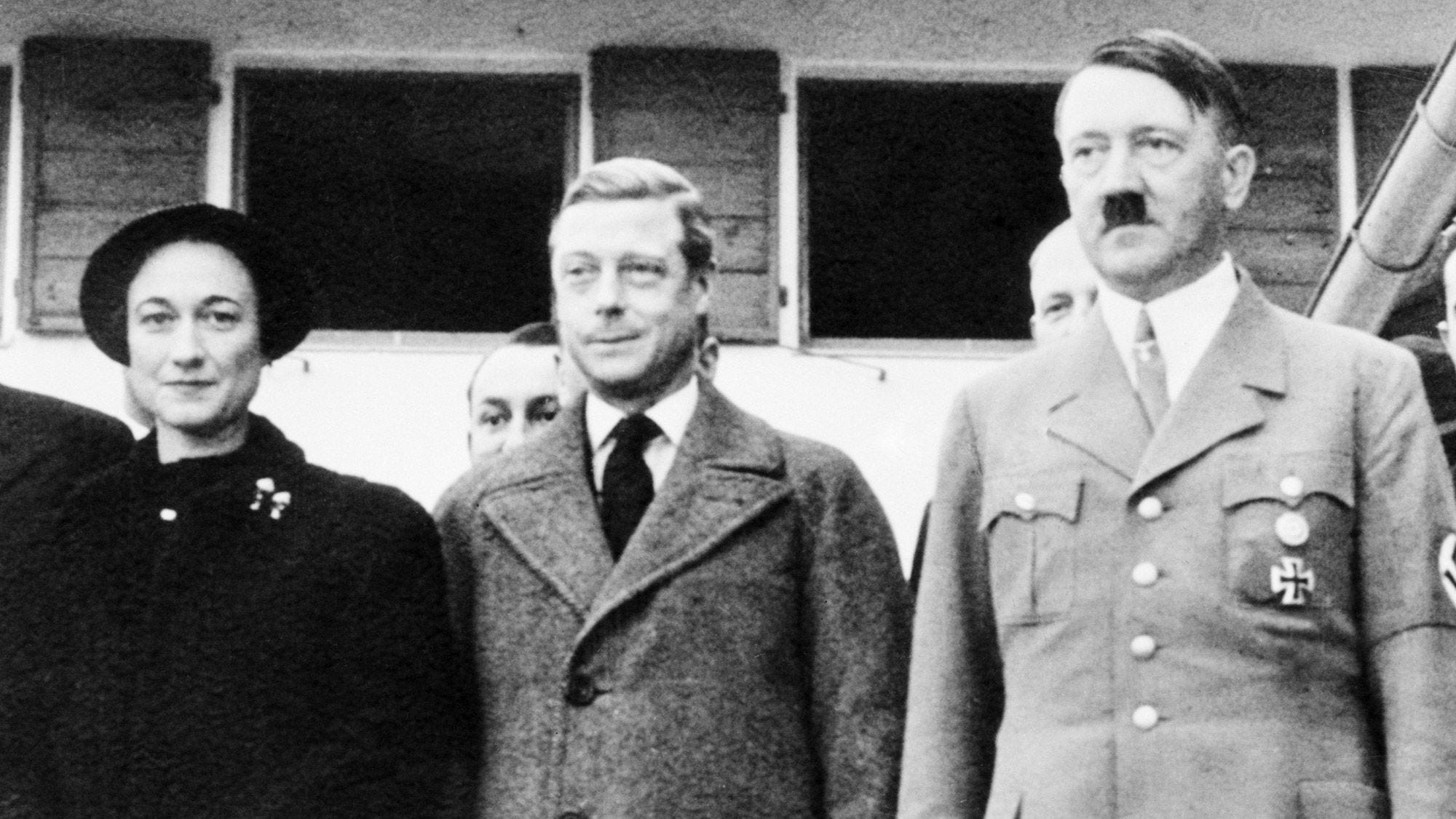
From the archives of other countries, Karina Urbach has uncovered evidence that Edward had volunteered the view that ‘if one bombed England effectively this could bring peace’ – which would have meant a forced negotiation on German terms. This opinion was expressed on 25 June 1940 to a Spanish diplomat, Don Javier Bermejillo, and passed on to the Germans. The sustained bombing of Britain began on 10 July 1940. Claire Luce’s anecdote was regaled in Martin Allen’s book, Hidden Agenda, which is a very readable account of the activities of the Windsors. Unfortunately, it transpired that a number of key documents upon which the author relied for his more sensational revelations turned out to be forgeries. The documents he had discovered in the National Archives had been smuggled in, and then found by him in his researches. That this came to light is only due to diligent detective work by the journalist Ben Fenton. The National Archives have now put in place measures to check what is coming in as well as what is going out. It is a pity that Martin Allen’s book had its credibility damaged in this way, for the case he makes against Edward stands up perfectly well without the icing on the cake.
Edward’s fascist sympathies had caused the British government to take the unprecedented step of subjecting him to secret surveillance. The Channel 4 documentary Spying on the Royals confirmed that George V had assented to this. It began with physical surveillance and was then stepped up to intercepted phone calls. This surveillance continued after his father died and he had succeeded to the throne, and indeed after he abdicated. It was constitutionally a questionable proposition that the Prime Minister of the day, with support from his Home Secretary, could decide to subject the King to surveillance and tap his phone, and it caused consternation at MI5 who had to carry this out. The director general referred it to the board of the organisation, who convinced him that the surveillance was necessary. History has more than justified Baldwin’s actions. Rudolf Hess, who had met Edward and Wallis in Paris just prior to their trip to Germany, recorded: ‘The Duke is proud of his German blood, says he is more German than British …
There is no need to lose a single German life in invading Britain. The Duke and his clever wife will deliver the goods.’ Hess’s note implies a faith in Edward’s ability to produce an official British government position in favour of a deal between the two countries, regarded by the Germans in 1937 as not a wholly unrealistic proposition, given the support for appeasement in the upper echelons of society in Britain at that time.
Edward was seen as a solid and reliable figure for the Nazis, and even after war broke out they harboured the idea of reinstating him on the throne, as a puppet like Pétain or Quisling. This is reinforced by Soviet intelligence records from 1940 which reveal a belief, or at least a fear, that Edward was conducting negotiations with Germany on a peace treaty, a new British government, and a military alliance against the USSR. Having Edward on the throne would have been a smart move. For one thing, he retained a great deal of public support at home amongst ordinary people, support probably only heightened by his decision to give up his throne for love. For another, the armed forces all take a personal oath to the monarch, and if he instructed them all to lay down their arms, they may well have done so – whatever Churchill or anyone else said. Physical surveillance of Edward continued after George VI ascended the throne – with the King’s support. Indeed, there is evidence, according to the Nottingham historian Dr Rory Cormac, that the new monarch paid for some of it. When the war finally broke out, Edward was still in exile. He offered his services to Britain, but this was received with lukewarm enthusiasm. He was eventually allocated to the British Military Mission in France from where he was sent on a tour to boost the morale of the French troops dug into their defensive positions. For the British, this was also an opportunity to nail down exactly what the French were doing, which was information they had been reluctant to share in its entirety with the British. Edward therefore made detailed notes of everything he saw, including the potential weaknesses in the French lines.
One key weakness he identified was the vulnerability of the potential route for the Germans through the Ardennes forest, a route the French had concluded would be too challenging for the Germans to attempt. This turned out to be exactly the route they would take, leading to the capitulation of the French in just six weeks. It seems certain that the Germans must have had knowledge of the French positions or they would have been most unlikely to want to go through the forest. The question is whether they gained that information from Edward or a source connected to him, or from a different direction. The general view amongst historians appears to be that the intelligence may well have come from someone in Edward’s circle, gleaned from him blabbing irresponsibly.
No such benefit of doubt can be given to the duke on another occasion when sensitive information reached the Axis powers, as recounted in Andrew Morton’s book. At a dinner, Edward learnt from the American ambassador of the derailment in Austria of a train heading from Germany to Italy. This revealed that the cargo consisted of naval shells on their way to an Italian port, clearly implying that the Germans were gearing up for a naval war. As soon as he could, Edward took an Italian diplomat present at the dinner to one side and told him of the find. Unsurprisingly, it was not long before the authorities in Rome and Berlin were aware they had been rumbled.
The Duke of Windsor continued to be a major headache for the British government as the war unfolded and there was a genuine concern that while in Franco’s Spain, he might succumb to German courting, including the offer of a crude financial bribe. In the end, Churchill had to threaten to court-martial him if he failed to follow instructions to leave for the Bahamas, where he was to take up post as governor-general. The Bahamas was chosen for him to sit out the war to ensure that he would be as far as possible from Britain, and as far as possible from the Nazis.
Edward still smarted from this appointment years later. In an otherwise friendly letter to his brother George VI in October 1945, he included this barbed comment: ‘I am satisfied that the job I undertook as your representative in a third-class British colony was fulfilled to the best of my ability.’ Yet even in the Bahamas he had continued to undermine the British war effort, attempting to persuade the Americans not to join in the fray. In a meeting in December 1940 with the writer (and undercover FBI agent) Fulton Oursler, he volunteered the view that it would be ‘a tragic thing for the world if Hitler were to be overthrown’. Hitler, he added, was ‘a very great man’.
Meanwhile he lounged around, much to the annoyance of Scotland Yard, who, not unreasonably, felt that the police officer deputed to guard him would be better deployed back in Britain. I was able as part of the research for this book to access hitherto closed papers of Walter Monckton, who acted as Edward VIII’s lawyer. Monckton was a significant figure in Edward’s circle, acting as a go-between between him and the government, and even helping to draft the famous abdication speech. He was the first person knighted after Edward ascended to the throne in 1936. The papers, held at Balliol College, Oxford, question why the officer, a Detective Sergeant Harold Holder, was still with the duke, almost a year after he had accompanied him to the Bahamas.
In a letter dated 7 May 1941 from Christopher Eastwood, the private secretary to the Secretary of State for the Colonies, to H. A. Strutt at the Home Office, he noted that the reason a police officer had accompanied him to the Bahamas at all ‘was a rumour of some plot against his life, which turned out eventually to be a mare’s nest … It was not, I think, intended that he should necessarily stay in the Bahamas for as long as the Duke is there.’ A Mr W. Bolland of Scotland Yard, who had been copied in, also wrote with feeling to the Home Office: The Commissioner was reluctant to allow Holder to go in the first place, but had to agree when told that the Duke would not go without a police officer. He feels that in his present job Holder is almost certainly wasting his time. The Duke and Duchess are probably in no danger whatsoever. If they were, one police officer could not look after them efficiently. Probably Holder spends most of his time fetching and carrying for the Duchess or wandering round golf links behind the Duke … If the Colonial Officer or anyone else can persuade the Duke to give Holder up, the Commissioner would be very grateful to have him back again.
The Home Office batted the whole thing back to Christopher Eastwood at the Colonial Office. Edward would continue to be closely monitored throughout the war, including by the Americans, and information helpful to the Germans would continue to reach them from his base.
He did, however, strongly disapprove of the Japanese attack on Pearl Harbor, although this was at least in part driven by his racist views of the Japanese.
So, was Edward a traitor? The charge sheet is bleak. He was pro-Hitler; he surrounded himself with Nazis and Nazi sympathisers; he encouraged the bombing of London; he tried to persuade the United States to keep out of the war; and variously deliberately and carelessly, he passed on highly sensitive intelligence to Britain’s enemies. On the other hand, with magnificent self-delusion, he probably really did believe he was acting in the best interests of Britain, and his absurd sense of self-importance probably clouded his judgement as to the consequences of his actions.
So he will not have seen himself as a German asset or spy, even if that was what he was. Whether that would have been enough for him to have been found not guilty of a charge of treason, had it been brought, is however doubtful. Others certainly suffered the ultimate penalty for their expression of pro-Nazi sentiments, including William Joyce, and for whom there could be no defence of good intentions. His was the fake soft upper-class voice that regularly broadcast Nazi propaganda to the British, his reports beginning with the sinister ‘Germany calling, Germany calling.’ After the war, he was hanged for treason, even though he was actually American by birth.
Edward, of course, escaped any official censure and continued to live a life of comfort and opulence until his death in 1972. Wallis Simpson continued to live in their Paris house until she died in 1986. The villa had been home to Louis Renault, the car manufacturer, who was deemed to have collaborated with the Germans, although some revisionists dispute this. In any case, his house was seized and nationalised. In another of those interesting quirks of fate, after the duchess’s demise, the house was then taken over by Mohamed Al-Fayed, whose link to the royal family came about through the relationship between his son Dodi and Princess Diana, which came to the violent end in a Paris road tunnel that shocked the world in the summer of 1997. Mr Al-Fayed still lives there.
It is generally believed that with Edward out of the way and his brother George VI on the throne, it was back to business as usual. So it was in the sense that the new King was a fundamentally decent person who was wholly committed to doing the right thing for Britain. Nevertheless, he shared an ambivalent approach to Hitler along with others in the royal family. He recognised the dangers Hitler posed for Germany’s neighbours and disliked the crude antisemitism he peddled. Yet there was grudging admiration for the economic progress and order the Nazis had brought to Germany, and he shared the view that Britain should seek to appease Hitler and, after the war started, attempt to secure a negotiated peace.
Karina Urbach quotes in her book a pre-war confidential note from a German observer to von Ribbentrop in Berlin, which recorded that George VI ‘has great sympathies for the Third Reich’. While this may be a tad exaggerated, and while it is without doubt that they would have preferred Edward to have remained on the throne, it does accurately capture the King’s overall pro-German sentiments. He was very much in Chamberlain’s camp, and even wanted to meet his plane at the airport as it touched down, bringing the Prime Minister back from Munich, waving his piece of paper which purported to demonstrate ‘the desire of our two peoples never to go to war with one another again’. He was dissuaded from this, so instead invited Chamberlain up on to the balcony at Buckingham Palace to give royal endorsement to this seemingly magnificent achievement.
![Neville Chamberlain returning from Germany with the piece of paper signed by Hitler which would bring "peace for our time" September 30th, 1938. [1920x1080] : r/HistoryPorn](https://substackcdn.com/image/fetch/$s_!H-Cs!,f_auto,q_auto:good,fl_progressive:steep/https%3A%2F%2Fsubstack-post-media.s3.amazonaws.com%2Fpublic%2Fimages%2Fc4798f5e-b244-4144-88b2-3832a9480607_640x360.jpeg "Neville Chamberlain returning from Germany with the piece of paper signed by Hitler which would bring "peace for our time" September 30th, 1938. [1920x1080] : r/HistoryPorn")
This act on the part of the King was unwise, and pulled him into the politics of the time. He was implicitly endorsing the Conservative Prime Minister Neville Chamberlain and his policy of appeasement, which, by 1938, was far from universally held to be the correct approach. As for Chamberlain, before war broke out he was obsessed with monitoring and seeking to influence the various factions, even to the extent that he had Churchill’s activities reported to him. On 23 October 1938, three weeks after Chamberlain’s return from Germany, George VI wrote to his brother, the recently abdicated Edward: I was so glad that the Prime Minister decided to see Hitler. I was always very anxious that he should make ‘personal contact’ with him and speak to him face to face. I am sure his policy is the right one in this case and let us hope this will be the turning point in our relations with Hitler in the future.
Edward replied: ‘I agree with you wholeheartedly that the Prime Minister’s personal contact with Hitler was the only thing that saved the World from war last month … I am in the front rank for taking my hat off to him.’ George VI, like his brother Edward before him, held the view that kings and queens still had a hands-on role to play when it came to foreign policy, and not necessarily one in line with the elected government. It was, according to the historian Tom MacDonnell, ‘as if nothing had happened to the map of Europe since 1914 when the Continent had been the private domain of royal cousins’. George VI repeatedly suggested he make a personal appeal to Hitler, something which would have been both inappropriate and ineffective. He suggested that his cousin, and uncompromising Nazi, Prince Philipp of Hesse could be used as a conduit to Hitler. When that did not find favour, he sent his brother, the Duke of Kent, to speak to his cousin anyway. Royal weddings and funerals provided ideal cover for such meetings. The present Duke of Edinburgh told the historian Jonathan Petropoulos in 2004 that there had been ‘a tremendous amount of contact between the two.’
As the war unfolded, George VI encouraged Lord Halifax to use the metaphorical back door at Buckingham Palace to keep him briefed.
Halifax, with the support of the King, continued to pursue appeasement well into the summer of 1940, even attempting to enlist the help of Mussolini to secure it. Naturally George VI much preferred the idea of the appeaser Halifax as Prime Minister rather than Churchill, though as time went on, his opposition to the Nazis did harden. As an aside, had the King succeeded in having Halifax as Prime Minister, he would have managed to wind the clock back. It had become standard practice for the Prime Minister of the day to sit in the Commons, not the Lords. That remains the case today. The last PM who sat in the upper house was Lord Salisbury, up to 1902.
What is perplexing is that anyone would think, after a string of betrayals and broken promises throughout the previous decade, that any agreement reached with Hitler would be honoured. The royals may have thought that there was a special relationship with Germany, and that Hitler’s alleged soft spot for Britain would make him amenable to a deal, but the evidence to date was that any pact or promise to respect neutrality lasted only as long as it suited Hitler politically and militarily.
One strange and much discussed event of the war was the flight to Britain by Hitler’s deputy Rudolf Hess on 10 May 1941. What is not in dispute is that he emerged from his twin-engined fighter bomber near the village of Eaglesham in Scotland, and when confronted by the local Home Guard, gave his name as Alfred Horn and asked to see the Duke of Hamilton. The duke had been personally appointed by George VI in 1940 to the important court position of Lord Steward of the Household, the first dignitary of the court. The King had in fact sacked his predecessor, the Duke of Buccleuch, who had served from 1937, on account of his embarrassingly overt pro-Nazi views – the duke had even attended Hitler’s birthday party in 1939.
After he was unmasked, Hess stated that the purpose of his visit was to seek peace between Germany and Britain. He would be detained here until 1946 when he was convicted for crimes against peace in the Nuremberg trials and thereafter held in Spandau prison until he died in 1987, aged ninety-three. What is in dispute is why he made the flight at all. After his capture, Hitler issued a statement suggesting Hess was mentally ill, but that smacks more of a deniability strategy than a serious suggestion. Numerous theories have been put forward, of which there are perhaps two credible front-runners. One is that he was deliberately lured here by the British in a sort of sting operation, holding out the false prospect of peace negotiations. If that were the case, we might have expected the authorities to have been prepared and to have whisked him away quite quickly upon arrival. As it was, he was left in a scout hut for four hours under the control of members of the Home Guard. The more likely explanation is that this was a genuine attempt by some on the British side to secure peace, and that the Nazis had received from key individuals in this country signals of sufficient weight to believe that it was worth Hess making the trip. After all, Britain was in poor shape by May 1941, and by any objective account was losing the war. That the country might want to come to some accommodation with Germany may well have seemed credible to the Nazis.
Interestingly, the then Lord Provost of Glasgow, Sir Patrick Dollan, seemed to know a good deal about the trip. He was reported in a Scottish newspaper shortly after Hess’s arrival saying that the leading Nazi believed he could remain in Scotland for two days, discuss peace terms, and then be given petrol and maps to return to Germany. It has also been suggested that there was a welcoming committee for Hess at the Duke of Hamilton’s residence at Dungavel House, and that that party included the King’s brother, the Duke of Kent. We shall never know what would have happened if Hess had not landed eleven miles away from where it seems he was expected.
It would certainly have required someone of sufficient importance to convince Hess, and probably Hitler too, that the flight was worth making. The Duke of Hamilton, who had worked for British Intelligence in the mid-1930s, was a known appeaser, and had even attended the Berlin Olympics in 1936. But he would surely not have been regarded on his own as that significant. The only people of sufficient clout would have been a senior politician like Lord Halifax. Or the Duke of Kent. Or George VI himself. Churchill seemed to give some credibility to the appeasement theory when he addressed the Commons on 27 January 1942: When Rudolf Hess flew over here some months ago, he firmly believed that he had only to gain access to certain circles in this country for what he described as the Churchill clique to be thrown out of power and for a government to be set up with which Hitler could negotiate a magnanimous peace.
This statement from Churchill, nearly nine months after Hess landed, was the first public one he had made on the incident – an extraordinary gap in time.
The other interesting timing is that 10 May 1941, the day Hess landed, was both the night of a devastating air attack on London by 520 bombers, and the last significant air raid on the capital until 1944. It is mere speculation, but one explanation that fits the facts is that with Hess’s capture, Hitler concluded that Edward’s view that the British could be bombed to the peace table was not going to work. It is perhaps worth noting that Hess’s flight occurred shortly before the German invasion of the Soviet Union. It would certainly have helped Germany if their western front could have been neutralised first, and of course, they had for years been receiving recurrent messages from members of the British royal family and others in the upper echelons of society that a solution that left the British Empire intact and Hitler free to tackle what they regarded as the scourge of Bolshevism was a good solution.
So the royal family survived the war, not least due to the King himself, whose basic decency and genuineness struck a chord with the public.
How different it would all have been if Edward had remained as king.
In 1956, the new German state released some wartime papers which cast a bad light on the motives and actions of the Duke of Windsor.
The British government quickly issued a statement by way of response which included the following statement: ‘His Royal Highness has never wavered in his loyalty to the British cause.’ Sir Alan Lascelles, Edward’s private secretary, saw it rather differently. He was to observe: ‘He never cared for England or the English … He hated this country.’
Order And What Do You Do? here - https://www.amazon.co.uk/What-Do-You-Royal-Family/dp/1785904914
No posts
Comments
Nothing yet. Say the first thing.
Sign in to join the conversation.