
Putting money in a savings account feels responsible.
It is familiar. It is boring. It is the thing most of us were told to do when we started earning money: keep some cash aside, do not touch it, let it sit somewhere safe.
That instinct is good.
The problem is what happens after the money gets there.
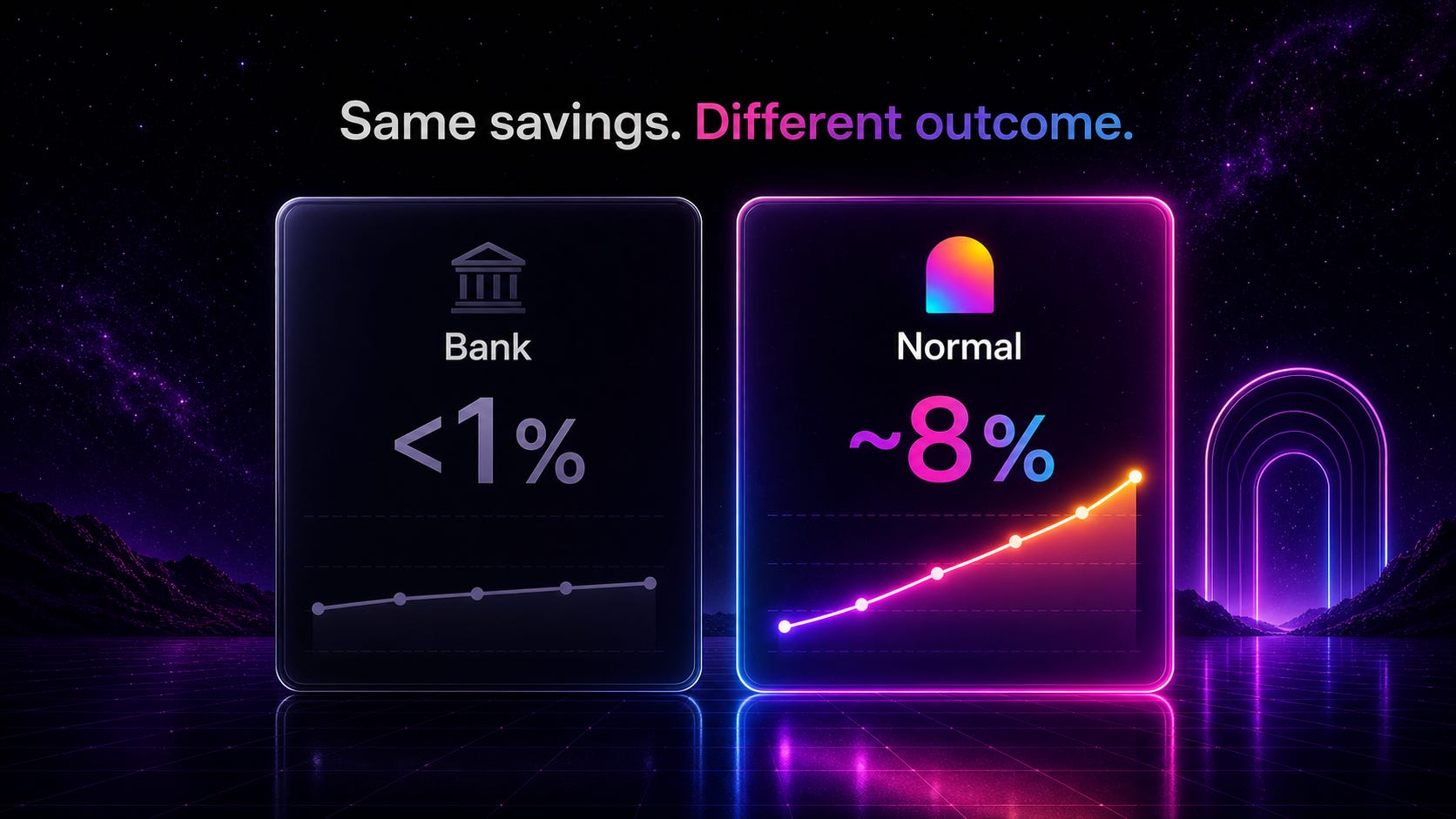
Most bank savings accounts pay almost nothing. Some pay less than 1%.
People know this, but they do not always feel it because the number looks small. A low interest rate does not hurt all at once. It becomes expensive quietly.
That is what makes it easy to ignore.
So let’s make it less abstract.
If you keep $10,000 in a savings account earning 0.5% APY, you earn about $50 in a year.
If that same $10,000 earns 8% APY, you earn about $800 in a year.
That is a $750 difference on the same starting amount.
Now scale it.
At $50,000, a 0.5% savings account earns about $250 in a year. At 8%, it earns about $4,000.
That difference is not a rounding error. It is rent. It is travel. It is an emergency cushion. It is money that could be working in the background while you are doing literally anything else.
The strange part is that most people already know their bank is not paying them much.
They accept it because banks feel safe, familiar, and easy.
That is understandable.
But familiar and optimal are not the same thing.
Banks benefit from inertia. People leave money there because moving it feels annoying, confusing, or risky. The bank gets the benefit of your deposit. You get a tiny percentage back.
Once you see that clearly, the next question becomes obvious.
Is there a better way for savings to work?
Normal exists because savers deserve a better option.
With Normal, users deposit USDC and earn current yield around 8% through audited, non-custodial yield infrastructure.
The product is designed to be simple:
Deposit digital dollars
Earn yield
Stay in control
No trading.
No charts.
No trying to guess the market.
No pretending finance should become your second job.
Normal uses blockchain technology, but the point is not to make you care about blockchain.
The point is to give people access to financial infrastructure that can be more transparent, more open, and more user-controlled than traditional systems.
The user outcome is simpler than the technology behind it:
Your money works harder.
You stay in control.
You do not need to trade.
That is the part that matters.
The obvious question is: what is USDC?
USDC is a stablecoin, which means it is designed to track the US dollar. You can think of it as a digital dollar used on blockchain networks.
Normal starts with USDC because it lets people earn yield on a dollar-based asset without asking them to speculate on volatile tokens.
That distinction matters.
Normal is not for people trying to chase the next 100x asset. It is for people who want their savings to do more without adding chaos to their lives.
The other obvious question is: who controls the money?
This is where Normal is different from a bank or a centralized exchange.
Normal is non-custodial. That means Normal does not hold your funds. Users interact through their own wallet and remain in control.
Normal is the user experience layer that helps people access yield infrastructure. It is not a company account where your money disappears into a black box.
That does not mean people should turn their brains off. Yield products deserve scrutiny. You should understand what you are using, how funds move, and what risks exist.
Better yield is not magic.
But low yield is not magic either.
It is a product choice. It is a business model. And for savers, it has a cost.
The real question is not whether 0.5% is low.
Everyone knows it is.
The question is whether you are willing to keep accepting it.
Check your current savings rate. Do the math on what it earns you over a year. Then compare it to what Normal offers today.
Your money can sit quietly and earn almost nothing.
Or it can sit quietly and work.
That difference compounds.
No posts
Comments
Nothing yet. Say the first thing.
Sign in to join the conversation.