
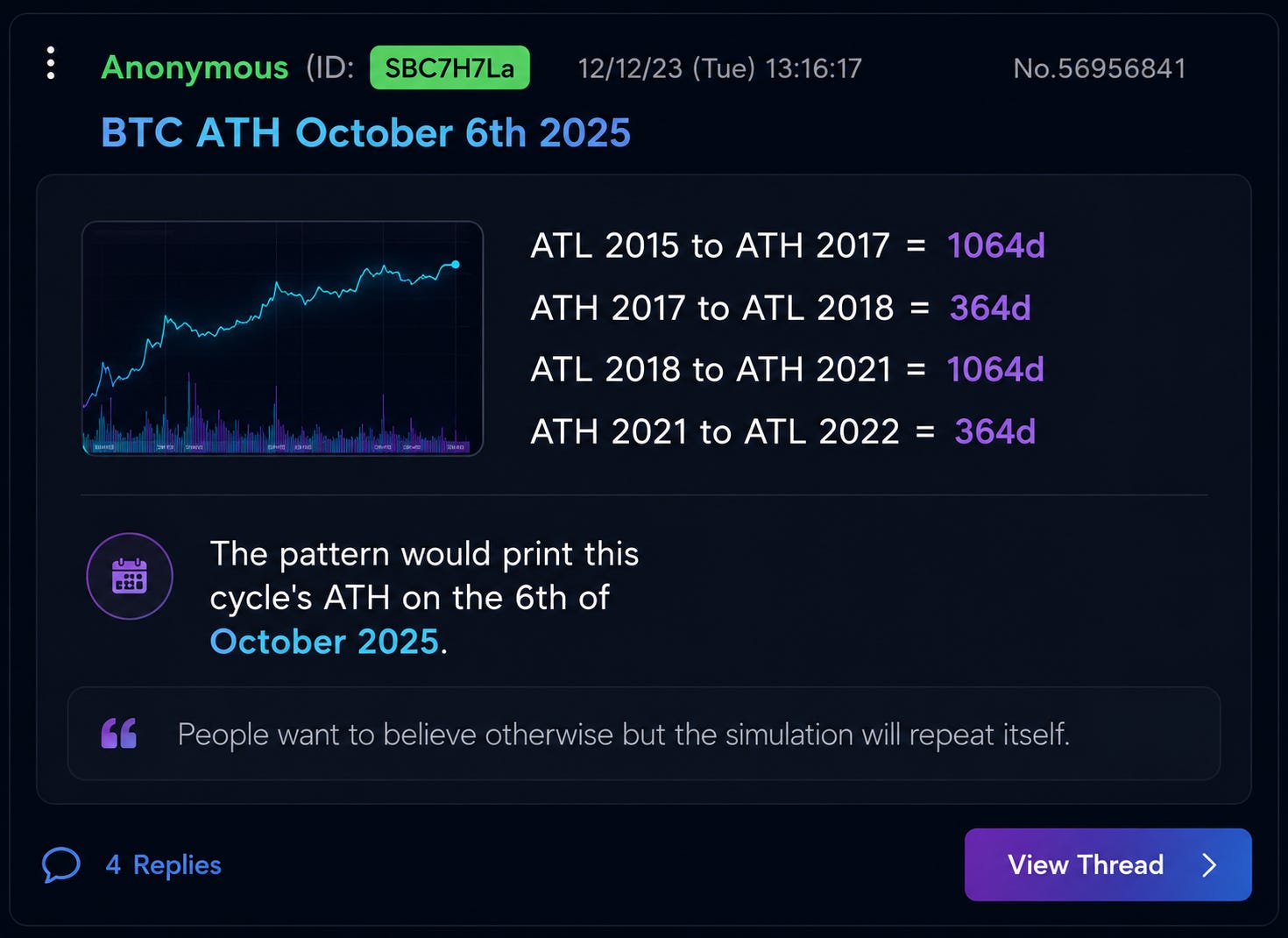
Approximately 1,064 days from cycle all-time low (ATL) to all-time high (ATH), followed by roughly 364 days from ATH back to the next ATL. This structure, observed across prior cycles, aligned remarkably with Bitcoin’s most recent peak on October 6, 2025, when the asset reached approximately $126,000.
If the pattern continues, the next major low could materialize around October 6, 2026—exactly one year after the 2025 high. This positions the current period, as of mid-2026, as a potential strategic accumulation phase amid ongoing market correction and capitulation.
The Historical Rhythm
The 1,064/364-day framework draws from clear precedents:
From the 2015 low to the 2017 high: ~1,064 days.
2017 high to 2018 low: ~364 days.
2018 low to 2021 high: ~1,064 days.
2021 high to 2022 low: ~364 days.
This symmetry, famously highlighted in anonymous online discussions years earlier, projected the October 6, 2025, peak with striking accuracy. Bitcoin has since corrected significantly, trading in the $60,000–$70,000 range in early June 2026, reflecting typical post-ATH bear market behavior with drawdowns of 40–50% or more so far.
In a deeper scenario consistent with historical 70–85% corrections from cycle peaks, Bitcoin could test levels as low as $40,000 by late 2026, creating what many cycle analysts view as one of the more compelling buying opportunities in the asset’s history.
Why This Pattern Persists
Bitcoin’s four-year cycle is anchored in the halving mechanism. The most recent halving in April 2024 reduced block rewards from 6.25 to 3.125 BTC, tightening new supply issuance. Past cycles show bull markets accelerating 12–18 months post-halving before peaking, followed by extended consolidation that shakes out weak hands and resets valuations.
Market psychology reinforces the rhythm: late-stage euphoria fuels parabolic tops, while fear-driven capitulation in bear phases creates oversold conditions. Even as Bitcoin matures—with institutional inflows via spot ETFs, corporate adoption, and growing macroeconomic integration—the core supply shock and human behavior elements have continued to echo prior cycles.
That said, debates persist in 2026 about whether increased institutional participation and Bitcoin’s larger market capitalization will moderate future volatility or shorten bear markets. Early evidence from the 2025–2026 correction suggests the classic structure remains intact for now.
Current Market Context (June 2026)
Bitcoin sits well below its 2025 highs, exhibiting reduced trading volume, tempered sentiment, and a focus on fundamental developments such as Layer-2 scaling, real-world asset tokenization, and DeFi maturation. This environment mirrors previous bear phases where long-term holders accumulated amid widespread pessimism.
The famous Warren Buffett maxim applies particularly well here: “Be fearful when others are greedy and greedy when others are fearful.” Patient positioning during periods of market fear has historically rewarded those with strong conviction in Bitcoin’s long-term scarcity and adoption thesis.
Risks and Considerations
While cycle history offers a compelling framework, no pattern is guaranteed. Potential disruptors include:
Macroeconomic headwinds, such as sustained higher interest rates or geopolitical tensions.
Regulatory developments affecting liquidity and adoption.
Evolving market structure from institutional dominance that could alter traditional cycle dynamics.
Bitcoin remains a high-volatility asset. Strategies like dollar-cost averaging (DCA) during drawdowns have proven effective for many, but investors should align any approach with personal risk tolerance, conduct independent research, and consider portfolio diversification. This is not financial advice—past performance does not predict future results.
Looking Ahead
Should the cycle hold, the window from mid-2026 through October 2026 represents a historically significant period for accumulation ahead of the subsequent leg upward, potentially setting the stage for new highs in the late 2020s. Bitcoin’s story continues to blend mathematical predictability with the unpredictability of global adoption and innovation.
As the asset class matures, the focus shifts toward making cryptocurrency more accessible and integrated into everyday finance, building infrastructure that bridges traditional systems with blockchain’s potential. Whether this cycle repeats with textbook precision or evolves, Bitcoin’s history underscores the value of discipline, patience, and a long-term perspective in volatile markets.
Want to be part of the journey?
We’re always looking for passionate people who want to Make Crypto Normal. If you’re excited about building the future of finance, connect with us:
Let’s Make Crypto Normal
Justin Benjamin
CEO, Co-Founder at normalfinance.io
No posts
Comments
Nothing yet. Say the first thing.
Sign in to join the conversation.