
This Substack is essentially my adult LiveJournal, where I try, through some alchemy, to turn what would be screaming into the void into something more productive. Back in the day, people had diaries and wrote letters. They seemed more or less okay. And I figure it’s a better outlet than Bluesky, where I have spent far too much time this weekend.
So I’m under no illusion that this is for anything more than an audience of one. Nevertheless, I do know some people read this, and I know some of those people personally. I’m also not hard to find on the internet, and there is always some possibility that a person I know could find this. I’m okay with that.
I’m saying this because anyone who is a lawyer knows you’re going to get “As a lawyer” questions. And in this moment — where there’s literal tumult in the streets, civil unrest, and terms like “administrative warrant” and “qualified immunity” are being bandied about by normies — I have been asked: as a lawyer, what do you think of all of this?
It’s probably unnecessary at this point, but for context: Alex Pretti was the U.S. citizen and ICU nurse who was killed by ICE on the streets of Minneapolis. By all sworn accounts, he was present as an observer and had been trying to assist a woman who, also an observer, had been accosted by ICE agents. He was lawfully carrying a holstered gun. I’ve listened to several interviews with former colleagues and others who knew him, and he comes across as a genuinely decent person characterized by affability and helpfulness. Notably, that Friday, the city of Minneapolis had engaged in a non-violent general strike.
All stories have multiple sides, but thus far the only accounts with names and testimony — under oath — are those of individuals on the street contra ICE. All we have on behalf of ICE is the government’s immediate defense and, as of this writing, little to no corroborating evidence. That might change, but it’s January 26, 2026, and that’s all I have now.
So here are my thoughts, as a lawyer, but more important, as an American.
First, if you’re thinking you need to be a lawyer to evaluate the information in front of you, let me disabuse you of that notion. There is no special skill set required to form an impression of what happened to Mr. Pretti or what is happening in Minneapolis. Lawyers are trained to be advisers and advocates, not truth-sayers. We possess no oracular powers to divine the facts.
What we do have is a tool set, and that tool set comes in many forms, from “thinking like a lawyer” to understanding the technical and sometimes Byzantine procedural frameworks applicable to certain cases and issues. A lawyer is better situated to explain what qualified immunity is, trace its doctrinal history, and walk you through how it applies to use-of-force claims. But two caveats follow:
First, every lawyer is trained to advocate for their client. The ability to construct a defense does not mean that defense is correct, likely to prevail, or morally sound. Second — and this is important — laws can be bullshit. If you, as a person and an American, believe the application of a law as written is unjust, harmful, or simply stupid, you can still think that and should still say it. Laws are not immutable. People change them. That’s the whole point of democratic governance.
This was the animating insight of the founding generation. John Locke’s Second Treatise of Government argued that governmental authority exists only to protect natural rights (i.e., life, liberty, property) and that authority which violates these rights forfeits its claim to legitimacy.1 The colonists didn’t need law degrees to recognize tyranny when they saw it. They needed eyes, judgment, and the conviction that their own reasoning mattered.
Martha Nussbaum, philosopher and law professor, has spent decades developing what she calls the “capabilities approach”: the idea that human dignity isn’t just a theoretical abstraction but requires substantive conditions to be meaningful. A dignified life, she argues, requires more than formal rights on paper. It requires real opportunities: to move freely, to participate in political life, to be secure in one’s person and property, to be free from unwarranted search and seizure.2 When Nussbaum asks “What is each person actually able to do and to be?” she’s asking the question that constitutional government is supposed to answer. And you don’t need a philosophy degree to answer it any more than you need a law degree. You just need to look at the gap between what the government says and what it does.
I’m not a criminal lawyer, and Fourth and Fifth Amendment jurisprudence is not my wheelhouse. But I know enough about constitutional procedure to recognize that what’s happening is absolutely bonkers. The procedural posture here — the lack of meaningful oversight, the opacity around the use of force, the invocation of immigration authority in a manner that looks more like paramilitary action than law enforcement — raises serious questions that anyone paying attention can identify.3
Ernst Fraenkel, the German legal scholar who fled Nazi Germany, wrote a book in 1941 called The Dual State. His central insight was that authoritarian regimes don’t simply abolish law; they maintain two parallel systems. One he called the “Normative State”: the ordinary legal order, with courts, procedures, property rights, and contracts, which continues to function because the economy requires predictability. The other he called the “Prerogative State”: the domain of arbitrary, unchecked power, where the regime operates outside all legal constraints whenever it deems necessary for political purposes.4
What Fraenkel observed was that the Prerogative State doesn’t replace the Normative State. It coexists with it. Citizens can go to court, enforce contracts, dispute parking tickets and simultaneously be subject to arbitrary detention, property seizure, or worse, with no recourse whatsoever. The genius of the dual state, if you can call it that, is that ordinary life continues with apparent normalcy while political violence operates in a parallel track, invisible to those not targeted.
I keep thinking about this framework when I watch ICE operate in Minneapolis. The rest of the legal system continues to function. The rest of America, until recently, goes to school and work. Courts are open. Contracts are enforced. And yet there is a domain — the “political sphere,” in Fraenkel’s terms — where none of that applies. It’s where agents can detain, strike, and kill, and the only “review” is their own assertion that they were afraid and subject solely to their opaque gestures towards investigation.
For a more granular breakdown of what a proper investigation would look like, I recommend Just Security’s piece by Julia Gegenheimer, “What a Proper Investigation of Alex Pretti’s Killing Would Look Like.” She’s a former Department of Justice prosecutor and walks through what investigators should be doing: securing the crime scene, preserving evidence with painstaking documentation, constructing a chain of custody, identifying witnesses. She also raises serious concerns about how federal authorities appear to have handled this scene, including moving evidence before photographing it and reportedly keeping state and local law enforcement away.
I’ve written previously about why investigations matter and about the pathology of well-credentialed people who use procedural norms to avoid naming what’s in front of them. Video footage provides initial impressions, but what matters in any investigation is as much about testimony and credibility as it is about physical evidence and forensics. Taken together, these create a more complete evidentiary picture.
But here’s what’s distinctive about Minneapolis: there is an extraordinary delta between the first impression conveyed by the video and what the government is saying.
It would be one thing if the government were appropriately counseling patience: telling everyone to hold their horses while gesturing at a theory that this was lawful immigration enforcement. But that’s not what’s happening. Instead, the administration has opted to speak categorically about the facts and the motivations of the parties involved, asserting conclusions without the predicate investigation that would support them.
Nussbaum, in The Monarchy of Fear, draws on Aeschylus’s Oresteia to make a point about civilization. At the end of the trilogy, Athena doesn’t simply punish the Furies (the ancient goddesses of blood vengeance.) She transforms them. She establishes courts of law with “established procedures of evidence and argument, and a jury selected by lot from the citizen body of Athens.” Blood guilt, she announces, will now be settled by law rather than by vengeance. This is the founding moment of democratic legal order: the replacement of arbitrary retribution with institutionalized deliberation.5
What we’re watching in Minneapolis is the reversal of that transformation. We are watching the Furies return, not as myth, but as policy. The government’s immediate designation of citizens as “terrorists,” its categorical assertions before any investigation, its treatment of the scene as a site of political messaging rather than evidence preservation — this is the logic of vengeance, not law.
So what I would implore everyone to remember is this: yes, prudence dictates waiting for the facts. However, your eyes, your ears, and your rational mind still matter. You can observe the distance between what you saw and what you’re being told and call bullshit. That is not irresponsible speculation. That is the basic epistemological work of being a citizen in a republic.
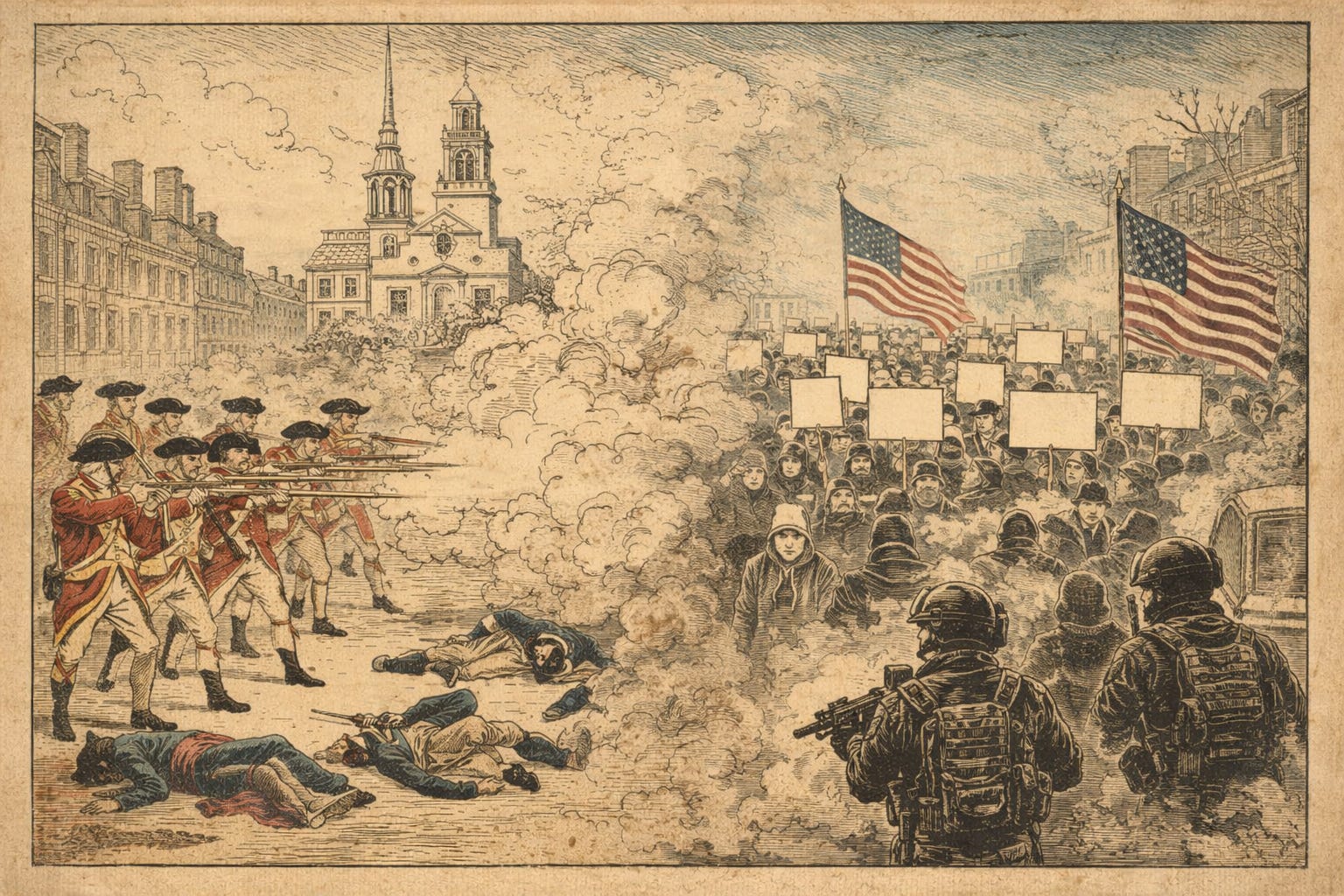
Again, the founders knew this. They lived it. They didn’t defer to Crown officials’ characterizations of colonial unrest. When British authorities described the Boston Massacre as a justified response to a violent mob, colonial pamphleteers and engravers circulated their own accounts. Paul Revere’s famous engraving was in no way objective, sure, but it wasn’t meant to be. Rather, it was an assertion that ordinary people could look at the evidence and reach their own conclusions about who was telling the truth. The whole revolutionary project was premised on the idea that citizens don’t need official permission to assess official conduct.
This is the point I will stomp on in virtually every single post I write about state action: the government must justify its conduct.
This is not a normative preference. It is the constitutional order. Under our system, the federal government is one of enumerated powers. It must point to where in the Constitution it derives authority to do whatever it is doing. You are entitled to walk freely on the streets of this country, and it is the government that must justify stopping you. They need papers, not you. The presumption of liberty is the baseline; restrictions on that liberty require justification.
Thomas Paine put it plainly in Common Sense:
“In America, the law is king. For as in absolute governments the King is law, so in free countries the law ought to be king; and there ought to be no other.”
This wasn’t a throwaway line. It was a statement of first principles: that power answers to law, not the reverse.
The Fourth Amendment’s protection against unreasonable searches and seizures was adopted specifically to repudiate the general warrants and writs of assistance that characterized British colonial rule: roving authorizations that allowed Crown officers to search anyone, anywhere, for any reason. James Otis argued against these writs in 1761, and John Adams, who watched from the gallery, later wrote: “Then and there the child Independence was born.”6 The founders remembered what it looked like when officers could act without showing their receipts and they wrote a Constitution to prevent it.
The demand for particularity, i.e., that the officer must specify this person, this place, this thing, for this reason, is not procedural fussiness. It is the wall between a free society and a police state. As Cato’s Letters warned in the 1720s: “Only the checks put upon magistrates make nations free; and only the want of such checks makes them slaves.”7
Similarly, you are able to lawfully possess a firearm. The mere presence of a weapon on one’s person does not constitute intent to fire or threaten anyone. My family has multiple firearms in our house. I know people who conceal-carry (mostly off-duty law enforcement or former military) and many on the older end have gone their whole lives without ever drawing their weapon in that context. If mere possession could be equated to intent to use deadly force, we’d have a hell of a lot more duels in the street. The legal standard requires reasonable apprehension of imminent harm, not theoretical possibility of harm. And it’s on the government to demonstrate that standard was met, not on the dead man to prove his innocence posthumously.
Which brings me to a point about the information asymmetry here and the irony embedded in it.
A lot of folks are being appropriately cautious. They’re saying things like: “I want to wait for more facts.” “I’ve only seen one angle.” “We don’t know what happened before the video started.” This is epistemically responsible. It’s how thoughtful people approach contested events. And to be clear, I’m not criticizing that instinct; it’s the right one.
But notice the delta, the gap. You are exercising caution with the same limited information that the government had when, within hours of Alex Pretti’s death, it labeled him a “would-be assassin” and a “domestic terrorist.” Alex Pretti was killed at 9:05 am and WH Deputy Chief of Staff Stephen Miller and DHS Secretary Kristi Noem were making these statements before his parents found out their son was killed.
Let that sink in. Within hours. Before any investigation. Before any forensic analysis. Before any review of the footage that the public would eventually see. The government had already rendered its verdict: this man intended to murder federal agents, and his death was justified.
That is not how the burden of proof works. That is not how any legitimate legal process works. You do not get to kill a citizen and then, in the same twenty-four hour news cycle, declare him a terrorist to justify it. The conclusion cannot precede the investigation — unless the point was never to investigate at all, but to establish a narrative that forecloses accountability.
So when you feel uncertain — when you think, “I should be careful here, I don’t want to rush to judgment” — ask yourself why the government felt no such obligation. You, a private citizen with no power over anyone, are holding yourself to a higher epistemic standard than the entity that killed a man and then called him a terrorist before his body was cold.
The word “terrorist” is not a legal term of art here. It’s a rhetorical weapon. It’s designed to trigger an emotional response that bypasses the question you should be asking: What actually happened? Once someone is labeled a terrorist, the ordinary rules feel like they don’t apply. That’s the point and that’s why the label came so fast.
There’s a recurring conversation about whether to reform or abolish ICE. I don’t know if that’s the right framing. It feels mostly like sloganeering. It’s the kind of discourse that generates heat but not light.
I think if you stepped back and applied what Rawls called the veil of ignorance — designing an immigration enforcement apparatus without knowing your own position in society — most Americans would not build something that looks like ICE.8 Such an agency would need to operate within constitutional standards for search and seizure. It would be trained in traditional law enforcement protocols. Its agents would be visibly identified and unmasked, consistent with basic principles of governmental accountability and the public’s right to know who is exercising state power against them.
So this feels like a Ship of Theseus problem: if you strip away all the features that make ICE a paramilitary organization, is it still ICE?
That said, I do think ICE needs to go, less because of the structural issues I’ve outlined (though they matter) and more because the agency’s recruitment pipeline and institutional culture have become so deeply problematic that I don’t believe the public could ever trust it to make good on any purported reforms. Fraenkel’s framework is useful here too: ICE has become the institutional embodiment of the Prerogative State. It is designed to operate outside normal legal constraints. The organizational rot runs too deep for cosmetic fixes.
We had nearly 250 years of immigration enforcement without ICE. I’m older than ICE…by like, a lot.9 Whatever solution we want to craft can surely be better than this.
Nussbaum’s book title The Monarchy of Fear is not accidental. Fear, she argues, is monarchical. It is the emotion of the absolute ruler, not the democratic citizen. “Fear erodes the sort of equal give-and-take, the reciprocity, that is needed if democracies are to survive.”10 Fear leads us to grasp for control, to scapegoat, to demand that complicated problems have simple solutions, usually involving the punishment of someone we’ve been told to blame.
The administration’s rhetoric about “domestic terrorists” and “maximum damage” and people who wanted to “massacre law enforcement” is designed to provoke fear. It is designed to make you feel that complicated questions about use of force, about due process, about the proper scope of federal power, can be bypassed because the threat is so grave, so immediate, so monstrous that normal rules don’t apply.
But that’s exactly backwards. The more grave the accusation, the more important the process. The founders understood this. For example, that’s why treason is the only crime defined in the Constitution itself, with explicit evidentiary requirements: “No Person shall be convicted of Treason unless on the testimony of two Witnesses to the same overt Act, or on Confession in open Court.” They were more careful about serious accusations, not less, precisely because they knew how easily fear could be weaponized.
Nussbaum draws on Lucretius, the Roman poet, to explain how fear operates: it “taints everything with its blackness,” operating beneath the level of consciousness. But she also offers an alternative that I’ve described above: at the end of the Oresteia, Athena doesn’t just establish courts. She persuades the Furies to join the city, to become protectors rather than avengers. The transformation isn’t just institutional; it’s emotional. Democratic citizens, Nussbaum argues, must resist the Furies within themselves, must channel justified outrage toward “an intelligent and imaginative effort toward justice” rather than retribution.11 That’s the work we’re being asked to do now, and why it’s important to stress our independence and influence.
Shield of the Republic recently ran an excellent interview with Stephen Kotkin, the Princeton historian and expert on authoritarianism and fascism. He notes toward the end that he doesn’t see fascism in America yet, at least not in the classical, per se markers we’ve observed in other countries.
I don’t want to argue with the fascism expert. But I’ll frame it normatively: our tolerance for even hints of fascism is and should be lower than the average country’s. Our inheritance and our entire political tradition is grounded in being grumpy about our rights.
My husband is Canadian, and this has always been a bit between us, almost like when someone makes fun of your younger sibling. Only I can complain about my country’s hypocrisy; when you pick on it, I’m going to talk about muh rights. But this instinct matters. It’s the immune response of a republic.
The philosophical tradition the founders drew from understood this. Aristotle taught that courage is not recklessness but right action in the face of fear, governed by reason and directed toward the good. The Stoics taught that self-mastery is the highest form of strength, and that the person who can restrain their own power is more admirable than the person who merely exercises it. Cincinnatus, the Roman farmer who was given absolute power to save the republic, then gave it back and returned to his plow. Washington was explicitly modeled on him. Remember: power is loaned, not owned.
I’ve been writing in this space for a while now, and in some ways this post is a culmination — an attempt to pull together threads I’ve been working through in different contexts. Why constitutional fidelity is itself a radical act. What it means when the government behaves like a fugitive from its own legal obligations. Why Democrats ignore the malleability of voters at their peril. What I remember when I think about who we are. These aren’t separate ideas. They’re facets of the same conviction: that the constitutional structure still exists, and that we still have agency within it.
Because for all the bad things happening in the United States today, I think Kotkin is correct — and I’ve said it multiple times — that we still have agency and we still have power. JVL at The Bulwark has an excellent piece on the power of people standing up for their neighbors. Congress, technically, still exists.
So let me end where I began: You do not need a law degree to assess what happened in Minneapolis. You don’t need to read the philosophy essays and books linked here, though I obviously find them grounding as a framework and recommend them. I’ll even conclude with one more.
Adam Smith, in The Theory of Moral Sentiments, described what he called the “impartial spectator”: a figure who is emotionally engaged but not personally invested, well-informed but not omniscient, capable of sympathy but not captured by self-interest. This spectator doesn’t have perfect knowledge. He has enough knowledge, and he uses it with care. Nussbaum has written extensively about this concept, arguing in Poetic Justice that the impartial spectator represents the posture democratic citizens and judges should adopt when evaluating claims of justice: attentive to particulars, emotionally literate, and unwilling to let abstractions obscure the human stakes.12
That is who you are being asked to be right now. Not a lawyer, not an investigator, but a judicious spectator.
So watch the footage. Read the sworn testimony that we do have. Notice who is speaking under oath and who isn’t. Notice who had access to the evidence and who was kept away. Notice how fast the government moved to characterize the dead, and how slow it has been to show its work. You are not being asked to render a verdict. You are being asked to pay attention and to refuse the false choice between credulous acceptance and paralyzed silence.
The founders did not design this republic for a citizenry that waits for permission from experts before forming judgments about the conduct of its government. They designed it for people who pay attention, who think critically, and who refuse to be bullied into silence by the incantation of official-sounding words.
You are allowed to draw conclusions. You are allowed to be angry. You are allowed to say, This does not look right, even if you cannot cite the statute.
We are in charge. The government has powers and people have rights. Whenever the government acts, it needs to justify itself by showing where that power resides and that it was justified in exercising it. We do not beg and plead to keep our lives. We do not require permission to record goings-on in public. And when someone tells you that obedience is the price of survival — to “obey or die” — that is the formulation of subjects before a crown and it is the logic of occupation. This is the test the whole American inheritance was meant to prepare us for — all of us, not just lawyers
A note on citations: The legal and historical references in this essay are intended for context and illustration, i.e., to show where the principles come from and why they matter. I have not Shepardized any cases, and I’m not representing that they constitute current binding precedent you’d cite in a 2026 filing. If you’re litigating something, hire a lawyer and do the proper research. The point here is not to win a motion; it’s to remind you that the law exists to serve principles that predate the technicalities, and those principles are yours to invoke as a citizen, not just as a licensed attorney.
John Locke, Second Treatise of Government (1689). Locke’s argument that legitimate government derives from the consent of the governed and that authority which violates natural rights loses its claim to obedience was foundational to revolutionary American thought.
Martha C. Nussbaum, Creating Capabilities: The Human Development Approach (2011). Nussbaum’s ten “central capabilities” include life; bodily health; bodily integrity; senses, imagination, and thought; emotions; practical reason; affiliation; connection to other species; play; and control over one’s environment (both political and material). The last explicitly includes “being able to participate effectively in political choices that govern one’s life” and “being secure against unwarranted search and seizure.”
The Fourth Amendment protects against “unreasonable searches and seizures” and requires warrants to be supported by probable cause and particularity. The Fifth Amendment's Due Process Clause prohibits the federal government from depriving any person of “life, liberty, or property, without due process of law.” These aren't obscure provisions. They're the basic architecture of limited government
Ernst Fraenkel, The Dual State: A Contribution to the Theory of Dictatorship (1941). Fraenkel defines the Prerogative State as “that governmental system which exercises unlimited arbitrariness and violence unchecked by any legal guarantees” and the Normative State as “an administrative body endowed with elaborate powers for safeguarding the legal order as expressed in statutes, decisions of the courts, and activities of the administrative agencies.” The key insight is that both operate simultaneously.
Martha C. Nussbaum, “Powerlessness and the Politics of Blame” (Jefferson Lecture, 2017), (web available here) drawing on material later published in The Monarchy of Fear (2018). The Oresteia analysis runs throughout her work on political emotions
James Otis’s 1761 argument against the writs of assistance is often cited as an early spark of revolutionary sentiment. The writs were general search warrants permitting British customs officials to search any location for smuggled goods, which was exactly the kind of roving, unjustified authority the Fourth Amendment was designed to prohibit. See M.H. Smith, The Writs of Assistance Case (1978); John Adams, diary entry.
Cato’s Letters, No. 115 (1723). These essays circulated widely in the colonies and taught Americans to be suspicious of unchecked magistrates.
John Rawls, A Theory of Justice (1971). The “veil of ignorance” is a thought experiment in which principles of justice are chosen by parties who do not know their own place in society thereby ensuring the rules aren’t rigged in anyone’s favor.
ICE was created by the Homeland Security Act of 2002 and began operations on March 1, 2003, following the September 11 attacks. It consolidated functions previously performed by the U.S. Customs Service and the Immigration and Naturalization Service (INS). The republic managed immigration for over two centuries without it.
Nussbaum, Monarchy of Fear, page 62.
Nussbaum, ‘Powerlessness and the Politics of Blame.” The phrase “intelligent and imaginative effort toward justice” is her gloss on what it means to transform justified outrage into democratic action rather than retributive anger.
Adam Smith, The Theory of Moral Sentiments (1759); Martha C. Nussbaum, Poetic Justice: The Literary Imagination and Public Life (1995). Nussbaum argues that Smith’s impartial spectator — refined through the practice of reading novels — models the kind of engaged, emotionally intelligent judgment that democratic citizenship requires.
No posts
Comments
Nothing yet. Say the first thing.
Sign in to join the conversation.