
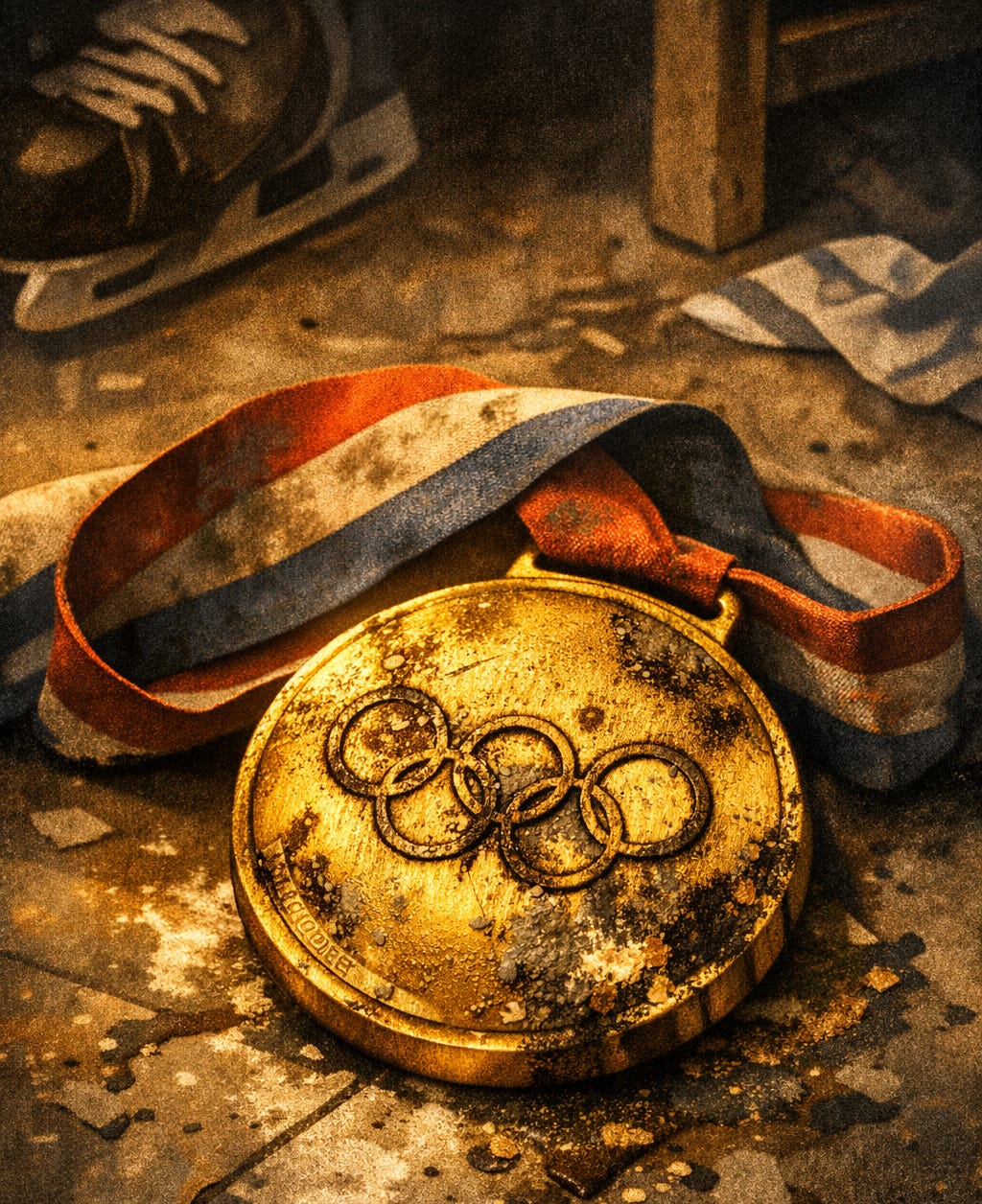
Quick note up top: I wrote most of this in between sets on my phone before a subset of the US Men’s Hockey Team was trotted out at the State of the Union. My thoughts below are about the locker room event. I don’t really know if I have much worth contributing to decisions thereafter besides this: it is one thing to be a semi-captive audience in a locker room operating within a 1-second window conversational window and entirely another to choose to be dog-walked by the state in service of their agenda — one characterized by checks notes shooting Americans in the streets and playing goalie for a rich guy child sex trafficking (and, I’d speculate, money laundering) ring. That’s just this year. And it’s February. History is going to be a harsher judge of their choices than I’ll ever be. Get right, my dudes.
One of the great joys of a long car ride is being able to listen to things like, say, audio books, music, and podcasts. As I traveled with my husband and dog to the great white north (Canada), I listened to a pretty strong take from JVL at the Bulwark on the men’s hockey team and Kash Patel’s Make-a-Wish visit to the US Men’s Hockey Team while they celebrated their gold medal win. I’m paraphrasing but his take was something like:
They made a choice
One choice was to let Patel in at all
A bolder, more intentional choice was to include him in the celebration and cover him in their gold medals — essentially an intentional show of solidarity
They’re adults with agency
Fuck them for that choice.
Soon after, on the ferry, I saw a few Instagram posts by Kevin Clancy (of Barstool Sports) saying — and I’m paraphrasing / going by memory (just kidding, I found a link) that (a) people are mad at the US Men’s Hockey Team because they hate Kash Patel, and; (b) in some general sense this is silly because most of these people don’t pay attention to hockey else-wise.
This was before the men enjoyed a hearty guffaw at the expense of the women’s hockey team — also gold medalists — which I will get to later.
First and foremost, I am, for now, a fair weather hockey fan. I grew up watching the Amerks in Rochester and a periodic Sabers game. Hockey is a great sport for many reasons, but one that is important in this context is that it’s very easy to watch and pick up — at least for me. I find it immediately entertaining, but I’ve never adopted any team. So when Seattle established the Torrent, I had to resist every impulse to immediately buy season tickets — I’m already deep in Reign territory (season ticket holder) and it’s hard enough finding game parking already.
So now that we’ve established I’m just a boob with eyeballs, let’s be real: most of us are fair-weather fans during the Olympics. Quiz me on ice skating. On luge and bobsledding. There are so many skiing events I wouldn’t be able to name them all, only that one involves rifles and I think that’s neat. I am here, first, to argue that this is fine — not just permissible but actually correct, in the sense that fair-weather Olympic fandom is a legitimate and coherent relationship to athletic competition, and you don’t need to apologize for it.
The reason has everything to do with what the Olympics actually is, and what we’re actually doing when we watch it.
There’s a temptation — mostly from people who follow a sport year-round — to treat casual viewership as a lesser form of engagement, a kind of aesthetic tourism. But this misreads what athletic spectatorship is for. The literary scholar Hans Ulrich Gumbrecht, writing about why humans watch sports at all, argues that deep knowledge of a sport isn’t what produces the core experience of watching athletic performance. What we’re responding to is something more immediate: the experience of watching a human body operating at the absolute outer limit of what a human body can do. Grace. Effort. Risk. The possibility of failure. These register before context, before box scores, before you know who’s favored or what the technical scores mean. You don’t need to understand figure skating to feel something when a skater lands a jump she’s been training toward for a decade.1 The response is pre-analytical. It’s almost physiological.
Gumbrecht calls this “presence”: the quality of athletic performance that resists the interpretive apparatus we normally bring to experience. Most of modern life is mediated. We process things through frameworks, narratives, expectations. Sports, particularly at the Olympic level, puncture that mediation. Something is actually happening, in real time, in real bodies, with real consequences. The fair-weather fan, who comes to an event without the accumulated narrative baggage of a full season’s investment, may actually be better positioned to experience this. There’s no prior story cluttering the image; you’re just watching a person do something extraordinary.
The other thing the Olympics actually is — and this is the part I don’t want to be coy about — is a tribal ritual. An agon, in the original Greek sense: a formal contest in which a community’s representatives compete publicly for honor. The ancient Greeks understood the Olympic games as simultaneously athletic, civic, and sacred, and they were right that those things are not separable. When I watch the Olympics and want America to win every event, including against our allies, including against my husband’s country, I’m not confused about geopolitics. I know perfectly well that the jurisdictional lines are invented and that the athletes are humans first. The point is not the geopolitics. The point is the ritual.
The philosopher Friedrich Schiller argued that play — Spieltrieb, the play drive — represents a uniquely human synthesis of the sensuous and the formal, and that it’s in play that we’re most fully ourselves. The Olympics is play at civilizational scale: all the structure of formal competition, all the sensuous reality of human bodies and effort and emotion, and the added dimension of collective identity. You’re not watching a person. You’re watching a nation’s people distilled into a representative, and you’re participating — however vicariously, however imperfectly — in something communal.
I’m not religious and I’m not particularly spiritual, but there is something about that communal participation that satisfies a need I can’t fully quantify or defend on purely rational grounds. It’s ephemeral and psychological and real. I think that’s basically what rituals do, and I think it’s worth naming rather than being embarrassed about.
I’m going out of my way to say this because I’m going to start sharing some opinions on what happened in that locker room, and why I think they’re discordant with a myriad of virtues I believe are inportant to being a good person — a virtuous person — and why that discordance matters to me even as a fair weather fan.
I also want to admit my biases and lay cards on the table.
I try to give people some grace and put myself in their shoes. This is much easier for me to do when I see athletes in a locker room because I’ve had that experience — both the camaraderie but also some of the comments that move from teasing and trash talk to situations I look back on as an adult and think “Well, shit. I wish I had said something.”
I absolutely hate Kash Patel and Donald Trump. I think they are dishonorable, untrustworthy, and fundamentally bad people.
Unlike JVL, I don’t blame the men’s hockey team for the sins of Kash Patel. For sure, as someone who abhors the guy, if he were in my locker room and there was alcohol, there’s a good chance I would’ve said something. I’m a good person (I think), but not a great person, and sometimes I just, you know, say things. Unlike my teens, my ability to hold my tongue is about zero these days. I certainly wouldn’t have put my medals on him. But if I was in the throes of victory and a bunch of people were celebrating I can’t say with any certainty I would’ve behaved any better — it’s entirely likely I’d just be caught in the moment. As gold medalist Hilary Knight put it:
I think there’s a genuine level of support there and respect. I think that’s being overshadowed by a quick lapse. I think the guys were in a tough spot, so I think it’s a shame this storyline and narrative has kind of blown up and overshadowing that connection and genuine interest in one another and cheering each other on.
So maybe I’m being too kind, giving a little too much grace, but Knight knows them better than I do,2 and even if we assume there’s diplomacy going on here, I’m inclined to take the good faith reading. Hughes’ comment of “It is what it is” lands like a fart, of course, and to that I’ll just re-up yet another of Knight’s comments:
[T]his whole situation is a really good learning point, to really focus on how we talk about women, not only in sport but in industry. Women aren’t less than, and their achievements shouldn’t be overshadowed by anything else other than how great they are.
But back to Kash and why he sucks, and specifically why his presence in that locker room isn’t incidental, it’s illustrative.
Honor is not a complicated concept. It doesn’t require a philosophy degree or a particular politics. It’s the thing that makes you show up when it’s hard instead of when it’s fun. It’s the thing that tells you the job isn’t about you. It’s the thing that keeps you at your post when the cameras aren’t there, because people are counting on you and you said you would be. You don’t get to pick your moments. A firefighter doesn’t get to say “Oof, rough week, I’m gonna sit this one out.” A soldier doesn’t get to skip a post because there’s something fun happening. Ultimately, you took the job.
What’s revealing about Kash Patel isn’t any single failure; it’s the pattern. He moves fast for cameras, for crowds, for moments where he gets to be in the frame. He goes quiet when there’s a court order to meet, a civil rights investigation to pursue, a family waiting for answers that don’t benefit him politically. He announced an arrest in a major domestic political violence case before the suspect was actually in custody, got in front of cameras, had to retract it 90 minutes later. He personally intervened to shut down investigations into federal agents who shot and killed civilians, then turned the investigative apparatus around on the victims. There are survivors waiting for answers about a child sex trafficking network3 who have been waiting their entire adult lives, and he sat before Congress and told them there was nothing there while his own bureau’s files said otherwise. That’s not being overwhelmed and it’s not being stretched thin. That’s a consistent and legible picture of what he thinks the job is for: himself, his access, his proximity to power and celebration.
So when he shows up in a winning locker room — invited in by the GM, which is its own conversation — he doesn’t just stand there and enjoy the moment. He pulls out his phone and calls the President and he makes himself the conduit. Under other circumstances, that might be unremarkable — a senior official calling the President after a national team wins gold isn’t inherently a problem, and I think it could honestly be pretty awesome and cool. But context is everything, and the context here is the pattern. Patel doesn’t make himself the conduit because he’s doing his job; he makes himself the conduit because being the conduit is the point, and he does so at the expense of the people who needed him to be something else entirely: not a connector, not a celebrity, not a man working the room, but a leader doing the unglamorous, unfilmable work of running an institution that people’s lives depend on. The families waiting for answers, the investigators waiting for direction, and the survivors who were promised accountability and got a document dump. Every moment he spends optimizing for the frame is a moment spent with his back to them and, unlike the athletes in that room, they don’t get a gold medal at the end. They just keep waiting. A person of genuine honor in that position might have made the same call, but you’d know it wasn’t for him.
Nobody expects the FBI Director to be personally dusting for fingerprints. I know that’s not the job and holding him to that standard would miss the point. The job is, however, to set the priorities, make the calls, and make sure the institution is pointed in the right direction when it matters — which means the job is, inescapably, a leadership job. The thing about leadership is that your presence or absence sets the tone for everyone beneath you. When you’re at your post, you signal that the work is serious. When you’re in a locker room making a call to the President because it makes you look cool, and when you do it partying in a long sequence of self-indulgent recreational and personal trips on taxpayer dollars, you signal something else entirely: that the institution exists to serve you. You signal that other Americans, the ones expressly relying on you, aren’t as important as hanging out with celebrities and athletes. Honor in a leader isn’t just about what you personally accomplish. It’s about what you make possible, and what you make impossible, by where you choose to be and when.
Before I extend any grace to the men in that locker room, I want to be clear about why they get it and Patel doesn’t, because the distinction matters and I don’t want it to look like inconsistency.
The men made a mistake in a human moment: swept up, unthinking, in the best night of their lives. That’s a lapse. Kash Patel is not a pattern of lapses; he’s a pattern of choices, made deliberately, using the machinery of a government institution that derives its legitimacy entirely from public trust. When a hockey player laughs at the wrong moment, the cost is real but it’s personal and social. When the Director of the FBI uses his office as a prop, buries investigations, lies to Congress, and protects the powerful at the expense of the powerless — that’s not a failure of character in a weak moment. That’s the weaponization of public accountability itself. The people he’s failed didn’t just feel disrespected; they were actively harmed by someone who swore an oath to protect them and chose, repeatedly and knowingly, to do the opposite. That asymmetry matters, and it’s why Aristotle’s framework of practice and improvement applies generously to the men and not at all to Kash: because Aristotle also understood that virtue requires the intention to be good, and nothing in Patel’s record suggests that intention has ever been present.
Which is different from a verdict in one important way: honor is a practice, not a possession. Aristotle’s insight about virtue — one of the pieces of ancient philosophy that holds up completely today if you want it to — is that you don’t have courage or have integrity the way you have blue eyes. You become those things by doing them, repeatedly, in small moments that add up. Which means you also fail to become them by not doing them, in small moments, when it would have cost you something in the room. Nobody is born knowing how to swim against a current. You learn by noticing when you got swept along, and deciding you’ll do it differently next time.
The men's team made a choice, even if it didn't feel like one in the moment. I know they're adults, but you'll be shocked to find out that adults are fallible humans, and when we assess choices, context matters and so does culpability. They were in the best moment of their athletic lives, champagne still in the air, the President on the phone — and a joke landed that treated their friends and teammates as a political inconvenience. They did the social math in about half a second and they laughed. I'll take them at their word that they didn't mean it and that the relationships are real. Jeremy Swayman said “we should have reacted differently,” and I want to take that seriously rather than treat it as damage control, because the ability to say that clearly — without hedging, without “well it was complicated” — is itself the beginning of the thing. That's where honor starts: not in the moment you got right, but in the honest accounting of the moment you didn't. “It is what it is” is not that accounting.
What makes the laugh matter beyond the moment — what keeps it from being fully absorbed into “we got swept up in it” — is something most women already know. The disappointment women carry isn’t usually about the obvious misogyny. Like, no shit. That’s almost easier: you see it coming, you calibrate accordingly, you don’t build anything on the assumption that he’s in your corner. The harder one is the man who genuinely likes you, who cheers for you, who would describe himself — accurately, even — as your biggest supporter4, and then you find out what he does when you’re not in the room.
Kate Manne’s work on misogyny is useful here. She draws a distinction between sexism, the ideological scaffolding that tells men women are less than, and misogyny, the enforcement mechanism — the social pressure that kicks in to maintain that hierarchy in practice. You don’t have to consciously believe women are inferior to participate in that enforcement. You just have to laugh when the most powerful man in the room makes a joke at their expense, because the social cost of not laughing feels higher in the moment than the cost of what you’re doing to the women who aren’t there. That’s not malice but it is cowardice dressed as camaraderie, and it confirms something women have been told, correctly, to watch for: the man who is your friend in public and silent in private is not, in the ways that count, actually your friend.
The standard you set for yourself is the one you get held to. These men have explicitly staked their identity on being different — on being close with their women teammates, on understanding what those women built. The off-ramp still exists. It doesn’t have to be a public stand or a speech. It could be as simple as a private call: that was wrong, and you deserved better from us in that room.
Nobody is going to make you do it, and I want to say that plainly rather than let it sit as an implication. There's no mechanism that forces any of this. You get to decide, entirely on your own terms, who you want to be and what kind of person you're building over time. Accountability doesn't have to be public or performative; it comes in all sizes, and the ones that happen quietly, in private, between people who actually know each other, are often the ones that mean the most. You can't reverse the moment, but you can learn from it, and you can reconcile — with your teammates, with yourself, with the gap between who you said you were and what you did when it cost something. That's not weakness, it's just how you become the person you actually want to be. The door for that is still open but I'm not going to scold anyone through it. No, these guys are going to have to make some more choices, including whether or not to walk through it.
Man, I still cannot believe these people basically do a pistol squat on skates. Then they jump real high and twist. Then they land on a blade. On ice. Like.
Megan Rapinoe and Abby Wambach are less forgiving, though the latter seems more pissed about the State of the Union (BIG SAME ON THAT ONE.) Since I’m reasoning by analogy and they’ve been in these locker rooms, I want to put their comments here. They’re both clips from podcasts so I’m picking the links I can find.
Speaking to wife Sue Bird on their ‘A Touch More’ podcast, Rapinoe said: ‘In what I like to call a classic “ripping defeat from the jaws of victory”, the United States men’s hockey team, in their utter moment of glory, childhood dreams come true, sensational, ruined it for themselves.
‘They allowed themselves to be co-opted by a clown. And now you’re a clown. You look like a clown.
‘You just accomplished this amazing thing,’ Rapinoe said. ‘You just gave this whole moment over to this person who you know is only going to use it for him.
‘First of all, the joke isn’t even funny. I don’t understand the funny part of the joke. And, like, why don’t you respect you more than to have that moment be taken by someone who for no reason at all takes a huge swing and a jab at women who did the exact same thing as you did.’
Rapinoe then admitted that sometimes teams have minimal influence over who enters their locker room after a big game but insisted her USA soccer team knew not to let Trump or the Republican party near to them.
‘I know what happens in those locker rooms,’ Rapinoe explained. ‘People get brought in, you have no say.
‘They obviously didn’t think that having Kash Patel, or having Trump on the phone, was a threat. So they’re cool with it. But that’s why you don’t put yourself in that position.
Wambach and Foudy:
Retired American soccer players Abby Wambach and Julie Foudy said they wish the U.S. Men’s Hockey Team rejected President Donald Trump‘s offer to visit the White House after their gold medal win and took accountability for their response to the president’s comments about also having to invite the women’s team.
“Stop laughing. Don’t laugh and just, I don’t know, knock it all the (expletive) way off,” Wambach said during a recent episode of her “Welcome to the Party” podcast with Foudy. “That is how I feel. Stop (expletive) laughing at things that aren’t funny.”
Following an Olympic win for the men’s hockey team, Trump spoke to the players on a locker room phone call, inviting the team to the State of the Union address on Tuesday, Feb. 24, which most of the players accepted. The president briefly mentioned the women’s hockey team, which also brought home gold, saying he had to invite them too, or he would be “impeached.” The comment sparked a collective laugh among the men’s hockey team, which has not been received well by many women athletes or fans.
No posts
Comments
Nothing yet. Say the first thing.
Sign in to join the conversation.