
In the last few days, my Substack news feed (if you don’t use the app, you don’t need to know what this is; basically think of Substack’s replication of an approximate Twitter algo) has been full of debates on AI-assisted writing, and detection of whether a piece was written by AI (or whether AI was used to assist writing the piece).
There are two triggers to this - the first was Substack’s tie-up with Pangram that allows readers to examine how much AI was used in writing a post (I’ve checked this out for some of my posts. Most of them have returned “0%” while one that I had mentioned is AI-written (and which lost me ~50 subscribers) returned “100%”). The more immediate prompt for this flood of writing about AI-writing (which, as you can see, I’m joining) was Anthropic’s decision to “watermark” Claude generated content.
Like you imagine, people are divided on this. Some believe that if AI is a tool, we should simply be allowed to use it rather than allowing others to “police you”. Some others believe that it is the personal choice of a reader - if you don’t like a post (whether AI generated or not), stop reading it. Maybe even unsubscribe from that blog. But there is no need to make a big deal of it. Some others think AI writing is outright evil and it is their moral duty to call out any such writing.
I articulated my own position on this in my podcast I recorded for Zerodha in June - I explain it using Indian high frequency trading and the “one touch DMA loophole”.
You can watch the video to find the analogy, but the summary of my position is that the responsibility lies with the author (or any other creator). I don’t care what tools you used to produce your content, but I’ll judge you based on the quality of the content you produce.
I generally don’t like reading slop and when I detect that something has been written with heavy usage of AI, I get turned off and stop reading it. And judge the writer for having used AI (and maybe stop reading them).
But I won’t go around with a magnifying glass looking for AI. Neither will I really use Pangram or similar tools to detect AI.
A few months ago I came across this post about how a lot of Kenyan writers get flagged for “writing like ChatGPT” (interestingly, I’d forgotten the link, and ChatGPT wasn’t able to find it for me, but Claude did. In general I find Claude better at both reading and putting out links).
The argument of this post is that Kenyans write fairly “official English” thanks to colonial legacy, and so this makes their writing appear especially formal or “AI written” (in fact, if I think back at my parents’ English, or that of anyone else who worked in Indian Government offices in the 1980s or earlier, one could make the same accusation of them).
I have another theory - a lot of the BPOs that provide training data for model builders (like Claude or OpenAI) are based in Kenya. So not only do Kenyans speak formally, the models are also trained on data collected from them. And so like the author here writes, “ChatGPT writes like Kenyans”.
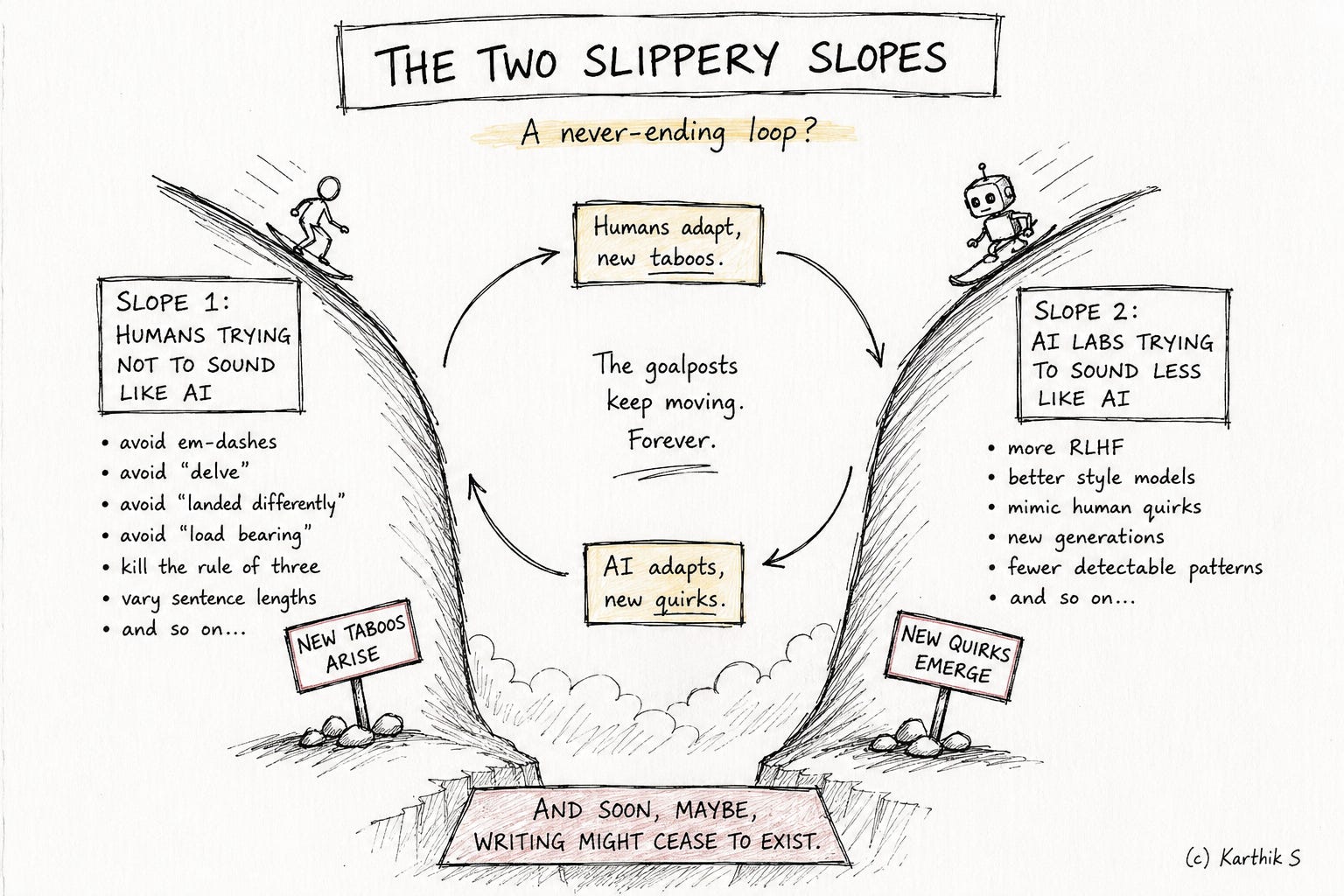
While people may have differing opinions on what it means to have AI write for you (or assist you in your writing), one thing that is sure to happen at least in the short run is a kind of slippery slope.
I can already see people making efforts to “not sound like AI”. My wife, whose debut book is now in the copy-edit phase, wrote this on Substack notes today:
I also used to be a big fan of em-dashes. Now — thanks to how much AI-led writing uses them — I’ve pretty much stopped using them (and I don’t even know if I use them correctly any more). People seem to be making an extra effort to avoid using terms like “delve” or “landed differently” or “load bearing”, again because Claude and ChatGPT use them.
As an aside, there is this theory of political extreme wings, that they get more and more extreme over time.
They first start by cancelling people who obviously don’t subscribe to their position. Think of this as them drawing a circle. Now the circle only has people who broadly subscribes to this position. Even within them, there are some (relative) extremists. The circle is drawn smaller. And even smaller over time. You get the drift.
I foresee the same happening to writing, as “respectable” people go through hoops to avoid their writing being labelled as “AI-generated”.
Em-dashes, delve and landing differently have already fallen victim to this effort. Next, the “rule of three” (see what I did in the previous sentence) will fall. Then people will go great lengths to make sure their sentences and paragraphs are of varying lengths.
Not only will this happen, but on the other side, AI labs will also make similar progress (again you see what I did there). For them, the more their bots can “write like humans, not like AI”, the greater the usage will be. And so I can imagine them cranking up their RLHF efforts to make sure that the next generation of AI models will “not write like AI”.
To be precise, the next generation of AI models will not write like this generation of AI models. However, being large matrix operations, they will have their own set of quirks (I don’t know what those will be). Then, those set of quirks will become taboo for “respectable” human writers, as they adapt. The AI labs will again adapt and introduce these taboos for their next generations as well.
And soon, maybe, writing might cease to exist.
What is more likely is that sooner than that, people will stop caring about AI-generated writing. Like fringe political groups that start mainstream but soon go so extreme that they stop getting taken seriously, the debates around AI generated writing will get so inane that people will simply stop bothering.
Given that we’ll get there anyway, and not too far away in the future, what should a rational writer do now?
Just keep writing as you would. As long as you are happy with what you are putting out (and are proud to put your name on it), you should be good. Whether you use AI or not doesn’t matter. And people will judge you anyway if they think you are using AI.
Comments
Nothing yet. Say the first thing.
Sign in to join the conversation.