
I’m writing this based on one data point - based on one pleasant experience today. By no means am I claiming that LLMs always help me think better, but at least there is a pattern worth documenting already.
While on my way to pick up my son from school yesterday, I had this sudden thought - that it is very difficult to pigeonhole my consulting work (I’d just come off a kickoff meeting for a new engagement). And this has always been the case (since 2011-12, when I started off in this line of business).
All my consulting has been fairly unique stuff.
For starters, pretty much NONE of my work has landed through a competitive process (to the best of my knowledge), where clients considered other vendors as well and then selected me. None of the work has been “standard” (“build me a ML model for this” or “build me a dashboard” types).
Almost all of the work has involved a fair amount of innovation - not particularly of the technical kind, but more in terms of how to formulate a messy business problem as one that can be solved using data and quantitative methods, and having solved it, turn the solution back into business-speak and business recommendations.
One downside of this has been that there hasn’t been any “transfer learning” (where I can directly lift insights from one engagement and port it into another), or any opportunities to “productise my consulting” (since no two assignments have looked like each other).
In any case, as I have been pondering about this over the last couple of days, I’ve been thinking that I should use this to fix my branding and positioning. I currently use “data and AI consultant” which sounds rather curdrice, and I’m pretty sure undersells me.
So I decided to consult an LLM (codex in this case). I have a “work” folder on my computer (which contains a lot of my consulting work) where I opened up a Codex session and told it what I’ve written above and asked it to help me with my positioning and branding.
Overall I was unhappy with the recommendations — it was full of slop. However, there were 2 pieces (I almost said “2 bits” but realised the information in this paragraph is much more than that) of information it surfaced that I was rather impressed with, and realised it’s one of the things that makes LLMs so good at making you think better. Quoting verbatim from Codex:
## Your actual “poison pill”
You wrote earlier about needing a positioning element competitors could not easily claim.
The poison pill is not “bespoke”, “AI” or “decision intelligence”.
And then a little below in the conversation it said:
This also connects three things you have already written:
- Consultants work on unusual, edge-triggered problems rather than BAU work in “Consultants and Employees” (https://noenthuda.substack.com/p/consultants-and-employees).
- LLMs have made small, bespoke systems economically practical in “How LLMs change software engineering” (https://noenthuda.substack.com/p/how-llms-change-software-engineering).
- Your original consulting motivation was taking quantitative methods from finance into `management decisions in “A banker’s apology” (https://karthiks.co/a-bankers-apology/).
The new positioning unifies these threads.
While the new positioning it suggested didn’t make sense at all, what I’m impressed with is:
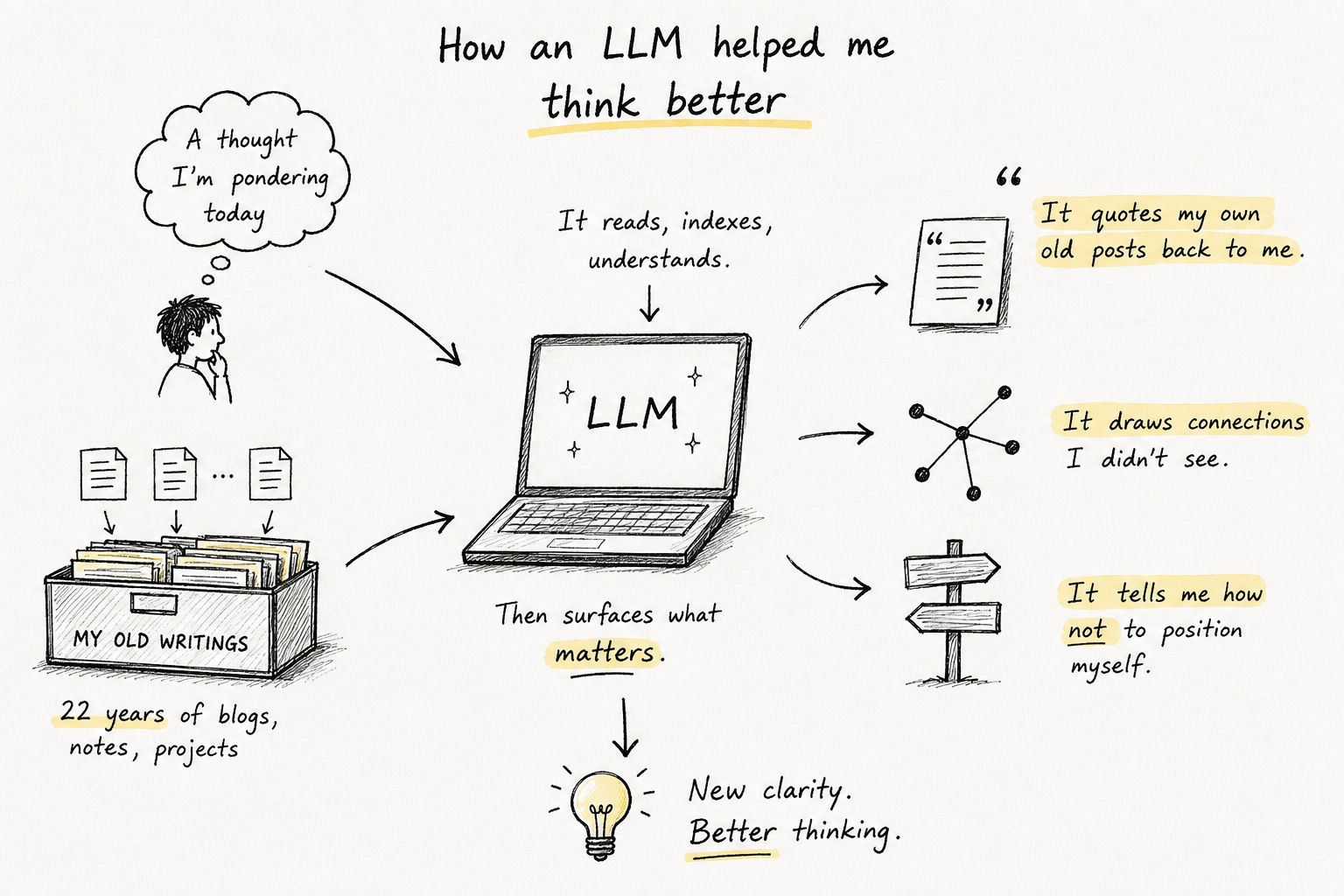
it quotes my own old blogposts back to me
I had myself forgotten about some of these blogposts, and the thoughts that had led to them (the poison pill positioning concept, for example)
it draws connections between my blogposts that I couldn’t myself make!
In that sense, I think I’m deriving value from LLMs now because 22 years ago I made the decision that I’ll document my life (or whatever I fancy of it) on my blog, and have kept up with it ever since. And because this corpus exists, and has been indexed by the LLM (all my blog archives are on my computer, etc., and I’ve created embeddings for them), it is able to go through that and draw connections between the blogs themselves, and connections between those blogs and things that I’m currently thinking about.
The LLM was also good at telling me how I should NOT brand myself:
## Language to avoid
- “I solve problems nobody else can solve.” Unverifiable and needlessly grand.
- “Cutting-edge business problems.” Readers will assume technical novelty.
- “Innovation consultant.” Too vague.
- “Fractional data leader” as the master identity. It implies BAU staffing.
- Long lists of capabilities: strategy, architecture, analytics, modelling, adoption.
- Leading with AI. It attracts tool-shaped briefs rather than unusual business problems.
Beyond that, in this particular conversation, the LLM wasn’t helpful, but I think it’s done its job for now.
That said, how do you think I should position myself based on what I’ve said above about the kind of consulting work I’ve done? To summarise, this is another piece of Codex’s response in this conversation I was happy with today, and am pasting it for you here.
Across the work archive, the recurring pattern is:
1. The client has an important but poorly specified business problem.
2. There is no standard methodology or obvious vendor category.
3. You encode it as a quantitative problem.
4. You combine methods from statistics, economics, operations research, software and now AI.
5. You turn the result back into a usable business rule, system or decision process.
Any ideas?
FWIW, here is my old post about poison pill positioning that I’d completely forgotten about
Poison pills and positioning
·
July 21, 2024

I possibly mentioned it recently in a private newsletter sent to “friends” of my company - one of the difficulties we had in our first attempt at fund raising earlier this year was to communicate accurately as to what we are doing.
Comments
Nothing yet. Say the first thing.
Sign in to join the conversation.