
To help understand why some people can wreak such havoc on the world, let me take you on a little journey, starting with this intriguing passage from D.W. Winnicott’s little-known 1969 essay, “Berlin Walls”:
“It must be assumed that the world, in so far as it becomes a unit in sociological terms, cannot be better than the individuals that compose it. A diagram of the human individual is something that can be made and the super-imposition of a thousand million of these diagrams represents the sum total of the contribution of the individuals that compose the world and at the same time it is a sociological diagram of the world. There is a complication here in that only a proportion of individuals achieve in their emotional development something which could be called unit status. Indeed, it is likely that the individual is a relatively modern concept and that there were no whole people until a few hundred years ago…. The world, therefore, has to contain a proportion of individuals who cannot achieve integration into a unit and therefore cannot contribute, except destructively, to the world’s integration” (Winnicott, 1990, p. 222, my emphasis).
So many questions pop up. So many brilliant things said, but so characteristically and cryptically Winnicottian.
First, what does Winnicott mean that “only a proportion of people” have developed emotionally enough to reach “unit status “and that the rest only contribute to the world destructively? To try to figure this out, after coming across this passage I started digging deeper into Winnicott’s writings looking for hints of what he means by the “unit self” — all to supplement the good deal I already know about his theory of development.
I already knew, in short, his overall view: human beings are born not yet thinking that they are individuals distinct from others. All the bits and pieces of their experience are undifferentiated, basically plenum of going on being, a nice fantasy facilitated by a primary caregiver (let’s call her a mother) who tends to the infant’s needs nearly the moment they arise. Gradually the mother weans the child from constant holding; and this carefully calibrated weaning gives the child cause to learn that some of what it is experiencing is “not me.” If all goes well through all this, the child experiences a “going on being” which is quite nice and allows the child to experience a kind of power or omnipotence that lays a good basis for future development, especially if the mother responds to the child with affirmations of what it seems to be experiencing. But when the mother fails to respond or meet the child’s needs, it experiences an unthinkable terror of annihilation. Not yet having a sense of continuity of time and other people, it doesn’t know that she’ll be back in a second. A good-enough caregiver instinctively intuits what the baby needs in order to minimize such moments unthinkable anxiety from arising. Too much of such impingement bodes ill. But if these anxieties are kept at bay and if all goes well, the infant’s experience becomes integrated and it comes to see itself as a psyche in a soma, that is, a person in this skin.
After reading a bit more, I now see what Winnicott means by a “unit self.” It is the outcome of a successful process of distinguishing oneself from what one is not and then integrating the experiences that are part of who one is, moving from an initial state of unintegration to integration of the continuity of its own experience into a personality as a unit self, a singular person. In modern parlance, the unit self has very good boundaries. It is not co-dependent.
I think that when Winnicott says that the unit self is rare, he means that hardly ever does one become it altogether, that there are degrees of achievement and some have managed to integrate the bits and pieces of experience better than others. I am going to guess, though I do not know for certain, that many of us at times find bits of ourselves escaping, or bits of others entering, and so often we are a bit beside ourselves.
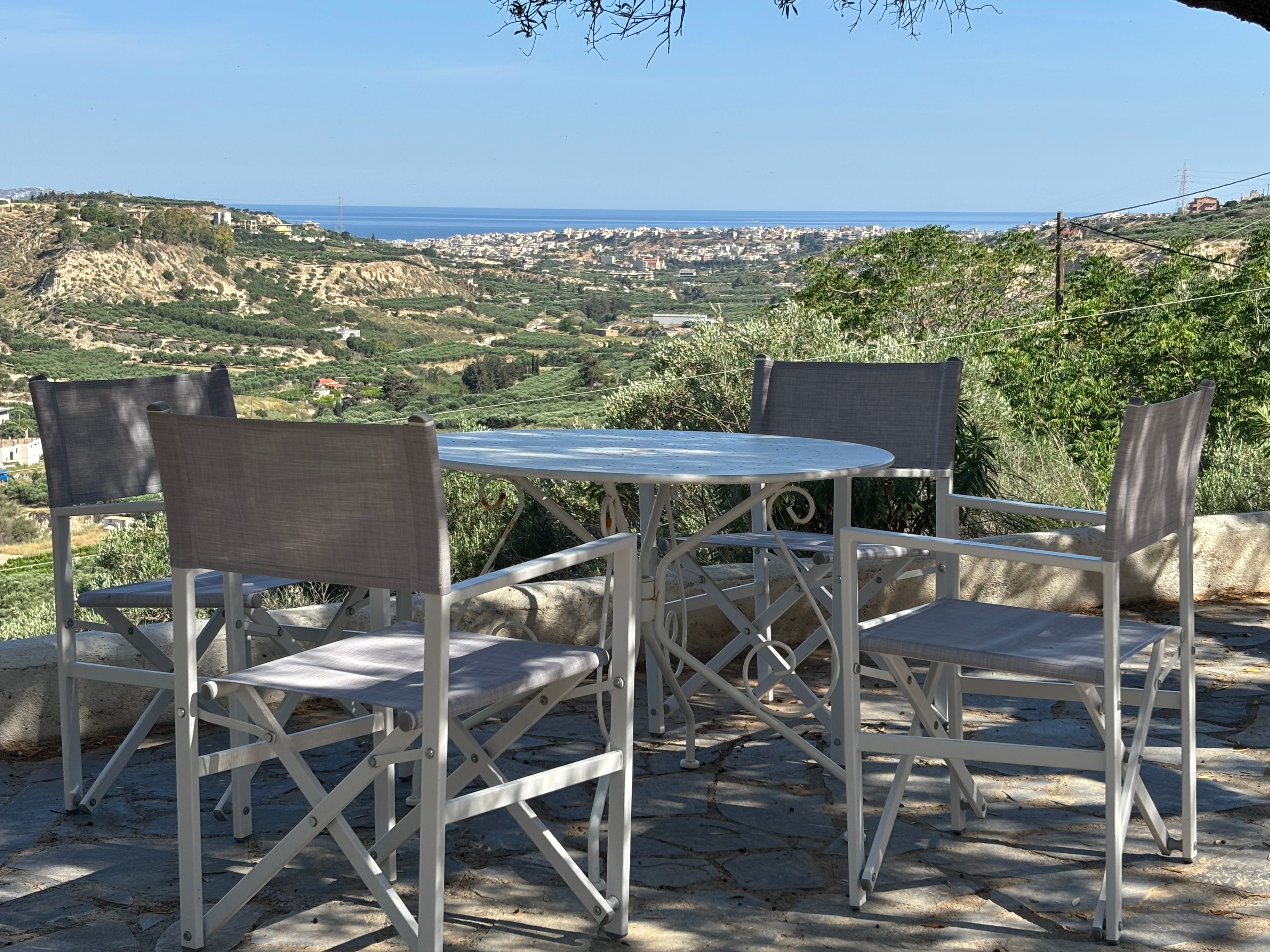
Take what happened the other day when I was reading Winnicott on the veranda of our family house in Greece. My 93-year-old mother stepped out of the house, came down to the patio table, and sat on a chair next to me. Her memory failing quite a bit, she pointed at the chairs, “Are these new?” I responded, yes, aren’t they nice? They were white metal with grey mesh fabric, exactly her color palette, I happily thought. I bought them at Praktiker, I told her, comfortable knowing that this European equivalent of Home Depot was hardly an extravagant place to shop, but I was also vaguely aware of me needing to indicate this. “How much did you pay for them?” My anxiety started to rise a bit. Had I spent too much? Forty-nine euros, I replied, maybe fudging a bit, yeah fudging a bit. “Each?” she asked, her face implacable. Yes, I replied, and my mind traveled to the side of the house where I had left the older chairs, mentally preparing to pick one up and bring it over to show her how ugly and torn the old plastic ones were. And then I realized what was happening: somehow her questions and her anxieties around money as I remembered them were swirling around with and exacerbating mine and it was not clear whose anxieties were now running around all over the place, at least in this part of my not fully integrated psyche. Though her face was implacable (likely because of the encroaching dementia), I thought I could see, behind her skin, judgment and reproach.
All those thoughts took about two seconds. Realizing what was happening, cause hello I was just sitting there reading Winnicott, I caught myself and said, affirmatively, “I like these” — thereby willing all those unintegrated bits of affect still swirling around after over six decades of being my mother’s daughter to come back home inside me where they belonged.
Oh, I realized, so that’s what Winnicott means.
When a self’s bits and pieces are not integrated, they can get mentally attributed to others rather than owning them oneself, or one might internalize bits and pieces that actually belong to someone else. This is not a good situation. This observation does not at all mean that we should aim to be little islands of self-sufficiency, like what’s presumed in the individualist notion of liberalism. It means rather that we can aim to gather up and say “this is what I believe” and not have what others believe colonize our own psyches or crowd out our own desires. Nor does it mean that we are not relational beings whose identities are not indebted to others. It means instead that emotional maturity can bring the capacity to choose what we want and gift what we decide to share rather than being caught up in maelstroms and cycles of lack, want, and sorrow.
Connected to this, what does Winnicott mean that likely “there were no whole people until a few hundred years ago”? I am going to guess that he is referring to developments of the Enlightenment and the Scientific Revolution and all that, that only with modernity did people throw off the shackles of conventionalism and start to think for themselves, you know, like bourgeois individuals. Maybe he didn’t mean that, but this still makes me nervous. I like the idea of a unit self but not the notions of bourgeois or liberal individualism. Winnicott was a pediatrician and not a philosopher and in 1969 wasn’t part of debates about modernity and the dialectic of enlightenment. So here’s what I think is the difference between a unit self and individualism. The latter is about the repeated instantiation of the rational subject. And that is not what Winnicott thought about much. The former is about singularity and the ability to live spontaneously and create anew. And Winnicott wrote amply about that. These are quite different. One need not be on team liberal individualism to be on team unit self.
Finally let’s turn to the closing part of the passage I quoted: “The world, therefore, has to contain a proportion of individuals who cannot achieve integration into a unit and therefore cannot contribute, except destructively, to the world’s integration.” It’s not clear whether or not Winnicott is being ironic when he says that a contribution might be destructive. Normally we think of contributions as positive things. Otherwise, one is just being destructive and not making any contribution. But in this “otherwise” scenario, things are going on and some people jump in and monkey with things. Maybe Winnicott is being ironic, and these people simply have nothing to add or they are just messing with what already is going on.
Or maybe he does in fact mean that they are contributing mayhem into the world. As examples, just think about the destruction caused by Donad Trump needing to go to war with Iran, misrecognizing and confusing the mayhem in his soul for conflict in the Middle East. Or the catastrophe caused by Israel deciding to seek retribution and annihilation of the Palestinian people after the violence of October 7, 2023, a retribution that would and will never be enough to assuage the actual wound. These were indeed “contributions” to the world in the sense that they are now features of that world — but unintegrated ones so misplaced that they will never be satisfied — contributing to an ever more fractured and dysfunctional global system replete with unmoored bits and pieces, seeking retribution, exorcism, and vengeance, that belong to madmen and not the body politic.
No posts
Comments
Nothing yet. Say the first thing.
Sign in to join the conversation.