
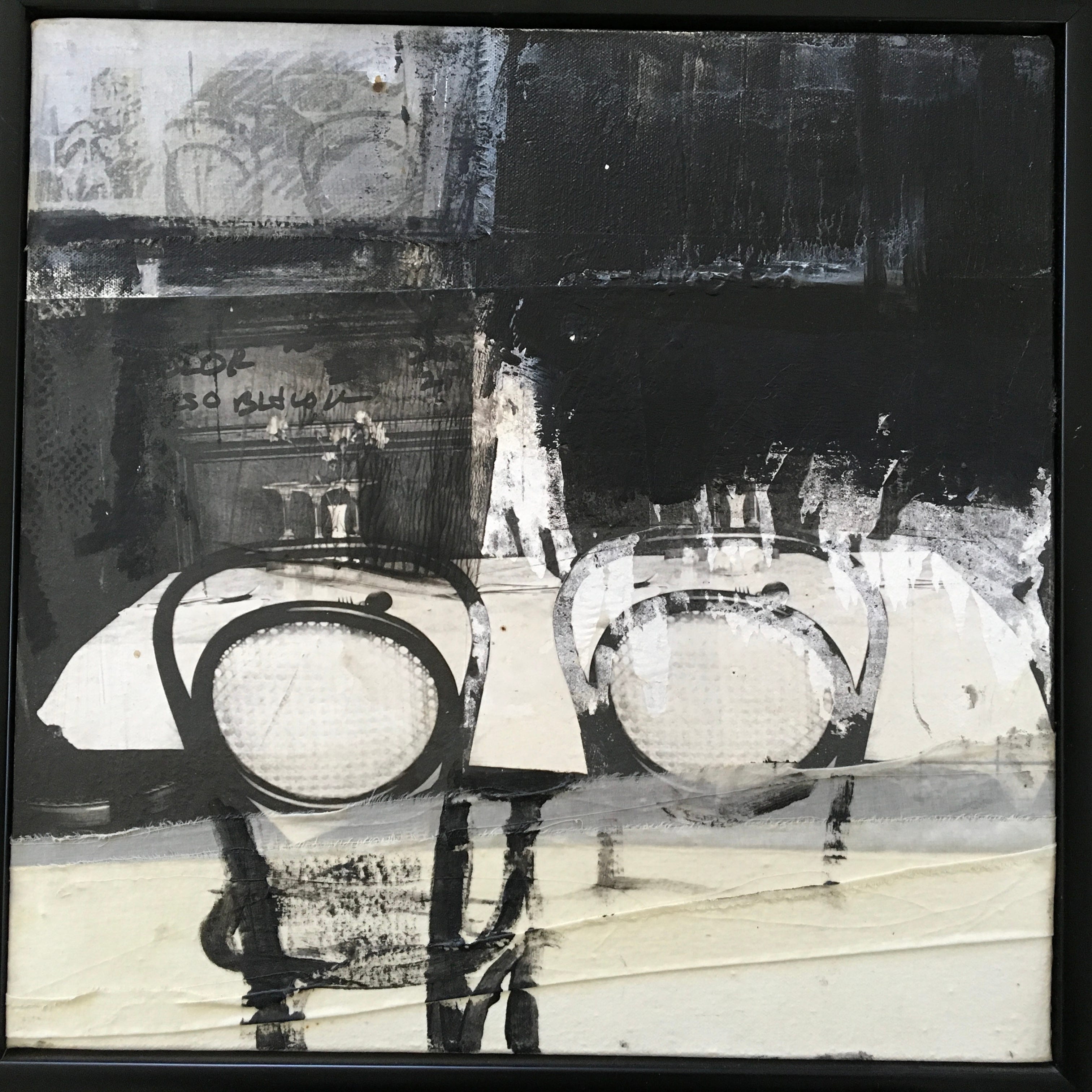
~~ mixed media art by Carol Kingston
I sometimes wear a Borromean knot on the little finger of my right hand. It is made of sterling silver, its three rings fashioned into one interconnected piece of jewelry. Each of its three rings are looped into another, just like the one my brother wears, just like the rubber bands one of my graduate students fashioned into a Borromean knot and keeps in his pocket, just like the drawings that Lacan includes in his lecture on the sinthome that my student and I read together one semester, the sinthome allegorically represented by the interlooping rings, a means for connecting pieces that might otherwise fly apart. My ring stays put on my pinky finger but I can also easily roll it off my finger in a few moves. It is very pretty but easily overlooked.
During my seven-year-analysis, I had a recurring dream. I was in a house that felt familiar, like it was actually my own house. It was ample and good and then I’d go out some side door or down some hidden stairs and find an entirely new wing or floor, often an unbeknownst basement, filled with furniture and extra sets of dishes, entire extra kitchens, desks covered in dust. So much more than I knew I had. For years of these dreams these spaces were covered in dust and cobwebs. They were so scary I feared even entering. In later years, I was able to overcome my immense trepidation and clear off the dust and bring extras bits into my own house.
The manifest content of these dreams seemed plain: I have more than I know I have. I have riches waiting to be dusted off and used. It is all so good, never mind that it was so creepy and scary and unexpected. But the latent content? Or the kernel of the dream?
During these years, there was another parallel set of architecture dreams. I was traveling from one quadrant of a city to another. I didn’t have shoes or proper transportation, but somehow I was able to glide and jump and find my way. There were familiar streets and intersections, at least familiar from earlier dreams, sometimes in a city and sometimes in a hotel. Sometimes I’d cut through but mostly I had to go around. There was both privacy and vulnerability, nearness and farness. Somehow I always managed to find my way.
These dreams went on and on and no amount of psychoanalysis seemed to move the needle. Eventually I called my mother and asked if she dreamed about buildings. She said no, and then I thought to ask her about the building she lost as a child. During World War II the Germans occupied Crete and the British were trying to liberate the island. My mother’s family owned a two-floor building, their residence on the top level and their family business and livelihood, a restaurant, on the main floor. When the Germans began their occupation, my grandfather moved the family to a village outside of town where they lived first in an aunt’s house, and then when the Germans commandeered the house, in the aunt’s barn. My grandfather remained at the house in Iraklion. One night he came to check on the family. That night the British dropped a bomb aimed at a German enclave but mistakenly felling my family’s home, destroying the building, all their belongings, their entire livelihood. No scrap of it remained, no photographs, none of my mother’s pretty dresses that her mother had made for her, not a thing. For years after the war, they lived in utter poverty and all the shame that comes with that.
I suspected that my dreams about architecture might have some connection to the loss of my mother’s house, which is why I asked her about it and how terrible that loss must have been. But no, she said, they had never even complained about it, so happy they were that their father was not there when the bomb fell and that he was alive. No one had ever even shed a tear over the house.
Now, one does not need to be a psychoanalyst to fathom the effects of an unmourned loss. But my mother refused to acknowledge there had been any loss at all.
During these years of my recurring architecture dreams, I would occasionally visit my friends Carol and Bob Kingston in a very grand house in a very posh village on the north shore of Long Island. As Bob fell ill, just before he died, Carol sold the house and moved them into a very sweet little yellow bungalow on a horsey estate in an even more posh village. The house was small with her art studio taking up most of the basement. On one visit, she had many of her paintings strewn about, propped up along walls in the kitchen and living room. One little piece of art absolutely seized me. It was about 12” x 12”, a mixed media depiction of the view of a corner of a little French bistro that she and Bob used to frequent. At the forefront were the back of two classic caned-back bistro chairs nestled into a table, in the rear was a large buffet or credenza behind which was a window.
Something about this painting completely gripped me. I wanted to ask Carol if I could buy it but was too shy to ask. After returning home I kept dreaming about it, utterly mesmerized, and when I returned a year later I asked her if she still had it. She didn’t remember it so I had to describe it for her. She went downstairs, found it, and brought it up, now nicely finished with a big black wooden frame. Nervously I asked her if I could buy it, and she said you can have it for the price of the frame. With that $200 transaction, I took possession, carefully stowed it on the plane, and took it home, hanging it above my desk where it kept me warm company. When my Fear of Breakdown book was going into production, I asked Columbia University Press to make it the central image for the book’s cover.
A few years later, my now very elderly mother moved in with me. One day I came home and she said, “that painting,” and walked me over to where it was now hanging above the bar cart. As she and I stood there, she started pointing at it, recounting a memory of standing in the dining room of her childhood home, angry at her mother for making her wear a crucifix around her neck. She told me how she pulled the necklace from her neck and flung it over the table and behind the buffet underneath the window. She was pointing to that place on the painting, speaking as if she were back in that house, as if this was an actual scene of her childhood home before the war, the house that had been destroyed and never seen since, no remnant intact, a house never mourned — until now as she stood there and began to cry, the first tears of grief for a house lost 85 years before.
Her tears released me from the phantom of that unmourned loss, a phantom that I had dutifully inherited and carried with me for most of my life. The phantom made me dream of something lost and impossible, something that I might be able to make use of, all those extra sets of dishes and credenzas (dining room things!) that were just too uncanny to bear or use. It had become my errand, much as Nicolas Abraham saw in his patients who had inherited phantoms and errands from their predecessors. After my mother shed her tears, that painting’s grip on me eased. Now it is for me just a lovely piece of art, not a missive from my unconscious seizing me to carry out some unbeknownst, impossible mission.
That mission used to look like a book I needed to write. I had a working title: “buildings and how they make us feel.” I spent years doing research for it, filled shelves with other related books, wrote grant proposals, drafted sketches. I had long been in love with architecture and design. As a teenager I would, after hours, wander into new houses under construction after the workers had gone home. Also during those years I would walk through the underground tunnels of Houston’s modernist downtown; I would sit and dream and write in the new Houston modern library. I wanted to become an architect, but I gave up before I even started, thinking that I did not have the proper talent or capacity. So I became an armchair design buff and collector, buying and pouring over scores of books and series of modernist magazine issues. I was a purist about modernism and was for nearly 30 years married to someone even more puritanical about all this than me. One of our houses was featured in Wallpaper magazine, the interior in all its quirkiness laid bare by walls of glass. So the impossibility of my desire abounded, its symptoms ranged from wanting to be an architect to creating the most purely midcentury space to wanting to write a book that would somehow get to the kernel of this drive, not only of how it makes us feel but how it makes us dream.
I still love architecture. But I no longer have the same debt to settle. Perhaps now it is less a symptom and more a sinthome, tying together parts of me and my history that might otherwise fly apart. I know it makes me who I am. It also makes me dream. This is not the end of a story but a middle chapter. The aim of psychoanalysis is not to recover a lost past. Mourning is vital, but that is for releasing ourselves from what is lost in order to begin imagining something new. Mourning may involve insurrection from forces and phenomena that keep us haunted by ghosts, but insurrection also involves being an architect -– imagining and creating new ways of living.
No posts
Comments
Nothing yet. Say the first thing.
Sign in to join the conversation.