
I was carrying groceries up eight flights of stairs when it happened again. The bag split. Apples scattered across the landing, rolling into the cellar, and there was that particular sound—keys hitting carpet-dampened granite, metal finding stone with just enough weight behind it to mean something. I stood there holding the torn paper, listening to the echo fade, and realised...
I was disappointed.
Not because I'd lost the apples, but because the sound hadn't been quite right. Too hollow. Too accidental.
The audio feedback I was waiting for doesn't exist in my stairwell.
It exists at 3,155 Hz in a virtual world where hidden numbers govern how long things can resist pressure before they give up entirely. I'm hyper-aware of this frequency now. I looked it up after the third sleepless night, after I found I'd been unconsciously listening for it during ordinary Tuesday mornings when nothing was supposed to be breaking.
I started playing Elden Ring again in winter because a player in a YouTube video said it would help with stress. "Hit things with swords," they said. "Very therapeutic." They weren't wrong, exactly, but they missed the part about the mathematics.
I'd abandoned this same character creation screen in 2023, defeated by the dragonskin soldier beneath the eternal city. Winter has a way of making abandoned projects look worth revisiting. I'd gotten into the habit of turning off the music in most games—except for The Witcher 3 because the Fields of Ard Skellig are just too evocative to mute. Better speakers helped too. Point is, I was hearing things I'd apparently been missing for months, if not years.
Instead of just trying to survive, I found myself wondering about the mechanics underneath. What made some enemies stagger after three hits while others tanked through everything?
A crucible knight has 80 points of poise. Hit them enough times and their stance breaks with that satisfying metallic snap. Wait too long between attacks and their poise refills at 13 points per second, erasing your progress.
I know these numbers not because the game told me, but because someone extracted them from the game files, put them in a spreadsheet, and I memorised them like they were my own phone number.
*
My brain has been physically rewired. This sounds more dramatic than it probably is. But I can provide citations from neuroscience if needed.
Each time I hear that poise-broken SFX, dopamine pathways strengthen their association between sound and satisfaction. It's classical conditioning, but with spectrum-analysable precision. The craving isn't (just) psychological—it's neurochemical.
I've started unconsciously testing everyday objects for similar sounds. Clicking pens repeatedly, listening for something that might approximate that metallic snap. Tapping cutlery against plates during dinner, adjusting the angle until the pitch feels almost right. I once spent twenty minutes in a hardware store listening to someone test different door latches, chasing echoes of what my brain has learned to interpret as completion. The sales assistant eventually asked if I needed help. I nearly said yes.
When I explain this to people, they get that look. The one reserved for train enthusiasts and people who collect vintage calculators. I've joined a very specific club. There's something obsessive about caring how many theoretical points of structural integrity a virtual knight possesses.
But they haven't heard what happens when those points reach zero.
What they're really looking at is someone who's become fluent in a language that didn't exist twenty to forty years ago—at least not in this diversity and richness. A language where satisfaction has measurable data points like frequencies or crest factors or delta features, where failure announces itself through exact acoustic signatures.
When you think about it, there may be social costs to such a reaction (or addiction?) to sounds, especially in connection to feeling of completion. Conversations don't have clear resolution markers. Friendships don't announce when they've crossed thresholds from casual to deep, or from thriving to failing. Sometimes, I'm unconsciously waiting for acoustic confirmation from interactions that will never provide it.
Yesterday my neighbour stopped me in the hallway to talk about the building's heating problems. Fifteen minutes of circling around the same issues—broken radiators, unresponsive landlord, rising bills. No decisive moment when the conversation shifted from information exchange to mutual complaint. Nothing to mark when we moved from strangers sharing practical concerns to allies sharing frustration. The interaction simply... dispersed. Left me standing there wondering what had actually been accomplished, what shift might have occurred without either of us knowing.
When someone says they're "fine," there's no pitch that reveals whether they mean it or whether they're approaching some internal breaking point. Conversations develop without acoustic markers. Friendships deepen or deteriorate in silence. I strain to hear confirmation that never comes—anything that would announce when understanding has been reached, when trust has been established, when someone has decided they actually like you.
In Elden Ring, after exactly 16 light attack hits with my katana within a certain window, the crucible knight will stagger. Always 16. Not 14. Not 17. But 16. The precision is temporal as much as mathematical. But human interactions operate on variables I can't measure, with delays I can't predict. The uncertainty has become harder to tolerate than failure itself.
*
The sound of "poise broken" in Elden Ring arrives before conscious thought can process what's occurred. Like a heavy door latch clicking into place—the moment when metal teeth find their groove and everything locks together with mechanical certainty. Not the hollow snap of plastic, but the substantial thunk of engineered accuracy. If you (I mean me, amateurishly) analyse the SFX file with Maztr's free online Audio File Analyzer, the frequency sits at 3,155 Hz, concentrated in that upper-mid range with a crest factor of 5.24—meaning the peak amplitude towers over the average signal by more than five times. It's a single, sharp transient event lasting about 4 seconds, but the impact happens in the first instant. Only 44 distinct spectral peaks, making it sparse and focused compared to the dense harmonic wash of e.g. the "enemy felled" SFX.
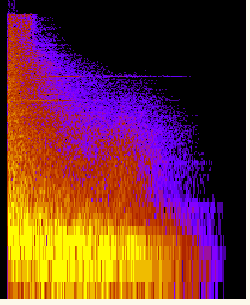
But it's not just the 3,155 Hz that matters—it's the entire sonic architecture of capitulation. The onset is immediate and unambiguous, no gradual fade-in like organic noise. The decay is long enough to register significance but short enough to avoid overstaying its welcome.
I can measure exactly what satisfaction sounds like. I have spectrum analysis screenshots saved in a folder labeled "certainty." This feels both ridiculous and necessary—and is either very advanced and a breakthrough in self-knowledge, or very stupid and proof that I need to go outside more. Modern life is strange.
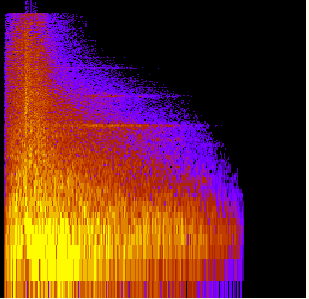
What follows cuts higher—4,926 Hz if you're quick enough. The critical hit. It's almost crystalline, a ping sitting atop a crunch that somehow manages to feel both electric and tactile. Like clicking two polished stones together, except the stones are made of concentrated certainty. The attack is immediate and highly defined—no buildup, no anticipation, just the clean spike of perfect timing meeting vulnerability. At about 5 seconds with 114 spectral peaks and a crest factor of 5.12, it rings with a brief, sparkling afterglow that feels almost mocking in its fidelity.
My friend calls while I'm walking through the park. He's stuck trying to get his WordPress site to do something specific with the layout—some plugin that should work but doesn't, some CSS that should align properly but keeps breaking. His frustration is real and immediate, but I am only half-listening, distracted by the absence of what I've learned to expect from problem-solving.
"Are you listening?" he asks.
I am always listening. Just not for what people think I'm listening for.
He describes clicking through menus, adjusting values, testing and retesting. All this mental work happening in silence—no chime when the code compiles correctly, no satisfying snap when the layout finally aligns. Just the quiet persistence of trial and error, success measured only by visual confirmation on a screen.
It sounds exhausting.
I'm actually wondering: How do people ever solve problems without acoustic feedback? How do they know when they've actually accomplished something?
That night I sit in front of my computer, playing Elden Ring—not because I need to progress through the game, but because I want to hear those two SFX again. Poise broken and critical hit. Together they create something I can only describe as temporal completion. A before and after separated by sound and silence that make surrender sound inevitable rather than tragic.
I fight the crystalians on purpose. Apply the same pressure to the same calculations. Wait for the same sound that announces something definitive has happened.
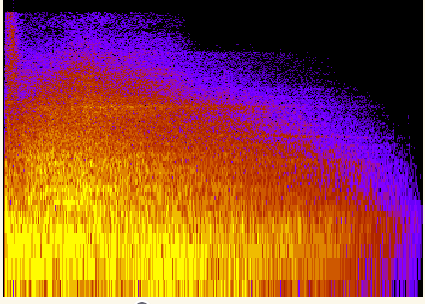
But after the critical hit fades, there's the "enemy felled" SFX. It sprawls across 294 spectral peaks where "poise broken" cuts clean with 44. Roughly 7 seconds of dense harmonics reaching 6,000 Hz, energy spread across the entire frequency spectrum. It blooms and sustains, filling space with luminous energy that should feel like resolution. The lowest crest factor at 3.93 and highest RMS amplitude reveal its voluminous, layered nature—multiple transient events creating a thick sonic curtain rather than a single decisive moment.
Yet it feels hollow. Decorative. All surface shimmer and no computational substance.
But this makes no sense. Death is the most mathematical moment of all—hit points reaching absolute zero, the final calculation in a series that began with the first sword swing. Every number in the game's architecture has been building toward this very instant when health becomes absence. It should be the purest expression of systematic completion, the moment when all the underlying mathematics resolve into a single, definitive state change.
Instead, it feels like applause.
The "enemy felled" sound celebrates an outcome rather than marking a threshold. It's congratulatory, designed to make me feel accomplished rather than to signal that something computationally decisive has occurred. The poise-broken sound announces that a system has reached its breaking point. I want to believe I can hear the mechanism failing, even though I know these SFX are identical across all enemy types. But death sounds like a reward being dispensed, not like mathematics concluding. Even though the numbers are doing exactly what they're supposed to do, even though this is the most mathematically final moment possible, the audio, for me, treats it like a festival rather than a calculation.
Maybe the difference is this: poise break happens to the enemy. Death—sound-wise as the "enemy felled" SFX—happens to me. When poise breaks, I'm witnessing the second a system fails under pressure I have applied. When the enemy dies, the game is telling me I've succeeded, wrapping the computational conclusion in congratulation. Maybe, poise break is diagnostic—it reports a state change. Then death is editorial—it interprets that state change as victory.
(I'm still not sure about this thought.)
I want to distinguish between sounds that report and sounds that celebrate. Between diagnostic feedback and emotional management as sonic experiences. Between hearing a system and hearing the game's opinion about that system.
The satisfaction is entirely different.
*
My neighbour upstairs drops something. A book, maybe. The thud reverberates through the ceiling—random, unanalysable, carrying no information about breaking points reached or resistance overcome. I'm listening anyway, waiting for some follow-up sound that might approximate this sonic experience I somehow crave. Another thud. Footsteps. A door closing. None of it designed for satisfaction specifically, all of it operating according to the messy physics of actual objects in actual space.
I catalogue these disappointments. Yes, I know how this sounds. Everyday sounds that promise something but deliver nothing my brain recognises as completion. The kettle's beep—too electronic, no spectral complexity. Rain against windows—definitely gives me ASMR, but in comparison to "poise broken" is too random, no defined onset. Even my own footsteps on the stairs feel inadequate, lacking the designed exactness that would announce definitive progress from one state to another.
My phone buzzes. Text from my friend: "Finally fixed the CSS issue." No accompanying crack or thud or clank or swoosh to indicate his success. No acoustic signature to confirm that his invisible web development calculations have finally resolved themselves. Just words on a screen, bloodless and silent.
Comments
Nothing yet. Say the first thing.
Sign in to join the conversation.