
In the previous chapter, we saw how those who work at the Bathhouse lose their names and their freedom, becoming mere cogs in the machine that drives the organization.
However, the darkness of society depicted in Spirited Away is not confined to the Bathhouse alone.
The abandoned town at the beginning of the story, Zeniba—who bears the same face as Yubaba—and the one-way train that runs across the water. These places and characters also reflect the meaning of wealth and labor from a perspective different from that of the Bathhouse.
At the beginning of the story, Chihiro’s father is driving a foreign-made four-wheel-drive vehicle, an Audi.
Even when he takes a wrong turn, he doesn’t slow down and forces his way along the narrow mountain road. He believes that even if the road isn’t paved, the car’s high performance will keep him safe.
That confidence reflects his faith in modern technology.
If you have a high-performance car, you can drive even on rough roads. If you have money, you can buy whatever you want. If you have a credit card, you can make a purchase even when there’s no clerk present—you’ll just pay the bill later.
For the father, the world’s problems can be solved with technology and money.
However, that way of thinking doesn’t hold true in the Other World.
Upon finding food in an unmanned shop, the father begins to eat without asking the shopkeeper for permission. The mother doesn’t stop him either. Neither of them considers who prepared the food or for whom it was intended.
They believe they have the right to eat simply because they can pay for it.
This reveals the danger of a consumer society.
When you think you can get anything by paying money, you lose sight of the time and labor invested in that item. The feelings of the person who made the product and the rules of that place are hidden behind the price tag.
The biggest mistake Chihiro’s parents made wasn’t just that they ate so much.
It was that they assumed everything right in front of them was a “commodity that could be bought with money.”
Looking at the building at the end of the tunnel, the father surmises that it is the site of a theme park planned in the 1990s but abandoned following the collapse of the bubble economy.
This is merely the father’s speculation; it is not the true nature of the place.
Nevertheless, the fact that the story’s starting point appears to be an “abandoned theme park” holds great significance.
In Japan in the late 1980s, the value of land and buildings continued to rise. Hotels, leisure facilities, and residential areas were developed across the country, and it was believed that Japan would continue to prosper indefinitely.
However, when the bubble burst, development came to a halt, leaving behind unused buildings and land.
Places that were supposed to entertain people had turned into deserted ruins.
Chihiro’s family passes through these ruins to enter the spirit world.
In other words, the world of Spirited Away does not suddenly emerge from nature. It begins in a place where people pursued grand dreams—and then abandoned them along the way.
This is also connected to the world of the Bathhouse.
Every night, the Bathhouse draws large crowds, uses vast amounts of food and hot water, and generates huge profits. The abandoned theme park, too, was once a place designed to attract people and encourage them to spend.
One has become a ruin, while the other continues to operate to this day.
However, both are massive facilities created by humanity’s endless greed.
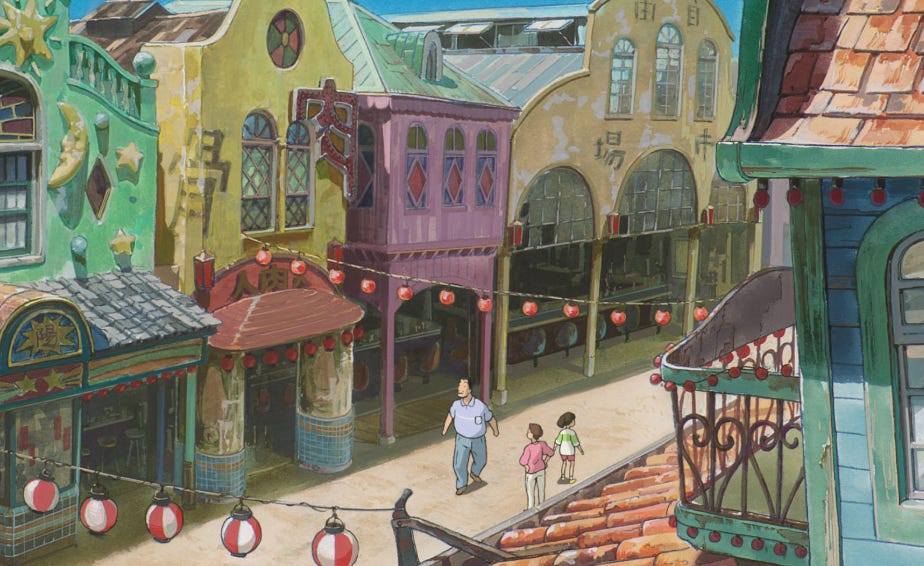
Chihiro’s parents are turned into pigs as a result of continuing to eat the food.
The pigs represent beings that continue to eat according to their desires.
They are not bad people. They are just ordinary parents trying to take their daughter to a new home. However, because they placed too much faith in technology and money, they lost sight of the boundaries they should have upheld.
And it is 10-year-old Chihiro who must solve the problems caused by the adults.
It is Chihiro who works to save her parents, negotiates with Yubaba, and boards the dangerous train.
It is not entirely accurate to directly link Chihiro to the “lost generation.” This term primarily refers to a slightly older generation that experienced the harsh job market following the bursting of the economic bubble.
Rather, Chihiro is portrayed as a representative of children who are forced to shoulder the problems of a society created by adults, without even understanding why.
Her life is turned upside down by her parents’ failures, and she is suddenly thrust into an unfamiliar world. In that situation, she must find a way to survive on her own.
Here, too, Hayao Miyazaki depicts the harsh contradictions of work.
The reason Chihiro is forced to work is the greed of adults. Yet, through that labor, Chihiro grows stronger than the adults themselves.
Comments
Nothing yet. Say the first thing.
Sign in to join the conversation.