
“Spirited Away,” a masterpiece that epitomizes Studio Ghibli, is beloved around the world. While the film depicts a beautiful and somewhat nostalgic world, there are some slightly eerie rumors circulating behind the scenes.
Perhaps the most famous of these is the theory that the “bathhouse” represents a “red-light district.”
This theory suggests that “Yubaba’s Bathhouse,” the setting of the story, represents the red-light districts of the Edo period or the modern sex industry.
Chihiro has her real name taken away by Yubaba and is forced to work under the new name “Sen.” This plot point is thought to resemble the aliases—known as “genjimei”—used in the nightlife industry. Furthermore, the fact that the Bathhouse has many private rooms where women entertain customers has also been linked to this theory.
There are other rumors as well, such as “the Umihara Electric Railway is a train that transports the dead to the afterlife” and “Haku is Chihiro’s deceased older brother who died to save her.”
Of course, none of these have been officially announced as part of the film’s canon. Many of these theories stem from fans’ imaginations and deep readings of the story.
However, what truly deserves attention is not merely whether these rumors are true.
What matters is why so many people have sensed the presence of a brothel, exploitation, poverty, and death within this story.
Spirited Away is an adventure story about a young girl growing up in a mysterious world. Nevertheless, beyond the steamy, glamorous atmosphere of the bathhouse, we sense something that isn’t merely cheerful.
It is precisely that dark undertone that serves as a crucial clue to interpreting this work.
The otherworld depicted by Hayao Miyazaki is not a dreamland completely detached from reality. Rather, it is a place like a mysterious mirror that reflects the society we live in, but in a different form.
At the beginning of the story, Chihiro and her parents wander into an abandoned town at the end of a tunnel. It looks like the ruins of a theme park that was abandoned midway through construction.
Japan once experienced the “bubble economy” era, when the value of land and buildings continued to rise and many people pursued wealth. However, when the bubble burst, facilities left unfinished and abandoned buildings were left behind in various locations.
The place Chihiro steps into also resembles the ruins left behind after Japanese society chased a grand dream and that dream shattered. In other words, human desire and its failure are depicted right from the very beginning of the story.
Places like tunnels, rivers, and bridges also hold significance.
In Japan, places such as tunnels and rivers have long been considered “boundaries” separating this world from the other world. Chihiro crosses that boundary and enters a world where the rules of everyday life do not apply.
However, it is not only magic that governs this otherworld.
There, mechanisms very similar to those in our society—such as money, work, contracts, and hierarchical relationships—exist. Although the Bathhouse is a sacred place where the gods gather, everyone there seeks profit and is forced to work without rest.
The purpose of this article is neither to accept all online rumors as fact nor to dismiss them as mere speculation.
Starting with the reasons these rumors arose, we will explore the larger themes hidden within Spirited Away.
At the heart of these themes lies “the fear of losing one’s true self through work.”
Yubaba takes away the names of those who work for her. Chihiro, too, has her real name taken away and is given the shortened name “Sen.” Haku warns Chihiro that she must not forget her real name, because if she does, she will be unable to return to her original world.
This mirrors the reality of modern companies, where workers are viewed not as individuals but solely through employee numbers and job titles. If someone quits, they are immediately replaced by someone else. Whether an individual is useful to the company takes precedence over their personal dreams or personality.
Having one’s name taken away at the Bathhouse is not merely magic. It symbolizes forgetting who one truly is and being transformed into a tool that works for the organization.
No-Face is also a crucial figure that reflects modern society.
No-Face has neither his own words nor a distinct form. He survives by absorbing the desires of those around him and mimicking what they seek. When No-Face enters the Bathhouse, he throws money around, devours food, and eventually swallows even those around him, growing to enormous size.
The employees of the Bathhouse do not truly care for No-Face himself. They are simply obsessed with the money he offers and are merely trying to keep him happy.
This scene depicts the notion that money can buy people’s affections—and the terrifying way in which intangible wealth destroys human relationships.
Does the Bathhouse truly represent a brothel?
What is the significance of Yubaba taking away people’s names?
And what aspects of a society dominated by money did Hayao Miyazaki seek to portray through the lonely monster known as No-Face?
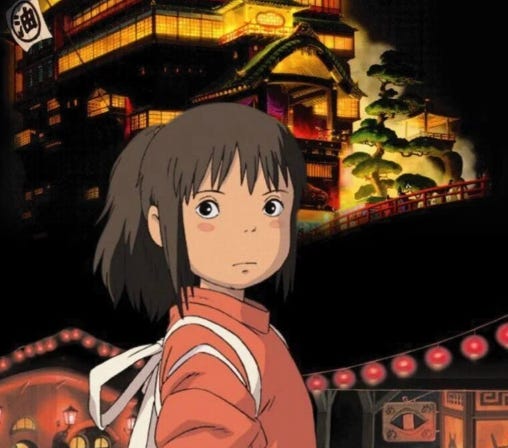
The Job of “Yuna (bathhouse prostitute)” That Once Existed in Japan
Among the rumors surrounding Spirited Away, the most famous is the theory that “the Bathhouse is a brothel.”
This theory posits that the Bathhouse is not merely a public bathhouse, but represents the brothels of the Edo period or the modern sex industry.
This is not entirely a fabrication. If you research the history of Japanese public bathhouses, you can see why this theory arose.
In ancient Japan, there were women known as “yuna.”
Yuna worked at hot springs and public bathhouses in towns, washing customers’ bodies, styling their hair, and tending to them after their baths. However, by the Edo period, an increasing number of yuna began serving alcohol and meals and entertaining customers with songs and dances. Furthermore, some bathhouses began offering sexual services as well.
In other words, bathhouses at that time had two distinct facets: a “place to cleanse the body” and a “nightclub to entertain customers.” This transformation is documented in the commentary on the “Picture of Bath Attendants” at the MOA Museum of Art1, as well as in the entries on “bath attendants” in various historical dictionaries.
Chihiro, Rin, and the others who work at the Bathhouse also wash the gods’ bodies, serve meals, and take care of the guests to ensure they have a pleasant time. These duties overlap significantly with those of historical bath attendants.
Therefore, there are historical reasons for associating the Bathhouse with brothels or adult entertainment establishments.
However, we must be careful here.
Just because historical yuna also performed sexual services does not necessarily mean that Chihiro does the same. There are no scenes in the film where Chihiro provides sexual services.
The “Bathhouse = brothel” theory is not so much a secret plot element hidden behind the story as it is one perspective for understanding the structure of the Bathhouse itself.
Why Doesn’t the Bathhouse Look Like a Bathhouse?
One reason this theory feels particularly compelling is the architecture of the Bathhouse.
Although the Bathhouse is a bathhouse for the gods, the large communal bath where many guests bathe together is scarcely depicted as a central element of the story. What stands out are the labyrinthine corridors, the staircases stacked in multiple layers, and the private rooms and baths designed to entertain guests one at a time.
This structure is reminiscent of modern private-room-style adult entertainment establishments.
It is said that Hayao Miyazaki once joked—to the effect that “it’s because they do unsavory things there”—when asked why the large communal bath was so inconspicuous. Furthermore, producer Toshio Suzuki later explained the Bathhouse by drawing parallels to hostess clubs and soaplands.
These statements from the production team indicate that the “Bathhouse = red-light district” theory is not merely a rumor created online.
However, the Bathhouse is not a building that directly replicates a real-life adult entertainment establishment.
Its exterior blends imagery from various Japanese structures, such as old hot spring inns, theater halls, temples, castles, and red-light districts. The Bathhouse is not a place modeled after a specific establishment; rather, it is a vast stage that brings together Japanese history and desire.
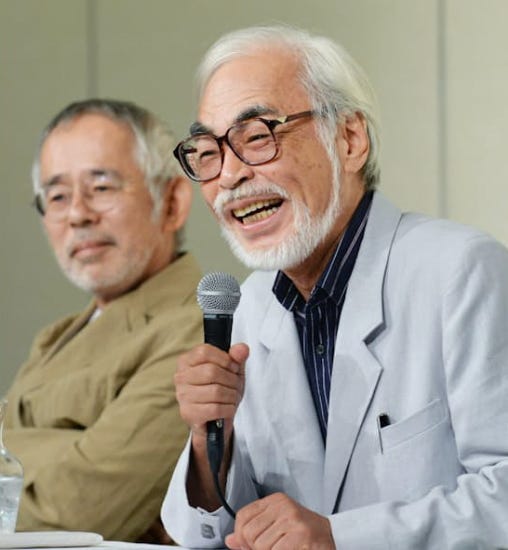
Producer Toshio Suzuki's Story About “Hostesses bar”
A key point to consider when examining the “bathhouse = red-light district” theory is a statement made by producer Toshio Suzuki.
Suzuki reportedly relayed to Hayao Miyazaki a story he had heard from an acquaintance who frequents hostess clubs.
According to that acquaintance, some women who start working at hostess clubs were originally shy and found it difficult to talk to people. However, as they continued working in jobs that required them to converse with customers, they developed the ability to interact with others and gradually became more cheerful.
When Suzuki shared this story with Miyazaki, it reportedly became one of the inspirations for Chihiro’s story. Suzuki further explained that, for Miyazaki, the Bathhouse was a place akin to an adult entertainment establishment.
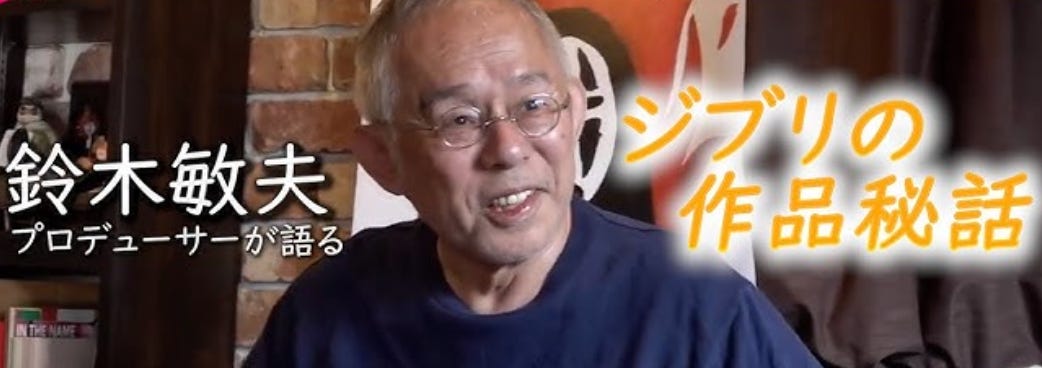
Miyazaki himself is said to have remarked in a 2001 interview that the image of “adult entertainment” was appropriate for depicting Japanese society at the time. It was a harsh social critique suggesting that in Japan, virtually every job had become a service industry designed to satisfy the desires of others. The content of this critique is reprinted in an article that cited both the interview from that time and Suzuki’s remarks.2
This statement contains expressions that may sound crude by today’s standards. However, what is important to note is not that Miyazaki intended to portray Chihiro in a sexualized manner.
What Miyazaki sought to depict was a society in which people offer themselves as commodities in order to survive, earning money by satisfying the desires of others.
The imagery of the sex industry was used as the setting that most powerfully conveyed that society.
A World Where If You Don't Work, You're Erased
At the beginning of the story, Chihiro is unhappy about moving to a new town.
Lying in the back seat of the car, clutching a bouquet of flowers she received at her old school, she follows her parents anxiously. She can neither decide her own path nor stop her parents.
However, once she enters the Bathhouse, Chihiro suddenly finds herself forced to fend for herself.
Yubaba threatens to turn anyone who doesn’t work into an animal or a lump of coal. For Chihiro to remain human, she has no choice but to work at the Bathhouse.
So, no matter how many times she is turned away, Chihiro keeps saying, “Please let me work here.”
This is no ordinary job. She has no safe home to return to, nor parents to come to her aid. If she refuses to work, she won’t even be allowed to exist as a human being.
Even in modern society, there are people who have no choice but to accept jobs with poor conditions simply to make a living. The Bathhouse presents this harsh reality in an exaggerated form.
Once Chihiro starts working, Lin strictly teaches her how to respond and greet others. She carries heavy loads, cleans dirty bathhouses, and washes the body of Oksare-sama, who emits a strong odor.
At first, Chihiro couldn’t do anything, but little by little, she learns to observe her surroundings and act accordingly. She becomes aware of others’ suffering and begins to take action not just for herself, but to help others as well.
There is a major contradiction here.
The Bathhouse is a dangerous workplace that strips employees of their names and forces them to work without rest. Yet at the same time, through this labor, Chihiro gains the strength to live and builds her self-confidence.
Hayao Miyazaki does not portray work as simply a bad thing. Work has the power to hurt people, but it also has the power to help them grow. He depicts both of these aspects within the Bathhouse.
Therefore, this story is not a simple coming-of-age tale that says, “Work is wonderful.”
The place where Chihiro grew stronger was also the place that took away her name and even her freedom to escape. It is precisely this bitter contradiction that forms a crucial part of Spirited Away.
Japan in 2001 and Chihiro’s Parents, Who Were Ruled by Consumerism
In 2001, when Spirited Away was released, Japan was in the midst of a long recession following the collapse of the bubble economy.
In the late 1980s, as land and real estate prices continued to rise, many people believed that Japan would remain prosperous indefinitely. However, when the bubble burst in the 1990s, companies went bankrupt, more people lost their jobs, and Japanese society began to lose its confidence. Even Studio Ghibli’s official history3 touches on the fact that the Japanese economy had lost its confidence at the time of the film’s release.
Chihiro’s parents can be interpreted as symbols of the desires of that era.
Her father drives recklessly down the road in a foreign-made car and begins helping himself to food displayed in an unstaffed restaurant. He believes that even if no one is there, it’s fine as long as he pays later.
Her mother doesn’t stop him either.
Neither of them considers the people who prepared the food or the restaurant’s circumstances. They believe that as long as they have money or a credit card, they can have anything right in front of them.
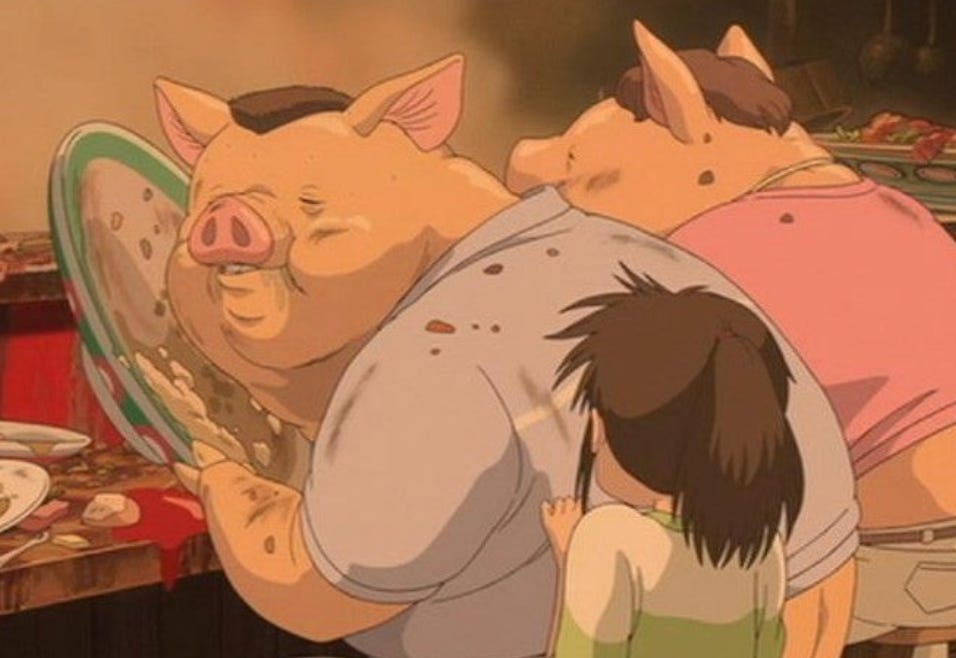
As a result, her parents are turned into pigs.
Being turned into pigs can be seen both as a punishment for succumbing to their appetites and as a representation of adults who are now capable of nothing but consumption. They have become beings who do nothing but keep eating whatever is in front of them, rather than creating anything themselves.
After the parents succumb to the pleasures of consumption, it is 10-year-old Chihiro who must shoulder the responsibility. A child is forced to resolve the problems created by adults through grueling labor.
This reflects the irony that the younger generation is forced to bear the heavy social burden left behind by the adults of the bubble economy era.
Comments
Nothing yet. Say the first thing.
Sign in to join the conversation.