
Thirty-five seconds before stepping onto the stage, I wondered whether I’d made a mistake.
Not because I wasn’t prepared. I’d rehearsed the talk, I knew the stories, the structure and the transitions but what unsettled me was something else.
For the first time, I wasn’t presenting a project. I was presenting my thinking.
For the past while, this platform has been a place for me to think in public.
‘Field Guide to Design’ began as a way to share ideas, not finished thoughts. What I discovered quite quickly was that writing was a way of showing me what I was actually paying attention to. The recurring questions and the connective tissue between projects that looked unrelated on the surface.
Writing for me has become less about producing content and more about learning to listen to my own work.
Which made last week feel somewhat different.
For the first time, I took this body of thinking - my field notes, lessons and questions I’ve been circling and I brought them into a room.
The talk distilled five things I’ve learned from paying attention - from observing thresholds, to materials, to the questions beneath my own work. But this isn’t about those lessons. It’s about what happened when I shared them out loud.
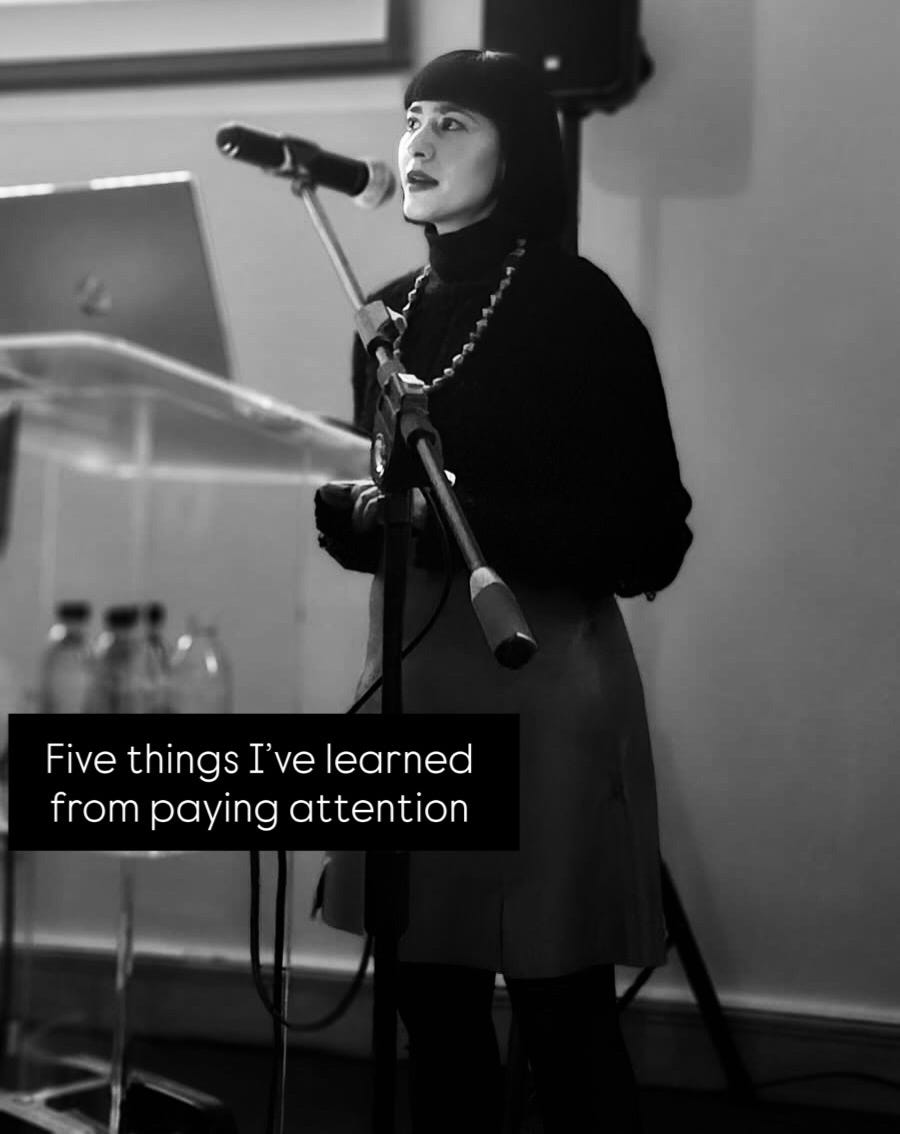
I’ve spoken in front of an audience many times, but not like this.
This was the first time I’d presented this particular work live. The thinking that has been forming in this weekly share, in my short essays and observations and half-finished ideas, all distilled into a 40 minute talk. A designed experience with people in seats, looking at me, waiting.
In the days leading up to it I felt both things at once: excited and exposed. Ready for the room, and equally uncertain about what the room would do to the work.
That tension, I’ve realised, is worth paying attention to.
Writing and speaking are not the same act.
When you write, there is distance. You can sit with a paragraph for days. You can delete the part that feels too raw and shape the rhythm until it presents the thought exactly the way you intended. The reader arrives in their own time, in their own space, on their own terms.
Speaking collapses all of that. The room offers no such luxury.
The room is live. The silence after a sentence is real. You can’t edit what you’ve just said. The ideas, the ones you’ve been thinking through privately for months, suddenly exist in a relationship with other people and you have their attention, their energy and their response.
There’s something both clarifying and simultaneously frightening about entering into that exchange.

I opened the talk with an exercise. I asked the room to notice five things they could see, four things they could touch, three they could hear, two they could smell, one they could taste.
It’s something I’ve written about here before. The 5–4–3–2–1 method - a grounding exercise I’ve started using as a design tool and a way of practising arrival.
But writing about it and asking a room full of people to do it together, in real time, are entirely different things.
I was the first speaker of the morning and I wondered whether people would participate. Whether they would find it awkward, and whether a room full of busy designer minds would be willing to sit quietly with themselves before the day had properly begun. Most of all, I wondered whether the silence would feel uncomfortable and if the idea would land the way it does on the page.
That uncertainty is something writing doesn’t prepare you for.
What I’ve been thinking about since is this: when work moves from the page to the room, something changes. On the page, you are thinking. In the room, you are present. The ideas may be identical but the experience is not.
The work becomes less about what you know and more about whether you can hold the space for other people to receive it and that I’ve learned is an entirely different skill.
I opened the talk with my sensory design tool, the way I always intended to but what surprised me was not that people actually did it but how they did it. The room went completely silent, not an awkward silence but something comfortable and grounding.
People closed their eyes. Others simply softened their gaze and went inward. For a brief moment, an entire room full of people who had never met one another shared the same act of noticing. It was far more powerful than I had imagined.
Afterwards, a student came up to me and thanked me for that moment specifically. I told her something I hadn’t planned to say, that the exercise isn’t just for the audience. I use it to ground myself before I speak. She seemed genuinely surprised by that. I think she’d assumed I was simply guiding the room, not also steadying myself within it.

I hadn’t fully understood it until I said it out loud in that moment, that sometimes the thing you offer others is also the thing holding you together.
I’d practiced this talk enough to know the rhythm but what surprised me was how differently I felt when there were people in front of me. I spoke more slowly, perhaps paused more often and listened more carefully to my own words. I also felt far more emotional speaking about my own stories than I expected to.
There’s something about a room full of attentive people that changes your relationship to your own work. You become more careful with your words. You feel the weight of them differently when they’re not just landing on a page, but on faces.
I don’t think I fully understood how personal this work was until I heard myself speaking it aloud, to people who were genuinely listening.
Writing, as I’ve said before, is a way of listening to my own work. What I hadn’t anticipated was how much listening would also come from other people.
Afterwards, several people came to find me. One said she’d been moved to tears, and that the talk had inspired her to pursue a more multidisciplinary path in her own design practice.
Someone else asked about a period of creative stuckness I had spoken about in the final lesson. We talked about how writing had helped me recognise that what felt like failure was actually evolution.
The following day, an email arrived from a Master’s student, currently developing their thesis. They had been struggling to communicate the emotional dimension of their work in a way that meaningfully connects with an audience. Something in the talk had resonated with that struggle and they wondered whether I might be willing to help.
Presence is reciprocal. The room doesn’t just receive what you give it, it also gives something back. Silence, a question, and an email are all signals, reminding you if something landed, or telling you if the work reached further than the room itself.
Writing taught me how to pay attention but the room has certainly taught me why it matters. It’s not so much about the feedback, but knowing that what I keep circling privately or on this platform are questions other people are circling too.
That, I think, is what it means for thinking to become public. It’s not that the work stops being yours but that it becomes something you’re no longer holding alone. That’s what left me speechless.
If you've ever shared something you'd only written before, and felt it change in the room, I'd love to hear what that moment was like for you.
See you next week,

No posts
Comments
Nothing yet. Say the first thing.
Sign in to join the conversation.