
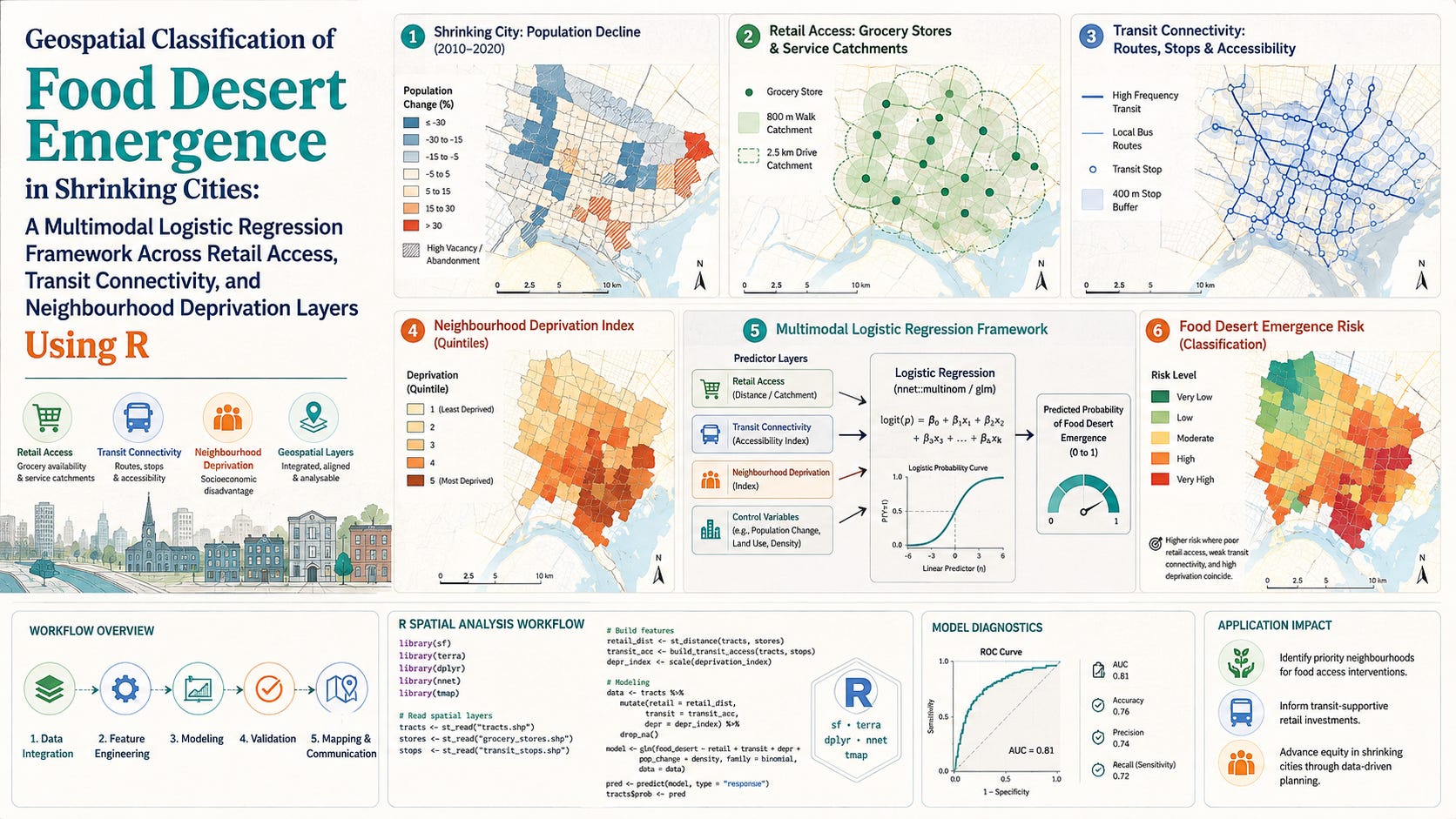
The article presents a complete R-based workflow for classifying food desert emergence in shrinking cities using a multimodal logistic regression framework. The central idea is that food deserts are not created by supermarket distance alone. They usually emerge where several disadvantages overlap, including weak retail access, store closure pressure, poor public transport, low car ownership, neighbourhood deprivation, population loss, vacancy and ageing demographic conditions.
The article begins by explaining why food desert emergence is especially important in shrinking cities. A shrinking city often experiences population decline, economic disinvestment, retail contraction, housing vacancy and reduced service availability. These conditions can weaken the local customer base for supermarkets and full-service grocery stores. When retail demand falls, grocery stores may close or avoid investing in declining areas. This creates a cycle where population decline leads to retail loss, and retail loss further worsens neighbourhood disadvantage.
The article frames food desert emergence as a binary classification problem. Each neighbourhood grid cell is classified as either experiencing food desert emergence or not. The outcome variable is food_desert_emergence, where 1 means emerging food desert conditions and 0 means no emergence. Because the outcome is binary, the article uses logistic regression. Logistic regression is suitable because it estimates probabilities and produces interpretable coefficients, making it useful for both prediction and policy explanation.
Comments
Nothing yet. Say the first thing.
Sign in to join the conversation.