
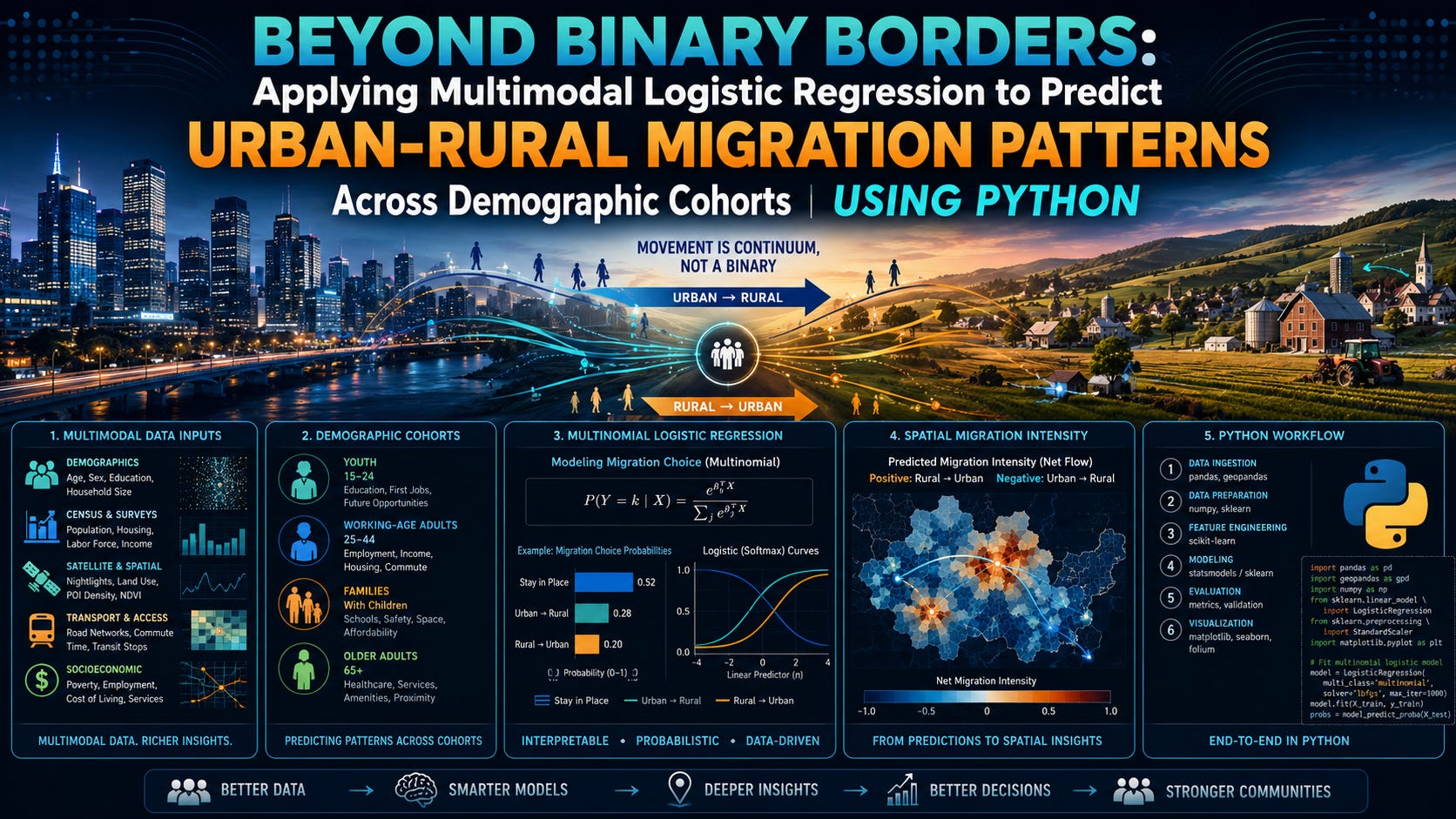
The article explains how multimodal multinomial logistic regression can be used to predict urban-rural migration patterns across different demographic cohorts. Instead of treating migration as a simple urban-to-rural or rural-to-urban movement, it models multiple pathways, including staying urban, staying rural, moving from urban to rural areas, moving from rural areas to cities, shifting to peri-urban areas, and moving from rural areas to towns.
Using a simulated but realistic Python dataset, the article combines demographic variables, housing affordability, job access, broadband quality, transport connectivity, rural amenity, service access and shrinking-area pressure. Exploratory data analysis shows how migration patterns vary by age group, origin type and spatial conditions. The multinomial logistic regression model then estimates the probability of each migration outcome and provides interpretable coefficients, probability maps, calibration plots and error diagnostics.
Overall, the article demonstrates that migration decisions are shaped by many overlapping demographic, economic, infrastructure and place-based factors. The framework provides a transparent and practical way to analyse complex migration pathways beyond a simple urban-rural divide.
Comments
Nothing yet. Say the first thing.
Sign in to join the conversation.