
If you thought that with the ending of the World Cup, and no major football competitions in play, we will have a couple of quiet weeks, Gianni Infantino has ensured that it’s anything but!
After backlash FIFA has now scraped its diabolical plan to set up a new FIFA Forward Enterprise (“FFE”), a subsidiary holding commercial rights, and to sell a stake in FFE to private investors, led by Josh Kushner’s Thrive Capital.
I won’t pontificate about why this is wrong and not needed, and the lack of due process, you’ve probably already seen that all over the internet. This is a short(ish) note on why $20bn valuation assigned to FFE is scandalous.
Valuation: $20bn
Minority stake sale: 21% for $4.2bn
Use of proceeds: $20m x 211 = $4.2bn
$20m one-off payment in early 2027 to each of FIFA’s 211 member associations
FIFA revenue 2023-2026 cycle: $15bn
2026 Men’s World Cup: $12.3bn (82%)
2025 Men’s Club World Cup: $2.1bn (14%)
2023 Women’s World Cup: $570m (4%) (broke even)
For comparison purposes we need to look at valuation multiple on annual basis. For 2023-2026 cycle that is:
$20bn / ($15bn / 4) = 5.3x Revenue multiple
How do I feel about using Revenue, and not EBITDA or Earnings multiples? Not great, but given that many sports teams and leagues fail to consistently generate positive operating cash flows, the industry has adopted Revenue multiples.
One of the most common mistakes I see people make when analysing valuations, both in PE and public markets, is looking at multiples, without also looking at the growth rates.
Companies that grow faster attract premium valuation multiples. And with the good reason!
In the 2019 – 2022 Qatar cycle FIFA generated $7.6bn revenue.
With $15bn generated in this cycle, that is 100% or 2x growth over 4 years. Of course, this big increase is partly because the World Cup was in America.
Growth: 100% over 4 years
FIFA World Cup is structurally different from individual teams and leagues.
Frequency and cash flow: World Cup is an episodic, quadrennial global mega-event. FIFA runs a deficit for three years, and then covers everything with one month of World Cup. Teams and domestic leagues generate steady, year-round or seasonal income.
Having said that, FIFA is diversifying its revenue with Women’s World Cup and Men’s Club World Cup, held in non-WC years.
Assets light model: Teams own physical assets (i.e. stadiums, training grounds) and player contracts that hold market value. The World Cup is asset light business; it does not own venues and has no contracted players – its value is derived purely from commercial rights and its role as a global custodian of football.
Operating costs: Teams and leagues manage and cover their own operating costs. For the World Cup, the host nations absorb majority of the infrastructure and staging costs. FIFA’s biggest cost is the cost of running tournaments (operational costs + prize money). Over the last four years budget for competitions was $7.6bn, with $3.8bn for 2026 World Cup.
Arguably the most difficult part in market approach valuation is picking the right comparables. This is even trickier when it comes to sports properties.
Given the discussed structural difference teams and leagues are not the closest comps. Especially, European football clubs, which are bottomless money pits, and face threat of relegation. Two more relevant comparables are:
LaLiga and CVC (2021): €2bn for 8.2% stake in the LaLiga’s broadcasting and sponsorship revenue for 50 years, implying €24.3bn valuation on €2bn revenue or 12x Revenue
PGA Tour and Fenway led consortium (2025): $1.5bn for 11.6% stake in the PGA Tour at a $12.9bn valuation on $1.45bn revenue or 8.9x Revenue
Even if the sports teams’ valuations are not like for like comps, given the scarcity of transactions it’s worth looking at them.
MLS teams are valued at 9.2x Revenue
NWSL teams are valued at 9.8x Revenue
32 Top Non-MLS football clubs are valued at 4.9 Revenue
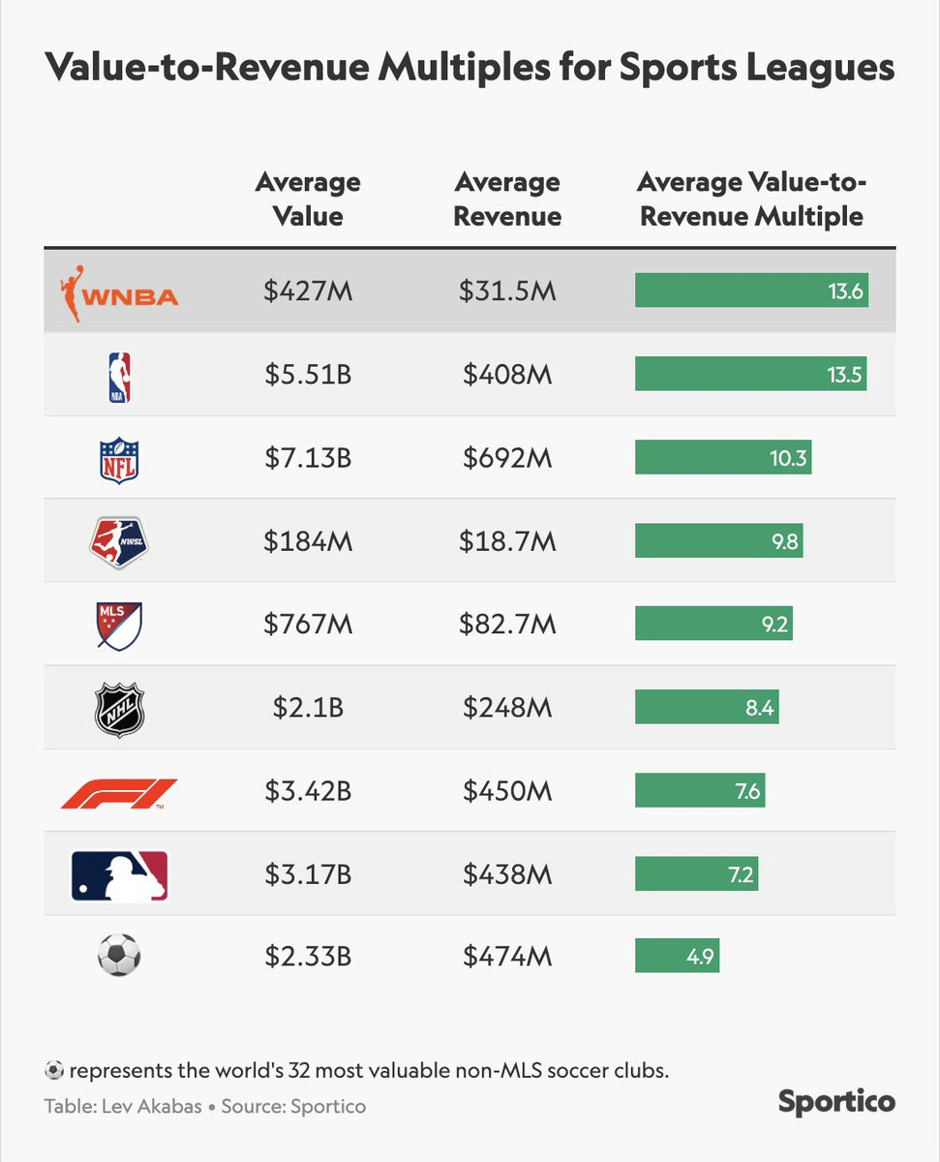
Interestingly, the WNBA teams trade at the highest multiples, because in its 30th season the league is still viewed as a young, growing league… well at least by those who are buying those teams!
What is one thing that almost all of these sporting properties share? That they have not doubled revenue over the last 4 years. And FIFA has.
Scarcity. Fandom. Impact and relevance. Growth.
Can any other competition better the World Cup with these?
The FIFA World Cup is the biggest sporting event on earth. It is in the league of its own. It’s one of one.
If anything, it should carry 50% premium to other sporting properties. And Gianni has tried to sell it at a 50% discount!
If we indeed apply a 50% premium, at 15x to 16x Revenue, FFE valuation would be $60bn. Or 3x the valuation set up by Gianni Infantino.
Effectively, Infantino has tried to do a quick and dirty on the world of football, and sell a stake in FIFA and World Cup to Trump’s inner circle at a massive discount.
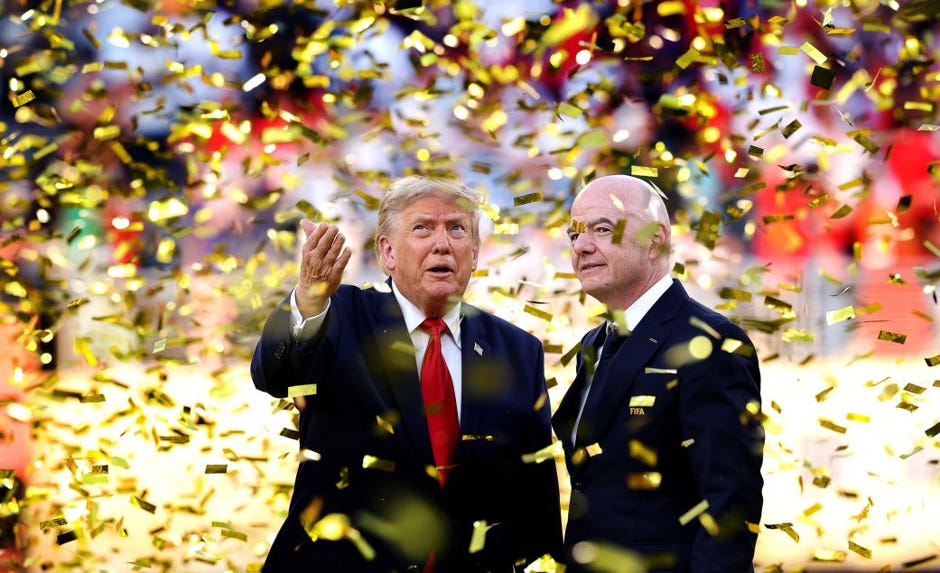
Artificial deadlines, pressure tactics, and brown envelopes are all staples of the Art of the deal. Gianni may soon learn that getting taken to the cleaners is often the price of the failed one.
Thanks for reading,
Nikola
No posts
Comments
Nothing yet. Say the first thing.
Sign in to join the conversation.