
With the flood of news surrounding Gianni Infantino’s shenanigans, another story from the last week garnered little attention – Bundesliga is having discussions with Apollo Sports Capital about €1 billion loan. This is a note with my detailed analysis based on the publicly available information.
Reportedly, the Bundesliga representatives met with Apollo Sports Capital in New York to discus €1 billion loan. The proposed loan is repayable over 20 years at a rate around 5.5%, secured by the league’s domestic broadcast earnings.
Note: I have provided some intro background, skip first three paragraphs to go directly to analysis.
Everyone following football knows that this has been rumbling for years, and taking on external investment has been one of the most contentious topics in German football.
One of German football’s most distinctive features is the 50+1 ownership rule. This means that unlike in the Premier League or Serie A, where billionaires and sovereign wealth funds can own clubs, German clubs are owned by their supporters.
A lesson I learned from losing a deal in Bundesliga
·
Apr 15
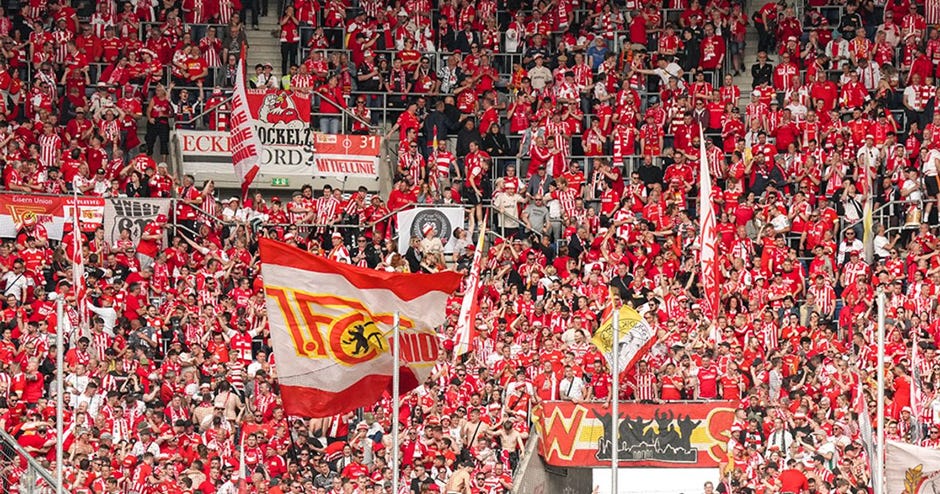
Some eight years ago, I worked on a private equity financing for a German Bundesliga club. We lost the deal, but I learned a valuable lesson. Our term sheet was rejected, because the club had a much cheaper source of financing – its fans.
It would be an understatement to say that the Bundesliga executives are much less enthusiastic than the fans, with limitations to take external investment. In fact, in 2023 the league and clubs attempted twice to bring in outside money by selling a share of future TV income.
First proposal was to sell 12.5% of the league’s TV broadcasting income over 20 years for €1.8bn to €2bn to Private Equity suitors including Blackstone, CVC, and Advent International. The plan was rejected by the 36 member clubs, with only 20 voting in favor, short of two-thirds majority needed. This was heavily influenced by fan opposition.
Second proposal to sell 8% of TV income over 20 years for €1bn narrowly passed in December 2023, but was scrapped two months later after intense, disruptive fan protests.
Note, this was not sale of the league or clubs, but rather a sale of small share of TV broadcasting income. But German fans strongly rebuked it, as they feared it was opening door to investors, and was giving up their independence.
Deals like this have already been made by French Ligue 1 (13%) and La Liga (8.2%), which sold share of their future broadcast income to CVC. Ligue 1 deal has not been a golden goose for CVC.
Real Madrid, Barcelona, and Athletic Bilbao opted out of the deal and sued LaLiga arguing the 50-year deal is “ruinous”. As it happens, these are the only three professional Spanish clubs fully owned by socios (members), alongside CA Osasuna being the fourth one.
Almost no football fan wants their club to be owned by American PE funds, petro states or billionaires. But they do want that clubs spend a lot of money!
One consequence of no, or limited, external investment, is that German clubs, except Bayern Munich and Borussia Dortmund, are falling behind the English Premier League. In the most recent UEFA Europa League final Aston Villa defeated thrashed SC Freiburg 3 – 0.
For me personally more depressing consequence is that the league winner is pretty much known at the start of the season. Bayern Munich has won 13 of the last 14 titles. They have such financial advantage over everyone that it’s not fun.
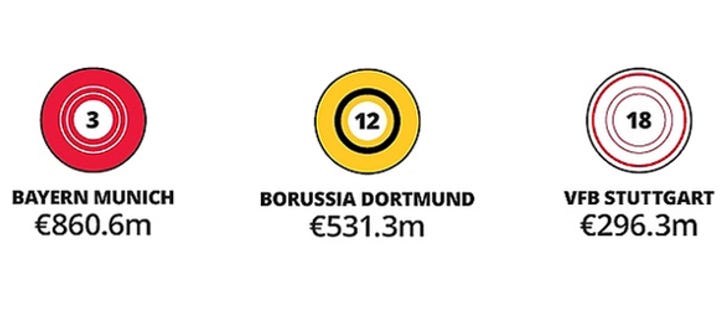
Looking at the 20 highest revenue generating clubs in the world in 2024/25 there were only three Bundesliga clubs. Bayern has almost 3x revenue of the third highest revenue generating club in Bundesliga.
This is not to say that solution for this is to allow sale of majority fan owned clubs to investors, or external funding. I actually think that 50+1 rule is good for Germany. Not just for football, but for the wider society. But there is no free lunch.
Reportedly the new proposal is a €1 billion loan, repayable over 20 years at around 5.5% interest, secured by the domestic broadcast earnings.
My first thought was – when the Bundesliga starts in a couple of weeks, there’s gonna be some “extracurricular activity” by the fans all over Germany. We all get that, no need to write a note about it. So let’s focus on the financial analysis with a cool head.
Just a loan – Noticeably, unlike previous proposals which entailed selling a share of broadcast income, this financing is reportedly just a loan secured by broadcast income, priced at around 5.5% (not clear if it is a fixed rate loan). Loan has no open-ended claim and it has less governance rights. Apollo would not receive an ownership stake in the league or in a separate commercial entity. This loan is akin to long-term TV rights factoring.
Avoids the “selling the league” optics – first and foremost, a loan avoids the negative optics that doomed the revenue-share deals, as it was viewed by fans as selling the league and its future. I anticipate that fans still won’t care and will not make that distinction, but in truth there is a difference.
Most Bundesliga clubs have loans – from stadium financing, to corporate debt, fan bonds and factoring, Bundesliga clubs have been borrowing for decades. So in reality it shouldn’t be terribly controversial that the league also takes a loan, if it makes sense (I’ll get to that part).
A question is why would Apollo propose just a loan at 5.5%? You don’t make fortune by lending money at 5-ish percent.
Let’s start with the obvious – because that is what they do. Apollo is primarily a Private Credit, and not a Private Equity firm. This is still not grasped by the majority of sportbiz community that likes to pontificate about sport and private equity.
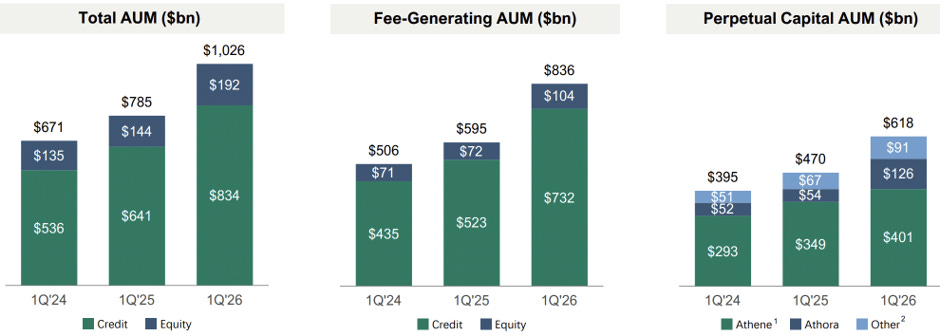
Over 80% of Apollo’s AUM is in private credit. And here is another statistic that will surprise many – approximately 80% to 85% of the credit they manage is investment grade.
In Q1 2026 Apollo passed $1trn AUM
Apollo’s investment-grade strategies primarily fund asset-backed lending. And in case of Bundesliga loan, it would be backed by broadcast income. So, in a nutshell for them this is bread and butter.
Yet I have a sneaky feeling there is more to this…
The notion which many have, that selling a share of future broadcast earnings is a way for PE to rip-off leagues and clubs is misguided. As with any transaction, how well each party does depend on the quality and price of the transacted asset.
Just ask CVC how their 2022 purchase of 13% stake in a commercial subsidiary of French league for €1.5bn is doing?
Five years ago, PE had a consensus bull case built around growth in value of media rights and revenues. It’s fair to say that the bullish sentiment has faded! And thus, today providing high investment grade over-collateralized loan at good interest rate is more attractive than it was 3 years ago. And buying media rights for the next 20 years is viewed as riskier than it was before.
The loan would be secured by domestic broadcasting rights revenue, which would serve as security and a source of repayment. These television rights are worth more than one billion euros per season.
As per DFL, the 36 clubs across the Bundesliga and 2. Bundesliga will receive €4.484bn for the four-year rights cycle from the 2025/26 to 2028/29 seasons. That is €1.121bn per season.
Essentially this loan is significantly overcollateralized.
5.5% interest rate translates to €55m in annual interest. There would probably also be some amortization payments over time.
Interest Coverage Ratio (ICR) based on current media rights is 20x.
Bundesliga does not have a public credit rating of its own, but it is probably the most financially sustainable professional football league in the world.
Arguably, Bundesliga is Germany! (some credit folks may disagree) And Germany firmly holds a top-tier, risk-free AAA credit rating with a stable outlook from Fitch, S&P, and Moody’s.
This is basically a senior secured loan from a high-quality issuer, that is significantly over-collateralized with a specific cash flow stream. I reckon the loan itself would be rated (internally or externally) as high investment grade – AA to AAA.
While 5.5% interest does not seem high, that is similar yield to BBB rated (lowest tier of investment grade) 20-year German corporate bonds, which are unsecured.
In other words, this loan has a great risk-return trade-off for Apollo.
The short answer is NO.
In the 2024/25 season, the 36 clubs (Bundesliga and 2. Bundesliga) generated €6.33bn in combined revenue, exceeding six billion euros for the first time. Total profit after expenses was €271.5m. Hence, the league has a luxury that it can turn down the offer. Taking the loan would be a strategic decision.
And there lies the biggest question – how would the league and clubs use the money?
How much would be invested by the league vs distributed to the clubs? You can see how it could get political. Especially since the smaller clubs depend more on centrally distributed funds, so future decline in funding due to interest payments would impact them more.
If the league does decide that it wants to borrow €1bn, it may make sense to run a competitive process including bank lenders and bond market, instead of taking Apollo’s exclusive offer.
There is a wide spread belief that it is bad to borrow money or raise capital. From the perspective of corporate finance that is simply not true. Whether taking the loan is a good or bad decision for Bundesliga, will ultimately depend on the ROI they generate on that capital.
Previous financings were sought in order to invest in digitalisation, growing the league internationally, and building its own media capabilities.
Such long-term investments certainly make more sense, at least on paper, than distributing a lot of money to the clubs to plug their budget holes and spend waste money on transfers.
In 2022, New Zealand Rugby All Blacks took NZ$262.5 million convertible loan from Silver Lake to invest in… guess what?... digitalisation, growing the brand internationally, and building its own media capabilities.
Their experiences are a reminder that deploying capital and generating ROI are two different things.
Thanks for reading,
Nikola
No posts
Comments
Nothing yet. Say the first thing.
Sign in to join the conversation.