
As Roland-Garros approaches, the perpetual debate over whether the Grand Slams should share more money they generate with the tennis players has been reignited.
So, should they?
I did some deep dive into the numbers, which changed my view of the topic. I am sharing them with you (read the second half), so you can make your own conclusion.
At the crux of the debate is how much of the revenue generated by the Grand Slams is being shared with the players.
Four Grand Slams, which generate over $1.5 billion combined annually, share around 13% to 15% of their revenue with players through prize money. Meanwhile, revenue share at the top ATP/WTA 1000 events is around 22%.
While Grand Slams are pointing out that the prize money has risen 45% since 2019, adjusted for inflation, the figure is only 14%.
Patrick Mouratoglou summarizes the problem:
Top-10 players have united and have sent multiple letters to the Slams with some specific demands. Players are asking each of the Slams to pay 22% of their revenue in prize money by 2030.
World No 1 Aryna Sabalenka believes tennis players should organise a boycott if they don’t start receiving a bigger share of tournament revenues at the Grand Slams.
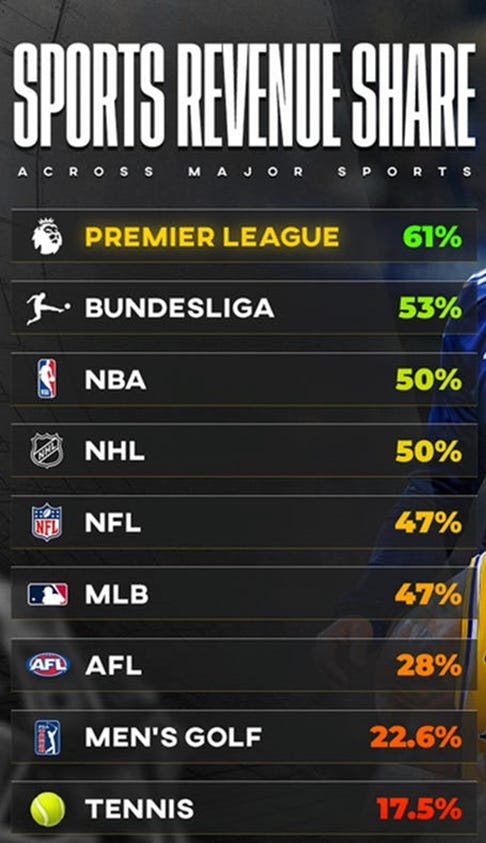
There is a clear disparity with many team sports, such as the NFL, NBA, or MLB, where athletes often receive around 50% of revenue. In the American leagues these percentages are negotiated in the Collective Bargaining Agreements between player unions and the leagues.
In European football player wages are usually higher percentage of revenue, often over 70%. Then again, it is fair to say that the business model of football is a template of how NOT to run a sport.
Looking at this table, it becomes clear that tennis players are hard done by the Slams. Isn’t it? That is certainly what they believe.
To be able to fully understand this debate it is important to understand the ownership structure of the Grand Slams and their mission.
Unlike other professional tournaments that are run by the ATP or WTA, the four Grand Slams are independent entities. They are owned and operated by their respective national tennis federations.
Australian Open: Owned and operated by Tennis Australia
Roland-Garros: Owned and operated by the French Tennis Federation
Wimbledon: Owned and operated by the All England Lawn Tennis & Croquet Club (AELTC) and the Lawn Tennis Association (LTA).
US Open: Owned and operated by the United States Tennis Association
Two key points on the Grand Slams:
The national federations that own the Slams are typically non-profit organizations that reinvest profits back into the sport, often at a grass-root level.
There is no oil or private equity money that can prop tournaments.
Meanwhile, various ATP and WTA tournaments are owned by different non-profits, including corporates, private equity, or wealthy individuals. In 2023, the WTA sold a 20% stake in its commercial business unit to CVC Capital Partners for $150 million.
I am looking at Wimbledon, but numbers are fairly similar across other slams.
2024 Revenue: £406.5 million
Revenue breakdown: Broadcasting 56%, Tickets 16%, Sponsorship 16%, Concessions & merchandise 12%
2024 Prize money: £50 million (£53.5 million in 2025)
2024 champions and runners-up prize: £2.7 million and £1.4 million
In recent years prize money has been growing more than revenues. Importantly there has been a significant increase in compensation for the early rounds of all Slams. Those who loss in the first round in 2025 received £66,000.
2024 Tournament Profits: £54.3 million
90% of profits are shared with the LTA to support British tennis.
Now look at it this way - profits before paying prize money was £104.3 million.
Essentially cost of tournament before paying players is ~£302m. This includes covering various costs for player welfare and better experience.
Players are getting only 13% revenue share, but they are getting almost half of the tournament’s profits (48%). Most of the rest is being reinvested to support tennis in Britain.
Players are asking for 22% revenue share. That would be £89.4 million, or 86% of profits.
Essentially, they are asking that almost all the profits made by the Grand Slams are paid to them in prize money. Which implicitly means that Australian, French, British, and US tennis federations say fuck you to supporting the sport locally.
From the perspective of the Slams, the players are not nearly as important as they believe. These events transcend the sport. Their success and financial status are a result of decades of growth, branding and history, which cannot be replicated. And most of the money they generate is invested back into the sport in their countries.
Having said that, there are hardly any top tennis players from these four countries. The sport, especially on the women side, is dominated by the players from Eastern Europe, where they receive little federation support. Many of them may not give a toss that the Slams are effectively a glorified fundraisers for the national federations in wealthy western countries.
It is also overlooked that players are considered independent contractors, unlike players in the team sports. This means they are double taxed on the prize money earned – paying withholding taxes in the tournament’s country, on top of income tax in the country of residence. Carlos Alcaraz was reportedly taxed half of his French Open prize money.
So, should tennis players be paid more at the Grand Slams?
It is all in the eye of the beholder, but they are certainly not being as hard done by the Slams, as many are presenting.
Thanks for reading,
Nikola
No posts
Comments
Nothing yet. Say the first thing.
Sign in to join the conversation.