
In the 1950s, a handful of engineers in a California suburb started building semiconductors in their garages. Seven decades later, Silicon Valley is an ecosystem worth ten of trillions of dollars that defines the world.
Around the same time, a handful of engineers in the English countryside started building racing cars in their barns. Seven decades later, Motorsport Valley, a cluster of towns between Oxford and Northampton, is a £16 billion advanced manufacturing and servicing ecosystem that produces almost every car on the Formula 1 grid.
While Silicon Valley became the most famous cluster in the world, Motorsport Valley remains largely unknown outside of the UK. This may be the most interesting and overlooked sport investment opportunity in the UK and Europe.
A 50-mile cluster in a compact strip of southern England is an area where 10 out of 11 F1 teams have HQ (8 teams) or major operations. Even Ferrari seriously considered establishing a technical hub in the Motorsport Valley.
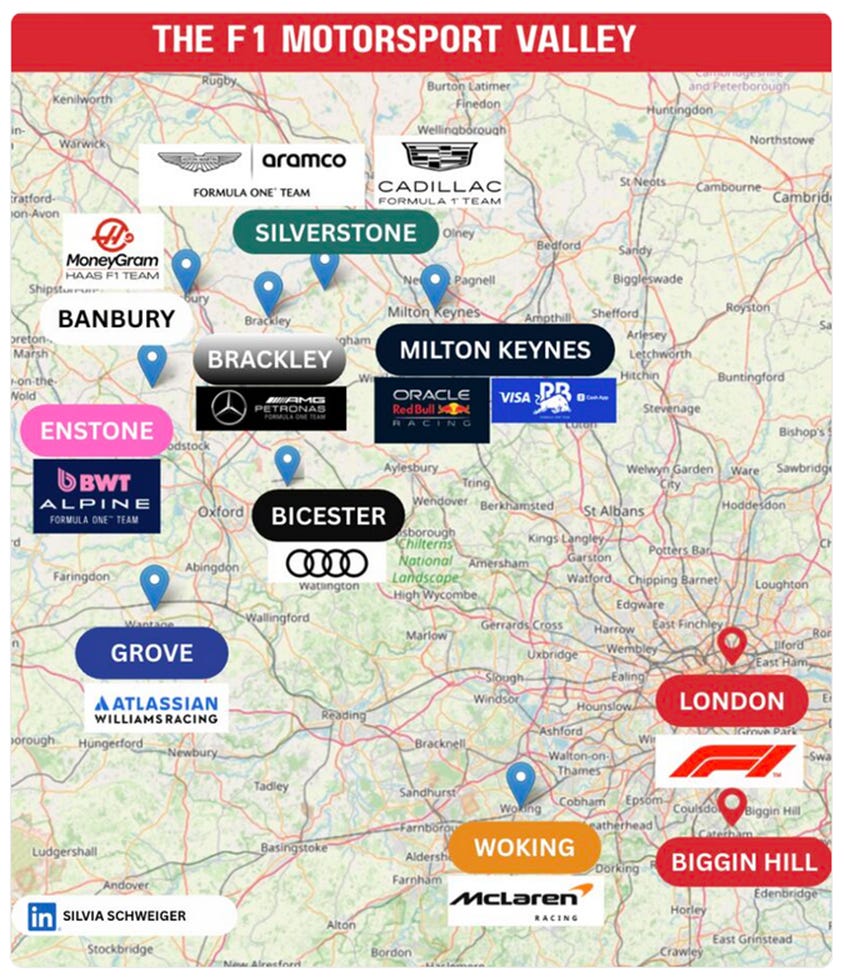
What is today a juggernaut, began small and almost accidental. In 1950, the first race in the newly created World Championship of Drivers (F1) was held at a deserted WW2 RAF airfield in Northamptonshire – Silverstone.
A generation of enthusiasts set up shops nearby, building cars in barns. These garage operations became small British constructors (Vanwall, Lotus, Cooper, BRM). Like in Silicon Valley, that proximity mattered. They were building cars near each other, near the circuit, and importantly near a deep pool of engineering talent from some of the best universities in the world.
The Motorsport Valley is textbook case of cluster economics, akin to semiconductors in Taiwan, software in the Bay Area, and finance in London and NY.
Teams attract talent and suppliers, suppliers attract more companies, universities supply talent, and the cycle compounds. Once a cluster reaches critical mass, it becomes almost impossible to replicate it elsewhere.
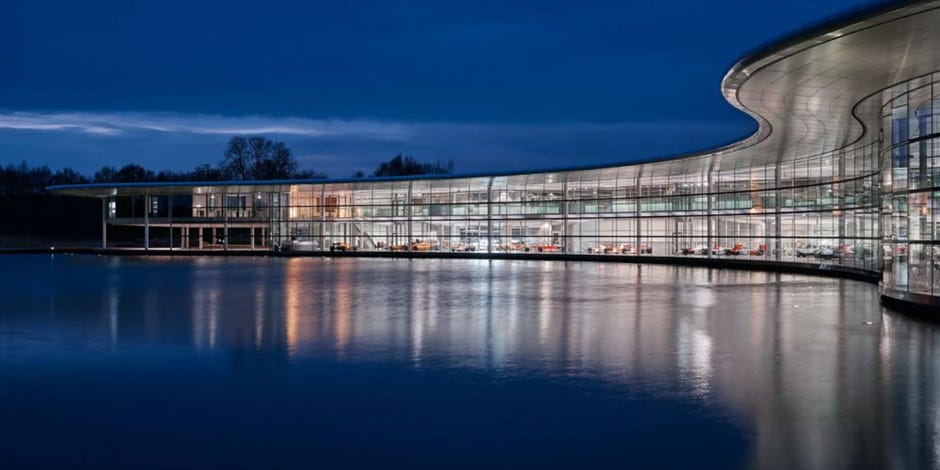
Image: The Mclaren Technology Centre
In 2023 this ecosystem generated £16 billion in turnover and employed over 50,000 people (Grant Thornton). The F1 supply chain alone comprises 4,500 companies, the vast majority located in or around the Valley.
I recently wrote about the opportunity for PE rollups in European sports-adjacent services. There is fragmented landscape of small, specialised businesses serving racing teams in two verticals:
Precision engineering
Business services
Motorsport Valley is where those businesses are concentrated.
The cluster creates both the demand (teams outsourcing non-core functions) and the supply (small firms with deep domain expertise but limited scale). This may be a rollup operator’s dream geography.
Family-owned, founder-led businesses built over decades of serving the paddock. The founders who started them decades ago are now approaching retirement, often without a clear succession plan.
Profitable, sticky, and deeply embedded in team supply chains. They are defensible, as F1 teams would rather keep a trusted supplier or service provider than onboard a new one.
Run like SMEs, with room for operational improvement, centralisation of functions and cross-selling across the cluster.
Can be acquired at lower EBITDA multiples given their nature, and would benefit from multiple expansion with scale.
Founders’ relationships with customers play a key role, and they should remain as a minority owners, at least for a few years during the transition.
The opportunity here is not concentrated in one sport. For all of F1’s dominance of the headlines, it is also home to the majority of Formula E teams, several Formula 2 and Formula 3 operations, GT racing outfits, and World Endurance Championship programmes.
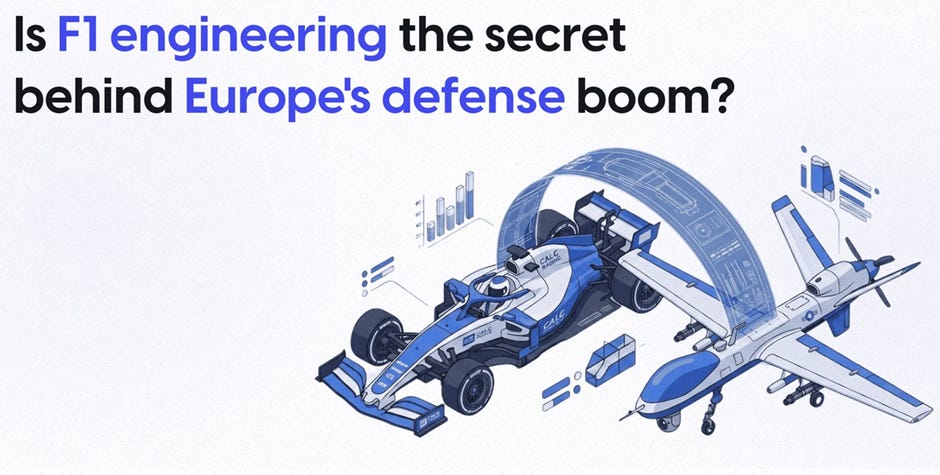
What makes Motorsport Valley more than a sports story is the technology that flows out of it. F1 teams are, in essence, the world’s most extreme rapid-prototyping operations. And increasingly, that capability is being applied far beyond the track.
The cluster’s reach extends well beyond the F1 paddock. It is also a hub for defence, aerospace, and clean energy sectors. This means the addressable market for rollups products and services is significantly larger than an F1-only lens would suggest.
Motorsport Valley has over decades created structural barriers to replication: a self-reinforcing talent ecosystem rooted in high R&D intensity, and services anchored in personal relationships. For a PE style rollup, this is where the targets live.
However, this is not your typical HVAC or dental rollup. You cannot run the same playbook you would use to consolidate plumbers in Missouri. The technical complexity is higher, the client relationships are more demanding, and the margin for error is smaller.
For a specialist acquirer who understands the ecosystem, the combination of low entry multiples, high switching costs, structural revenue growth from F1’s growth, and expansion into adjacent sectors creates a rare and compelling opportunity to create an infrastructure-like platform.
If you are an operator or investor interested to discuss this further, feel free to message me.
Thanks for reading,
Nikola
No posts
Comments
Nothing yet. Say the first thing.
Sign in to join the conversation.