
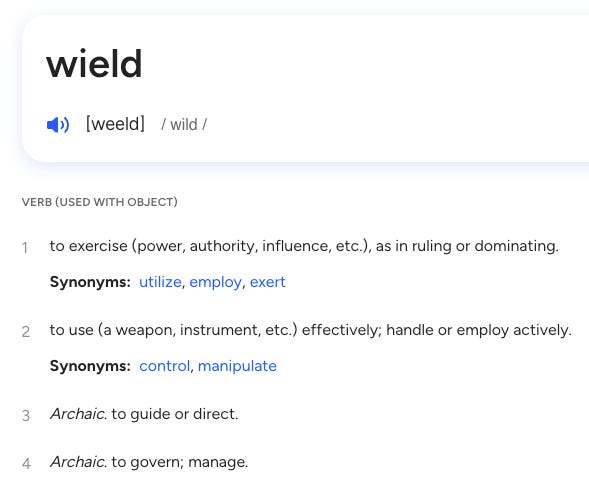
The word wield carries weight.
It assumes action. Judgment. Authority. It makes clear that a tool isn’t acting on its own — someone is directing it with intent.
That word keeps coming to mind as I watch teams and candidates navigate the current wave of AI tooling. Not because AI is the point, but because this moment is making something else visible.
Lately, I’ve stopped asking whether someone is using AI.
Instead, I’m paying attention to how they’re using it.
Because there’s a meaningful difference between adopting a tool and wielding it — and that difference is quickly becoming one of the clearest signals of great startup talent.
This moment of watching who can wield AI is useful far beyond the technology itself. It gets at the harder-to-define qualities that have always made great startup talent great: people who constantly uplevel how they use all available tools and resources to solve problems strategically, in ways that serve both the function they own and the company as a whole.
Yes, that’s a mouthful. But that mix — singular focus paired with a breadth of inputs — is the point. It’s hard to do, especially well. And it’s exactly why we work in startups in the first place.
We don’t just do hard things.
We treat them as our advantage — and thrive on tackling the hardest challenges.
Using a tool is easy to convey.
You can list it on a resume.
You can talk about prompts.
You can demo workflows.
Wielding a tool is different.
To wield something means:
Using it with authority
Using it effectively
Knowing when to use it — and when not to
Learning, experimenting, iterating — all of that matters. It’s part of the path. But wielding implies something further along that curve: ownership, judgment, and responsibility for outcomes.
That distinction matters more than ever right now.
This question comes up in nearly every hiring conversation I’m having.
We’re all operating under intense pressure to move faster. Today’s tooling — especially AI — allows for a level of output and pace that simply didn’t exist a few years ago.
But speed alone isn’t the goal.
What teams actually need are people who can:
Produce at modern velocity and
Hold strategic context
Make good tradeoffs
Be right way more than we’re wrong
Anchor decisions in broader company goals, not just local optimization
Wielding is where those things come together.
Nowhere is this more visible than in engineering.
The market is already splitting into two distinct groups:
Those using AI tooling to dramatically accelerate their pace
Everyone else
That gap is widening quickly.
But the real differentiator isn’t which tools someone has access to. It’s how they think about them. The strongest engineers aren’t delegating thinking to AI — they’re amplifying their own judgment with it. Unleashing it where it’ll be most effective, with control, context and focus.
The same skills that have always built great startups are just compounding faster now.
Across the rest of the business — product, marketing, sales, ops — each function has its own evolving set of tools that are quickly becoming table stakes. The specifics differ by role, but the dynamic is the same.
Those tools — and the outputs they enable — are changing constantly. Weekly ( sometimes daily even!).
So as teams hire to meet immediate needs, we’re also paying closer attention to something deeper: who consistently thrives amid change and is ready for whatever comes next.
Not in the abstract — but in practice.
Who adapts naturally as tools evolve?
Who has a track record of learning new ways to solve problems, rather than defaulting to the same familiar approaches?
Who understands the underlying problem deeply enough to choose the right tool — instead of forcing the problem to fit the tool they already know?
Who can move fluidly between execution and strategy, ensuring speed doesn’t come at the expense of direction?
Who stays grounded and curious when a workflow breaks?
That’s why this moment is so instructive.
AI isn’t just another tool being added to the stack — it’s accelerating the feedback loop on how people think, adapt, and build. It rewards the same qualities that have always mattered in high-growth environments, just compounding faster.
I’m seeing a lot of people trying so hard to use AI that they’re overwhelmed by it.
New tools every week.
New prompts.
New workflows.
It becomes about keeping up — instead of understanding.
But wielding a tool starts before you ever open it.
Wielding a tool means:
Knowing what problem you’re actually trying to solve
Understanding what the tool is capable of — and what it isn’t
Recognizing where your experience and judgment need to step in
Practicing. Testing. Iterating. Missing the shot and adjusting
Because no one walks onto a court and drains threes without reps.
You miss.
You adjust your stance.
You learn your range.
AI is no different.
The candidates and operators who stand out right now aren’t the ones using every tool.
They’re the ones who:
See the big picture
Run small, intentional experiments
Pay attention to what works (and what doesn’t)
Ask around, crowdsource and contribute to best practices
Insert their own thinking where it actually matters
They’re not chasing novelty.
They’re building judgment.
That’s ownership.
That’s mastery.
I was discussing this notion of “wielding” while recording a podcast episode recently with Evelyn Cools (can’t wait for this one to drop), and she used an analogy that stuck with me: the warrior.
The most powerful warriors don’t just pick up a random sword.
They know:
The right tool for the right task
The right tool for the right user
The right tool for the broader mission
They understand a tool’s power and its limitations. They practice until using it becomes instinctual. And they know when to put it down.
That’s what wielding looks like.
In hiring, I’m starting to look for this signal more and more.
Not:
“Are you using AI?”
But:
How do you decide when to use it?
Where do you rely on it — and where don’t you?
How do you validate that it’s actually helping?
How do you adapt as the tools change?
In other words:
How are you wielding it?
And taking it one step further: why are you wielding towards that outcome?
This let’s us get beyond tactical usage into a person’s judgement and functional mastery within business and prioritization contexts.
The question isn’t whether someone has access to the tool.
It’s how they approach it.
With context.
With ownership.
With an understanding of the problem they’re actually trying to solve — and the outcomes that matter most.
That’s why this moment of watching who can truly wield (esp. vs. just use) AI is useful far beyond the technology itself. It sharpens our view of the qualities that have always defined great startup talent: people who consistently uplevel how they use every available resource, who can move between strategy and execution, and who take responsibility not just for doing the work — but for where it leads.
In hiring, this has become one of the clearest signals I’m paying attention to. Not who’s chasing every new tool, but who knows how to turn tools into progress. Who can learn in motion. Who can adapt as the environment changes without losing their footing. Who builds with the broader company in mind, not just their own lane.
The tools will keep changing. Faster than ever.
What won’t change is the kind of people it takes to build something meaningful with them.
And this moment gives us a rare, accelerated window into exactly who those people are — and how to find them.
No posts
Comments
Nothing yet. Say the first thing.
Sign in to join the conversation.