
Early stage, the Founder is everywhere in hiring. First call. Second call. Final call. They are the process.
But there’s a moment in every scaling startup when the Founder quietly steps back from hiring.
It happens gradually. The calendar fills up. A few good managers get hired. The process starts to run without them. And suddenly the CEO — who used to interview every single candidate — is showing up at the very end of the process for a 30-minute final conversation they’re not quite sure how to use.
It’s not a bad thing. It’s actually a sign of growth. But in addition to that shifted place in the lineup, Founders need to stay actively involved in hiring. If we just show up in that final layup conversation, the cost is about to get expensive.
The Pendulum Problem
Most founders swing from one extreme to the other.
First, they’re in every interview. Every round, every role. They’re the screener, the culture check, the closer. It’s exhausting and it doesn’t scale, so eventually something gives.
Then they’re at the end. A checkbox. A formality. Brought in to close the deal.
But doing less interviewing doesn’t mean equal less hiring.
As we scale, the founder’s job should be to do MORE hiring — multiplying their hiring judgment through other people.
So often though, this pendulum swings too fast, and we don’t intentionally map out that transition from star player in the interview loop to coach.
From Player to Coach
The founder’s role in hiring doesn’t shrink as the company scales — it transforms. And the best thoughtful transformations I’ve seen look like this:
Early in a new role search, the CEO is a pattern-matcher.
Before a hiring manager runs their first few screens, the CEO should be in the room — not to take over, but to calibrate. What does “right” actually look like for this role? What’s the instinct we’re trying to replicate? This doesn’t have to be formal. It can be a few shadow interviews, a debrief after the first three or four candidates, a working session where you name what you’re actually looking for beyond the job description.
This is where the CEO’s pattern recognition gets transferred. Because the CEO has seen what good looks like across every function at your stage. That’s hard-won judgment. The question is whether it lives only in their gut, or whether it gets built into the process.
Most of the time? It stays in the gut. And then a hiring manager makes a call the CEO wouldn’t have made, and nobody knows exactly why it felt off.
The Founder is a culture and vision carrier.
In addition to defining those gut calls into clear rubric-ready definitions, ensuring that the values of the company are clear, in place and used as guardrails to hone and empower individual decision making is key. One of my favorite quotes from Scott Belsky’s book The Messy Middle is
“As a leader, you are your team’s window… You are their storyteller.”
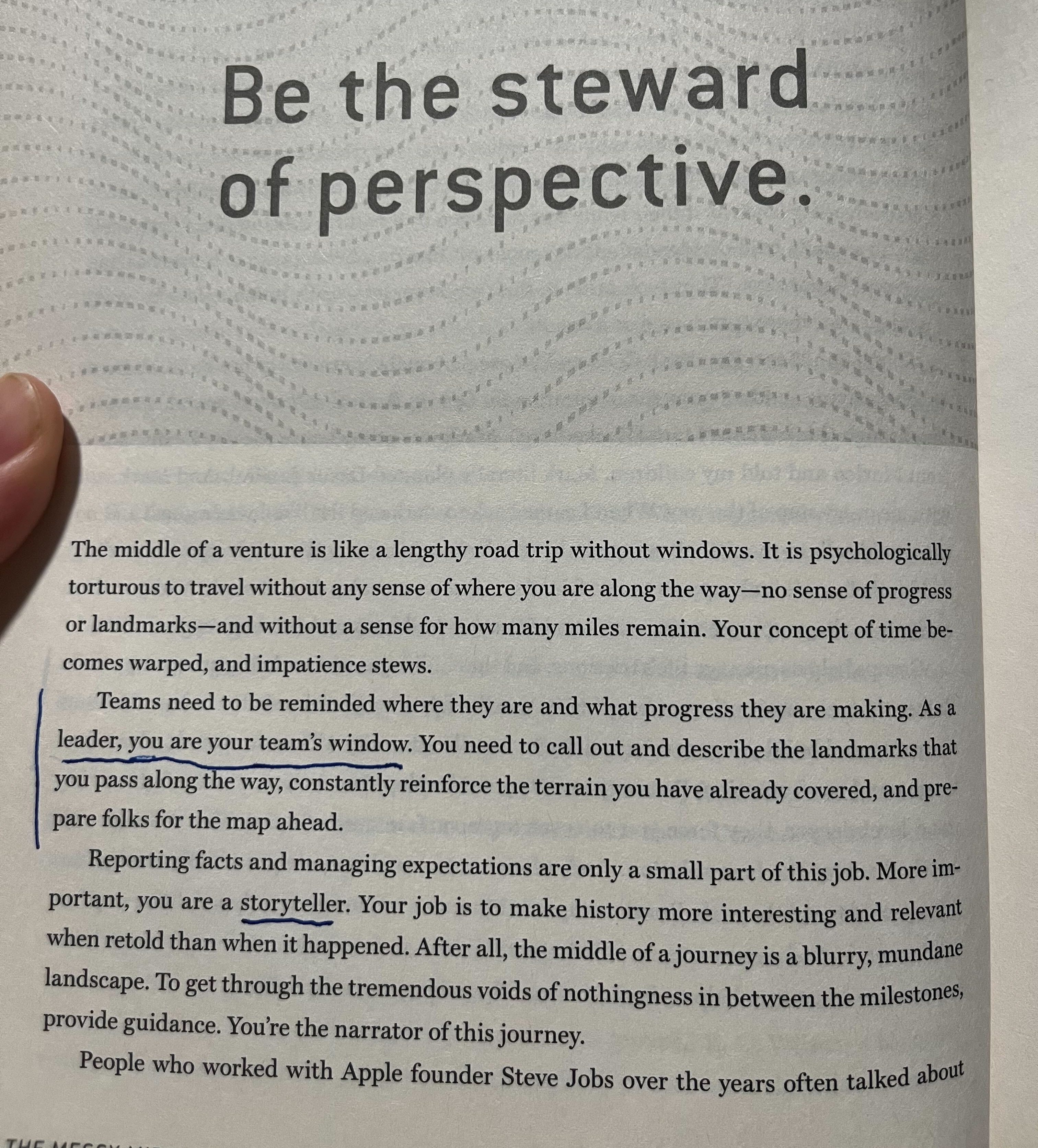
We’re contextualizing situations across the entire business for our team so they’ll understand the big picture, build the muscle themselves, and be able to co-own that full vision. One of the main jobs of leaders is to constantly evangelize the mission. If it doesn’t feel like you’re a broken record, you’re probably not saying it enough. We have to be the coach, letting the player’s we’ve brought on play.
And then there’s the piece most founders skip entirely: mentoring the hiring managers themselves.
It’s probably the highest-leverage thing a scaling CEO can do in hiring.
The goal isn’t for the CEO to stay in every loop forever. The goal is to transfer their judgment so the people running the process start to internalize it. That means debriefing together after interviews — not just sharing a thumbs up or down, but talking through why. What did you see? What did I see? Where did we land differently and what does that tell us?
It means sending a new hiring manager into their first few interviews with the CEO present — not to be evaluated, but to learn. To watch how the CEO probes for self-awareness, or resilience, or whatever quality matters most for that role. To build their own version of that instinct.
This is the stair-step model. The CEO doesn’t go from doing everything to doing nothing. They gradually hand off the pattern, stay close enough to catch drift, and invest in making the people around them better at hiring.
The result is a hiring process that actually scales — one that carries the founder’s judgment without requiring their presence in every room.
The Question Worth Sitting With
As you consider stepping back and participating in less interviews, how will you still show up in the organization’s hiring?
Because if we don’t take this transition on strategically, we know we’ll pay the dues six months later, when someone isn’t working out and you’re trying to figure out where the process broke down.
The CEO interview doesn’t have to be a checkbox or a bottleneck. We can use it as a trigger for the transition from player to coach.
No posts
Comments
Nothing yet. Say the first thing.
Sign in to join the conversation.