
Hey folks, Nijay here. I am excited to have Dr. Sandra Glahn (DTS) on Engaging Scripture today to share from her wisdom about how to read Scripture. Glahn has a brand new book coming out THIS WEEK. This is a taste of the insight she offers as a master teacher.

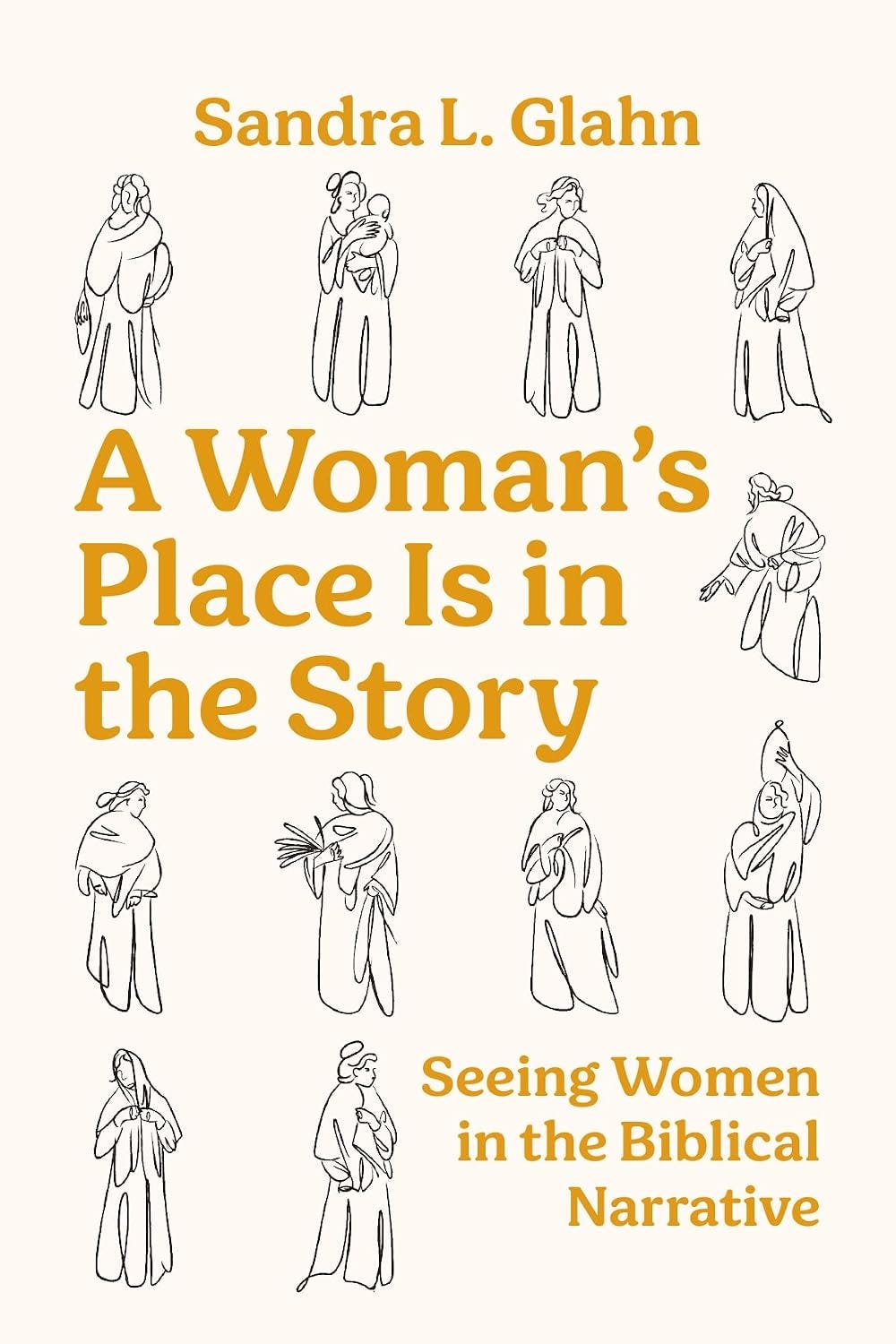
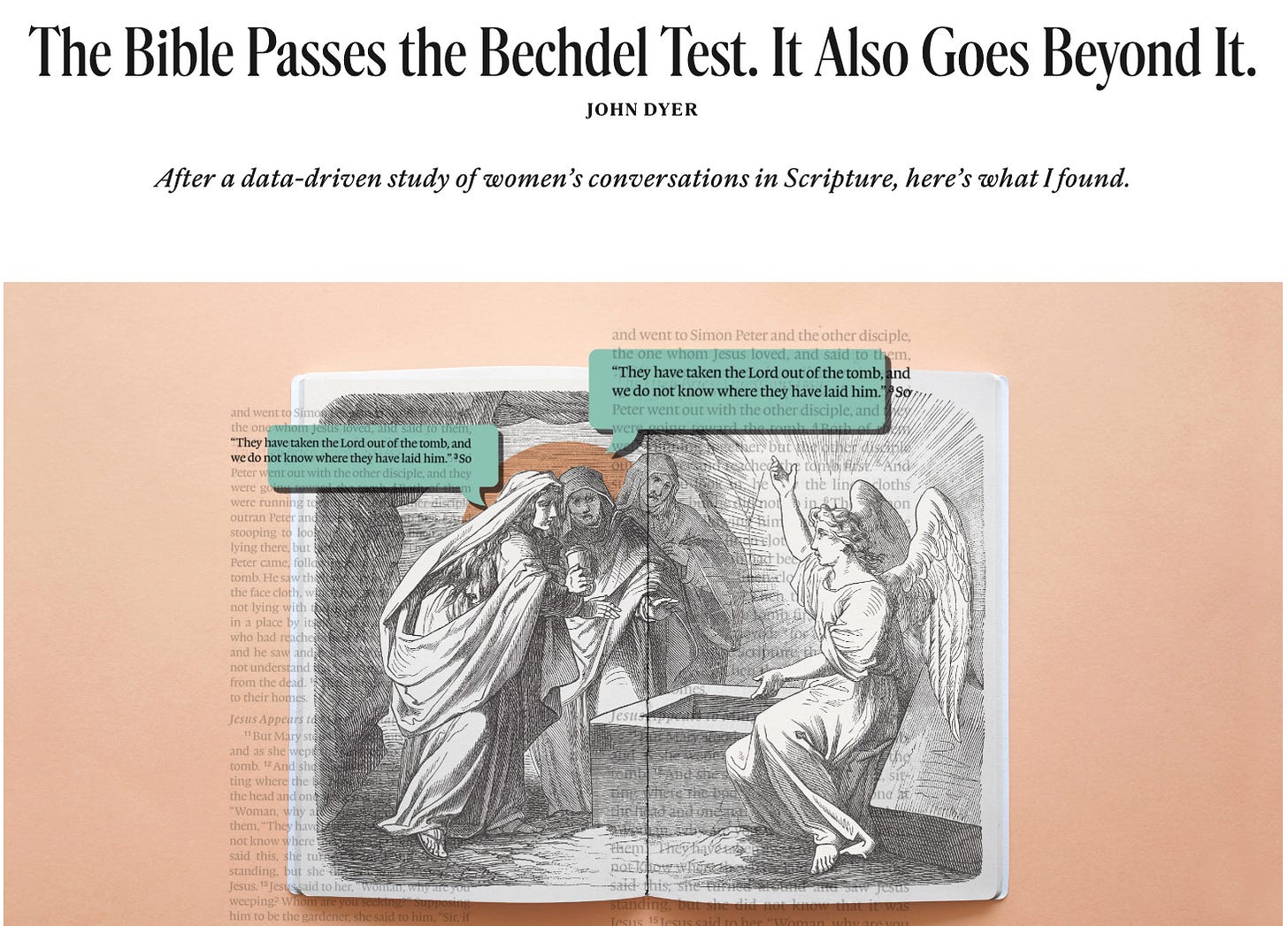
Six years ago, my colleague, John Dyer, wrote an article for Christianity Today titled, “The Bible Passes the Bechdel Test. It Also Goes Beyond It.” John, a genius when it comes to crunching data, did a data-driven study of women’s conversations in Scripture and how they rated according to the Bechdel test. The test measures the representation of women in movies and books “based on a comic by Alison Bechdel that suggests a work must contain a scene that meets three specific criteria: (1) at least two named women who (2) talk to each other (3) about something other than a man.” Dyer added the written word as a medium and ran the numbers, motivated by a tweet in which someone asked whether the Bible would even pass such a test. The article title tells you what he found.
The topic of women’s representation in Scripture comes up in part because often women in the biblical text remain nameless and even silent. Consequently, some readers assume the narrator is a misogynist. An example of such a story is the one at the end of the book of Judges (ch. 19–21), where we find the story about “The Levite’s Concubine.” In that narrative multiple men sexually abuse a woman all night and leave her to die. Her common-law husband cuts her into twelve pieces and sends her body parts to the twelve tribes of Israel to shock them into seeing their own depravity. The text does not quote her or even give readers the woman’s name.
Some interpreters have seen this woman’s lack of identification as evidence of the biblical narrator’s misogyny. Helen Paynter, in Telling Terror in Judges 19 (2022), assigns this unnamed woman a name — “Beli-Fachad,” meaning “Fearless One” — as a direct, corrective response to the text’s refusal to name her. Paynter explicitly frames the narrator’s “refusal” as part of the story’s violence against her.
But there’s a more charitable way to read this story. What if the narrator is using this woman’s “erasure” as a literary device to indict those who contributed to her silencing—the men? The storyteller writes in such a way that the original audience will see how far Israel has fallen. God’s people are the ones who have silenced this woman, not God. And nothing in the text suggests the narrator is cheering.
We would do a better job of noticing and interpreting narratives about women of the Bible if we focused more attention on the narrator’s storytelling devices. In assuming a narrator who privileges men while ignoring women in the Judges story, we miss the narrator’s subtle arguments against misogyny. We should be asking, “What purpose does women’s silence and/or namelessness serve in this text?”
Telling the story as men’s history. For much of my Bible education, I learned the men’s stories in the Bible first—Adam, Abraham, Joseph, David, Daniel, Jesus, Paul. Only later did I learn the stories of women like Esther, Ruth, and Mary Magdalene. I never did learn about Noa or Shiphrah. Even by the time I had earned a bachelor’s degree in Bible and a Master of Theology degree, I had never studied the daughters of Zelophehad nor heard a sermon on Tamar, Judah’s daughter-in-law—though Tamar is essential to Judah’s about-face. That’s because commentators and Bible teachers have often treated the Genesis “Tamar story” as a detour from the Joseph narrative. Yet Judah is the son through whom Messiah will come. It’s Judah’s actions we need to keep our eyes on.
In Exodus, we have tended to rush past the heroic midwives, and even the unnamed sister, mother, and princess to get straight to the burning bush—missing that God has been at work to save Israel long before he calls Moses. A heading in my Bible reads, “The Birth of Moses.” Yet mention of that birth takes up only one line, and the baby himself remains unnamed. Meanwhile, five women have already saved Israel through their subversive actions. Even God does not get named or quoted in this part of the story. That should tell us the narrator is up to something. Why assume the Bible’s silences are deliberate erasure?
Telling the stories of women as cameos. Another flawed approach to storytelling that affects how we encounter women in the Bible is in treating them as select characters starring in sidebars rather than as integral to the narrative. New Testament scholar Holly Carey notes that studies of Bible women often address their subjects “individually, in relative isolation from each other,” missing how the characters’ actions function in the larger story.
By going back to fill in what we missed about women of the Bible, we often see the errors of treating Esther as the star of a romance, Bathsheba as a seductress, Mary Magdalene as a harlot, and the woman at the well as morally compromised. None of these interpretations represents these women accurately.
Vilifying the women we do include. Although women are in the minority if we simply look at the male/female ratio of named characters, readers who do notice them often vilify them. Speakers say the women in Matthew’s genealogy of Jesus serve as proof that God forgives sinners—as if Matthew needs to add the women when he already has Abraham (who compromised Sarah’s safety); David (who violated Bathsheba and had Uriah killed); and Solomon (with 700 wives and 300 concubines). The three alone could easily make the same point. Matthew doesn’t need to add Tamar, Rahab, Bathsheba, or Ruth to prove God forgives sinners.
When we make “women sinning,” especially women’s sexual sin, the focus of the Gospel-writer’s list, we miss the ingrafting of women of faith into Jesus’s line; we miss seeing Christ as the king of both Jew and Gentile; and we miss how God has regard for the outsider—a key theme in Matthew’s Gospel.
Other flawed approaches include blaming the Fall on Eve as a prototype of all women, seeing women as both easily deceived and expert at deceiving; assuming the Bible’s patriarchal backdrop is God’s own perspective rather than evidence of God working through imperfect systems; or even assuming women are mostly models of the domestic ideal while men get “boys will be boys” latitude. The biblical record shows both men and women as capable of first-class sin as well as the fruit of the Spirit. Neither sex has a monopoly on sin or righteousness.
Behind all these approaches is a tendency to fragment Scripture into a book of quotes or vignettes rather than seeing the grand narrative of creation, fall, redemption, and restoration that unfolds through a people, through a story in which women play essential roles. But how can we do that?
Recognize the backdrop—not the ideal—as patriarchy. Both Testaments unfold in patriarchal worlds, so we should pay special attention when women appear in unexpected places. When I was in high school, girls were told our bodies weren’t made for sports; then Title IX changed the rules, and today women excel at professional soccer. Cultural absence was never proof of inability. So too in Scripture notice how remarkable it is when Jael does what an entire army can’t do—take down a general. Notice when Esther, one of the least powerful people in the empire, saves her people. Notice when Paul names ten female ministry partners in his letter to the Romans. And notice when Moses’s own account of the exodus opens with five women—Shiphrah, Puah, his mother, his sister, and Pharaoh’s daughter—saving his life, and ultimately Israel, decades before he hears the voice of God in a burning bush.
Embrace all the stories as written for all of us. Why segregate texts according to male/female characters and audiences? There are no texts in Scripture written for women only or men only. Occasionally, we find commands that are sex-specific or role specific, but even these are instructive for us all. A passage addressed to slaves teaches all of us, though I’m not a slave; a passage addressed to husbands still instructs all of us, though I’ll never be a husband. We wouldn’t refer to the books of Daniel or Ezekiel as “men’s stories.” The cloud of witnesses in Hebrews 11 includes men and women together. The biblical stories of men and women are for both men and women.
Pay attention to how narrative works. Knowing the simple building blocks of “story” can serve as a corrective that helps us interpret more faithfully. In the account of Abigail and David (1 Sam 25), her husband’s name sounds like the Hebrew word for “fool,” while Abigail is called intelligent and beautiful. The narrator provides not-so-subtle clues as to how readers should view each of them. Factor in setting, character, and plot as part of the grand narrative of God. This means encountering the Bible in larger sections than vignettes to get a sense of the whole.
If we see that a woman’s place is in the story, that woman is essential to the biblical narrative, we will view the Scriptures less as isolated episodes and more like what we gain by binge-watching an entire series. The story just before John’s account of the woman at the well who meets Jesus at noon recounts how Nicodemus, a high-status insider, comes to Jesus at night. The Samaritan woman asks sharp spiritual questions, hears Jesus reveal himself as the “I AM,” and leaves to tell her village about him. Read her story alone and we lose the contrast John is drawing between night and day, insider and outsider.
Partly because most hero stories feature men, we might get the impression that God likes men better than women. But God’s own image is male and female. The biblical narrators live in worlds where men have historically held more social power, in places where women are more likely to experience erasure. But that does not mean God approves of such cultural backdrops. Consider how the Gospel writers repeatedly show male disciples faltering while female disciples appear more faithful, and not because women are inherently more spiritual. Rather, the narrator often has a different agenda from what we might expect. Frequently, readers will see an emphasis on how the spiritual outsider often “gets it” more than the insider does. And those outsiders are frequently women.
How do we benefit when we see women in the bigger picture? We improve our interpretation skills. But we do far more than that! We expand the limits of a Bechdel grid to include a woman naming God. And women talking with angels. And how about this one? God himself inhabits a virgin’s womb, formed, nourished, and carried within a woman’s body.

Glahn serves as professor of media arts and worship at Dallas Theological Seminary, where her emphases are first-century backgrounds related to women, culture, gender, and the arts. She has authored or edited more than twenty books, including Nobody’s Mother, Vindicating the Vixens, and Sexual Intimacy in Marriage (coauthor).
Here is my endorsement for her latest, A Woman’s Place Is in the Story.
“Some have said women should be seen and not heard; others think women shouldn’t be seen or heard. But Scripture includes and affirms the presence, voices, and actions of numerous women. Sandra Glahn proves herself a master teacher by highlighting some of the many ways in which women are not just present in the Bible but, in fact, play crucial roles in the grand story of the gospel. You will not just learn about the women of the Bible; you will also learn how to read the Bible well.”
Glahn also has a podcast called The Chick Report.
Here is a recent episode.
Definitely check out Glahn’s new book!
Comments
Nothing yet. Say the first thing.
Sign in to join the conversation.