
Hey friends! We are back after a summer hiatus.
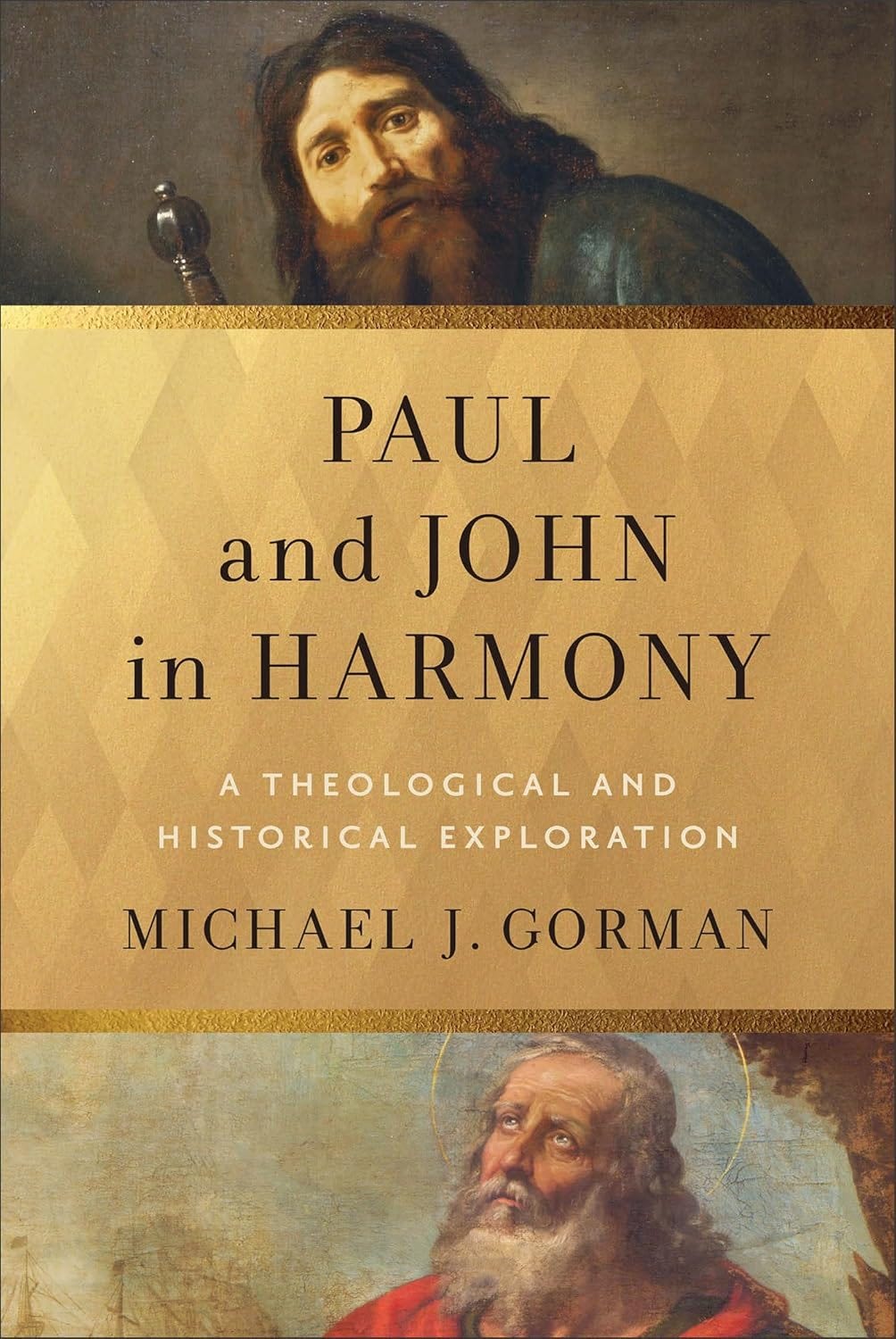
Recap: We are in a 6-week review series talking through Dr. Michael Gorman’s latest book, PAUL AND JOHN IN HARMONY: A THEOLOGICAL AND HISTORICAL EXPLORATION. My chapter summaries are available to everyone for free, but my critical analysis is for paid subscribers.
Part 1 covers chapter ch1 (Click HERE).
Part 2 covers ch 2 (HERE)
Part 3 covers ch3 (HERE)
Paul and John in Harmony is a comparative theological study looking at these two figures in relationship in the New Testament. Chapter 2 offered a deep dive into comparing two texts: John’s Footwashing narrative (John 13) and Paul’s Philippians Christ Hymn (Phil 2). In Chapter 3, Gorman steps back to do a more thematic comparison between John and Paul on Christology and spirituality by looking at indwelling language in both writers.
Today we are looking at chapter 4 where Gorman explore how both texts describe the relationship (or “spirituality”) that arises from being in Christ. Gorman looks at four themes: mutual indwelling, essential identity , Trinitarian character, and transformational dynamic.
Mutual Indwelling. Gorman grounds this theme in the OT covenant where God commits himself to being with his people (in spite of their sinfulness) and to be their God and they his people (Lev 26:11-12). When it comes to John, the key text of focus is John 15 and Christ abiding in his disciples. As the branches abide in the vine, they can be fruitful, producing good things (John 15:4-5). Gorman also looks as mutuality in 1 John with a focus on the language of abiding (esp. 1 John chs. 2-4). Gorman offers an excursus on Richard Bauckham’s argument that John’s conception of mutuality is not cleanly comparable with Paul’s. For example, Paul tends to focus on being “in Christ” (in a unidirectional indwelling), but John’s idea of mutuality is more reciprocal and mutual. Gorman provides evidence that shows Paul’s interest in mutuality, even if it is not as pervasive as it is in John (see, e.g., Galatians 1-2; 4:19; 5:6).
Essential Identity. Here Gorman argues that both John and Paul see abiding or being-in-Christ as the central identity of the disciple or believer. Gorman compares, for example, John’s vine-branch image to Paul’s body-of-Christ image: “the community’s essential identity.”
Trinitarian Character. John 17 indicates how the mutual abiding of Father and Son is the ground for the Son’s mutuality with his disciples. Gorman looks to John 14 for the inclusion of the Spirit who will be with them forever (14:16). So: “Abiding in Jesus means abiding also in the Father and the Spirit, which means in the Triune God.”
Likewise, in Paul, Gorman turns to texts like Romans 8 to show that the people of God are “in the Spirit” in Christ. There is a lot of material in Paul to discuss, and Gorman covers a lot of ground. Here is the upshot: “Life in Jesus the Messiah is life in the Triune God.”
Active and Transformational Character. Finally, Gorman looks at the end result of being in Christ in John and Paul. John focuses on bearing fruit and obeying the commandments. There is a strong emphasis in John and 1 John on love as the demonstration and outworking of belief and abiding.
For Paul, being in Christ will naturally lead to living in holiness, truth, and love; Gorman notes Christlike and Spirit-filled outworkings like hospitality, endurance in suffering, courage, and obedience. And, of course, Paul has his own interest in bearing fruit (i.e., the Fruit of the Spirit, Gal 5:22-23).
Pulling the various threads together, Gorman argues that both John and Paul are interested in not only the relational aspects of being in Christ or mutual indwelling, but also the formative character of this life with God (“missional theosis,” he calls it).
I have a few thoughts to share.
Comments
Nothing yet. Say the first thing.
Sign in to join the conversation.