
Exactly fifty years ago this July 4, I boarded a plane for my first trip to Japan!
On July 3, I wrote in my diary:
Well, I’m going to be flying out of Honolulu on “our nation’s” 200th anniversary, which is appropriate, I guess. Just as soon miss all those fireworks. The Honolulu Star-Advertiser ran a huge 2-line red and blue headline today, something about “Hawaiians celebrate America’s 200th birthday.” A 15-year-old girl jumped out of an 8th floor Waikiki hotel window this morning at 8 am, but she fell into a tree which broke her fall, so she walked away.
No idea what those quotes around “our nation’s” were supposed to mean. And it would seem I had already developed an eye for the incongruous.
The day that I arrived, I wrote:
Japan! Tokyo! Arriving in Japan was a fantastic kaleidoscope of impressions. Imagine a machine for buying monorail tickets whose entire face is covered with kanji. On taxi-drivers who don’t know where you’re going, with no way to look it up in the phone book. Mile after mile of gray industrial districts, with sad canals and rusty machinery. Office districts that look like shapes out of the 50’s. Tiny cars whizzing by on the left-hand side of roads decorated with huge kanji. Masses of black-haired Japanese packed into trains. A huge Japanese palace, surrounded by a moat, whose white walls went right up to the moat’s walls and were a continuation of them. Cozy houses and restaurants in a friendly area that almost seems to make up a town within a town. A taxi-driver who runs down the street half a block to ask someone where your destination is. A bustling, elegant Japanese restaurant where you kneel/sit on the floor.
I had taken the monorail from Haneda to Hamamatsucho, then a cab to the Go center where I would be staying. In the lobby, I met some friends who were watching sumo. I think it was the first day of the basho and the beginning of a life-long fascination with sumo. The stars of the tournament were Wajima and Kitanoumi. And of course Takamiyama was competing too.
I was committed to learning Japanese, even though I wasn’t sure how long I was going to be there:
I’m going to begin working even harder on Japanese. I’d like to spend two or three hours a day on it, including one with a native tutor. The alphabets are an immediate priority, but I can’t wait on kanji either. They are a basic necessity for everything from riding the subway to eating, unless you want to make yourself dependant on a Japanese guide or the random, truly rare English speakers you encounter. I insist on being able to read Japanese go books before I leave Japan.
Three months later, in October:
I’m learning a lot of words, and am getting reasonably proficient at reading the Kana and what Kanji I know, but comprehension still escapes me by and large. As for speaking, I can usually mumble some words to get my meaning across, especially in standard public situations, but nothing too impressive. I wish I remembered more about my progress in German, so I could compare. I think it was a little bit faster. Being able to read the alphabet was a big help. I’m studying the Jordan book for everyday conversation, and Naganuma for reading. I find, interestingly enough, that my progress in learning kanji from street signs and inferences and asking friends is faster than that from studying the book. Still, using the books firms up my knowledge, gives me practice in writing, and teaches me new readings. I’m also using a Japanese 1st grade book, which is mostly good for reviewing kanji, learning vocabulary, and reading kana more quickly. I’d say I know around 300 kanji. I can predict, I think, that in a year I’ll know the Tōyō kanji, and be able to read, speak and comprehend so that no problems arise. But reading Seward’s book has made me even more aware of the difficulty of achieving real fluency.
The following month:
November! Tokyo is starting to cool down. The days are bright, clear, chilly, characteristic autumn days. I’m reminded of the change of the seasons, of autumn days on the Zürichsee, of snow-covered days alone working in Albany, sitting on a bench in the fall on the Charles. I realize there’s something about autumn and winter I dislike, but at the same time something I like very much—its simplicity, its firmness, its briskness. The falling away of summer luxuriousness and over-fertility.
Later that month, on the 29th:
A most unusual thing is happening now while I’m studying Japanese. It’s an indescribable feeling of the language penetrating down to the roots of my brain, and some connection being made there. In fact, a number of things are happening which show the quantitative advances I’ve made are metamorphizing into a qualitative change. For instance, people will tell me prices and I’ll pay them without thinking about how much it is in English. Some simple patterns are becoming second nature to me. If I listen, I can understand whole phrases. I’m also learning all the abstract words which are so important, especially for talking about the kinds of things I like to talk about.
In general, I feel like my first lap around the Japanese language has been completed. My view is basically complete, although with many tattered edges and holes. In other words, I know “where to put” the things I don’t know.
Now, if I could only bottle that “penetrating down to the roots of my brain” thing and sell it.
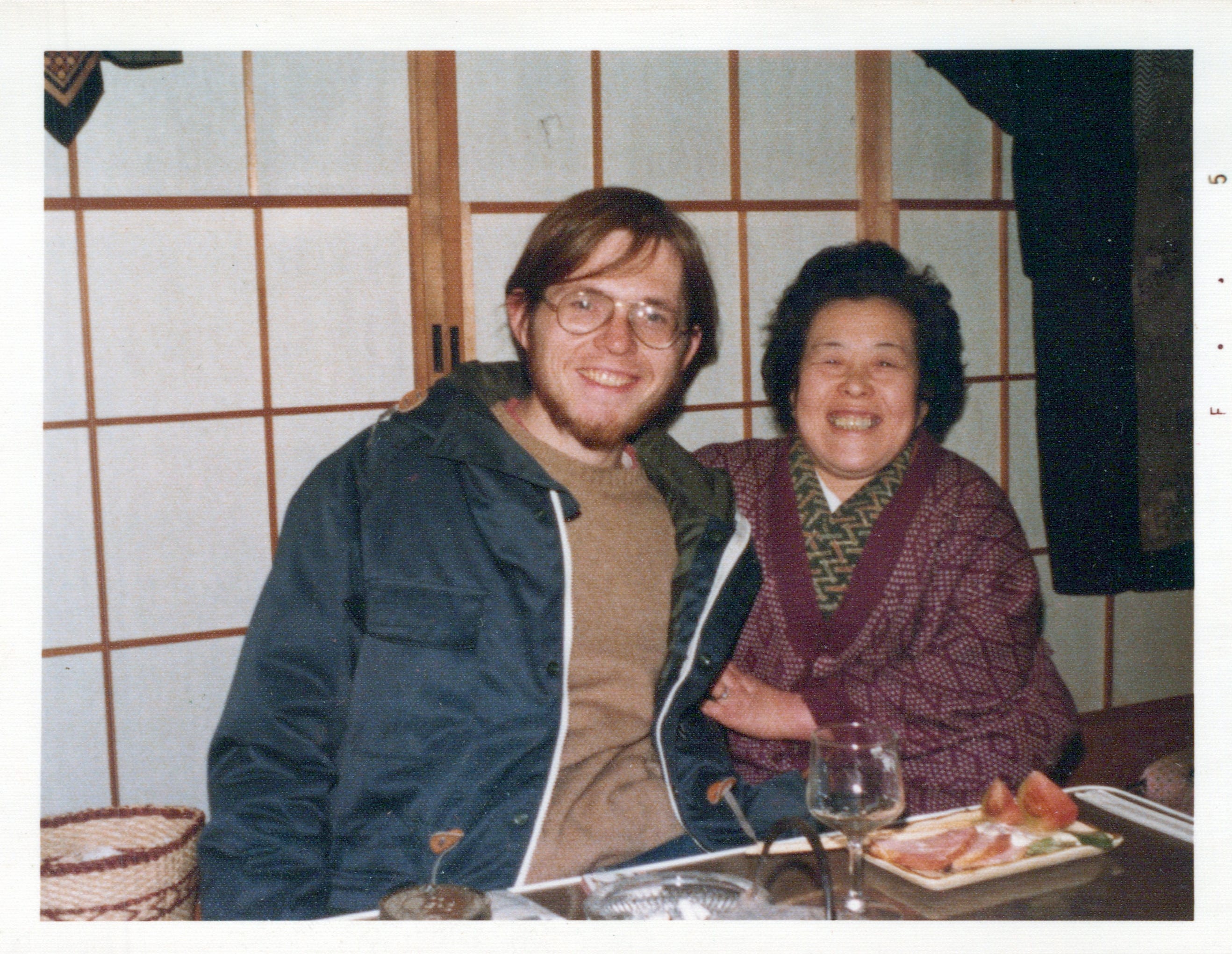
I wish I had recorded more about my study and my progress. Like the hours I spent at the 座卓 in my little six-mat room on the second floor at the Hashiras place in Setagaya-ku.
Or writing kanji over and over again in notebooks.
·
March 3, 2025
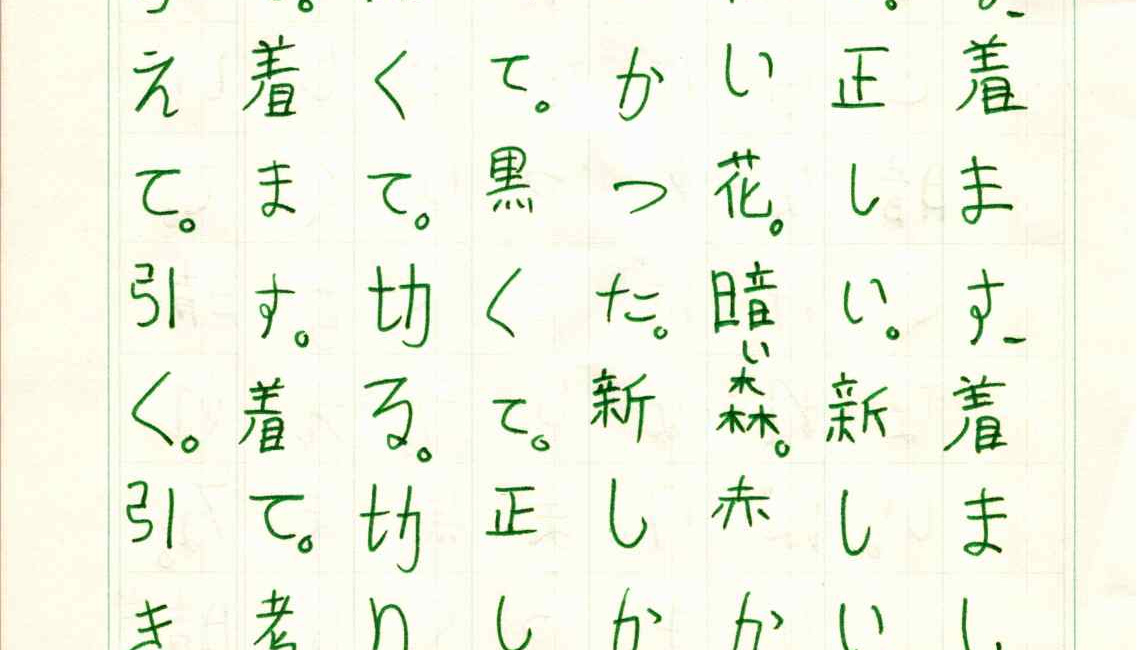
I started studying Japanese about fifty years ago. Whew! One of my techniques was transcribing Japanese words and sentences.
On January 22, half a year after arriving:
Concerning Japanese, I feel like I’m making good progress.
I had distilled my German experience down into the formula “I studied German for a year and learned to speak it fluently,” forgetting what a lot of work was involved. Objectively speaking, I would say Japanese is twice as hard as German, meaning that it will be another six months before I reach a point of fluency in reading and writing, whereas I reached that point in 6 months with German.
With Japanese, it’s hard to learn words, especially abstract words, without knowing how they’re written, or at least it’s so much easier learning them if you know how they’re written that it’s not worth bothering if you don’t, and kanji can be learned at a limited rate, around 10 to 15 a day, according to my experience, so for the cycle of reading the paper — listening to TV, with an emphasis on politics and economics, to close, will still take another three or four months. This was the cycle that rapidly accelerated my German progress.
The best thing I’ve come across so far is a book written for 4th graders on “国語.” It gives me a good oversight of the language, teaches me grammatical terms, resolves questions and ambiguities which are evidently troubling the school child as well as the foreigner, and provides a framework for learning kanjin.
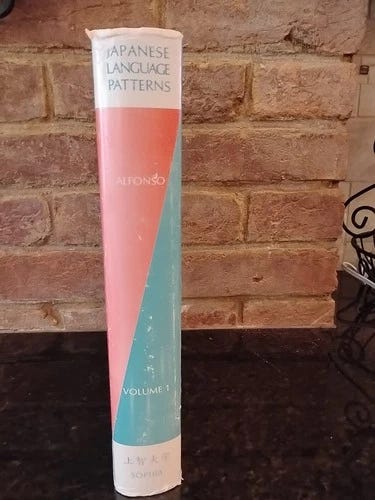
I’m also working in Japanese Language Patterns, and I’m just getting to the point now where it departs from all the other texts. For foreigners learning the language at an advanced age, it’s important to learn patterns explicitly—implicit learning may simply never take place—and this book is the only one which teaches some of the advanced patterns.
Besides the basic question of “Why am I bothering?” there are no problems with my Japanese study. The other day I was sitting under my kotatsu, looking at my truly impressive collection of dictionaries, books, courses, reading material—and I could feel my attitude of 6 months ago, where Japanese was nothing more than a word.
In retrospect, I was being immensely optimistic about my potential progress given even the most conservative possible definition of “fluency”.
It is an ironclad rule that all aspiring Japanese learners must write haiku. In April, I was already writing some extraordinarily bad haiku, inspired by some girl I had met (later my wife).
春ってさ Harutte sa
花が咲いてる Hana ga saiteru
春じゃない? Haru ja nai?
At least I got the 5-7-5 right. This was inspired by her comment that she wished it was spring. Translation will be left as an exercise for the reader.
In another entry, I wondered whether the word kara might be composed of the interrogative particle ka and the conditional ending ra. (It’s not, although kara is a very interesting word to study. Stay tuned). Shades of my future Nihongoism self!
I used to study until late into the night. This was an entry on June 2, 1977.
4:30 am. The sky is getting light. The birds, chirping. A neighbor opened the shutter. A very strange green bug is crawling on the books on my kotatsu.
Unfortunately, during my next couple of stays in Japan I was not keeping journals—too busy, you know—so I have nothing else to share about my further learning process other that what I can pull out of that dusty basement I call a brain.
Consider this a modest contribution to a shared dialog among Japanese language learners about how they studied and learned.
Comments
Nothing yet. Say the first thing.
Sign in to join the conversation.