

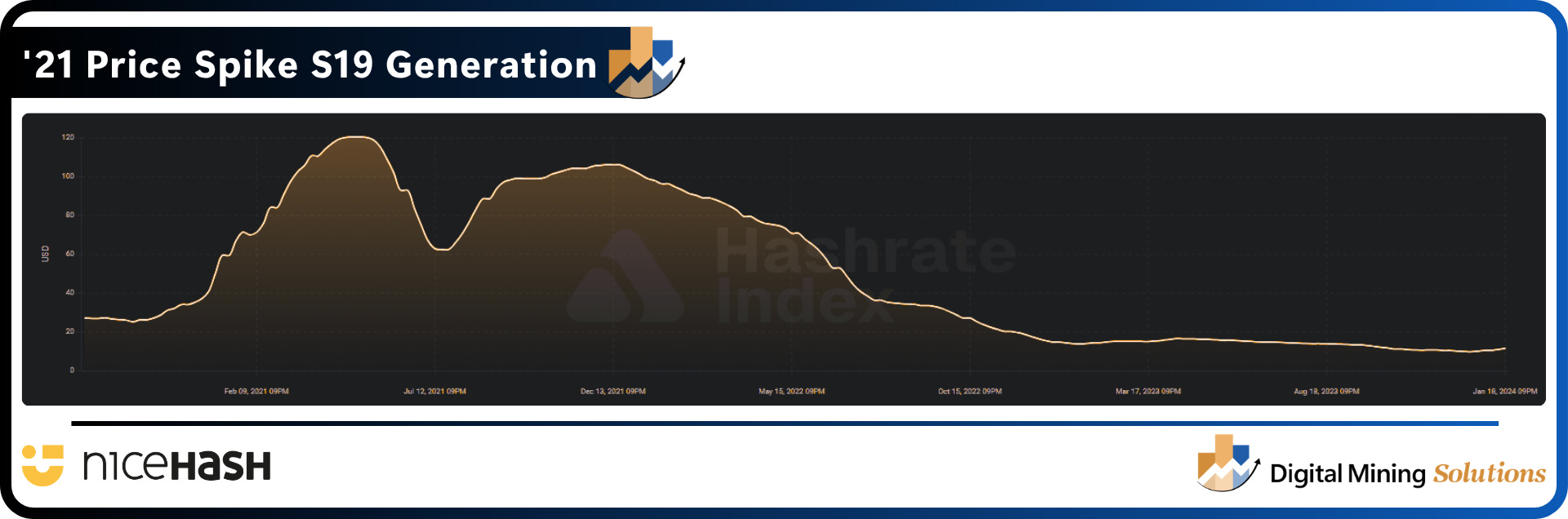
In November 2021, an Antminer S19j Pro changed hands for more than $12,000. Publicly listed miners were trading at multiples that implied near-infinite hashrate growth. Every operator was racing to energize ASICs sitting in warehouses because there was nowhere to plug them in. Then the price broke, margins collapsed, and the machine was worth $600 by the summer of 2024. Fast forward to 2023: an NVIDIA H100 hit $40,000 on secondary markets. NVIDIA’s supply chain was a bottleneck. CoreWeave was valued at $19 billion before it had a single public quarter. A hundred AI infrastructure announcements landed per week. And across the US, a 3-to-7 year grid interconnection queue was building up behind more than 54 GW of requested load that had nowhere to connect. The asset class changed. The cycle did not.
The Stocks Ran First
When Hardware Becomes a Lottery Ticket
Nowhere to Plug It In
The Pivot Trade
Where the Analogy Breaks Down and Why That Matters More 🔒- Premium Insights
What Operators and Allocators Should Do Now 🔒- Premium Insights
FBOX’s 10MW modular data center solution is designed for rapid, turnkey deployment with prefabricated cooling, power, and IT modules. With major subsystems pre-tested before shipment, FBOX helps operators reduce on-site complexity, accelerate infrastructure rollout, and achieve faster time-to-compute in high-density AI environments.
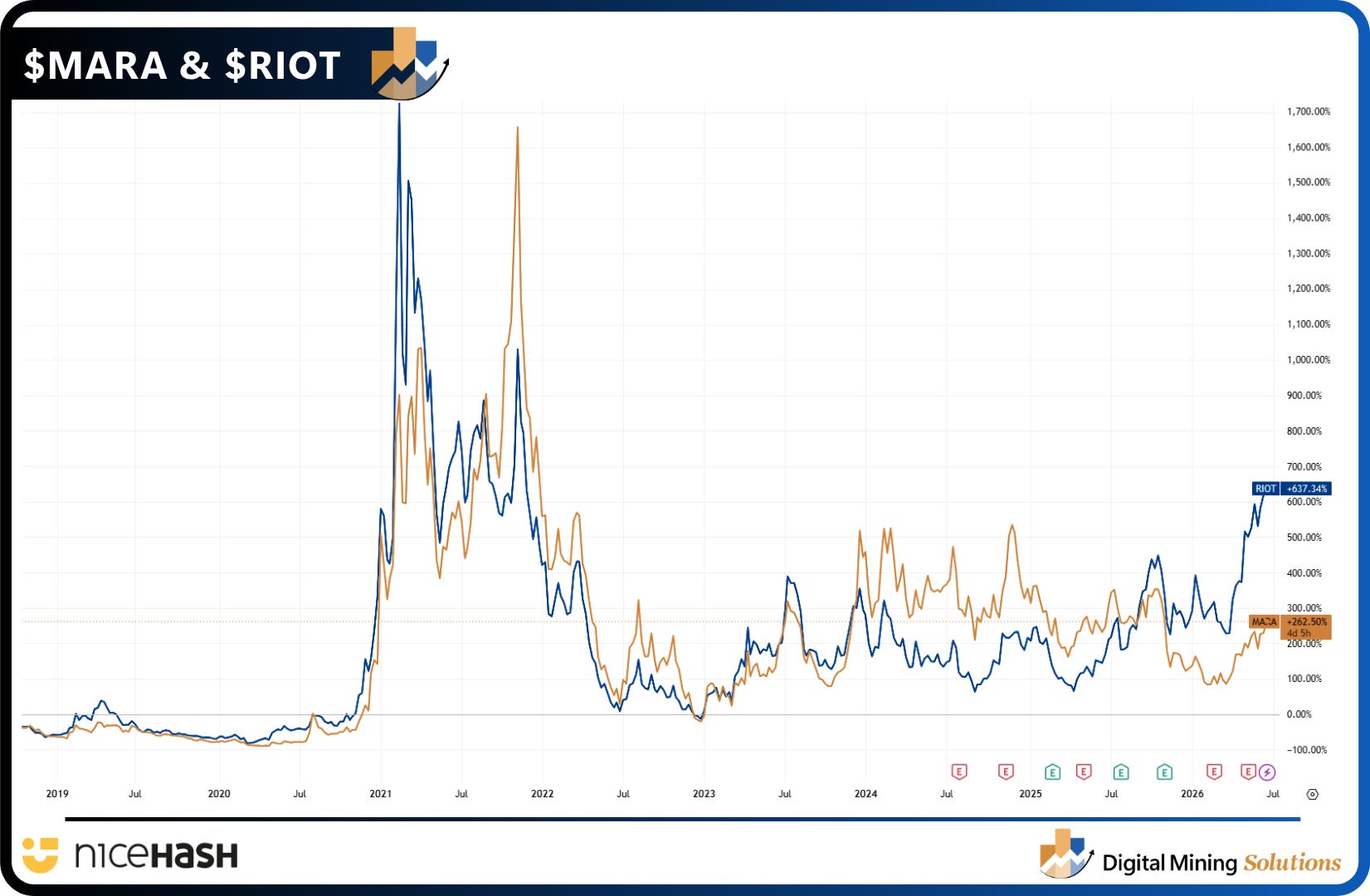
In both cycles, the equity markets moved before the infrastructure did. MARA’s stock rose more than 10x between early 2020 and early 2021. Riot’s followed a similar trajectory. Investors were pricing in hashrate capacity that hadn’t been deployed.
The same dynamic played out in AI infrastructure. CoreWeave went from a crypto mining company (originally Atlantic Crypto, mining Ethereum with GPUs) to a $19 billion AI cloud platform by mid-2024, before its IPO. Applied Digital jumped 17% on a single lease announcement. TeraWulf jumped 13% after announcing a 1 gigawatt hyperscale development site in Kentucky capacity that won’t come online until 2028. IREN added another 13% on a $3 billion capital raise announcement, even as the company was still in the early stages of converting mining capacity to GPU infrastructure. The market was pricing future capacity, not operating revenue.
In both cases, the initial stock price dynamics reflected a bet on future capacity, not earnings. That’s not irrational as infrastructure is a long-duration asset and the market prices the queue, not the queue’s contents.
ASIC prices in 2021 behaved like a leveraged bet on the Bitcoin price. The S19 series went from below $3,000 in late 2020 to more than $12,000 at the peak in November 2021, a 4x move in under 12 months. Bitmain’s Antminers were sold out through August 2021. TSMC wafers were the binding constraint. Secondary market brokers ran grey-market premiums. If you didn’t have a direct manufacturer allocation, you were buying from someone who did.
The H100 ran the same script. Supply constraints in 2023 pushed SXM5 units to $35,000–$45,000 on secondary markets. TSMC’s CoWoS packaging capacity was the bottleneck, the same foundry supply chain logic that constrained ASIC manufacturing years earlier, just one node up the stack. Neoclouds that secured early NVIDIA allocations built durable margin advantages not from software moats, but from hardware queue position.
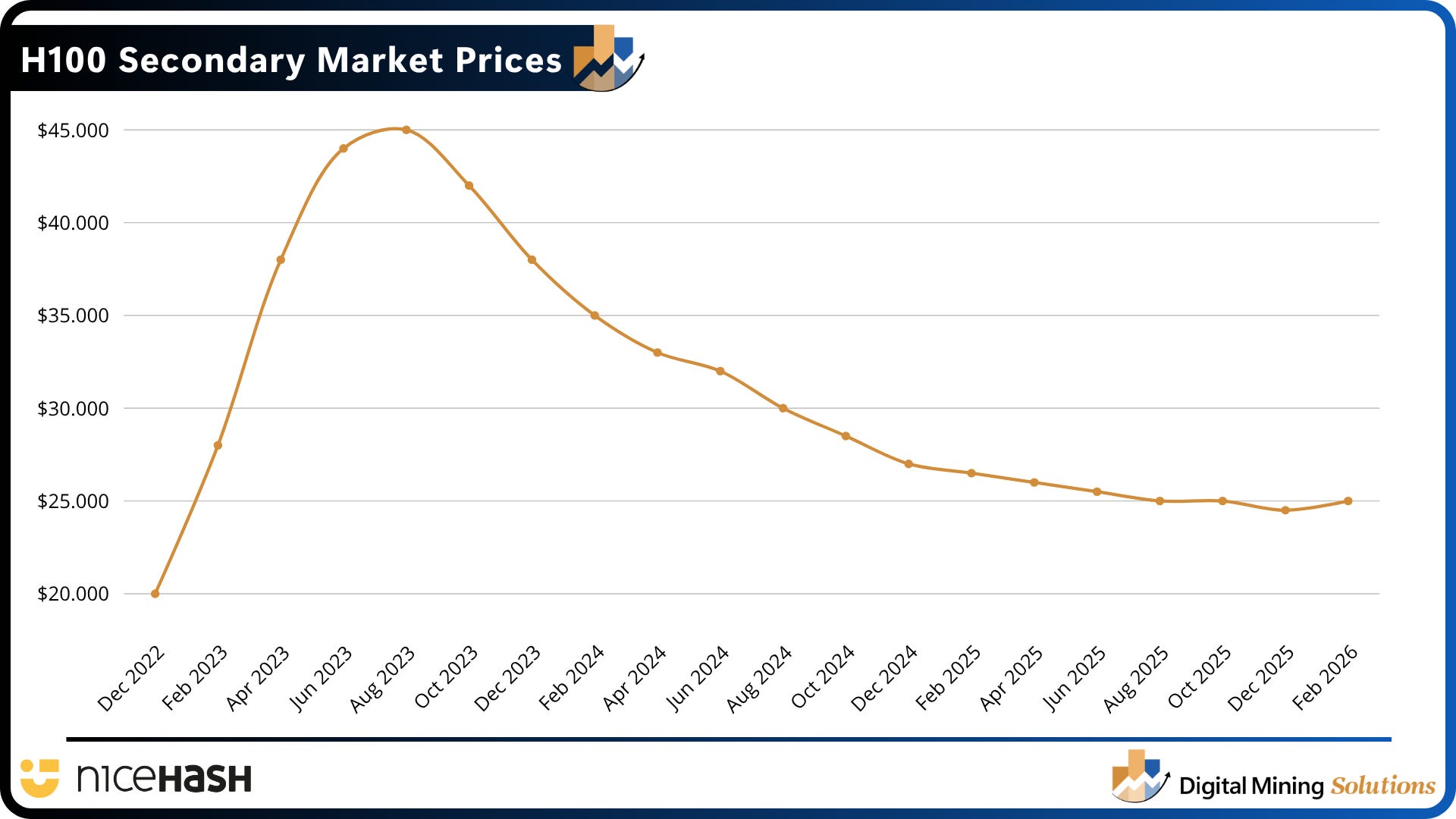
Both cycles created the same short-lived arbitrage: own the hardware before the market does, and you print margin. In mining, the operators who bought S19s at $4,000 and deployed them at $12,000 hashprice environments captured the full upside. In AI, the companies that locked in H100 allocations before the generative AI demand wave are sitting on the same type of positional advantage, until rental rates started compressing.
The correction in hardware prices in both cases was the driven by the same mechanism. Supply caught up with demand, the margin on the hardware normalized, and the next hardware generation (S21 Pro, Blackwell B200) reset the efficiency baseline. Operators caught holding older machines at peak prices took the write-down.
By early 2022, public miners were disclosing tens of thousands of ASICs sitting in warehouses. MARA had over 51,000 S19s waiting for deployment, representing roughly $449 million in hardware earning zero revenue. The constraint wasn’t the machine. It was the rack, the power, and the substation. Infrastructure buildout couldn’t keep pace with hardware procurement.
The AI data center cycle hit the same wall, harder and faster. Grid interconnection timelines in the US stretched to 5–7 years in the most congested regions. PJM data shows that projects entering service in 2025 took an average of more than seven years to reach operational status. Of 110 data center projects slated for 2025, more than a quarter were delayed due to power, permitting, and construction constraints, according to Bessemer Venture Partners research. Transformer lead times stretched to five years in some cases, up from roughly one year pre-COVID.
The Deloitte 2025 AI Infrastructure Survey of 120 US power company and data center executives found grid stress was the leading challenge for data center development, above capital costs, above talent, above hardware availability.
The binding constraint in both cycles was never the compute hardware. It was the ground under it, the wire connecting it to the grid, and the transformer stepping down the voltage. Operators who controlled energized, connected sites before the demand wave arrived held the most defensible position in the market in 2021, and again in 2025.
When the Bitcoin mining margin compressed in 2022–23, the operators who survived were the ones who owned infrastructure, not just machines. The ASIC was a consumable. The site, the power contract, and the grid connection were the asset. Some of those operators began looking at what else could run on their megawatts.
By 2025–26, that pivot had become structural. Core Scientific secured a $10.2 billion, 12-year agreement with CoreWeave, sold approximately $175 million in Bitcoin to fund the conversion, and reported AI colocation revenue at 39% of total sales. TeraWulf signed HPC contracts totalling $12.8 billion and hit 522 critical IT megawatts under contract. IREN locked a $9.7 billion Microsoft deal for 76,000 NVIDIA GB300 GPUs across 200 MW at its Texas campus. S&P Global projects that IREN, Core Scientific, and TeraWulf will each derive approximately 70–71% of total revenue from HPC/AI by end of 2026.
The companies that executed this trade successfully had one thing in common: they controlled permitted, energized, grid-connected sites in locations where new power was years away. The hardware pivot was secondary. CoreWeave’s attempted $1 billion acquisition of Core Scientific in mid-2024 made the thesis explicit. The hyperscalers weren’t buying the ASICs. They were buying the megawatts and the interconnection rights.
This is the same lesson the 2021 mining cycle taught, just denominated differently. The infrastructure is the moat. The compute sitting on top of it is replaceable.
🔒 The next section is for premium subscribers. The analysis above is free. What follows goes deeper: specific positioning frameworks for site owners, capital allocators, and operators deciding whether to hold, convert, or sell infrastructure into the AI demand cycle.
The difference between a well-structured infrastructure investment and a poorly executed one isn’t the thesis. It’s the underwriting, the deal structure, and the people running the project.
Digital Mining Solutions advises investors and capital allocators deploying $5M–$100M into energy-backed digital infrastructure: Bitcoin mining, AI compute, and hybrid energy assets. We cover the full lifecycle: evaluating opportunities before the term sheet, structuring deals that protect the downside, and staying engaged through deployment and operations to make sure capital performs as modelled.
We bring what most investors in this space lack: real operator relationships, a clear framework for underwriting infrastructure economics, and the credibility to sit across the table from developers and vendors on your behalf. Ready to deploy with confidence?
Leverage data-driven insights and a powerful network to launch strong, optimize efficiently, and scale with confidence. We offer:
Market Intelligence - Masterclasses, Tailored Reports & Articles and Industry Benchmarks.
Advisory Services - Business Plan Assessment, Investor Presentations, M&A Advisory and Executive Coaching.
Sites & Rackspace - Due Diligence & Partnership Matchmaking, Institutional Investment Guidance and Rackspace Sales
Elevate your mining operation today with Digital Mining Solutions!
If you enjoy the content, if you have not subscribed, please ensure to click the button below and share The Bitcoin Mining Block Post.
If you want to stay ahead in the world of Bitcoin mining, make sure to follow me on Twitter and LinkedIn. Would you like to become a sponsor of the newsletter or are you interested in a workshop on mining economics? Contact me at nicosmid@digitalminingsolutions.tech.
Comments
Nothing yet. Say the first thing.
Sign in to join the conversation.