

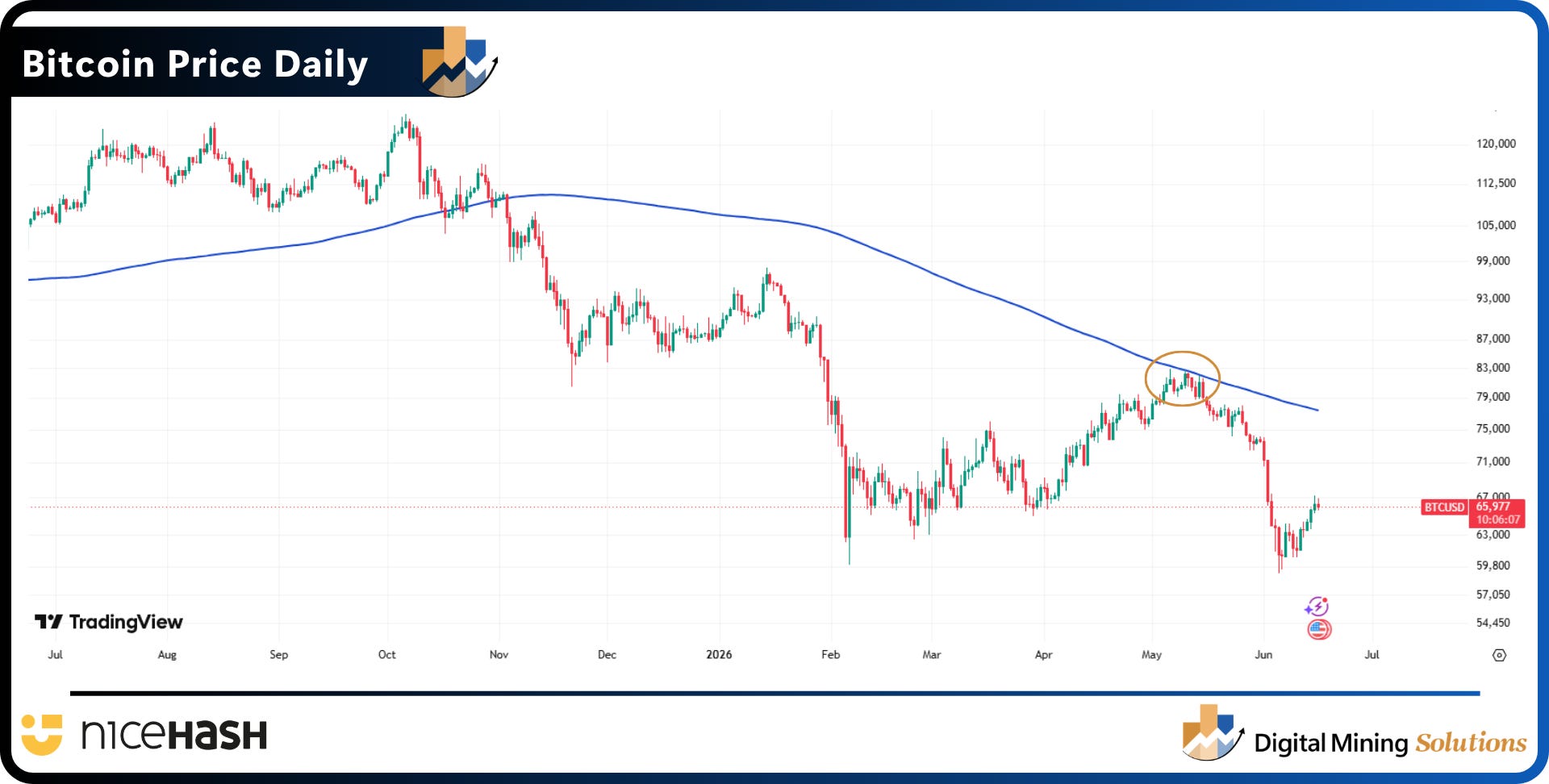
Bitcoin dropped over 26% in under a month, flushed from $82,000 to a low near $60,000 before recovering to around $67,000. In the same window, US spot ETFs bled $5.1 billion across 19 consecutive days of net outflows, hashprice set a new all-time low of $27.75/PH/day, and the hash ribbons inverted, a signal that has preceded every significant bottom in Bitcoin’s history. Liquidity in the broader market is abundant. A $75 billion IPO proved that this week. The bid just isn’t in Bitcoin right now.
How $82,000 Became the Wall Twice
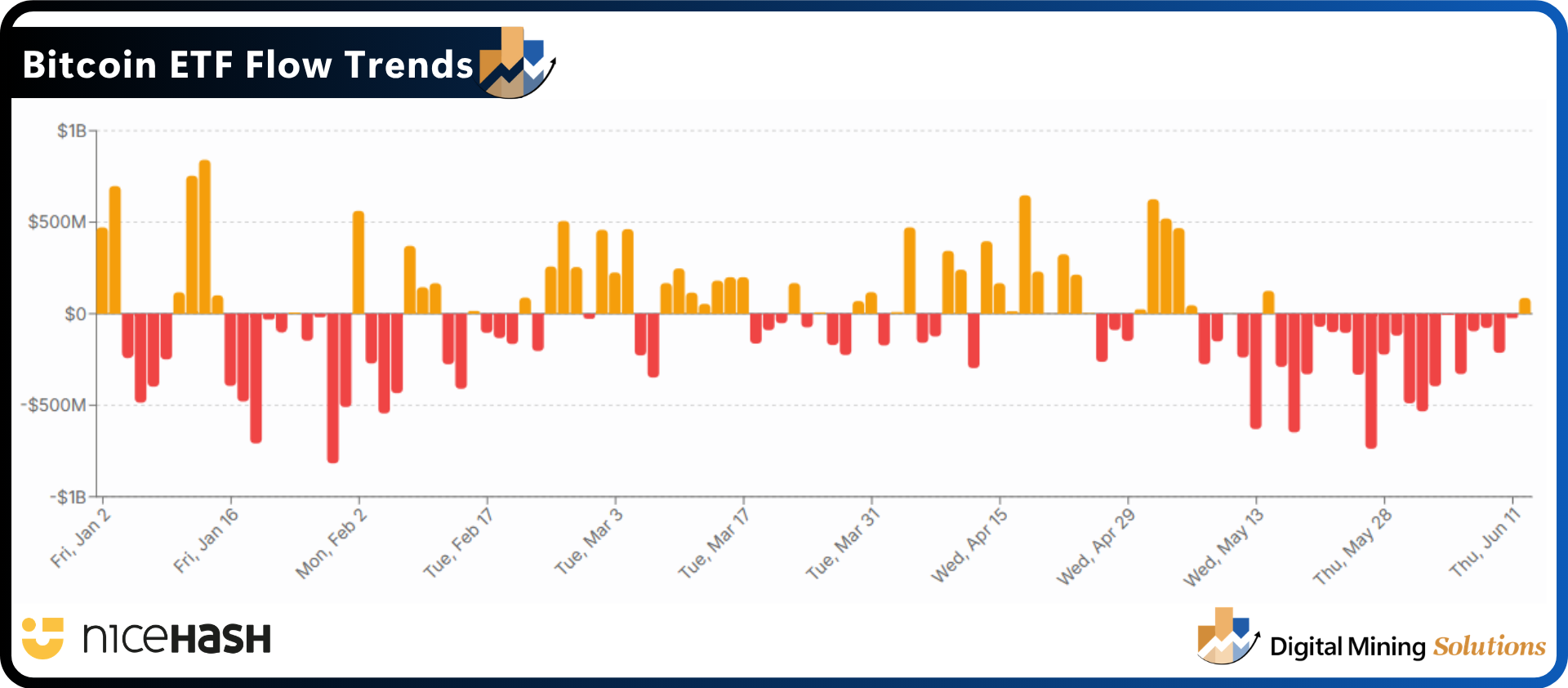
19 Days and $5.1 Billion of Net Outflow
The Rocket That Ate Bitcoin’s Bid
Hashprice Writes a Record Nobody Wanted
Hashrate Can’t Hold the Line
The Signal That Has Never Cried Wolf 🔒- Premium Insights
The 11th Largest Difficulty Drop in Bitcoin History 🔒- Premium Insights

FBOX’s 10MW modular data center solution is designed for rapid, turnkey deployment with prefabricated cooling, power, and IT modules. With major subsystems pre-tested before shipment, FBOX helps operators reduce on-site complexity, accelerate infrastructure rollout, and achieve faster time-to-compute in high-density AI environments.

Bitcoin flushed from $82,000 to roughly $60,000 in under a month. That’s a 26.8% decline, and the velocity matters as much as the magnitude. Not only did Bitcoin run into the 200-day Simple Moving Average, but the approximate break even for a big cohort that bought the late-cycle rally was also around $82,000. When Bitcoin bounced toward that level, they tried to exit at cost. The problem was that there was no new demand behind them. The market hit their sell orders, found nothing underneath, and dropped. Bitcoin has since recovered to approximately $67,000, about 18% below the May rejection high and 46% below the October 2025 peak of $125,000. Whether this was a floor or a midpoint depends on the demand picture. The ETF data gives you the clearest read on that.
US spot Bitcoin ETFs recorded 19 consecutive trading days of net outflows from May 15 through June 11, the longest streak since the products launched in January 2024. Total AUM have dropped 37.9% from their October peak at $165.1B to $102.6B million BTC. The net outflow streak ended June 12 with a modest net inflow, and flows look like they start to have stabilize. However, one positive day and a few flat sessions don’t constitute a reversal, but the selling has at least paused.
SpaceX began trading on the Nasdaq last week under the ticker SPCX. The company priced 555.6 million shares at $135 each, raising $75 billion at a valuation approaching $1.8 trillion, the largest IPO in financial history and nearly three times the size of Saudi Aramco’s 2019 record. Roughly 30% of the offering went to retail investors, about triple the industry norm. Withing 15 days, SpaceX enters the Nasdaq-100, expected to trigger an estimated $22–27 billion of mechanical index buying in early July. A $75 billion raise absorbed in a single week tells you capital availability is not the problem. The bid is concentrated in AI and space; Bitcoin doesn’t currently sit at the top of that stack.
There’s an irony in the SpaceX story worth noting. The company immediately entered the public Bitcoin treasury rankings with more than 18,700 BTC on its balance sheet, number eight among publicly listed holders. And because SpaceX’s market capitalization now surpasses Tesla’s, it is the largest publicly traded Bitcoin holder by market cap. The rocket may be good for Bitcoin long-term. It just isn’t providing the bid the market needed this week.

When Bitcoin briefly dropped below $60,000, hashprice followed and set a new all-time low of $27.75/PH/day. The trajectory of this cycle’s compression is worth tracking. Hashprice touched $28.22 in early February, already a level of historic distress. A few weeks later it retested near $28.06. The market staged a partial recovery, climbing back toward $39/PH/day by spring, a meaningful improvement. That recovery has since fully reversed. Bitcoin’s renewed slide drove hashprice through the prior floor and into uncharted territory.
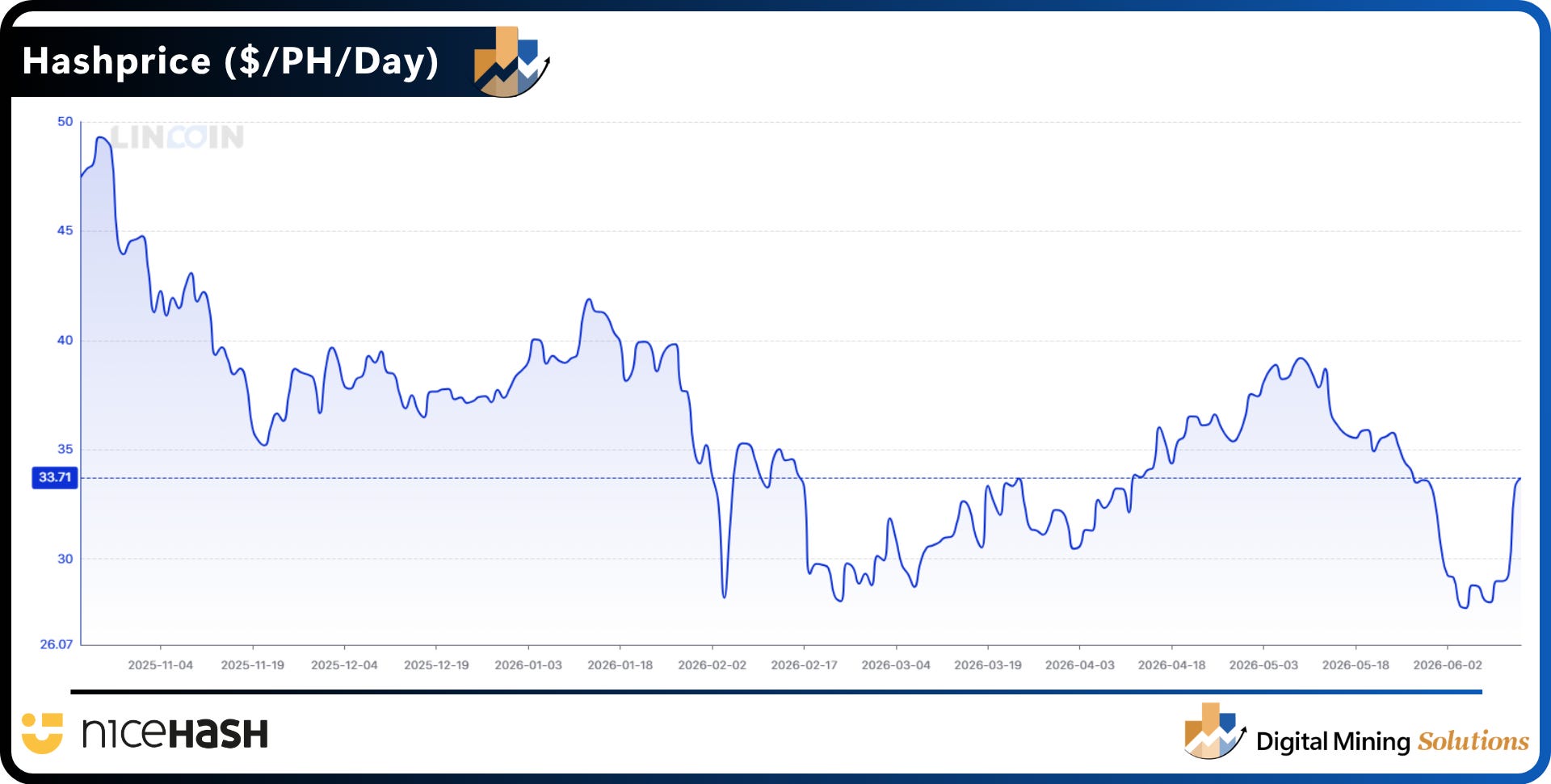
For machines operating above 20 J/TH with all-in operating costs exceeding $0.06/kWh, a hashprice of $27.75/PH/day results in negative margins. Operators in this category are left with two options: absorb ongoing losses or shut down capacity. The hashrate data increasingly suggests that many are choosing the latter.
Hashprice has since recovered above $30/PH/day, driven by a double-digit downward difficulty adjustment and Bitcoin rebounding from last week’s lows. While this provides some short-term relief, profitability remains challenging for less efficient fleets operating at higher power costs.
Two weeks ago, network hashrate briefly reclaimed the 1 zettahash level on the 7-day moving average. The milestone attracted some positive commentary about the industry’s resilience, but it didn’t hold.
Hashrate came offline hard from there, approaching the yearly lows of 867 EH/s. A level last seen during a severe US winter storm curtailment event, when Texas and Georgia (two of the heaviest hashrate states) went dark due to weather. That low was externally imposed. Machines didn’t go offline because mining became uneconomic. They went offline because the grid forced them to.
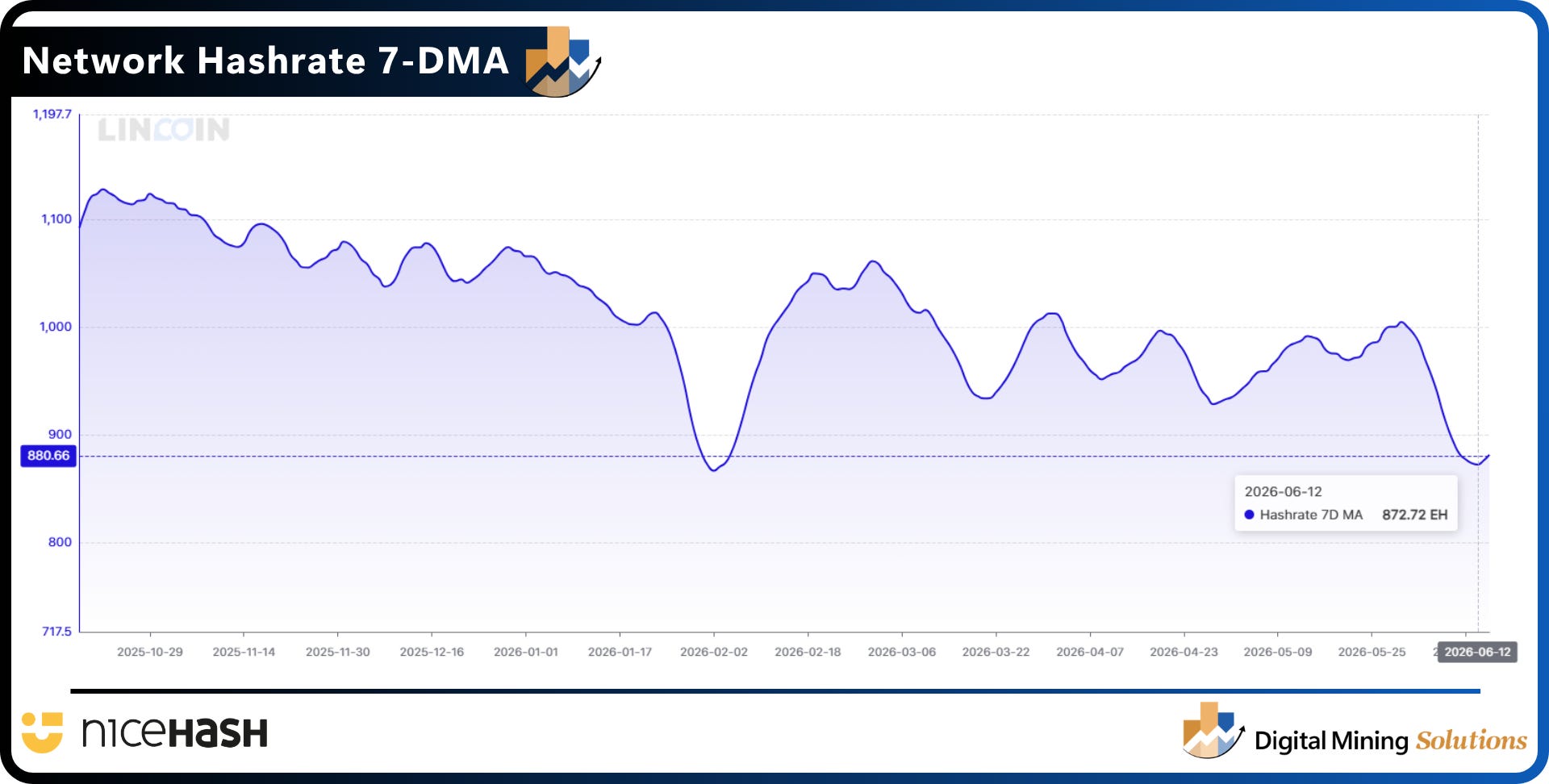
This pullback had two drivers running simultaneously. The first is economic: operators unable to generate sufficient margin at ~$28/PH/day at the trough turned machines off, and some didn’t turn them back on. The second is seasonal as June marks the start of the 4CP season in ERCOT, where large Texas power users curtail to avoid the four summer peak intervals that set next year’s transmission costs. Bitcoin miners in Texas have a strong financial incentive to go offline during potential peak windows, even when real-time power prices are not elevated. That curtailment is voluntary in name but mandatory in margin terms.
🔒 This next section is for premium subscribers. The analysis above is free. What follows goes deeper: the specific capitulation signal that has marked every major bottom in Bitcoin's history and what the second double-digit difficulty adjustment of 2026 means for the economics of the operators still running.
The difference between a well-structured infrastructure investment and a poorly executed one isn’t the thesis. It’s the underwriting, the deal structure, and the people running the project.
Digital Mining Solutions advises investors and family offices deploying $5M–$100M into energy-backed digital infrastructure: Bitcoin mining, AI compute, and hybrid energy assets. We cover the full lifecycle: evaluating opportunities before the term sheet, structuring deals that protect the downside, and staying engaged through deployment and operations to make sure capital performs as modelled.
We bring what most investors in this space lack: real operator relationships, a clear framework for underwriting infrastructure economics, and the credibility to sit across the table from developers and vendors on your behalf. Ready to deploy with confidence?


Leverage data-driven insights and a powerful network to launch strong, optimize efficiently, and scale with confidence. We offer:
Market Intelligence - Masterclasses, Tailored Reports & Articles and Industry Benchmarks.
Advisory Services - Business Plan Assessment, Investor Presentations, M&A Advisory and Executive Coaching.
Sites & Rackspace - Due Diligence & Partnership Matchmaking, Institutional Investment Guidance and Rackspace Sales
Elevate your mining operation today with Digital Mining Solutions!
If you enjoy the content, if you have not subscribed, please ensure to click the button below and share The Bitcoin Mining Block Post.
If you want to stay ahead in the world of Bitcoin mining, make sure to follow me on Twitter and LinkedIn. Would you like to become a sponsor of the newsletter or are you interested in a workshop on mining economics? Contact me at nicosmid@digitalminingsolutions.tech.
Comments
Nothing yet. Say the first thing.
Sign in to join the conversation.