
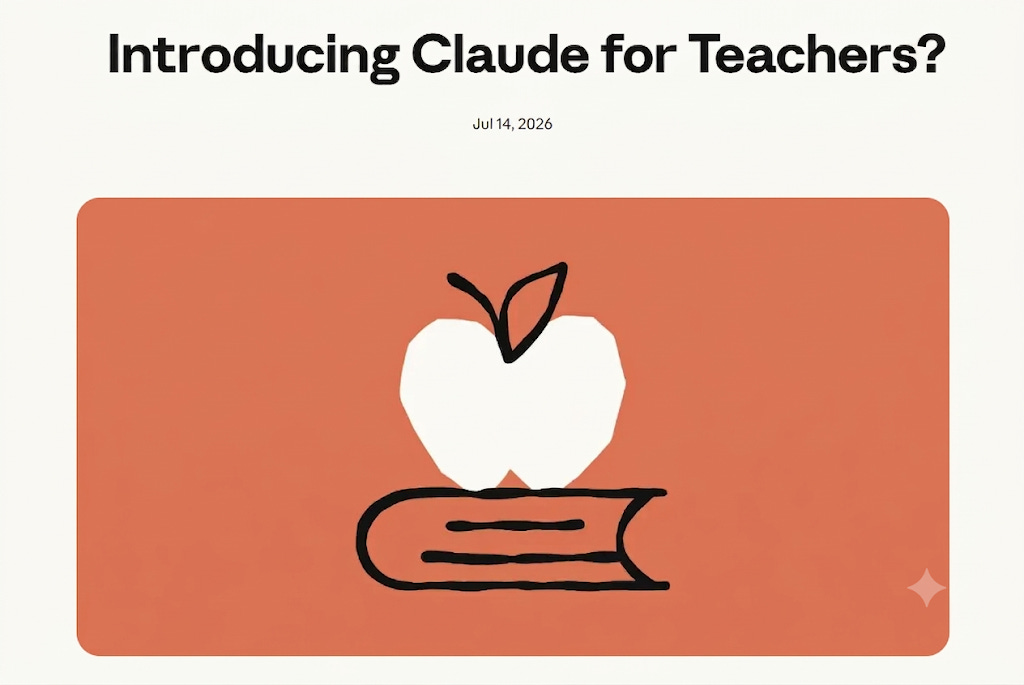
Note from Author: Image Altered by Gemini
This post is being released early as added value for paid subscribers. The full piece goes live for free subscribers on next Thursday. Thank you for your continued dedication to this space and to the work of transforming education. Your support makes this work possible.
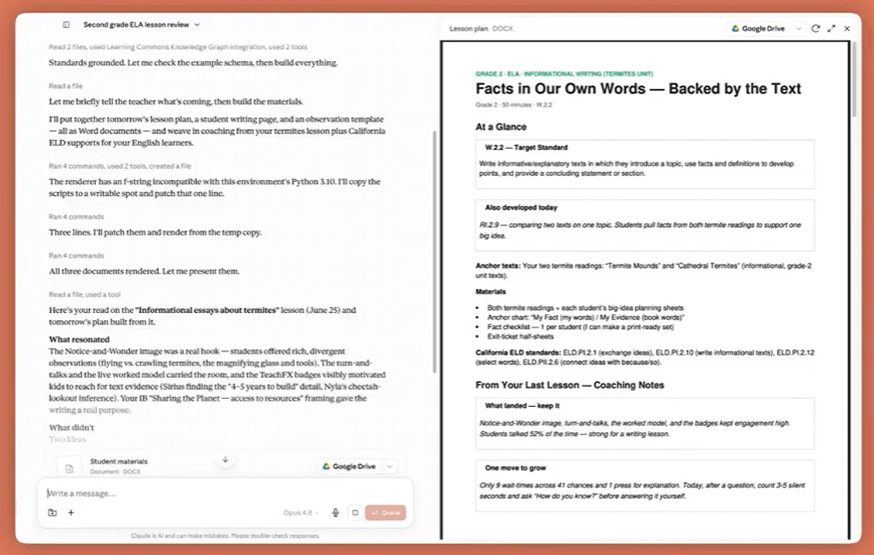
Anthropic launched Claude for Teachers this week, and the launch reads like the work of a company that has learned some of the lessons from ChatGPT for Teachers and skipped the rest. What it learned is visible in the product itself. What it skipped is visible in what the product asks of a district that has no idea the product exists yet.
Privacy Explanation and Access to Anthropic’s AI Fluency Course
GitHub links to Claude Skills for Educators
The privacy language in the launch material does not say one thing. It shifts registers depending on which page you are reading. The press release states that student information is “protected by our K-12 Data Processing Addendum, written to comply with FERPA,” a specific, legally load-bearing claim.
The product page, a few clicks away, softens it twice over: “Built with FERPA in mind,” and “FERPA-aligned terms.” “Written to comply with” is a compliance claim. “Aligned with” and “with FERPA in mind” are marketing claims that borrow FERPA’s authority without making its promise. A company confident in its compliance would not need three different levels of confidence to describe the same product.
The inconsistency lands on exactly the question a district cannot outsource to a vendor’s phrasing: how does it track personally identifiable student information entering the tool through an account the district itself did not provision. Anthropic’s answer, in effect, is that training is off by default and conversations can be deleted under an SLA. That tells you what Anthropic will not do with the data. It does not tell a district what its own staff are putting into the tool, or give it a dashboard to find out.
Districts spent 2023 and 2024 watching teachers sign up individually for a wide range of free AI tools, each collecting classroom data in a slightly different way, none of it visible to the people responsible for FERPA and COPPA compliance. Most districts I work with responded with consolidation: approved-tool lists and mandatory DPAs, routed through a single point of procurement rather than forty individual sign-ups. Claude for Teachers, in its current form, returns to the exact pattern districts spent two years dismantling. In Ohio, a district cannot use a tool like this without a signed DPA in hand, and I do not know a single district in my area with Claude on an approved list.
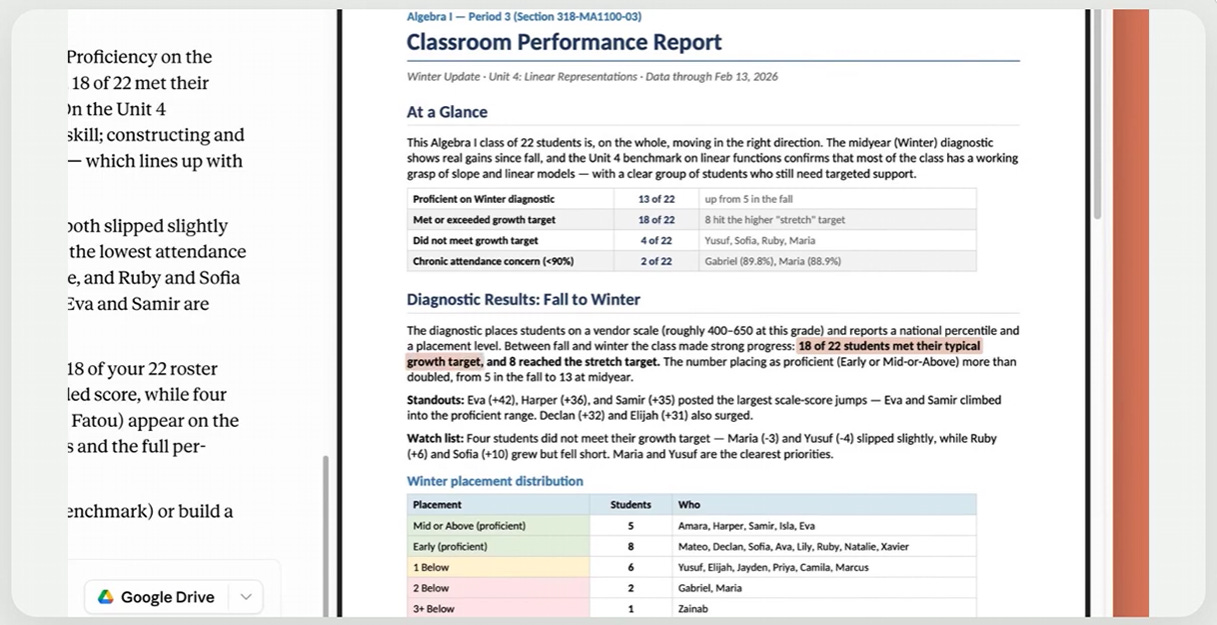
The most concrete demonstration in Anthropic’s own materials follows a high school teacher named Zach, who hands Claude a desktop folder: roster, diagnostics, attendance, notes. Only once that context exists does the tool become useful. The power is not in the model. The power is in the folder, and the folder is built entirely by the teacher, by hand, every time. Anthropic’s own promotional language admits the next step is not fully trustworthy either: the tool “identifies patterns,” a teacher “reviews, adjusts, and decides.” If an AI data analysis is unreliable enough that a teacher has to independently verify it before trusting it with a student, the honest question is whether she needed the AI step at all, or whether she now has two jobs where she used to have one.
The connector list makes this worse. Claude for Teachers advertises connections to platforms like TeachFX, MagicSchool, Brisk, and Diffit, but that interoperability runs through individual accounts and, per the open-source skills repository Anthropic published alongside the launch, through manual plugin installs for anyone who wants to extend it further. I do not know a district that gives individual teachers control over API connections or agentic tool configuration. That is infrastructure decision-making, and it belongs to the people accountable for the whole system, not to whichever teacher is most comfortable with a terminal.
Individually verified accounts. A hard June 2027 cutoff. A published skills repository and evaluation framework. A pilot embedded in Detroit Public Schools. A research partnership with the Gates Foundation. None of that is incidental. It is the cheapest possible way to run a year-long study on efficacy and eventual willingness to pay, using teachers as the verified data points and districts as the audience for the pitch that arrives once the free year ends. When that cutoff hits, districts will be asked to formalize what a year of ungoverned individual use has already normalized. Anthropic thought about districts enough to design around them for exactly one year.
The requirements for a genuinely useful free tool are not mysterious. Admins need visibility across individual accounts, not a promise that it is coming later. Districts need the ability to recall and audit what happened in an account, not a deletion SLA only the vendor can act on. Schools need a vendor in actual compliance with FERPA and state-level DPA requirements, not one whose marketing downgrades “written to comply with” into “aligned with” a few clicks later.
None of this is unknown to companies with the engineering resources of Anthropic or Google. Google Vault already gives a district administrator recall across a teacher’s Gemini interactions, proof the infrastructure for real visibility exists and is buildable. Microsoft, Google, Anthropic, and OpenAI are not short on the capacity to build systemic visibility and district-level control into these launches. Doing so is expensive and slow, and it requires selling into procurement offices instead of onboarding individual users with a sign-up form. A less accountable access point is all a company needs to claim the ground and start the clock on a paid tier before any of the harder infrastructure gets built. The visibility districts actually need is a cost these companies have decided, for now, not to pay. Or more accurately, districts will eventually pay for “a dedicated offering for schools and districts…coming soon.”
Nick Potkalitsky, Ph.D.
Mike Kentz’s AI EduPathways: Insights from one of our most insightful, creative, and eloquent AI educators in the business!!!
Terry Underwood’s Learning to Read, Reading to Learn: The most penetrating investigation of the intersections between compositional theory, literacy studies, and AI on the internet!!!
Alejandro Piad Morffis’s The Computerist Journal: Unmatched investigations into coding, machine learning, computational theory, and practical AI applications
Michael Woudenberg’s Polymathic Being: Polymathic wisdom brought to you every Sunday morning with your first cup of coffee
Rob Nelson’s AI Log: Incredibly deep and insightful essay about AI’s impact on higher ed, society, and culture.
Michael Spencer’s AI Supremacy: The most comprehensive and current analysis of AI news and trends, featuring numerous intriguing guest posts
Daniel Nest’s Why Try AI?: The most amazing updates on AI tools and techniques
Jason Gulya’s The AI Edventure: An important exploration of cutting-edge innovations in AI-responsive curriculum and pedagogy
No posts
Comments
Nothing yet. Say the first thing.
Sign in to join the conversation.