
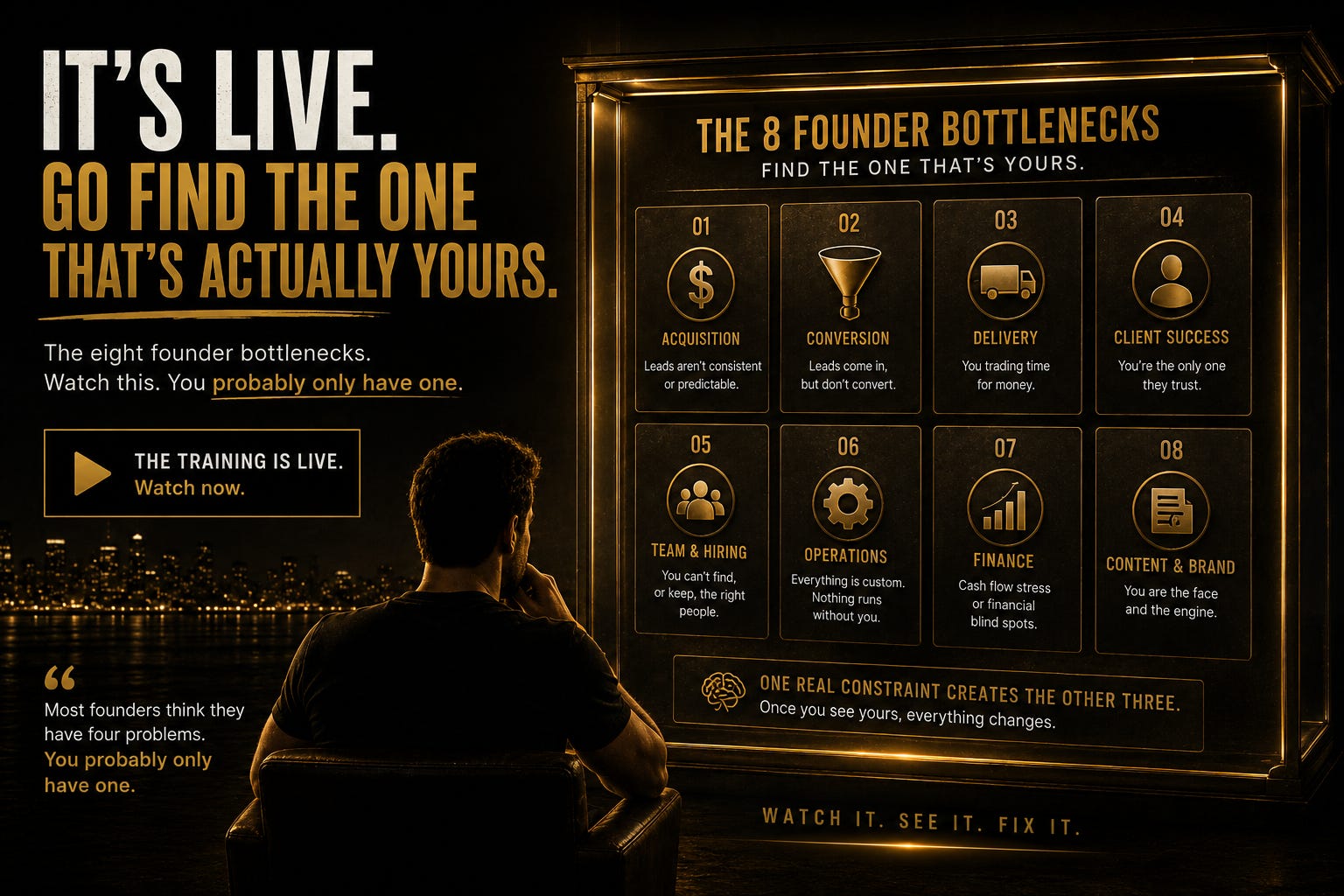
It’s live. The link is at the bottom.
For the last few weeks I’ve been circling one idea from different sides, and before I send you to the thing itself I want to name the idea plainly one more time, because it’s the whole point. Stuck founders are almost always misdiagnosed, and usually the one doing the misdiagnosing is them. The thing that hurts is rarely the thing that’s broken. And what looks like a discipline problem, can’t stay consistent, can’t let go, can’t step away, is almost always a structure problem wearing a personal disguise. You’ve been carrying it as shame. It was never yours to carry as shame. It was a design problem the entire time, and design problems get solved, not suffered.
I made the thing that puts all of it in one place.
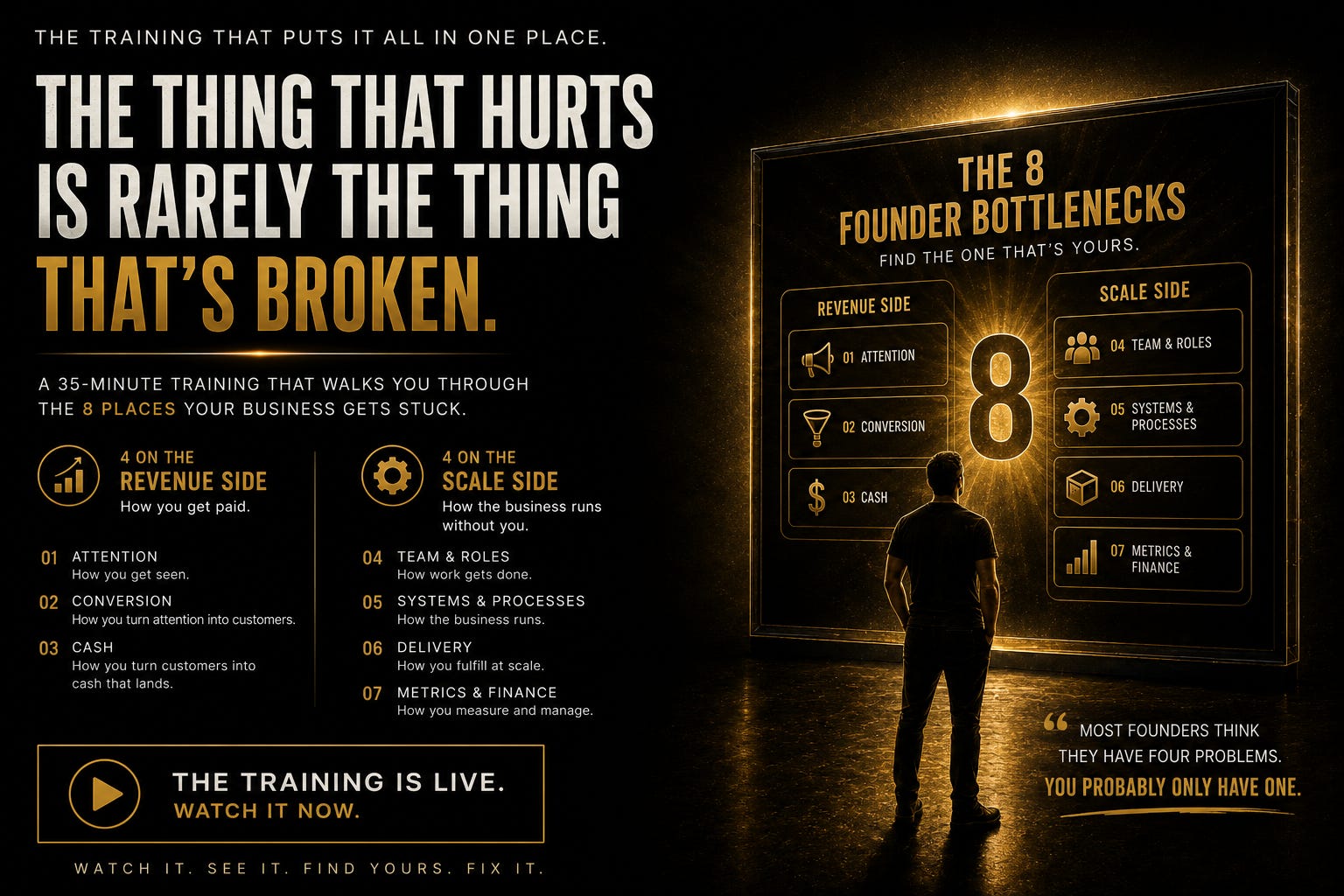
It’s a knowledge and training, about 35 minutes, and it does exactly one job. It walks through all eight of the places a founder-led business gets stuck. The four on the revenue side, how you get attention, how you turn that attention into customers, how you turn customers into cash that actually lands in the account. And the four on the scale side, how the business runs, or fails to run, without you standing in the middle of it. And it does the walk in a way that’s built for one specific thing to happen while you watch. Recognition. The flinch. The moment something lands and you think, that’s me, that’s my Tuesday, how does he know that, I’ve never told anyone that.
Here’s how to watch it, because how you watch it matters. Watch it once, all the way through, in a single sitting, not half-watching it between emails and Slack. And pay close attention to where you flinch. Most people watching will see themselves in three or four of the eight, and the immediate instinct will be to think, alright, so I’ve got four things to fix, no wonder I’m exhausted, no wonder nothing’s working.
But that instinct is the trap, and dismantling it is the entire reason I built this. You almost certainly do not have four problems. You have one. One real constraint sitting upstream, quietly generating the other three as downstream symptoms. The founder who feels a closing problem and a content problem and a delegation problem all at once usually has one actual cause underneath, and the other two dissolve on their own once the real one is fixed. That’s not a trick or a reframe. It’s how the chain works. The whole job of the training is to help you find which one is genuinely yours, the cause, not the loudest symptom, because finding that from inside your own business is the single hardest thing to do alone. You’re too close to it. You’re standing inside it. That’s not a flaw in you; it’s just the nature of being the one in the chair.
A fair warning, the same one I’d give anyone before they hit play. This is not a feel-good video. It’s a diagnosis, and the entire premise of a diagnosis is that the thing you’ve been blaming is probably not the thing. Some of you are going to recognize yourselves in a way that’s genuinely uncomfortable to sit with, a little exposing. That discomfort is the most useful thing in the whole training. It’s not a bad sign. It’s the sound of getting warmer, of getting close to the real thing for the first time instead of circling the symptom.
WATHC IT HERE: https://nickjayala.com/training
Watch it when you’ve actually got the 35 minutes to give it, not in fragments. And when you reach the end, there’s a next step there for the founders who want help finding their real one instead of guessing at it alone. But the training stands completely on its own. Even if you do nothing else, watch nothing else, buy nothing, you will walk out of those 35 minutes seeing your business differently than you walked in. That alone is worth the time.
Thank you for reading along as this whole thing came together over the last few weeks. It means more than you know. Now go find yours.
About the Author

Nick Ayala is an operator, capital strategist, and author of Capital Is the Game: Business Is Just the Board.
He has built and sold four companies across three industries, and now works with founders on the real reason businesses stall: not a shortage of tactics, but the one hidden constraint that keeps the whole thing dependent on the person who started it. His framework maps the eight places a founder-led business gets stuck, across the two engines every business runs on, how it makes money and how it runs without you.
The work comes from two decades of actually doing it. Four exits across three industries. Raising and structuring private capital across private equity, private credit, and real estate. Operating companies through the parts nobody writes about. Across all of it, he watched the same thing again and again, what actually separates the businesses that break through from the ones that run in place for another year. The bottleneck framework is the distilled version of that.
Nick is the founder of The Come Up, a community and program where founders find their one real constraint and remove it, alongside other founders doing the same work. He writes for founders who are tired of working harder every year and landing in the same place, and who suspect, correctly, that the problem isn’t them.
No posts
Comments
Nothing yet. Say the first thing.
Sign in to join the conversation.