

It’s nine at night and you are redoing it yourself.
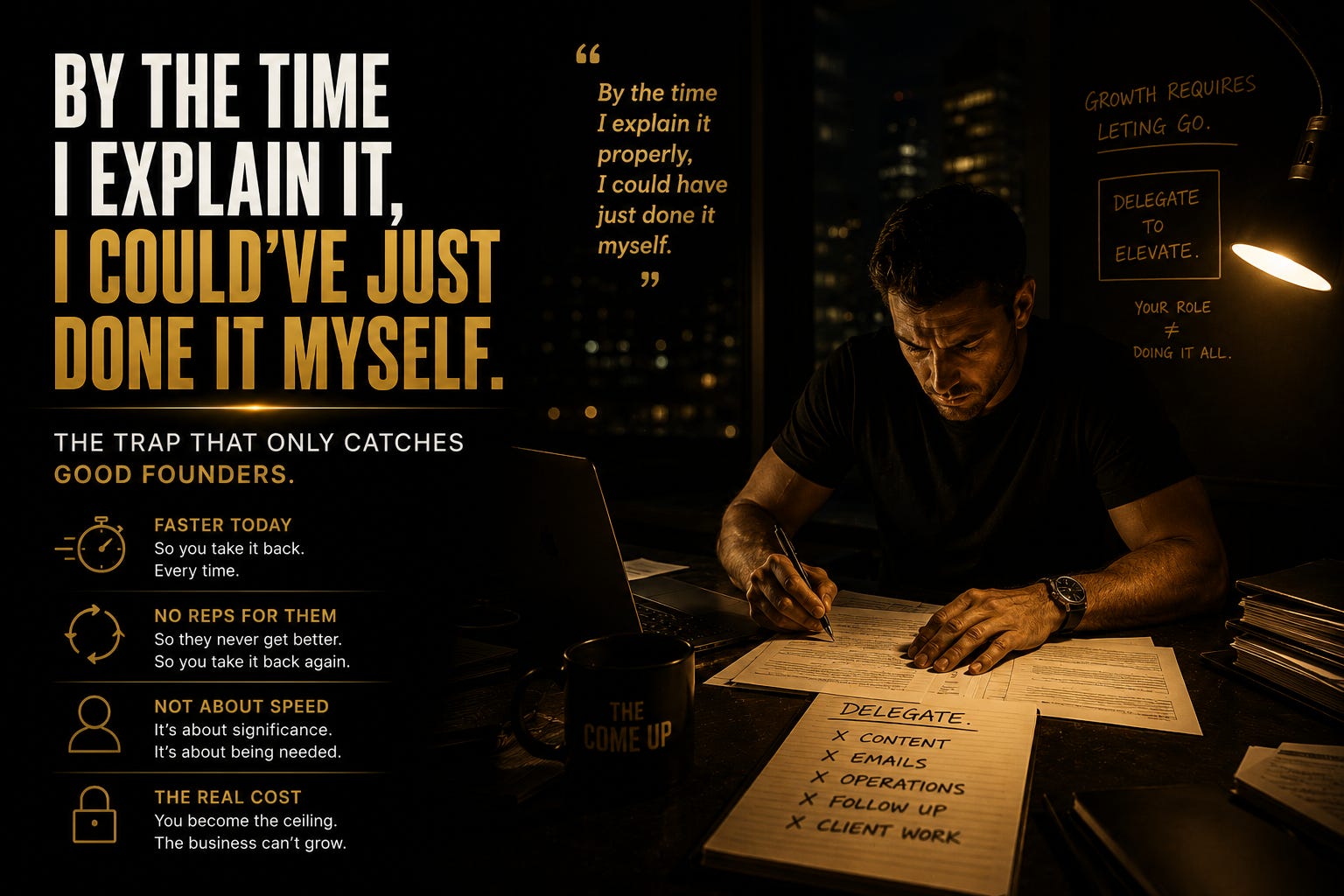
You gave the task to someone. You hired them for exactly this, you pay them for exactly this. And they did it, and it came back not wrong exactly, but not how you would have done it, a little off, missing the thing you would have caught. So now you’re sitting here at nine at night quietly fixing it, and the sentence running in your head is the sentence every founder runs in this moment. By the time I explain this properly, I could have just done it myself. It’s faster this way. I’ll hand off the next one.
I’ve said it. You’ve said it. It is one of the most common sentences in all of business, and it feels completely, obviously true when you say it, and that is exactly what makes it so dangerous.
Because here’s what’s actually happening, and it’s worth being honest about, because this particular trap only catches good founders. The ones who aren’t good enough at the work never develop this problem; they’re relieved to hand things off. This is a trap built specifically for capable people. You are faster than the person you hired. You probably are, right now, today, genuinely. So every individual time, the math really does seem to say do it yourself, and so you do. And because you keep doing it, they never get the reps that would make them faster, so they stay slow, so the math keeps saying do it yourself, forever. You have built a closed loop that guarantees the exact thing you complain about. They’re not ready, so you take it back, so they never get ready, so they’re not ready. Round and round, and you’re the one keeping it spinning while believing you’re the victim of it.
But the speed thing is the cover story. I want to go to the real one, because I genuinely do not think founders take work back because it’s faster. Faster is the respectable reason you give. I think they take it back because of something they would never say out loud, sometimes something they don’t even let themselves think clearly.
Underneath it is a quiet fear that if you are not the one doing the work, you are not needed. That the doing is the thing that makes you valuable. You have been the person who does everything since the very beginning. That is your identity, that is what you bring, that is who you are in your own head, the one who handles it, the one it all runs through. And handing it off does not just feel inefficient. It feels like vanishing. Like if other people can do the work, then what exactly are you for. So you hold on. Not because they truly can’t do it. Because you cannot yet be the kind of person who lets it go, because letting go feels like losing your place, your significance, the proof that you matter to this thing you built.
I’ve seen it show up in small, telling ways. The founder who delegates the meeting and then can’t stop himself from sitting in on it. The one who hands off the client relationship and then quietly inserts herself back into every email thread, because nobody understands that client like she does. The one who finally hires the assistant he desperately needs and then never gives the assistant anything that actually matters, just busywork, because trusting them with something real means trusting that the business can be carried by hands that aren’t his. In every one of those, the story they tell is about standards, about quality, about how good help is hard to find. The truth underneath is about significance. About what it would mean to not be the one.
That is the actual bottleneck. Not their competence. Your significance. And it is so much harder to look at than “they’re just not good enough yet,” which is precisely why almost nobody looks at it, and precisely why the smartest, most capable founders are so often the most stuck right here. The better you are at the work, the more being the doer feels like the core of who you are, and the harder it becomes to put it down. Your talent becomes the cage.
I’ll say the same thing I’ve said the last two times, because it’s the spine of all of this. You have probably been telling yourself this is about standards, that you’re just a perfectionist, that you care more than other people, that nobody does it like you. Those are the comfortable versions. The real version is that delegation was never a skill problem or a hiring problem. It is that handing off the doing requires you to believe you are still valuable when you are not the one with your hands on it. And that is not a character flaw to be ashamed of. It is maybe the most human thing there is, the need to matter, the fear of being unnecessary. But it has a hard cost, and the cost is brutal in its simplicity: the business can never grow larger than your two hands and your one calendar. You become the ceiling. Everything has to pass through you, so everything moves at the speed of you, so the whole thing is capped at exactly the size of one exhausted person.
And there’s a deeper layer underneath even this, which is where I’m going next, because the founder who cannot let go of the doing eventually becomes the single thing the entire business depends on. And a business that depends completely on one person is not really a business yet. It’s a job you can’t quit, can’t sell, and can’t step away from. That’s the one I most want you to see clearly, and I’ve built something that walks through all of it, all eight places this happens, properly. It goes live this week. Watch for it.
About the Author

Nick Ayala is an operator, capital strategist, and author of Capital Is the Game: Business Is Just the Board.
He has built and sold four companies across three industries, and now works with founders on the real reason businesses stall: not a shortage of tactics, but the one hidden constraint that keeps the whole thing dependent on the person who started it. His framework maps the eight places a founder-led business gets stuck, across the two engines every business runs on, how it makes money and how it runs without you.
The work comes from two decades of actually doing it. Four exits across three industries. Raising and structuring private capital across private equity, private credit, and real estate. Operating companies through the parts nobody writes about. Across all of it, he watched the same thing again and again, what actually separates the businesses that break through from the ones that run in place for another year. The bottleneck framework is the distilled version of that.
Nick is the founder of The Come Up, a community and program where founders find their one real constraint and remove it, alongside other founders doing the same work. He writes for founders who are tired of working harder every year and landing in the same place, and who suspect, correctly, that the problem isn’t them.
No posts
Comments
Nothing yet. Say the first thing.
Sign in to join the conversation.