
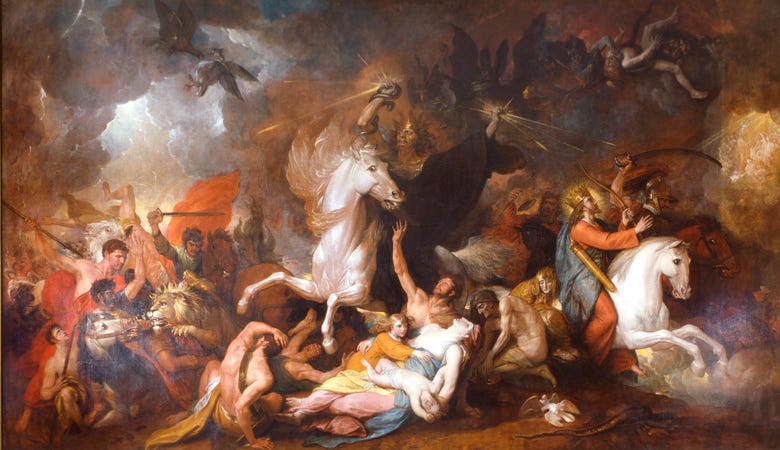
It is not hard to imagine that we are living in apocalyptic times. The daily news is filled with stories of global conflict, famine, disease, and natural disaster. Society is riven by division, people are being led astray by false teachings. However, this is not a news summary, but a paraphrase of something said by Jesus in the Bible (see Matthew 24.7, 10-11).
I am often struck by the way in which Biblical narratives provide vivid descriptions of contemporary experience, though this should not be at all surprising. A narrative is an interpretative framework by means of which we process and explain the world. To comprehend experience through the lens of a story that gives it meaning and significance is just something that human beings do. We have little choice about that; the only thing we get to choose is which story. Personally, I think there is something to be said for choosing a story that has stood the test of time. Whatever one’s views about the historical circumstances relating to any particular story within it, the Bible remains an invaluable repository of timeless wisdom.
Therefore, when an apocalyptic prophecy made 2,000 years ago sounds eerily familiar, we might want to consider the possibility that we are dealing with something of archetypal significance. Routinely used to denote catastrophic destruction, the word ‘apocalypse’ actually means something like uncover or, in religious terminology, revelation. This is to say that what makes a disaster apocalyptic is not its extent or ferocity, but the fact that it is a sign of some deeper malaise. We live in an era marked by conflict and division, anger and distrust. To view these phenomena as ‘apocalyptic’ is to seek the underlying causes of which these disturbances are symptoms, rather than assume that the disturbances themselves represent the problems we need to solve.
Jesus begins his apocalyptic prophecy by foretelling the destruction of the temple (Matthew 24.2), the source and symbol of not only divine authority but, by extension, earthly power and influence as well. The temple represents the worldview of the people; to destroy it is not just to demolish a building but to overturn a world order. Then as now, the apocalypse is a sign of societal collapse, which is what happens when a people lose their religion, or that which binds them together as a people in the first place. Take the cult out of culture – destroy the temple – and it all falls apart. The cult (Latin, cultus, worship) at the heart of a culture is its unifying object of worship, and all cultures worship something. The question is what?
In answering that in relation to our present circumstances, we might want to try and identify the ‘temple’ of contemporary post-Christian society. This task is made trickier by the fact that we won’t find it by looking in what we might unthinkingly assume to be the obvious places, such as the great cathedrals or other historic religious buildings. They have already been overturned and replaced. Instead, we need to think about where cultural power and influence is actually located. On this view, the ‘temple’ of today is represented by the media and entertainment industries, academia and NGOs; its clergy are the professional managerial classes. Conceptualising ‘the temple’ in this way gives an added resonance to the incident when Jesus furiously denounces the people conducting business in the outer courts of the temple in Jerusalem, overturning the tables of the money changers, and driving out the merchants selling animals and birds to be offered in sacrifice (Matthew 21.10-13).
Stories like this have contributed to the popular idea of Jesus as a political revolutionary, tried and executed by the Romans for insurrection. Yet he seldom, if ever, criticised the Romans directly, reserving his ire for the ‘Scribes and the Pharisees’, the managerial class of domestic rather than imperial politics. Indeed, when questioned by Pilate about his alleged political aspirations, Jesus explicitly says, ‘my kingdom is not of this world’ (John 18.36). His opposition was not to secular powers but spiritual corruption. Tempting though it may be to see the ‘cleansing of the temple’ as an ancient precursor to the anti-capitalism movement of recent times, a more plausible way of reading this story in relation to a contemporary context might be as a condemnation of, say, the Church of England’s cringeworthy enthusiasm for last week’s version of the latest thing. This, of course, is symptomatic of a more fundamental problem. The church’s willing capitulation to societal norms at variance with orthodox teachings reveals a betrayal not so much of particular doctrinal principles – though that is certainly an issue – but the basic religious disposition itself.
Following the eminent American economist Thomas Sowell, we can posit two foundational attitudes from which are derived the specific positions that may be taken on any given matter. On the one hand, there is the view that socio-political problems are basically systemic and ultimately soluble. If we can only apply the correct analysis, and raise awareness of the issues, then appealing to reason will do the rest. The other view is that problems cannot be solved because human beings themselves are the problem, and the problem with human beings is that they are fundamentally flawed. You cannot educate them into a better version of themselves. Rather than enlightened self-interest, there is just the plain old fashioned selfish kind. The best you can do is draw on the wisdom of experience to try and hold things together with practical incentives – typically a mixture of carrots and sticks – combined with strong cultural traditions.
Sowell described the latter disposition as the constrained vision and the former as the unconstrained vision, whilst others have called them the tragic vision and the utopian vision. In theological terms, we might talk about Augustine versus Pelagius.
The unconstrained, utopian, Pelagian vision is endemic in the elite discourses of contemporary western societies and epitomised by liberalism’s core belief in progress, which in its hyper-liberal mutation becomes progressivism. This can be seen as a form of Christian heresy that inverts the fundamental insight – common to a number of other religious worldviews too, as it happens – that human beings are less than perfect and have an almost unlimited capacity to make things worse. Theologically speaking, the word we’re looking for here is ’sin’.
Christianity and, for that matter, Buddhism, both present a similarly pessimistic – or realistic – diagnosis of the human condition. Both describe it in terms of suffering and unsatisfactoriness; both identify the cause in terms of disordered desires. Where they most obviously diverge is in their respective prescriptions for what we’re meant to do about it. To be more specific, the Christian revelation departs from many other traditions in having a doctrine of redemption. This is not to be effected by social engineering or the power of enlightened reason – which is where the utopian tendency collapses into incoherence – but by bowing our heads and seeking forgiveness. And I’m not talking about grovelling apologies on social media for perceived offences against the stifling diktats of Pharisaical groupthink, but true repentance, which involves turning away from self, towards that which is ultimately real and true.
There is a parable in Luke’s gospel that describes two men praying in the temple, one a Pharisee, the other a tax collector. ‘The Pharisee, standing by himself, was praying thus, “God, I thank you that I am not like other people: thieves, rogues, adulterers, or even like this tax-collector. I fast twice a week; I give a tenth of all my income.” But the tax-collector, standing far off, would not even look up to heaven, but was beating his breast and saying, “God, be merciful to me, a sinner!” I tell you, this man went down to his home justified rather than the other; for all who exalt themselves will be humbled, but all who humble themselves will be exalted’ (Luke 18.9-14)
I take cold comfort in the fact that virtue signalling, though the phrase may be of relatively recent provenance, nevertheless describes a behaviour with a much more ancient pedigree. Indeed, the tendency to see the splinters in the eyes of other people whilst missing the logs in our own lies deep within the human heart, where it has customarily been subjected to some sort of moral discipline.
Now, however, the corruption of the religion that formed us has allowed the tendency to self-righteousness to metastasise from individuals to institutions, rendering them no longer fit for purpose. I am hardly the first to point out that the dogmatic, some would say irrational, beliefs and the strict enforcement of suffocating conformity by a clerical caste of activists and experts, give the various performative stances typically labelled ‘woke’ an unmistakably religious character. However, one of the most striking, not to mention unpleasant, features of our increasingly apocalyptic ‘culture wars’ is the absence of forgiveness. This, more than anything, reveals the death of God at the heart of post-Christian Western society. Whatever we may think of the disparate collection of ideologies and causes misleadingly labelled ‘progressive’ – whether they be understood in terms of identity politics, cultural marxism, hyper-liberalism, institutional feminisation or some sort of perverse theological mutation – there can be little doubt that our gleeful abandonment of mainstream Christianity in favour of sentimental liberal humanism has at least something to do with the mess we’re in.
Liberalism, whether classical, modern, or post-modern is essentially Christianity without God. Ironically, so-called progressivism masks a deeply reactionary instinct, rooted in nostalgia for a lost world that never was, stubbornly wedded to the crumbling ruins of the post-WWII open society consensus. The fantasy of the global village and its rules based international order has been exposed as a utopian delusion reminiscent of the Tower of Babel, and likely to end just as badly. It is simply not possible to legislate a cohesive transnational social order based on supposedly universal values into being, and I’m not convinced there is any virtue in wishing we could. Moreover, the underlying belief in the pseudo-Christian eschatology of ‘progress’ fails to recognise that when a people reject the story of meaning and purpose that made them ‘a people’ in the first place – their ‘religion’, in other words – they don’t simply default to a supposedly natural state of enlightened universalism. They reach out for anything that will satisfy their innate religious instincts in the absence of more coherent narratives. Thus, wellbeing becomes a substitute for spirituality, social justice provides the dogmatic scaffolding of a belief system, and virtue signalling replaces morality to mark membership of the ‘good people’s club’.
The ‘West’ is a religious idea that has become a hollow shell of the religion that gave rise to it, a culture without a cult. This is why societal collapse – the cultural apocalypse – is at heart a religious problem. The fact that it is generally not seen as such rather proves the point. The ruling class, with its guilt-ridden luxury beliefs, such as in the intrinsically imperialistic notion of multiculturalism, does not understand the importance of religious identity to the people they so obsequiously patronise because they don’t have any meaningful sense of religious identity themselves. Identity, whether personal or cultural, can only be grounded in something specific. Universal values, however ’enlightened’, are ultimately meaningless.
Sadly the Church – and especially the Church of England – seems to have bent the knee to the new creed. In thrall to middle-class hobby-leftism, it has rejected Augustinian orthodoxy in favour of Pelagian heresy. It has, in short, stopped believing in the reality of sin. Without the basic understanding that we are all fallible – not just those whom we judge to be inferior for some reason or other, but all of us – there is no tolerance of actual difference. And because of this we have, as a society, lost the capacity for forgiveness.
Without the awareness of sin the idea of forgiveness is incoherent; without forgiveness there can be no redemption, and without redemption there can be no salvation. If you believe that human beings are fundamentally flawed, you will set a value on forgiveness, whereas if you believe that human beings are essentially perfectible, then forgiveness is irrelevant because ‘raising awareness’ is the solution to every problem and outright condemnation is the morally justifiable response to the slightest dissent.
Maybe we don’t think we need salvation or, worse, that we can engineer it ourselves. The evidence of this utopian fallacy can be seen in the worst excesses of twentieth century totalitarianism, as well as the regressive attitudes of today’s ‘progressive’ elites, who by denying history condemn themselves to repeat it. This is why I am increasingly of the view that the West urgently needs a Christian revival. In saying this I am well aware that many will view the prospect with absolute horror, unable even to countenance the idea that there is any positive value in the notion of ‘Western culture’ in the first place. Indeed, many of its own children clearly wish to destroy it altogether. In one sense they may be justified. The idea of ‘the West’ has sadly become an empty simulacrum. I am willing to bet, however, that they will like the alternative even less.
No posts
Comments
Nothing yet. Say the first thing.
Sign in to join the conversation.